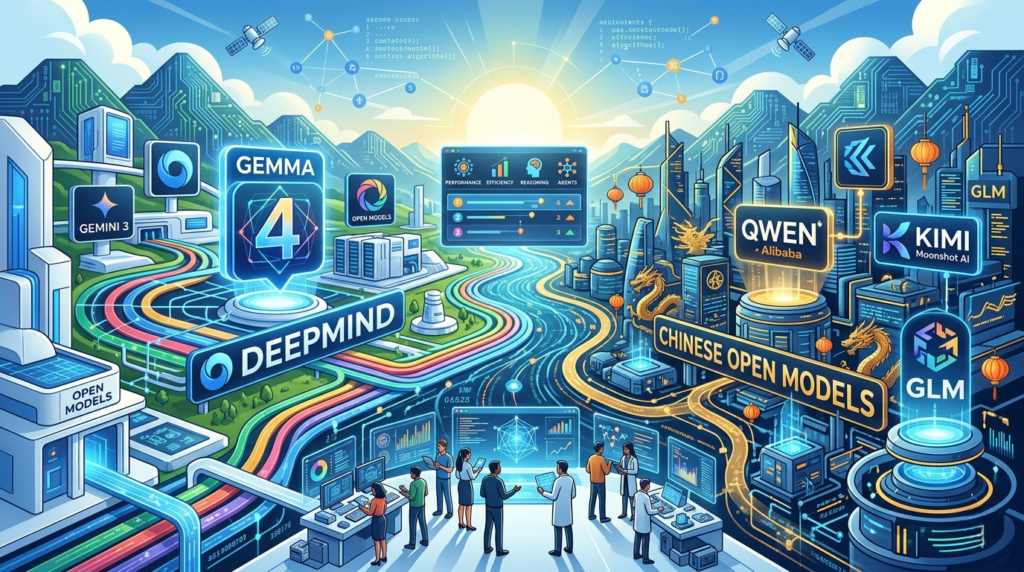
The landscape of open-source artificial intelligence just witnessed a seismic shift. On April 2, 2026, Google DeepMind officially launched Gemma 4, a new generation of open-weights models that aim to bring “frontier-level” intelligence directly to local hardware. Built on the same research foundations as the proprietary Gemini 3 models, Gemma 4 is not just an incremental update—it is a strategic move by Google to reclaim its dominance in the developer community, particularly as competition from Chinese open models reaches an all-time high.
In this comprehensive technical deep dive, we will break down the architecture of Gemma 4, compare its performance against global rivals like Alibaba’s Qwen and Moonshot’s Kimi, and explore how developers can leverage these models for next-generation agentic workflows.
What is Gemma 4? The New Frontier of Open Weights
Gemma 4 is a family of four distinct open models designed to scale from mobile devices to high-end developer workstations. Unlike “closed” models accessed exclusively via APIs, The Qwen-3.5 challenger allows developers to download the weights and run the AI locally, ensuring data privacy and reducing latency for sensitive applications.
For the first time in the series’ history, Google has moved to a permissive Apache 2.0 license. This shift is crucial; it removes the restrictive “custom terms” that previously made enterprise legal teams hesitant to adopt Google’s open-weights technology. With this change, The Qwen-3.5 challenger is now as open as its primary competitors, fostering a more collaborative ecosystem.
The Four Variants of the Gemma 4 Family
- Effective 2B (E2B): A compact model optimized for smartphones and IoT devices. It fits in under 1.5 GB with 2-bit quantization, making it ideal for on-device tasks.
- Effective 4B (E4B): A slightly larger version built for enhanced mobile capabilities and single-board computers like the Raspberry Pi 5.
- 26B Mixture of Experts (MoE): Known as the “A4B” (Active 4B), this model activates only 3.8 billion of its 25.2 billion total parameters during inference, offering high speeds on consumer GPUs.
- 31B Dense: The flagship model, designed for maximum output quality, complex reasoning, and deep fine-tuning on professional workstations.
Technical Breakthroughs: Beyond Traditional Parameters
Google DeepMind has introduced several architectural innovations in The Qwen-3.5 challenger that allow it to punch far above its weight class. These features ensure that the model remains relevant in a market increasingly obsessed with “intelligence-per-parameter.”
1. Agentic Workflows and Reasoning
The Gemma 4 series is purpose-built for agentic AI. This means the model isn’t just generating text; it is designed to act as a core engine for AI agents that can use tools, call functions, and complete multi-step tasks autonomously. With native support for function-calling and structured JSON output, The Qwen-3.5 challenger enables developers to build agents that can query external APIs or manage complex software workflows without human intervention.
2. Efficiency through Per-Layer Embeddings (PLE)
The “Effective” (E) series utilizes Per-Layer Embeddings. This allows the models to behave with the intelligence of a larger parameter count while maintaining a small compute footprint. By leveraging this hybrid design, the E2B model achieves a processing speed that preserves battery life on mobile devices while providing deep awareness for long-context tasks.
3. Alternating Attention and Proportional RoPE
To manage its massive 256K token context window, The Qwen-3.5 challenger uses an “alternating attention” mechanism. Layers alternate between local sliding-window attention (for speed) and global full-context attention (for long-range coherence). Coupled with Proportional Rotary Position Embeddings (p-RoPE), the model avoids the quality degradation typically seen when LLMs process very long documents.
Gemma 4 vs. Chinese Open Models: The Battle for the Leaderboard
While Google has achieved unprecedented efficiency, they are no longer the only major player. Models like Qwen 3.5 (Alibaba), GLM-5 (Zhipu AI), and Kimi K2.5 (Moonshot AI) have set incredibly high benchmarks for open-weights models.
Benchmarking the Best
On the Arena AI text leaderboard, the Gemma 4 31B model currently ranks third globally among open models. While it is occasionally outperformed by GLM-5 in raw knowledge retrieval, The Qwen-3.5 challenger holds a significant advantage in mathematical reasoning and coding logic.
| Feature | Gemma 4 (31B Dense) | Qwen 3.5 (Alibaba) | GLM-5 (Zhipu AI) |
| Primary Strength | Logic & Reasoning | General Knowledge | Multilingual Mastery |
| License | Apache 2.0 | Apache 2.0 | Custom Open |
| Context Window | 256K tokens | 128K tokens | 200K+ tokens |
| Active Params | 31B | 35B (MoE) | ~32B (MoE) |
| MMLU Score | 88.4% | 86.0% | 87.5% |
The data shows that while Chinese models often lead in pure information retrieval, Gemma 4 excels in multi-step planning. For instance, in math benchmarks like GPQA Diamond, The Qwen-3.5 challenger scores a staggering 84.3%, outperforming most models in its size category.
Multimodal Mastery: Vision and Audio at the Edge
A standout feature of Gemma 4 is its native multimodality. Unlike previous versions that required external encoders, these models handle various inputs directly.
- Vision understanding: All models process images and video (up to 60 seconds at 1 fps for the larger variants) with variable aspect ratios. This is a game-changer for OCR and chart analysis.
- Audio Processing: The smaller E2B and E4B models include a USM-style conformer that handles speech recognition and translation across 140+ languages natively.
- On-Device Deployment: Because The Qwen-3.5 challenger is optimized for hardware like the Qualcomm IQ8 NPU, these multimodal features can run entirely offline on the next generation of “AI PCs” and smartphones.
Why the Apache 2.0 License Matters for You
For years, developers criticized Google for its “Gemma Terms of Use,” which included monthly active user (MAU) caps and restrictive content policies. With the release of The Qwen-3.5 challenger, Google has fully embraced the Apache 2.0 license.
What this means for your business:
- No MAU Limits: You can scale your application to millions of users without needing a custom commercial license from Google.
- Digital Sovereignty: You have complete control over the model weights. You can host them on-premises, ensuring that sensitive data never leaves your infrastructure.
- Commercial Freedom: You are free to modify, distribute, and monetize products built on The Qwen-3.5 challenger without legal ambiguity.
Actionable Insights: Implementing Gemma 4 Today
If you are a developer or an IT decision-maker, here is how you can start leveraging The Qwen-3.5 challenger immediately:
- Build Local Coding Assistants: Use the 31B Dense model with tools like Ollama or vLLM to create a private coding assistant. Its high performance on HumanEval makes it a viable alternative to cloud-based solutions.
- Develop Autonomous Agents: Use the Google Agent Development Kit (ADK) to pair The Qwen-3.5 challenger with tool-calling capabilities. Build agents that can autonomously manage your calendar, refactor codebases, or conduct market research.
- Optimize for Mobile: If you are building a mobile app, integrate the E2B model via Android’s AICore. This allows you to offer AI features like smart replies or image description without incurring API costs.
- Fine-Tune for Niche Domains: Because the architecture is dense (for the 31B version), it is highly stable for fine-tuning on specialized datasets like legal documents or medical records.
The Verdict: Reclaiming the Crown
The launch of Gemma 4 signals that Google is no longer content with just leading the proprietary AI market. By releasing high-efficiency, reasoning-heavy models under a truly open license, they are directly challenging the dominance of Chinese open models and Meta’s Llama series.
While competitors like Alibaba and Moonshot still offer fierce competition in raw parameter counts, Gemma 4 offers the best “intelligence-per-watt” for developers who need to run state-of-the-art AI on their own terms. Whether you are building a simple chatbot or a complex autonomous agent, the The Qwen-3.5 challenger family provides a scalable, efficient, and legally clear foundation for the next decade of AI innovation.
What exactly is Gemma 4, and how does it differ from Gemini?
Gemma 4 is a family of “open-weights” models. This means that while Google provides the pre-trained weights and the architecture for you to run on your own hardware, the underlying training data remains proprietary. Gemini 3, by contrast, is a “closed” model accessed only via API. Gemma 4 is built using the same core research and technology as Gemini 3 but is optimized specifically for local performance and efficiency.
When was Gemma 4 released, and under what license?
Gemma 4 was officially released on April 2, 2026. In a historic first for the series, it is distributed under the Apache 2.0 license. Previous versions used a custom “Gemma Terms of Use” which had commercial restrictions; the move to Apache 2.0 makes Gemma 4 truly open-source and commercially permissive.
What are the different sizes available in the Gemma 4 family?
The family is divided into four primary variants:
- Effective 2B (E2B): Optimized for ultra-low power mobile/IoT.
- Effective 4B (E4B): Balanced for high-end mobile and light laptop use.
- 26B Mixture of Experts (MoE/A4B): A “sparse” model that provides 26B intelligence with the speed of a 4B model.
- 31B Dense: The powerhouse model for complex reasoning and fine-tuning.
2. Technical Architecture & Innovation
What does the “E” in E2B and E4B stand for?
The “E” stands for Effective. These models use a technique called Per-Layer Embeddings (PLE). Instead of just one massive embedding table at the start, each decoder layer has a small, specialized embedding lookup. This allows the model to act with the intelligence of a much larger parameter count while maintaining a tiny “effective” footprint during actual calculation.
How does the 26B Mixture of Experts (MoE) work?
The 26B variant (often called A4B for “Active 4B”) contains 25.2 billion total parameters but only activates about 3.8 billion for any single request. It uses 128 “experts” and selects only a few to process each token. This results in incredibly high tokens-per-second (speed) without sacrificing the depth of knowledge a 26B model provides.
What is the “Alternating Attention” mechanism?
To handle its massive 256K token context window, Gemma 4 alternates its attention layers. Every other layer uses Sliding Window Attention (looking only at nearby tokens to save memory), while the interleaving layers use Global Attention (looking at the entire history). The final layer is always global to ensure the model doesn’t lose the “big picture.”
3. Performance & Global Competition
How does Gemma 4 stack up against Chinese open models like Qwen 3.5?
The competition is fierce. Qwen 3.5 (Alibaba) and Kimi K2.5 (Moonshot) currently lead in raw multilingual knowledge and visual frame processing (Qwen can handle nearly 300 images in a single sequence). However, Gemma 4 dominates in:
- Reasoning Speed: It arrives at mathematical answers using far fewer “reasoning tokens” than Qwen.
- Logic Benchmarks: It ranks #3 globally on the Arena AI leaderboard for open models, specifically excelling in coding and hard sciences.
What are the benchmark scores for the 31B Dense model?
- MMLU Pro: 88.4% (General knowledge)
- AIME 2026: 89.2% (Mathematics and reasoning)
- HumanEval: 84.1% (Coding proficiency)
4. Capabilities: Multimodality & Agents
Can Gemma 4 process images, audio, and video?
Yes. All Gemma 4 models are natively multimodal:
- Vision: They support variable aspect ratios and can read charts or perform OCR.
- Audio: The E2B and E4B models include a built-in audio encoder for speech-to-text and translation across 140+ languages.
- Video: The larger models can process up to 60 seconds of video at 1 frame per second.
How does Gemma 4 support “Agentic Workflows”?
Gemma 4 was designed with “tool-use” as a core priority. It features:
- Native Function Calling: No more “hacking” prompts to get JSON; the model understands when to call an external tool.
- Structured Output: It guarantees valid JSON formatting for easier integration into software.
- Native System Prompts: A dedicated “system” role allows you to give the AI permanent “personality” or “rules” that it won’t forget during long conversations.
5. Local Setup & Hardware Requirements
What hardware do I need to run Gemma 4 locally?
- E2B/E4B: Can run on modern Android flagship phones (like Pixel 9/10) or laptops with 8GB of RAM.
- 26B MoE: Requires roughly 16GB–20GB of VRAM (e.g., an NVIDIA RTX 4080/5080) when using 4-bit quantization.
- 31B Dense: For full precision, you need a professional GPU like an A100 or H100 (80GB). For consumer use, a 4-bit quantized version fits on an RTX 5090 (24GB–32GB).
Which software tools support Gemma 4?
Thanks to “Day 0” support, you can use Gemma 4 with:
- Ollama: Simple command-line execution.
- LM Studio: A GUI for Windows and Mac.
- llama.cpp: High-performance C++ implementation.
- Unsloth: The fastest way to fine-tune Gemma 4 on your own data.
6. Enterprise & Legal FAQ
Is it safe to use Gemma 4 for commercial products?
Absolutely. The Apache 2.0 license is the industry standard. It allows you to modify the code, redistribute it, and use it in commercial products without paying royalties to Google. The only requirement is that you include the original license and attribution.
How does Gemma 4 help with “Digital Sovereignty”?
For organizations with strict data privacy needs (healthcare, legal, government), Gemma 4 is a game-changer. Because it runs entirely offline, your data never touches a third-party server. You own the infrastructure, the model weights, and the resulting data.
Can I fine-tune Gemma 4 on my own business data?
Yes. The 31B Dense model is particularly effective for fine-tuning because its dense architecture is more stable than MoE models for specialized domain knowledge. Using tools like LoRA or QLoRA, you can train Gemma 4 on your company’s documents on a single high-end consumer GPU. (AI Benchmarks)