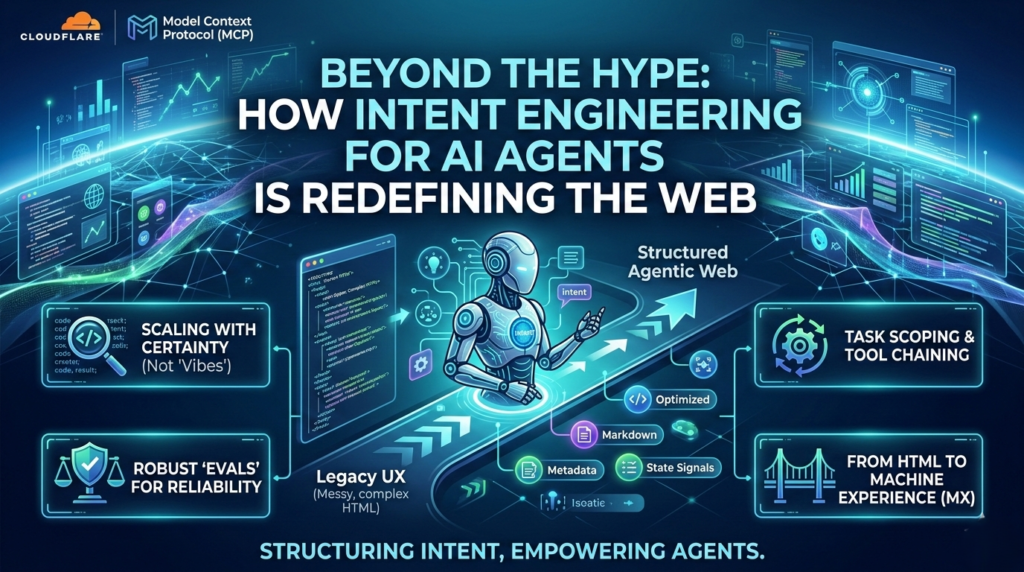
Intent engineering for AI agents is the critical shift currently transforming how we build for the modern web. While the industry has spent the last year enamored with “vibe coding”—the art of using natural language prompts to create software through intuition—we are now hitting a wall where those “vibes” fail to meet production-level standards for reliability and security. We are moving away from simply talking to bots and toward a structured, predictable discipline of building interfaces specifically designed for agentic consumption.
For the past year, the tech world has been obsessed with “vibe coding”—the practice of using natural language prompts to conjure up functional applications through sheer LLM intuition. It felt like magic, but as any seasoned developer knows, magic doesn’t scale in production. The industry is hitting a wall where “vibes” meet the cold, hard reality of reliability and security.
Enter intent engineering. As recently highlighted by thought leaders and tech giants like Cloudflare, we are moving away from simply “talking to bots” toward a structured, predictable discipline of building interfaces specifically designed for agentic consumption. This shift isn’t just a trend; it’s the fundamental architecture of the next web.
What is Intent Engineering for AI Agents?
Intent engineering for AI agents is the practice of designing software systems, APIs, and web content to be explicitly “agent-readable” so that AI can execute tasks with 100% certainty rather than probabilistic guesswork.
In the traditional web, we designed for human eyes (UX). In the era of intent engineering, we are designing for “Machine Experience” (MX). This means providing the metadata, structured headers, and transparent state signals that an AI agent needs to understand why a button exists and what will happen if it’s clicked.
The Problem with the Current “Agentic” Web
Currently, most AI agents navigate the web like a blind person in a crowded room. They use computer vision or messy HTML scraping to guess where a “Checkout” button is. This leads to:
- High Latency: Agents spend too many tokens “thinking” about the UI.
- Fragility: A slight CSS change breaks the agent’s workflow.
- Security Risks: Agents might click “Delete” when they meant “Archive” because of ambiguous labeling.
The Cloudflare Revelation: Markdown as a Bridge
One of the most significant leaps in intent engineering for AI agents recently came from Cloudflare. They introduced “Markdown for Agents,” a feature that automatically makes websites agent-ready by serving a simplified, structured version of a page when a bot is detected.
By using specific HTTP headers (like x-markdown-tokens), servers can now communicate directly with an agent’s intent. Instead of the agent parsing a heavy React app, it receives a clean Markdown file that clearly outlines the hierarchy and available actions. This is the essence of intent engineering: removing the friction between a user’s goal and the agent’s execution.
Core Principles of Intent Engineering
To move beyond the “wow” phase of AI and into the “reliability” phase, developers must adopt specific principles for intent engineering for AI agents.
| Principle | Traditional Development | Intent Engineering Approach |
| Data Format | Heavy HTML/JS for browsers | Lightweight Markdown/JSON for LLMs |
| State Management | Visual cues (colors, icons) | Transparent state headers (e.g., x-agent-state) |
| Navigation | Hyperlinks and menus | Semantic intent maps and “baton” passing |
| Reliability | “Works on my machine” | Robust Evals (Evaluation datasets) |
1. Scoping Tasks to the Bare Minimum
In intent engineering for AI agents, bigger is rarely better. Large language models (LLMs) are notoriously bad at sprawling, open-ended objectives. Intent engineering teaches us to shrink the agent’s mandate. If you want an agent to optimize a Dockerfile, don’t just say “make this faster.” Give it a specific tool that counts image layers and feeds that precise data into the prompt.
2. The Power of “Evals”
You cannot engineer intent without measuring it. Reliability in agentic workflows lives or dies by “Evals”—automated tests that check if an agent still achieves the correct outcome when:
- The underlying model is swapped (e.g., moving from GPT-4o to Claude 3.5).
- The prompt is tweaked.
- The tool output format changes.
3. Machine-Readable Metadata
Effective intent engineering for AI agents requires adding “semantic signposts” to your applications. This includes using standardized protocols like the Model Context Protocol (MCP) or Twilio’s A2H (Agent-to-Human) to ensure that when an agent gets stuck, it has a structured way to ask for help or clarify the user’s intent.
Why Technical SEO Matters for AI Agents
You might think SEO is just for Google Search, but in a world of intent engineering for AI agents, SEO is the language of discovery. Agents use search engines to find the tools they need to complete a task.
If your “Talent Portal” or “SaaS Dashboard” isn’t optimized for the right keywords and doesn’t have a clean, crawlable structure, an AI agent will never find it. Intent engineering extends to how you describe your services in meta tags, ensuring that when an agent asks, “Where can I find a job-ready AI developer?”, your site is the first clear answer it parses.
Actionable Steps for Implementation
If you are a Software Project Manager or Developer looking to implement intent engineering for AI agents, follow these steps:
- Audit your HTML: Use tools to see how your site looks in Markdown. If the hierarchy is messy, your agent will fail.
- Implement Custom Headers: Start serving agent-specific headers that describe the “Intent” of a page.
- Use Smaller Prompts, Better Context: Instead of one giant prompt, use a chain of small, specialized agents with narrow scopes.
- Adopt Protocols: Look into the Model Context Protocol (MCP) to standardize how your agents talk to your local data and tools.
The Future: From “Vibe Coding” to “Agentic Engineering”
We are witnessing the birth of a new role: the AI Engineer. This professional doesn’t just write code; they orchestrate “orchestras of agents.” As Andrej Karpathy recently suggested, “agentic engineering” is the more accurate description of where we are headed.
Intent engineering for AI agents is the bridge that takes us from experimental “vibes” to production-grade AI systems. By focusing on structured communication, narrow task scoping, and rigorous evaluation, we can build a web that is as easy for an AI to navigate as it is for a human.
The Shift in Professional Standards
In the coming months, the ability to design for intent engineering for AI agents will become a “table stakes” skill for software leadership. It requires a blend of technical architecture and a deep understanding of business logic—the very “soft skills” that allow a manager to translate a human’s vague desire into a machine’s precise execution.