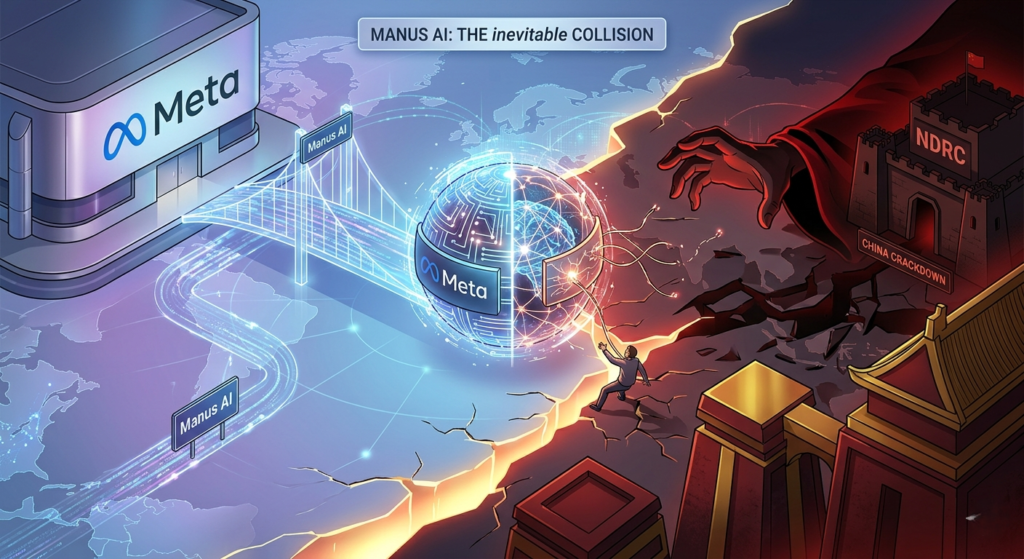
Introduction: A Predictable Reckoning in the AI Cold War
There’s a kind of dramatic irony in watching a story unfold exactly as everyone feared it would, yet being powerless to stop it. That’s precisely the Manus AI saga in a nutshell.
In early 2025, a Chinese AI startup burst onto the global scene with a flashy demo, a viral moment, and a valuation that Silicon Valley’s most discerning venture capitalists couldn’t resist. Within a year, the same startup had relocated to Singapore, sold itself to Meta for $2 billion, and watched its co-founders get summoned — and reportedly detained — by Chinese regulators for questioning.
The Manus AI story is not just a corporate drama. It’s a case study in what happens when the ambitions of a high-growth AI startup collide headfirst with the realpolitik of the U.S.-China technology war. It’s a story that every founder, investor, and AI observer needs to understand — because it won’t be the last of its kind.
This post breaks down what happened, why it mattered, what Beijing’s response reveals about the future of global AI development, and what founders and investors can learn from the Manus AI trajectory before making similar bets.
Who Is Manus AI? A Rapid Rise Worth Understanding
Before we get to the geopolitical fallout, it’s worth appreciating just how meteoric — and legitimately impressive — Manus AI‘s rise was.
The Demo That Started It All
In the spring of 2025, Manus AI dropped a demo video that made waves across the AI community. The video showcased an AI agent doing things that felt genuinely futuristic: screening job candidates autonomously, planning detailed vacations, and analyzing stock portfolios with apparent sophistication. To add some spice, the company cheekily claimed its system outperformed OpenAI’s Deep Research tool.
Was it a carefully staged demo? Probably, at least in part — that’s the nature of tech demos. But it was compelling enough to ignite serious investor interest and generate enormous public attention.
Benchmark’s Bet and the $500M Valuation
What came next surprised even seasoned observers: Benchmark, the consummate Silicon Valley venture firm behind companies like Uber, Snap, and Dropbox, led a $75 million funding round valuing Manus AI at $500 million. For a Chinese-founded AI startup, this was notable. For a Chinese AI startup with no shortage of regulatory red flags already visible, it was eyebrow-raising.
Senator John Cornyn certainly thought so. He took to social media at the time to question why American investors would fund a company with ties to China’s AI ecosystem — one that could, he argued, ultimately serve Beijing’s strategic interests.
His concerns weren’t fringe paranoia. They were a preview of the reckoning that was coming.
Explosive Growth: $100M ARR and Millions of Users
By December 2025, Manus AI had scaled to millions of users and was reportedly pulling in over $100 million in annual recurring revenue (ARR). For context, reaching $100M ARR in under a year is a benchmark that most startups never achieve at all. It speaks to genuine product-market fit, strong distribution, and a compelling use case for autonomous AI agents.
This growth trajectory made Manus AI an obvious acquisition target — and Meta, betting its entire future on AI dominance, came calling.
The Meta Deal: $2 Billion and a Clean Break from China
Mark Zuckerberg has been relentlessly transparent about one thing: Meta’s future is AI. The company has poured billions into large language model research, AI-powered products across its social platforms, and strategic acquisitions designed to accelerate its position in the AI race.
Acquiring Manus AI for $2 billion fit neatly into that thesis. Here was a company with proven AI agent technology, massive user traction, strong revenue, and — importantly — a team that had already begun distancing itself from China.
The Singapore Pivot: Manus AI Tried to Escape Beijing’s Orbit
This is a critical and often underappreciated part of the Manus AI story. The company didn’t just sell to an American buyer. For the better part of 2025, it actively and methodically tried to restructure itself as a non-Chinese company:
- Relocated its headquarters and core team from Beijing to Singapore
- Restructured its ownership to reduce Chinese investor exposure
- Post-acquisition, Meta pledged to sever all ties with Manus’s remaining Chinese investors
- Committed to shutting down its China operations entirely
By every formal measure, Manus AI was trying — hard — to become a Singapore company. The move to Singapore was not accidental; the city-state sits in a regulatory gray zone that many Chinese tech founders have used to create separation from Beijing’s oversight while remaining accessible to global capital.
But here’s the uncomfortable truth: in China’s view, you don’t get to simply opt out.
Beijing’s Response: “Selling Young Crops” and the Reckoning
China has a phrase — selling young crops — for exactly what Manus AI did. It describes the phenomenon of homegrown AI companies that relocate abroad and sell themselves to foreign buyers before fully maturing, taking their intellectual property, talent, and strategic value with them.
Beijing hates it. And Beijing has a well-documented history of making its displeasure known in very concrete ways.
The Jack Ma Playbook, Revisited
To understand why Manus AI‘s founders taking the Singapore-to-Meta route was always a geopolitical gamble, consider the precedent set by Alibaba’s Jack Ma. In 2020, Ma gave a speech mildly criticizing Chinese financial regulators. What followed was swift and devastating: Ma disappeared from public life for months, Ant Group’s massive IPO was killed overnight, and Alibaba was hit with a $2.8 billion antitrust fine. Beijing then spent the next two years methodically dismantling China’s booming tech sector, wiping out hundreds of billions in market capitalization.
The lesson Chinese tech founders should have internalized: Beijing does not do subtle. When it decides to send a message, the message is loud, expensive, and public.
The Summons: Founders Can’t Leave
In March 2026, the Financial Times reported that Manus AI co-founders Xiao Hong and Ji Yichao had been summoned to meet with China’s National Development and Reform Commission (NDRC). The message was clear: they would not be leaving China for the foreseeable future.
No formal charges have been filed. Beijing is framing the situation as a routine regulatory inquiry into whether the Meta acquisition violated China’s foreign investment rules. But framing something as “routine” when it involves detaining a startup’s founders sends an unmistakable signal to the broader ecosystem.
The Manus AI founders may have thought they’d escaped. Maybe they still will. But the odds were never as good as they might have hoped.
What the Manus AI Saga Reveals About the Global AI Race
This is not just a story about one company. The Manus AI episode is a microcosm of the structural tensions now defining the global technology landscape. Here’s what it tells us:
1. The U.S.-China AI Race Is Geopolitical, Not Just Commercial
Both Washington and Beijing treat AI supremacy as a matter of national security — not merely economic competition. The U.S. has implemented export controls on advanced chips. China has responded with its own restrictions on AI-related intellectual property and talent. In this environment, a Chinese-founded AI company selling itself to an American tech giant was never going to be treated as a purely private transaction.
2. Regulatory Arbitrage Through Singapore Has Limits
The Singapore move was smart in theory: establish distance from Beijing, gain access to global capital, reduce regulatory exposure. But as Manus AI discovered, restructuring your corporate headquarters doesn’t automatically restructure your political exposure. If your founders still hold Chinese citizenship, if your original intellectual property was developed in China, and if the Chinese state views the company as a strategic asset — a Singapore address may provide legal separation but not political protection.
3. American Investors Face Growing Scrutiny
Senator Cornyn’s concerns weren’t just political noise. They reflect a growing consensus in Washington that American venture capital flowing into Chinese AI startups — even nominally Singapore-based ones — creates pathways for technology transfer that regulators find uncomfortable. Benchmark’s investment in Manus AI will likely be scrutinized as a precedent as policymakers tighten rules around cross-border AI investment.
4. AI Talent Is the New Battleground
Behind every great AI startup is a team of researchers, engineers, and technical leaders. When Manus AI relocated to Singapore and then sold to Meta, it effectively transferred a high-value AI talent pool out of China’s reach. Beijing’s response — restricting the founders’ movement — is partly about the deal itself and partly about signaling that China’s AI talent base is not freely exportable.
Key Timeline: The Manus AI Story at a Glance
| Date | Event |
|---|---|
| Spring 2025 | Manus AI releases viral demo; claims to outperform OpenAI’s Deep Research |
| Spring 2025 | Benchmark leads $75M funding round at $500M valuation |
| Mid-2025 | Manus AI relocates HQ and core team from Beijing to Singapore |
| December 2025 | Manus AI reaches millions of users and $100M+ ARR |
| Late 2025 / Early 2026 | Meta acquires Manus AI for $2 billion |
| Post-acquisition | Meta pledges to cut all China investor ties; China ops to be shut down |
| March 2026 | Co-founders summoned by China’s NDRC; reportedly prevented from leaving China |
What Founders and Investors Should Learn From Manus AI
The Manus AI story isn’t a cautionary tale about ambition — it’s a cautionary tale about underestimating the political dimension of operating in the AI space. Here are the actionable lessons:
For Founders
- Geography is not just logistics — it’s political exposure. Where you incorporate, where your team is based, and where your IP was developed all carry geopolitical implications that compound over time. Plan accordingly from day one, not after you’ve already built a unicorn.
- Understand what “exit” actually means in a geopolitical context. Selling to a foreign acquirer is not a neutral transaction when you’re operating in a strategic sector. Get legal and political risk counsel early, not after a deal is signed.
- Regulatory arbitrage is a strategy with a shelf life. Singapore, Dubai, and other “neutral” tech hubs can provide useful structural separation — but they are not magic shields. If your business touches sensitive technology, assume that both Washington and Beijing are paying attention.
For Investors
- Political risk due diligence is now standard practice for cross-border AI deals. The old framework — evaluate the tech, evaluate the team, evaluate the market — is insufficient. You need to evaluate the geopolitical exposure, the founders’ citizenship and obligations, and the regulatory landscape in both the home country and target markets.
- Benchmark’s bet on Manus AI will shape future scrutiny. Expect U.S. policymakers to use this deal as a reference point when crafting new rules around foreign AI investment. If you invest in Chinese-founded AI companies, even Singapore-domiciled ones, be prepared to defend that decision in front of Congress.
- $2 billion exits can become complicated quickly. The acquisition price is agreed; the geopolitical fallout is open-ended. Meta now faces the operational and reputational complexity of integrating a company whose founders are entangled in a Chinese regulatory inquiry.
For the AI Industry at Large
The Manus AI episode is likely not a one-off. As AI becomes more central to national security calculations, expect more cases where talented teams — built in one country, funded by another, acquired by a third — become flash points in the technology cold war. The industry needs clearer norms, clearer regulatory frameworks, and clearer thinking about what it means to build “global” companies in a deglobalizing world.
The Broader Context: China’s Tech Crackdown Is Structural, Not Episodic
It would be a mistake to view the pressure on Manus AI as an isolated reaction to one deal. China’s regulatory posture toward its own tech sector has been consistently assertive since 2020. The government has:
- Killed Ant Group’s blockbuster $37 billion IPO overnight
- Fined Alibaba $2.8 billion for antitrust violations
- Systematically dismantled the dominance of its largest consumer internet companies
- Established data security laws that give the state broad authority over technology companies operating in or founded in China
These actions were not random. They reflect a coherent strategic doctrine: China’s technology sector exists to serve national development goals, not to enrich founders or foreign investors. When a company like Manus AI appears to be “taking” Chinese-developed technology and talent to benefit an American tech giant, Beijing’s response is entirely consistent with that doctrine — even if the specific mechanism (detaining founders pending an inquiry) feels dramatic from a Western perspective.
What Happens Next? Three Scenarios for Manus AI
The situation remains unresolved as of late March 2026. Here’s how it could play out:
Scenario 1: Negotiated Resolution Beijing uses the Manus AI founders’ situation as leverage to extract concessions — perhaps requiring Meta to maintain some Chinese operations, share certain technologies, or make other accommodations. The founders are eventually allowed to leave. The deal proceeds in modified form.
Scenario 2: Deal Unraveling Regulatory pressure becomes severe enough that Meta finds the acquisition untenable — either due to operational complexity, legal liability, or the inability to integrate the team. The deal is unwound or restructured significantly, becoming a cautionary precedent that chills similar cross-border AI M&A for years.
Scenario 3: Protracted Stalemate The inquiry drags on indefinitely, keeping the founders in legal limbo while the deal technically stands. This creates ongoing operational uncertainty for Meta and a prolonged negotiation with no clean resolution — a situation that suits neither party but demonstrates Beijing’s willingness to play a long game.
Whichever scenario unfolds, the reputational signal has already been sent to every ambitious Chinese AI founder: if you try to take your company global by selling to an American buyer, the state will want to have a conversation about that.
Conclusion: The Least Surprising Ending in AI’s Most Consequential Story
The Manus AI saga is, as TechCrunch aptly put it, the least surprising chapter of an already dramatic story. Every data point was there: the geopolitical heat around cross-border AI investment, China’s track record on tech sector control, the audacity of a $2 billion sale to Meta, and a Singapore relocation that may have changed the corporate address but couldn’t change the political reality.
What makes this story important isn’t the drama — it’s the precedent. Manus AI and its founders made a high-stakes bet that they could escape Beijing’s orbit through structural maneuvering. Beijing’s response has, at least for now, made clear that the orbit extends further than anyone hoped.
For the global AI industry, the message is equally clear: building, funding, and acquiring AI companies is no longer just a business decision. It is, inescapably, a geopolitical one.
The founders of Manus AI gambled on being the exception to a very well-established rule. Whether they win or lose that bet, the story they’re living through will define how the next generation of AI founders — in China and everywhere else — thinks about what it means to build a company in the age of AI nationalism.
1. What is Manus AI and why did Meta acquire it?
Manus AI is a startup that gained global fame in 2025 for its “general-purpose AI agents.” Unlike simple chatbots, these agents can independently execute complex, multi-step tasks like planning travel, conducting deep market research, and writing code. Meta acquired the company in December 2025 for an estimated $2 billion to integrate this “agentic” technology into Facebook, Instagram, and WhatsApp, aiming to stay ahead of competitors like OpenAI and Google.
2. Who are the founders of Manus AI?
The company was co-founded by Xiao Hong (CEO, also known as “Red” in tech circles) and Ji Yichao (Chief Scientist, known as “Peak”). Both are prominent figures in the Chinese AI ecosystem. Xiao Hong previously developed the Monica AI assistant, which gained millions of users before the launch of Manus.
3. Why are the founders currently unable to leave China?
In March 2026, reports surfaced that Xiao Hong and Ji Yichao were summoned to a meeting with China’s National Development and Reform Commission (NDRC). Following the meeting, they were reportedly placed under an “exit ban.” While they can travel freely within China, they are prohibited from leaving the country while regulators investigate whether the sale to Meta violated Chinese technology export and foreign investment laws.
4. What is “Singapore Washing” and how does it relate to this case?
“Singapore Washing” is a term used to describe Chinese startups that relocate their headquarters to Singapore (or other neutral hubs) to distance themselves from Beijing’s regulatory reach and appear more attractive to Western investors or buyers. Manus AI relocated to Singapore in 2025, but Beijing’s current crackdown suggests that simply changing a corporate address is not enough to sever political and legal ties with China.
5. Is the Meta acquisition of Manus AI still going through?
The deal was technically completed in late 2025; however, it has hit a significant “regulatory wall.” The Chinese government is reviewing whether the transfer of core intellectual property to a foreign entity was legal. If regulators find a violation, they could attempt to force an unwinding of the deal or impose massive fines, leaving the future of the integration in limbo.
6. Can I still use Manus AI products?
Yes. As of March 2026, Manus has launched a desktop application called “My Computer” and remains active on platforms like Telegram. Meta has stated its intention to keep Manus operating as a standalone service while slowly integrating its capabilities into Meta AI.