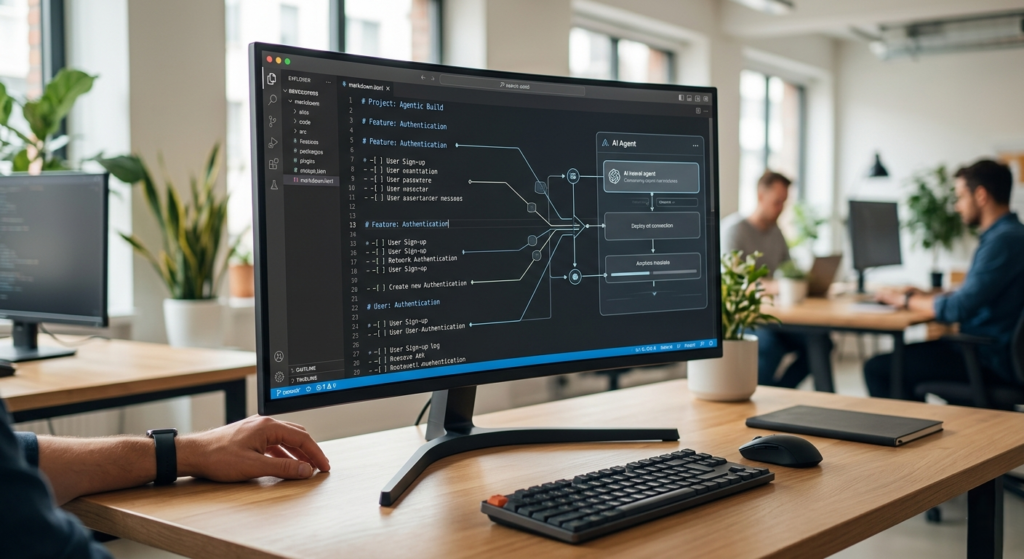
For decades, the tech world viewed Markdown as nothing more than a lightweight tool for README files and basic documentation. It was the “diet version” of HTML—convenient, but secondary. However, as we move into the era of AI-driven engineering, the boundaries of software development are shifting. High-profile tech leaders and the rise of autonomous agents are proving a provocative point: Markdown as a coding language is no longer a fringe theory; it is a functional reality.
Why the Tech World is Calling Markdown a Coding Language
The conversation recently ignited when Garry Tan, CEO of Y Combinator, released “gstack”—a series of Markdown-based files designed to guide Claude (an AI coding agent) through complex software development cycles. Critics argued that these are “just text files” or “prompts,” but this overlooks the fundamental evolution of programming abstraction.
Historically, coding moved from mechanical switches to binary, then to assembly, and eventually to high-level languages like Python and TypeScript. Each step increased the abstraction level to make human intent more readable for machines. Today, large language models (LLMs) act as the “compiler” for human intent. In this ecosystem, Markdown as a coding language serves as the structured syntax that tells the AI exactly how to architect, build, and debug a product.
The Power of Abstraction
When you write a Dockerfile or a YAML configuration, you are essentially writing a text file that a system interprets to perform a task. If an AI agent can interpret a structured Markdown file to build a full-stack application, that Markdown file has effectively become the source code. This shift towards Markdown as a coding language allows developers to move from “mushy” prompting to high-precision engineering.
Key Benefits of Using Markdown as a Coding Language
Treating Markdown with the same rigor as traditional code offers several strategic advantages for modern development teams:
- Human-Machine Readability: Unlike JSON or XML, which can be verbose and difficult to parse visually, Markdown is designed to be “humane.” It is easily understood by both the developer and the AI agent.
- Version Control Compatibility: Since Markdown is plain text, it lives perfectly within Git. You can track “code” changes, diff versions, and manage pull requests just as you would with Python.
- Token Efficiency: In the world of LLMs, tokens are currency. HTML is heavy and cluttered with tags. Markdown as a coding language is lean, allowing AI agents to process more information with fewer resources.
- Seamless Integration: Most modern IDEs and developer tools have native support for Markdown, offering syntax highlighting and previews out of the box.
Comparing Traditional Code vs. Agentic Markdown
To understand how Markdown as a coding language fits into your workflow, let’s look at how it compares to traditional programming approaches.
| Feature | Traditional Coding (Python/JS) | Markdown as a Coding Language |
| Execution | Compiled or Interpreted by Software | Interpreted by AI Agents (LLMs) |
| Abstraction | High-level Logic | Intent-based Architecture |
| Maintenance | Manual Refactoring | Agent-led Iteration |
| Learning Curve | Weeks to Months | Minutes to Hours |
| Primary Use | Building Logic Units | Orchestrating Workflows |
How to Implement Markdown as a Coding Language in Your Workflow
If you want to leverage the power of Markdown as a coding language, you need to stop thinking of it as “just documentation.” Here are actionable steps to treat your .md files as functional code:
1. Structure Your Intent with Headings
Use H1 and H2 tags to define the “Modules” or “Roles” of your application. For example, use an H2 for # Backend Requirements and an H3 for ## Authentication Logic. This provides a clear hierarchy for the AI compiler to follow.
2. Use Code Blocks for Specificity
Even when using Markdown as a coding language, you will often need to embed snippets of traditional code. Use triple backticks to define these areas, ensuring the AI knows where the “soft” intent ends and the “hard” logic begins.
3. Leverage Checklists for State Management
Markdown checkboxes (- [ ]) are perfect for tracking the progress of an agentic build. By updating the Markdown file, you provide a persistent memory of what has been “compiled” and what is still in the “backlog.”
4. Optimize for “Agentic Workflows”
The true strength of Markdown as a coding language lies in its ability to manage “Agentic Workflows.” You can define personas—such as a Product Manager, a QA Engineer, and a DevOps Lead—within a single Markdown file to guide the AI through a multi-step deployment.
The Future: Will Markdown Replace Python?
While Markdown as a coding language is gaining traction, it isn’t meant to replace the deep logic of C++ or the versatility of Python. Instead, it is becoming the “orchestration layer.” Just as SQL is the language of databases, Markdown is becoming the language of AI interaction.
By embracing Markdown as a coding language, developers can build products faster, reduce technical debt through clearer documentation, and stay ahead of the “Agentic Web” curve. Whether you are a solo founder or a lead architect, the message is clear: the most powerful coding language of 2026 might just be the one you’ve been using for your README files all along.
Final Thoughts on Markdown as a Coding Language
The transition to Markdown as a coding language represents the ultimate simplification of software development. It democratizes the ability to build, allowing intent to drive execution without the friction of complex syntax. As AI agents become more sophisticated, the role of the developer will shift from writing every line of logic to mastering the structure of intent.
If you haven’t yet experimented with gstacks or AI-orchestrated .md files, now is the time to start. Markdown as a coding language is here, and it’s time to deal with it.