
MoE model fine-tuning optimization has officially hit a breaking point—in the best way possible.
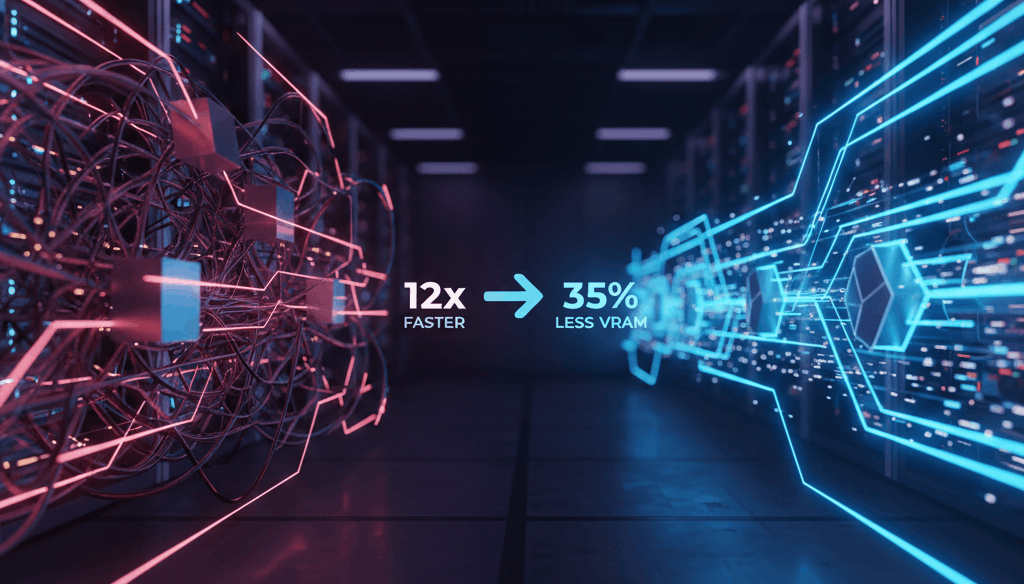
Until recently, training Large Language Models (LLMs) was a luxury reserved for those with deep pockets and data-center-grade GPUs. But a new breakthrough in Mixture of Experts (MoE) architecture is changing the game. We’re talking about cutting training times by 12xwhile slashing GPU memory usage by 35%.
Whether you’re rocking an older RTX 3090 or the latest B200 chip, here is how these innovations democratize AI development.
Breaking Down the Breakthrough: MoE Model Fine-Tuning Optimization
MoE model fine-tuning optimization has officially hit a breaking point—in the best way possible.
Until recently, training Large Language Models (LLMs) was a luxury reserved for those with deep pockets and data-center-grade GPUs. But a new breakthrough in Mixture of Experts (MoE) architecture is changing the game. We’re talking about cutting training times by 12x while slashing GPU memory usage by 35%.
These innovations, pioneered by libraries like Unsloth AI, democratize development for everyone from individual researchers to enterprise teams.
## Two Core Innovations in MoE Model Fine-Tuning Optimization
How do we achieve a 12x speedup? It comes down to two major technical innovations that fix the fundamental bottlenecks of MoE architectures.
1. The Split LoRA Approach
Traditional fine-tuning merges adapter weights before computation, which creates a massive memory overhead. The new Split LoRA technique reorders operations to avoid this.
The Math Hack: Instead of calculating $(A \times B) \times C$, the system computes $A \times (B \times C)$. The result is identical, but the intermediate memory footprint is tiny.
For a model like Qwen3-30B, this allows you to process 32,000 token sequences comfortably, whereas standard methods would crash at 16,000. You can explore the arXiv research on Dynamic Rank LoRA to see how this reordering maintains accuracy.
2. Custom Triton Kernels
By using specialized Triton computational kernels optimized for MoE architectures, the system achieves a 2.5x speed increase on hardware like the NVIDIA A100. The system is intelligent; it automatically selects the best backend for your specific GPU, whether it’s a Tesla T4 or a Blackwell B200.
## Benchmarking MoE Model Fine-Tuning Optimization Performance
Numbers don’t lie. Here is how these optimizations perform across popular model families:
| Model | Speed Gain | Memory Savings | Key Highlight |
| GPT-OSS 20B | 7.3x Faster | 35% Less VRAM | Fits in just 12.8 GB VRAM |
| Qwen3-30B | 1.7x Faster | High | Scales to 8K context |
| GLM 4.7 Flash | 2.6x Faster | 15% Savings | Massive throughput boost |
## Best Practices for MoE Model Fine-Tuning Optimization
While the speedup is the headline, scaling across different architectures requires a strategic approach.
- For High-End GPUs (H100, B200): Leverage PyTorch’s Grouped Matrix Multiplication to batch expert operations into a single parallel call.
- For Consumer GPUs (RTX 3090, 4090): Stick to 4-bit or 8-bit quantization (QLoRA) to keep the base model weights small enough to leave room for the LoRA adapters.
- Model Selection: Newer architectures like DeepSeek-V3 or GLM-4.7 Flash are natively designed for this type of sparse activation, making them the most efficient targets for fine-tuning.
Deep Dive into Hardware Scaling
While the 12x speedup is the headline, the way this optimization scales across different GPU architectures is the real technical feat. The system utilizes a Dynamic Backend Selector that identifies your hardware at runtime:
- The Blackwell & Hopper Advantage (H100, B200): On these chips, the optimization leverages Grouped Matrix Multiplication (GMM). Instead of launching individual kernels for each of the active experts, it batches them into a single, massive parallel operation, reducing overhead to near zero.
- The Ampere Powerhouse (A100, RTX 3090): For these ubiquitous GPUs, the system switches to Custom Triton Kernels. These are hand-optimized to manage the “sparse” nature of MoE models, ensuring that the 8 active experts (out of 128) don’t leave the other 94% of your compute power sitting idle.
- Legacy Support (Tesla T4, RTX 20 series): Even on older hardware, the Split LoRA memory savings still apply, allowing you to train models that were previously “too big” for 16GB or 24GB cards.
### Final Thoughts
This is a massive step forward for inclusive AI. By making MoE model fine-tuning optimization accessible on consumer-grade hardware, we are moving away from a world where only “Big Tech” can innovate. The future of AI is faster, leaner, and open to everyone.