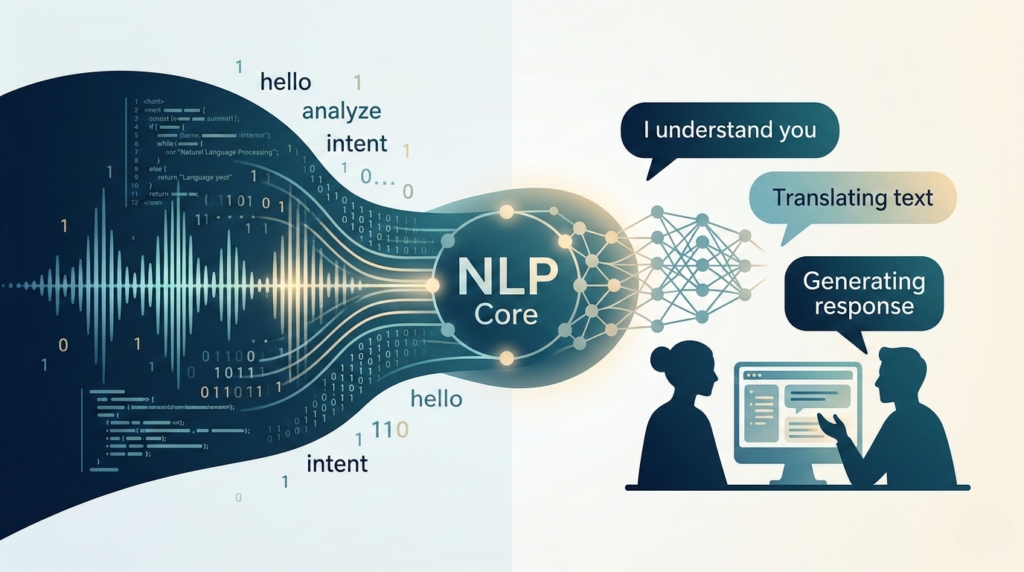
In the modern digital landscape, we often interact with technology so seamlessly that we forget the complex machinery operating beneath the surface. From asking your smartphone for the weather to receiving a perfectly translated email from a global colleague, the bridge between human thought and machine action is built on a specific pillar of artificial intelligence. This invisible force is Natural Language Processing.
As we navigate an era where data is the new oil, the ability for machines to not just “read” but truly “understand” human language has become a competitive necessity. Whether you are a business leader looking to automate customer support or a developer curious about the mechanics of Large Language Models (LLMs), understanding how Natural Language Processing functions is the first step toward mastering the future of tech.
What is Natural Language Processing?
At its most fundamental level, Natural Language Processing (NLP) is a branch of artificial intelligence that enables computers to understand, interpret, and generate human language. Unlike traditional programming, which relies on rigid code and binary logic, NLP allows machines to navigate the messy, nuanced, and often ambiguous nature of how we speak and write.
Human language is riddled with sarcasm, idioms, and context-dependent meanings. For a computer, the word “bank” could mean a financial institution or the edge of a river. Natural Language Processing provides the mathematical frameworks and linguistic rules necessary for a machine to distinguish between these two based on the surrounding words.
The Two Pillars of NLP
To achieve human-like interaction, Natural Language Processing generally splits into two functional sub-domains:
- Natural Language Understanding (NLU): This focuses on the “reading” part—dissecting syntax and identifying the intent behind a sentence.
- Natural Language Generation (NLG): This focuses on the “writing” part—taking structured data or intent and turning it into a coherent, human-sounding response.
How Machines “Learn” to Speak: The Technical Journey
Machines do not experience language the way we do; they process it as high-dimensional math. The journey from a raw sentence to a machine-understandable format involves several critical stages of Natural Language Processing.
1. Tokenization and Preprocessing
The first step in any Natural Language Processing workflow is breaking down a block of text into smaller units called “tokens.” These are usually words or sub-words. This stage also includes:
- Stopword Removal: Deleting common words like “the,” “is,” and “at” that don’t add much meaning.
- Stemming and Lemmatization: Reducing words to their root form (e.g., “running” becomes “run”).
2. Syntactic and Semantic Analysis
Once the text is cleaned, the AI looks at the structure. It identifies parts of speech (nouns, verbs, adjectives) and maps the relationships between them. Semantic analysis then steps in to assign meaning, ensuring the AI understands that “I saw a man with a telescope” has two different structural interpretations.
3. The Power of Transformers
The real “magic” behind modern Natural Language Processing—and tools like ChatGPT—is the Transformer architecture. Before Transformers, AI processed words one by one in a sequence. Transformers use a mechanism called “Attention,” which allows the model to look at an entire paragraph at once and decide which words are most relevant to each other, regardless of how far apart they are in the text.
Real-World Applications of Natural Language Processing
You likely interact with Natural Language Processing dozens of times a day without realizing it. Its ubiquity is what makes it “invisible AI.”
Virtual Assistants and Chatbots
Siri, Alexa, and Google Assistant are the most visible faces of NLP. They use speech recognition to convert your voice into text, NLU to figure out your intent, and NLG to give you a spoken answer.
Sentiment Analysis in Business
Companies use Natural Language Processing to “read” thousands of customer reviews or social media posts in seconds. By identifying the “sentiment” (positive, negative, or neutral), brands can pivot their marketing strategies or address product flaws in real-time.
Machine Translation
Services like Google Translate have evolved from clunky word-for-word substitution to sophisticated systems that understand cultural nuances and grammar, all powered by deep learning models within the Natural Language Processing ecosystem.
Comparing Traditional Programming vs. NLP-Driven AI
| Feature | Traditional Programming | Natural Language Processing |
| Input Style | Explicit commands / Code | Natural human speech or text |
| Flexibility | Rigid; fails on typos or slang | High; adapts to context and errors |
| Output | Predetermined results | Dynamic, generative responses |
| Learning | Requires manual updates | Learns patterns from massive data |
The Core Challenges: Why NLP is Hard
Despite the breakthroughs, Natural Language Processing still faces significant hurdles. Human communication is not just about words; it’s about what isn’t said.
- Sarcasm and Irony: When someone says, “Oh, great, another meeting,” the literal meaning is positive, but the intent is negative. Standard algorithms often struggle with this.
- Cultural Nuance: Slang and regional dialects vary wildly. An AI trained on American English might struggle with British or Australian colloquialisms.
- Ethical Bias: Because Natural Language Processing models are trained on internet data, they can inherit the biases, prejudices, and misinformation found in that data. Ensuring “fair” AI is a major focus for researchers today.
Actionable Insights: How to Leverage NLP Today
You don’t need to be a data scientist to benefit from Natural Language Processing. Here is how you can start using it to boost productivity:
- For Content Creators: Use AI-driven SEO tools to analyze keyword intent. These tools use NLP to tell you what your audience is actually searching for, not just the words they type.
- For Business Owners: Implement a basic sentiment analysis tool on your customer feedback. It can help you identify a PR crisis before it goes viral.
- For Developers: Explore libraries like Hugging Face or spaCy. These provide pre-trained Natural Language Processing models that you can plug into your own apps with just a few lines of code.
The Future: Where is NLP Heading?
The future of Natural Language Processing lies in “Multimodal AI”—systems that can understand text, image, and voice simultaneously. We are moving toward a world where your computer doesn’t just process your text but understands the tone of your voice and the frustration on your face through a webcam.
As these systems become more integrated into our homes and workplaces, the “invisible” nature of this AI will only increase. We are reaching a point where the barrier between human intent and machine execution will finally vanish