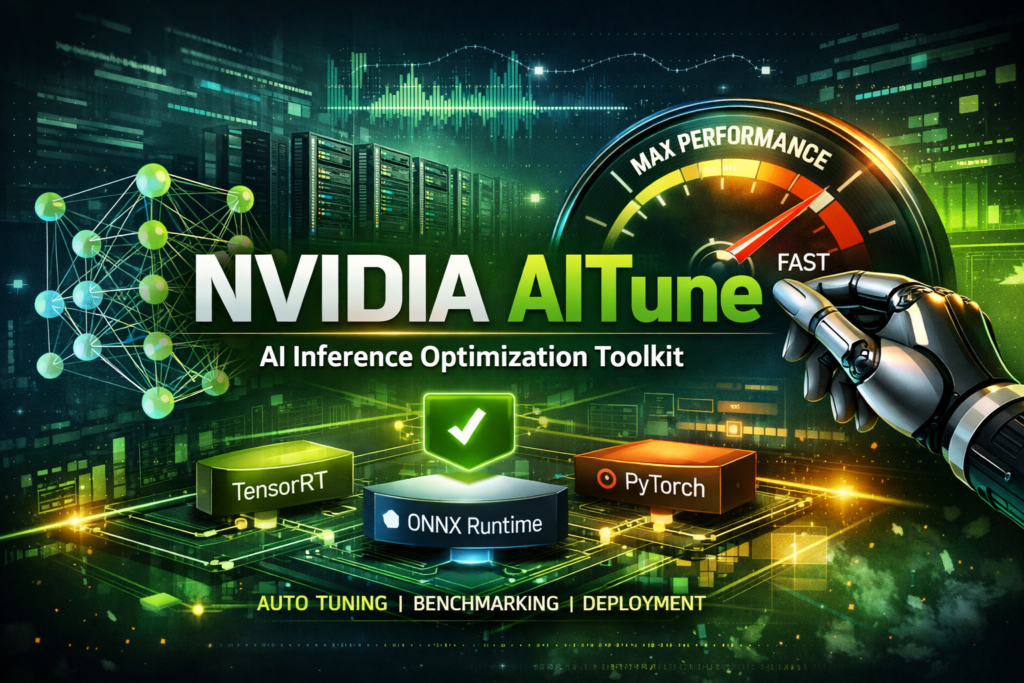
AI models are only as good as how fast they run in production—and that’s exactly what NVIDIA AITune solves. This open-source toolkit automatically finds the fastest inference backend for any PyTorch model, eliminating manual optimization and boosting performance instantly.
If you’re deploying AI systems, this could be one of the most important tools you’ll use in 2026.
🧩 What Is NVIDIA AITune?
Definition:
NVIDIA AITune is an open-source AI inference optimization tool designed to automatically select the most efficient backend for running PyTorch models.
Expansion:
Traditionally, optimizing AI inference required deep expertise—engineers had to test multiple frameworks like TensorRT, ONNX Runtime, or native PyTorch execution manually. NVIDIA AITune changes this paradigm by automating the entire process.
Built by NVIDIA, the toolkit intelligently benchmarks different inference backends and selects the fastest one based on your model and hardware configuration.
In simple terms:
👉 You give it a model
👉 It finds the fastest way to run it
⚡ Why AI Inference Optimization Matters in 2026
AI adoption is exploding across industries, but one bottleneck remains consistent: inference performance.
The Problem:
- Models are getting larger (LLMs, multimodal systems)
- Infrastructure costs are rising
- Latency expectations are shrinking
The Impact:
Slow inference leads to:
- Poor user experience
- Higher cloud costs
- Reduced scalability
The Solution:
Tools like NVIDIA AITune are becoming essential because they:
- Reduce latency dramatically
- Optimize hardware utilization
- Eliminate trial-and-error optimization
With AI now powering real-time applications—from chatbots to autonomous systems—optimization is no longer optional.
⚙️ How NVIDIA AITune Works (Step-by-Step Breakdown)
🔍 1. Backend Selection
AI models can run on multiple inference backends, including:
- Native PyTorch runtime
- TensorRT
- ONNX Runtime
- Custom GPU accelerators
NVIDIA AITune evaluates all available options automatically.
📊 2. Performance Benchmarking
Once candidate backends are identified, the system:
- Runs performance tests
- Measures latency, throughput, and memory usage
- Compares results across configurations
This benchmarking phase ensures that the best backend is selected—not just theoretically, but practically.
🤖 3. Automatic Optimization
After benchmarking, NVIDIA AITune:
- Chooses the fastest backend
- Applies optimizations like quantization and graph fusion
- Outputs a production-ready configuration
No manual tuning required.
🌟 Key Features of NVIDIA AITune
1. Fully Automated Optimization
No need for deep expertise in inference engineering.
2. Backend Agnostic
Works across multiple runtimes and hardware setups.
3. Open-Source Flexibility
Developers can modify and extend it freely.
4. PyTorch-Centric Design
Seamlessly integrates with existing workflows.
5. Performance-First Approach
Focuses on real-world speed improvements, not theoretical gains.
📊 NVIDIA AITune vs Traditional Optimization Methods
| Feature | NVIDIA AITune | Manual Optimization | Static Frameworks |
|---|---|---|---|
| Automation | ✅ Fully automated | ❌ Manual | ❌ Limited |
| Speed Optimization | ✅ Dynamic | ⚠️ Depends on expertise | ⚠️ Fixed |
| Ease of Use | ✅ Beginner-friendly | ❌ Complex | ⚠️ Moderate |
| Backend Flexibility | ✅ High | ⚠️ Medium | ❌ Low |
| Time Required | ✅ Minutes | ❌ Days/Weeks | ⚠️ Hours |
Key Insight:
NVIDIA AITune dramatically reduces optimization time while improving performance outcomes.
🏭 Use Cases Across Industries
🏥 Healthcare
- Faster medical imaging analysis
- Real-time diagnostics
🛍️ E-commerce
- Personalized recommendations at scale
- Instant search results
🚗 Autonomous Systems
- Low-latency decision-making
- Real-time object detection
💬 AI Assistants
- Faster response times
- Better user experience
In all these cases, NVIDIA AITune ensures models run efficiently in production.
🛠️ How to Get Started with NVIDIA AITune
Step 1: Install the Toolkit
Clone the repository from NVIDIA’s open-source platform.
Step 2: Load Your Model
Provide your PyTorch model as input.
Step 3: Run Optimization
Execute the tuning process.
Step 4: Deploy
Use the optimized backend for production.
Example Workflow (Simplified)
aitune optimize --model my_model.pt
Within minutes, NVIDIA AITune outputs the best-performing configuration.
✅ Advantages and ⚠️ Limitations
✅ Advantages
- Saves massive engineering time
- Improves inference speed automatically
- Reduces infrastructure costs
- Works across multiple environments
- Ideal for both beginners and experts
⚠️ Limitations
- Currently focused on PyTorch ecosystem
- Performance gains depend on hardware compatibility
- May require fine-tuning for edge cases
- Early-stage tool (evolving rapidly)
🔮 Future of AI Inference Optimization
The release of NVIDIA AITune signals a broader shift toward automated AI engineering.
What’s Coming Next:
- Fully autonomous model deployment pipelines
- Real-time optimization during runtime
- Cross-framework compatibility (beyond PyTorch)
- Integration with cloud-native AI platforms
As AI systems grow more complex, tools like NVIDIA AITune will become foundational infrastructure.
🧠 Final Thoughts
AI development is no longer just about building better models—it’s about running them efficiently at scale.
NVIDIA AITune represents a major leap forward by removing one of the most complex and time-consuming parts of AI deployment: inference optimization.
Instead of spending weeks benchmarking backends and tweaking configurations, developers can now rely on automation to achieve optimal performance in minutes.
For startups, this means faster time-to-market.
For enterprises, it means lower costs and better scalability.
For developers, it means focusing on innovation—not optimization.
In a world where milliseconds matter, NVIDIA AITune isn’t just a helpful tool—it’s a competitive advantage.
❓ Frequently Asked Questions (FAQ) About NVIDIA AITune
🔹 What is NVIDIA AITune and why is it important?
NVIDIA AITune is an open-source AI inference optimization toolkit designed to automatically select the fastest backend for running PyTorch models. Its importance lies in solving one of the most critical challenges in modern AI deployment—inference performance.
Traditionally, optimizing AI inference required engineers to manually test different backends such as TensorRT, ONNX Runtime, or native PyTorch. This process was not only time-consuming but also required deep expertise in performance tuning and hardware optimization. NVIDIA AITune eliminates this complexity by automating backend selection and optimization.
In today’s AI-driven world, where applications demand real-time responses—like chatbots, recommendation engines, and autonomous systems—slow inference can directly impact user experience and operational costs. By using NVIDIA AITune, developers can significantly reduce latency, improve throughput, and maximize hardware efficiency without manual effort.
This makes it a crucial tool for startups, enterprises, and AI researchers looking to scale AI applications efficiently in 2026 and beyond.
🔹 How does NVIDIA AITune automatically choose the best backend?
NVIDIA AITune uses a systematic and intelligent approach to identify the best inference backend for a given model and hardware environment.
First, it detects all available backends compatible with your system, such as TensorRT, ONNX Runtime, and PyTorch. Then, it runs a series of benchmarking tests using your actual model. These tests evaluate key performance metrics like latency, throughput, memory usage, and hardware utilization.
Unlike static optimization tools, NVIDIA AITune doesn’t rely on assumptions or pre-configured rules. Instead, it performs real-world performance testing, ensuring that the selected backend is genuinely the fastest for your specific use case.
Once the benchmarking is complete, the toolkit selects the optimal backend and applies additional optimizations such as quantization, graph fusion, and kernel tuning. The result is a production-ready configuration that delivers maximum performance with minimal manual intervention.
This automated decision-making process is what makes NVIDIA AITune highly efficient and reliable.
🔹 What types of AI models can NVIDIA AITune optimize?
NVIDIA AITune is primarily designed for PyTorch-based models, which are widely used across the AI industry. It can optimize a variety of model types, including:
- Computer vision models (e.g., image classification, object detection)
- Natural language processing models (e.g., transformers, chatbots)
- Recommendation systems
- Speech recognition and audio processing models
- Multimodal AI systems
Because PyTorch is one of the most popular frameworks, NVIDIA AITune covers a vast majority of real-world AI applications.
However, the effectiveness of optimization depends on the model architecture and compatibility with supported backends. For example, models that can be easily converted to TensorRT or ONNX Runtime formats often see the most significant performance improvements.
As the tool evolves, support for additional frameworks and model types is expected to expand further.
🔹 Is NVIDIA AITune suitable for beginners?
Yes, NVIDIA AITune is highly suitable for beginners, especially compared to traditional inference optimization methods.
One of the biggest challenges for new AI developers is understanding the complexities of backend optimization, hardware acceleration, and performance tuning. These tasks often require advanced knowledge of GPU architecture and low-level optimizations.
NVIDIA AITune abstracts away this complexity by providing a simple interface where users can input their model and let the system handle everything else. With minimal configuration, beginners can achieve professional-level optimization results.
At the same time, advanced users can still benefit from its flexibility by customizing optimization parameters and integrating it into larger pipelines.
This balance between simplicity and power makes NVIDIA AITune an ideal tool for developers at all skill levels.
🔹 How much performance improvement can NVIDIA AITune deliver?
The performance gains from NVIDIA AITune can vary depending on the model, hardware, and workload. However, in many cases, users can expect:
- Significant reduction in inference latency
- Improved throughput (more requests processed per second)
- Better GPU and CPU utilization
- Reduced memory footprint
For models that are not optimized by default, the improvements can be dramatic—sometimes achieving 2x to 10x speedups when switching to optimized backends like TensorRT.
It’s important to note that the tool doesn’t create artificial improvements. Instead, it identifies the most efficient way to run your model using existing technologies.
By automating this process, NVIDIA AITune ensures that you consistently get the best possible performance without manual experimentation.
🔹 Does NVIDIA AITune support GPU and CPU optimization?
Yes, NVIDIA AITune supports optimization across both GPU and CPU environments.
For GPU-based systems, it leverages high-performance backends like TensorRT to maximize parallel processing capabilities. This is especially beneficial for large-scale AI workloads and real-time applications.
For CPU environments, it can utilize optimized runtimes like ONNX Runtime to ensure efficient execution even without specialized hardware.
The ability to adapt to different hardware setups makes NVIDIA AITune highly versatile. Whether you are deploying on edge devices, cloud servers, or high-performance GPUs, the toolkit can find the best configuration for your setup.
🔹 How is NVIDIA AITune different from TensorRT?
While TensorRT is a powerful inference optimization framework, NVIDIA AITune serves a different purpose.
TensorRT focuses on optimizing models for NVIDIA GPUs, but it requires manual configuration and expertise to use effectively. Developers need to decide when and how to use TensorRT, which can be challenging.
NVIDIA AITune, on the other hand, acts as an intelligent orchestration layer. It automatically determines whether TensorRT is the best option or if another backend like ONNX Runtime or PyTorch would perform better.
In simple terms:
- TensorRT = Optimization tool
- NVIDIA AITune = Optimization decision-maker
This makes NVIDIA AITune more user-friendly and efficient, especially for developers who want quick results without deep technical involvement.
🔹 Can NVIDIA AITune reduce cloud infrastructure costs?
Absolutely. One of the biggest advantages of NVIDIA AITune is its ability to reduce cloud infrastructure costs.
By optimizing inference performance, the toolkit allows models to process more requests in less time. This means you can achieve the same workload with fewer compute resources.
For example:
- Lower GPU usage reduces cloud billing
- Faster inference reduces server load
- Efficient execution minimizes energy consumption
For businesses running large-scale AI applications, these savings can be substantial over time.
In many cases, the cost savings alone justify the adoption of NVIDIA AITune.
🔹 Is NVIDIA AITune production-ready?
NVIDIA AITune is designed with production use in mind, but its maturity level may still be evolving depending on the version.
As an open-source toolkit, it is continuously improving through community contributions and updates from NVIDIA. While it can already deliver significant performance benefits, organizations should thoroughly test it within their specific environments before full-scale deployment.
For mission-critical applications, it’s recommended to:
- Validate performance results
- Monitor stability under load
- Integrate fallback mechanisms
Despite these considerations, NVIDIA AITune is rapidly becoming a reliable solution for production AI systems.
🔹 How does NVIDIA AITune handle model compatibility issues?
Model compatibility is an important factor in inference optimization, and NVIDIA AITune addresses this intelligently.
When evaluating backends, the toolkit checks whether the model can be successfully executed on each option. If a backend is incompatible due to unsupported operations or conversion limitations, it is automatically excluded from consideration.
This ensures that the optimization process remains stable and error-free.
In cases where partial compatibility exists, NVIDIA AITune may still apply optimizations selectively, ensuring the best possible performance without breaking functionality.
🔹 Can NVIDIA AITune be integrated into CI/CD pipelines?
Yes, NVIDIA AITune can be integrated into modern CI/CD pipelines, making it a powerful tool for continuous AI deployment.
By automating inference optimization as part of the deployment workflow, teams can ensure that every model update is optimized before going live.
Benefits of CI/CD integration include:
- Consistent performance optimization
- Reduced manual intervention
- Faster deployment cycles
- Improved reliability
This makes NVIDIA AITune an excellent choice for organizations adopting MLOps practices.
🔹 What are the limitations of NVIDIA AITune?
While NVIDIA AITune is a powerful tool, it does have some limitations:
- Primarily focused on PyTorch models
- Dependent on backend compatibility
- Performance gains vary by use case
- Still evolving as an open-source project
Understanding these limitations helps developers set realistic expectations and use the tool effectively.
🔹 What is the future of NVIDIA AITune?
The future of NVIDIA AITune looks extremely promising as AI systems continue to grow in complexity.
We can expect:
- Support for more frameworks beyond PyTorch
- Real-time adaptive optimization
- Deeper integration with cloud platforms
- Enhanced automation across the AI lifecycle
As AI moves toward fully automated engineering workflows, tools like NVIDIA AITune will play a central role in simplifying development and deployment.
🔹 Should you use NVIDIA AITune in 2026?
If you are working with AI models—especially PyTorch-based ones—the answer is a strong yes.
NVIDIA AITune offers a unique combination of automation, performance, and ease of use that makes it highly valuable in modern AI workflows.
Whether you are a solo developer, a startup, or a large enterprise, adopting NVIDIA AITune can give you a competitive edge by improving performance, reducing costs, and accelerating deployment.
In a landscape where speed and efficiency define success, NVIDIA AITune is not just a helpful tool—it’s becoming a necessity.
🧠 Final Thoughts: Why NVIDIA AITune Matters More Than You Think
In the rapidly evolving AI landscape, building powerful models is no longer the ultimate differentiator—running them efficiently is. This is where NVIDIA AITune emerges as a game-changing solution. It doesn’t just optimize inference; it fundamentally reshapes how developers approach performance, scalability, and deployment.
For years, inference optimization has been a bottleneck requiring deep expertise, countless hours of benchmarking, and complex decision-making. With NVIDIA AITune, that entire process is simplified into an automated workflow that delivers real, measurable results. This shift is incredibly important because it democratizes high-performance AI—making advanced optimization accessible not only to large enterprises but also to startups and individual developers.
What makes NVIDIA AITune truly powerful is its practical impact. Faster inference means better user experiences, lower latency, and reduced infrastructure costs. In a world where milliseconds can determine user satisfaction and business outcomes, these improvements are not just technical—they are strategic advantages. Companies that leverage tools like NVIDIA AITune can scale faster, serve more users efficiently, and innovate without being held back by performance limitations.
Looking ahead, the significance of NVIDIA AITune goes beyond just one tool. It represents a broader industry trend toward automation in AI engineering. As models become more complex and deployment environments more diverse, manual optimization will no longer be sustainable. Intelligent systems that can adapt, benchmark, and optimize in real time will become the backbone of modern AI infrastructure.
In that context, NVIDIA AITune is not just a helpful addition to your toolkit—it’s a glimpse into the future of AI development. Adopting it today means staying ahead of the curve, reducing operational friction, and unlocking the full potential of your AI models.