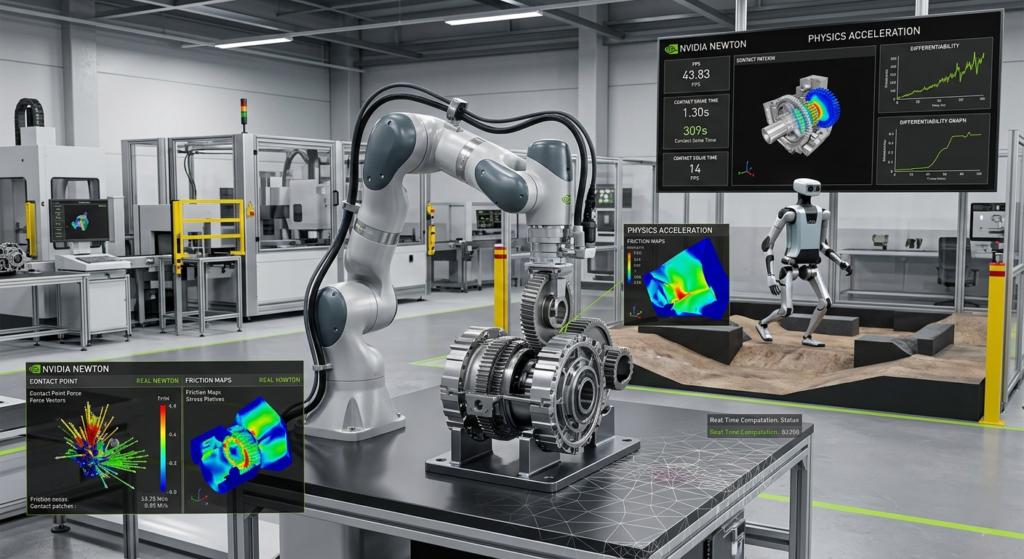
In the rapidly evolving landscape of automation, the transition from simple “pick-and-place” tasks to complex physical interactions remains one of the industry’s greatest hurdles. Traditional simulation engines often force developers to choose between speed and physical accuracy, leaving a significant “sim-to-real gap” that delays deployment.
NVIDIA recently bridged this divide with the release of NVIDIA Newton, a GPU-accelerated, open-source physics engine designed specifically for contact-rich manipulation and locomotion. By integrating Newton into the NVIDIA Isaac Sim and Isaac Lab ecosystems, developers can now train robots to handle delicate fabrics, assemble intricate machinery, and traverse rugged terrains with unprecedented fidelity.
Why NVIDIA Newton is a Game-Changer for Robotics
At its core, NVIDIA Newton is a modular framework built on NVIDIA Warp and OpenUSD. It serves as a unified architecture that brings together multiple solvers—including the advanced MuJoCo-Warp—to handle the non-smooth dynamics of physical contact.
For industrial applications, the primary benefit of NVIDIA Newton is its ability to simulate “contact-rich” environments. Unlike standard simulations that treat contacts as simple point-force interactions, Newton provides the high-fidelity modeling required for tasks where robots must continuously slide, frictionally engage, or manipulate deformable objects like cables and cloth.
Core Features of the Newton Physics Engine:
- GPU-Acceleration: Built on NVIDIA Warp to utilize the massive parallel processing of RTX GPUs.
- Differentiable Physics: Enables gradient-based optimization for system identification and policy learning.
- OpenUSD Integration: Allows for seamless asset exchange across different simulation environments.
- Modular Solver Architecture: Supports rigid-body, deformable, and custom solvers within a single scene.
Mastering Contact-Rich Manipulation
Contact-rich manipulation refers to tasks involving continuous or repeated physical interaction between a robot and its environment. In industrial settings, this includes:
- Threaded Fastening: Inserting and tightening bolts where friction and alignment are critical.
- Snap-fit Assembly: Managing the precise forces needed to click parts together without breakage.
- Soft Goods Handling: Manipulating cloth or flexible wiring, which requires two-way coupling between the robot and a deformable object.
NVIDIA Newton excels here by offering a penetration-free contact solver. In cloth manipulation demos using the Franka Emika arm, Newton achieved over 300x higher performance than traditional GPU-based incremental potential contact solvers while maintaining real-time speeds (approx. 30 FPS) on an RTX 4090.
Advanced Locomotion and Sim-to-Real Success
For mobile and humanoid robots, locomotion isn’t just about moving legs; it’s about managing the unpredictable forces of varying terrains. NVIDIA Newton provides the stability required to train robust locomotion policies that transfer to the real world without extensive fine-tuning.
The Training Pipeline with Isaac Lab
Using NVIDIA Newton within the Isaac Lab framework follows a streamlined three-step workflow:
- Step 1: Large-Scale Training: Massively parallelize environments on the GPU to simulate thousands of robot iterations simultaneously.
- Step 2: Sim-to-Sim Validation: Validate a policy trained in Newton by testing it against other solvers (like PhysX) to ensure it hasn’t “overfit” to a specific engine’s quirks.
- Step 3: Real-World Deployment: Export the policy via TorchScript for zero-shot deployment on hardware like the Unitree G1 or Boston Dynamics Spot.
| Feature | Traditional Simulators | NVIDIA Newton |
| Primary Compute | CPU-Heavy | Fully GPU-Accelerated |
| Contact Modeling | Simplified Point Contacts | High-Fidelity Contact-Rich |
| Multi-Physics | Often Separated | Unified (Rigid + Deformable) |
| Optimization | Black-box / Manual | Differentiable (Gradient-based) |
Actionable Insights for Robotics Developers
To leverage NVIDIA Newton effectively in your industrial workflows, consider these professional strategies:
1. Optimize for Differentiability
Use Newton’s differentiable nature to solve “System Identification” problems. If your real-world robot behaves differently than the sim, you can use the gradients provided by NVIDIA Newton to automatically adjust simulation parameters (like friction or motor damping) until the two match perfectly.
2. Utilize the Newton Visualizer
Training on the GPU is fast, but rendering high-end graphics in Omniverse can slow down the process. Use the lightweight --newton_visualizer flag to monitor your robot’s training progress in real-time without the overhead of the full GUI, maximizing your frames per second (FPS) during reinforcement learning.
3. Implement Sim-to-Sim Testing
Before taking your robot to the factory floor, perform a Sim-to-Sim transfer. If a policy trained in NVIDIA Newton performs well when moved to a different backend (like PhysX), it is a strong indicator that the policy has learned “true” physics rather than exploiting a solver’s mathematical shortcuts.
The Future: Physical AI and Modular Solvers
The integration of NVIDIA Newton marks a shift toward “Physical AI“—the concept of robots that can perceive, reason, and interact with the physical world autonomously. Because Newton is open-source and managed by the Linux Foundation, it invites a community-driven approach to solving the most difficult problems in robotics.
Whether you are building humanoid robots for logistics or high-precision manipulators for electronics assembly, NVIDIA Newton provides the accelerated, production-ready foundation needed to bridge the gap between digital training and physical reality.