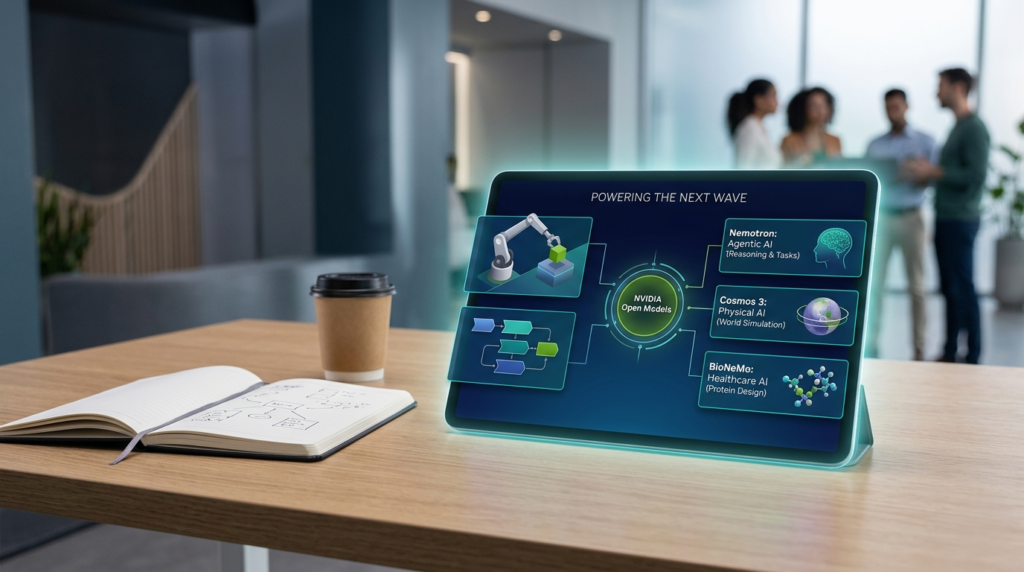
The artificial intelligence landscape is shifting from models that simply “chat” to systems that “act.” At the recent GTC conference, NVIDIA announced a massive expansion of its NVIDIA open model families, signaling a new era for autonomous agents, robotics, and lifesaving medical research.
By releasing these advanced foundation models to the global developer community, NVIDIA is moving beyond language-based AI into the realms of biology, physical motion, and complex multi-step reasoning. Whether you are building a coding assistant, a humanoid robot, or a new therapeutic drug, these updates provide the essential building blocks for the next generation of intelligent systems.
In this post, we’ll dive deep into how the NVIDIA open model families are being utilized to power agentic, physical, and healthcare AI, and what this means for the future of industry automation.
1. Transforming Agentic AI with Nemotron 3
The “agentic” wave refers to AI that can reason, plan, and execute tasks autonomously. To support this, NVIDIA has introduced significant updates to the Nemotron family. Unlike standard large language models, these are specifically optimized for integration into agentic workflows.
The Nemotron 3 Expansion
The NVIDIA open model families now include specialized versions of Nemotron designed for diverse enterprise needs:
- Nemotron 3 Ultra: Optimized for the NVIDIA Blackwell platform, this model offers 5x higher throughput. It is the powerhouse for complex automation, such as autonomous coding assistants and deep-research tools.
- Nemotron 3 Omni: A multimodal marvel that understands language, vision, and audio simultaneously. This allows agents to “watch” a video or “read” a complex document to extract actionable insights.
- Nemotron 3 VoiceChat: Designed for real-time, low-latency human-model interaction where the AI can listen and respond at the same time.
Why It Matters for Developers
By providing these models as open-source assets or via NVIDIA NIM microservices, developers can build “sovereign AI”—systems that reflect local cultures and languages without relying on a single closed-source provider.
2. Pushing the Boundaries of Physical AI
Physical AI refers to artificial intelligence that can perceive, reason, and act within the real world. This is the “brain” inside robots and autonomous vehicles. The expansion of the NVIDIA open model families includes three critical pillars for physical intelligence.
Foundation Models for the Real World
NVIDIA’s latest releases bridge the gap between digital simulation and physical action:
- NVIDIA Cosmos 3: This is the first world foundation model that unifies synthetic world generation with physical reasoning. It allows AI to “simulate” a scenario before acting in it.
- NVIDIA Isaac GR00T N1.7: A vision-language-action (VLA) model specifically for humanoid robots. It is now commercially viable, meaning companies can deploy it in real-world factory or logistics environments today.
- NVIDIA Alpamayo 1.5: Specifically tuned for autonomous vehicles, this model improves navigation guidance and supports flexible multi-camera configurations.
| Model Name | Primary Use Case | Key Feature |
| Cosmos 3 | World Simulation | Unifies synthetic generation & reasoning |
| Isaac GR00T N1.7 | Humanoid Robotics | Commercially viable for real-world deployment |
| Alpamayo 1.5 | Autonomous Vehicles | Advanced multi-camera & navigation logic |
3. Accelerating Healthcare and Life Sciences
One of the most profound impacts of the NVIDIA open model families is in the field of drug discovery and biomedical research. Traditionally, identifying a protein binder for a new drug could take years; NVIDIA is helping to compress that timeline into days.
BioNeMo and Proteina-Complexa
The BioNeMo platform has been expanded with Proteina-Complexa, a generative model designed for protein binder design. This allows researchers to model and simulate biological systems at a scale never before possible.
The Power of Massive Data Collaboration
In a landmark move, NVIDIA collaborated with Google DeepMind and EMBL’s European Bioinformatics Institute to expand the AlphaFold Protein Structure Database. They added 1.7 million high-confidence predictions, providing a massive open-source library for scientists worldwide to identify new drug targets.
77x Faster Simulations with nvQSP
NVIDIA also introduced nvQSP, a GPU-accelerated simulation engine. In benchmark tests, it performed up to 77x faster than traditional CPU-based methods. This allows pharmaceutical companies to test hundreds of patient sub-populations and dose levels digitally before ever starting a clinical trial.
4. Why “Open” Models are the Future of Industry
The decision to keep these NVIDIA open model families accessible via GitHub, Hugging Face, and NVIDIA’s own build platform is a strategic move to democratize high-end AI.
Actionable Insights for Enterprises:
- Scalability: Use NVIDIA NIM (microservices) to deploy these models securely on your own infrastructure, whether in the cloud or at the edge.
- Privacy: By using open models like Nemotron, businesses can keep their sensitive data in-house rather than sending it to a third-party API.
- Customization: Use the new “Nemotron-Personas” datasets to fine-tune your agents so they align with specific regional demographics and values.
5. Adoption by Global Leaders
The impact of the NVIDIA open model families is already visible across various sectors. Early adopters are using these models to redefine their operational capabilities:
- Agentic AI: Perplexity, ServiceNow, and CrowdStrike are integrating Nemotron 3 for advanced search and security automation.
- Physical AI: LG Electronics and Milestone Systems are leveraging Cosmos and Isaac for smarter robotics.
- Healthcare: Novo Nordisk and Manifold Bio are utilizing BioNeMo to accelerate therapeutic development.
Conclusion: The Next Wave of Intelligence
The expansion of the NVIDIA open model families represents more than just a software update; it is a fundamental shift in how we interact with technology. We are moving from AI that understands what we say to AI that understands how our world works—from the molecular structure of a protein to the complex movements of a humanoid robot on a factory floor.
For developers and business leaders, the message is clear: the tools to build the future are now open, accessible, and faster than ever. By leveraging the NVIDIA open model families, you are not just building an application; you are contributing to a global ecosystem of intelligent action.