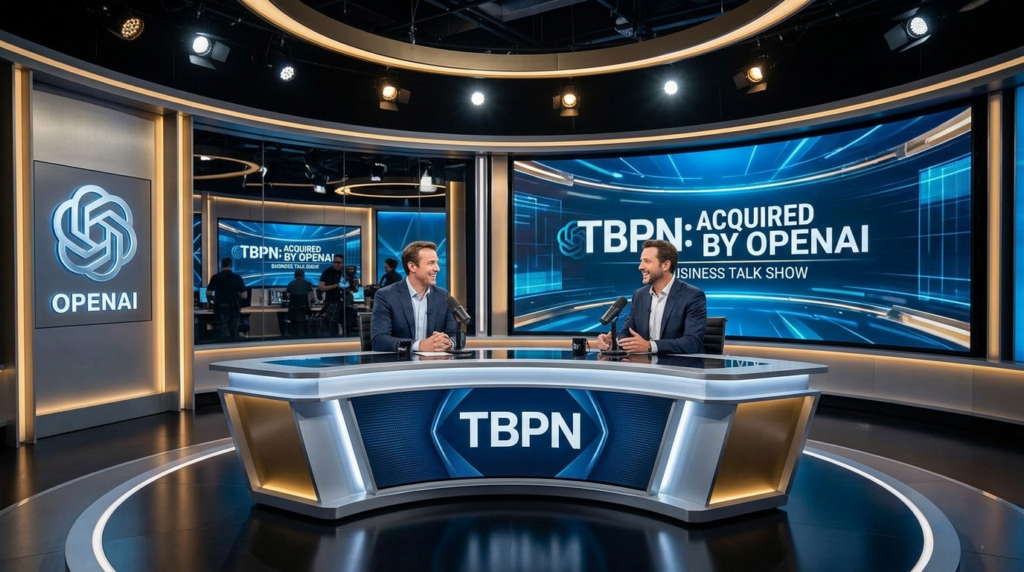
On April 2, 2026, the technology world witnessed a landmark shift in corporate strategy. OpenAI, the organization at the forefront of the artificial intelligence revolution, officially announced the acquisition of TBPN (the Technology Business Programming Network). While OpenAI is primarily known for its groundbreaking Large Language Models (LLMs) and the pursuit of Artificial General Intelligence (AGI), this move marks its first major entry into the media landscape.OpenAI acquires TBPN
The acquisition of a buzzy, founder-led business talk show signals a new era for Silicon Valley. It isn’t just about owning a podcast; it’s about controlling the narrative, engaging directly with the developer community, and reshaping how the world perceives the risks and rewards of AI. In this comprehensive analysis, we explore the mechanics of the deal, the strategic “why” behind it, and what it means for the future of tech journalism.
What is TBPN? The “ESPN of Silicon Valley”
To understand why OpenAI acquires TBPN, one must first understand the cultural weight the network carries. Founded in 2024 by entrepreneurs John Coogan and Jordi Hays, TBPN quickly rose to prominence as the go-to platform for high-stakes tech discourse.
The Rise of the Technology Business Programming Network
TBPN isn’t a traditional news outlet. It is a live, three-hour daily talk show that streams across YouTube and X (formerly Twitter). Described by The New York Times as “Silicon Valley’s newest obsession,” the show fills a void left by traditional financial media like CNBC and Bloomberg. It offers a “pro-builder” environment where CEOs can speak candidly to an audience of their peers.
Key Highlights of TBPN’s Growth:
- High-Profile Guests: The show has hosted the “Avengers” of tech, including Mark Zuckerberg, Satya Nadella, Mark Cuban, and even Sam Altman himself.
- Rapid Monetization: Prior to the acquisition, TBPN was on track to generate $30 million in annual revenue, primarily through integrated sponsorships and a dedicated “insider” subscriber base.
- Cult Following: With a focus on AI, defense tech, and venture capital, the show became “must-watch” morning TV for the engineers and founders building the future.
Breaking Down the Deal: OpenAI Acquires TBPN
The announcement came via a memo from Fidji Simo, OpenAI’s CEO of AGI Deployment. While the exact financial terms remain undisclosed, industry insiders estimate the deal to be in the “low hundreds of millions.”
Strategic Reporting Structure
One of the most discussed aspects of the deal is where TBPN sits within the OpenAI organization. Rather than being housed under a standard Marketing or PR department, TBPN will sit within the Strategy Organization.
The team, including founders John Coogan and Jordi Hays, will report directly to Chris Lehane. Lehane is a legendary political strategist and OpenAI’s chief political operative. This reporting line suggests that the acquisition is less about “media” and more about “geopolitics and influence.”
The Promise of Editorial Independence
OpenAI has been vocal about maintaining TBPN’s “stated editorial independence.” Fidji Simo emphasized that the show will continue to choose its own guests and maintain its own tone. However, skeptics point out that an outlet owned by the world’s most powerful AI company can never be truly objective when discussing AI safety or regulation.
Why Now? The 5 Strategic Pillars of the Acquisition
Why would a company focused on neural networks want to own a talk show? The decision for OpenAI acquires TBPN is rooted in five strategic goals:
1. The “Go Direct” Media Strategy
In recent years, tech giants have become increasingly frustrated with traditional journalism, which they perceive as overly critical or “anti-innovation.” By owning TBPN, OpenAI can bypass traditional gatekeepers and speak directly to its most important stakeholders: developers, investors, and early adopters.
2. Talent Retention and Recruitment
The war for AI talent is fiercer than ever. Competitors like Anthropic and Google are poaching researchers with massive equity packages. TBPN is the “water cooler” for the AI research community. By owning the media channel that engineers watch, OpenAI maintains a permanent presence in the minds of the world’s best builders.
3. Explaining AGI to the Public
As OpenAI moves closer to AGI, the societal implications become more complex. Fidji Simo noted that the “standard communications playbook” doesn’t work for a technology this transformative. TBPN provides a long-form platform to explain the nuances of AI safety, labor shifts, and the “for-profit” transition in a way that 280-character tweets cannot.
4. Data for Training Models?
While not explicitly stated, owning a library of high-quality, long-form video interviews with the world’s smartest business minds is a goldmine for training future AI models on reasoning, negotiation, and business strategy.
5. Influence Over Policy
With Chris Lehane at the helm, TBPN becomes a tool for “soft power.” As global governments move to regulate AI, having a platform that can shape the “pro-innovation” narrative is a massive asset for OpenAI’s lobbying efforts.
Comparison: Traditional Media vs. The TBPN Model
The reason OpenAI acquires TBPN instead of a legacy brand like Wired or The Verge is due to the fundamental shift in how information is consumed in 2026.
| Feature | Traditional Tech Media | TBPN (New Media Model) |
| Format | Written articles / Edited video | 3-hour daily live stream |
| Tone | Investigative / Adversarial | Conversational / Insider-led |
| Primary Platform | Owned Website / Newsstands | YouTube / X / Spotify |
| Speed | 24-hour news cycle | Real-time / Immediate |
| Audience | General Public | Builders, VCs, and Engineers |
| Incentive | Ad Clicks / Subscriptions | Ecosystem influence / Community |
Actionable Insights: What This Means for You
Whether you are a founder, a marketer, or an AI enthusiast, the news that OpenAI acquires TBPN offers several key lessons:
- Media is the New Marketing: If you aren’t building a media entity around your product, you are leaving your narrative to chance.
- The Rise of the “Insiders”: Trust is shifting away from institutions and toward individual “founder-hosts” who understand the tech from the inside.
- Vertical Integration of Information: We are seeing a trend where tech companies own the full stack—from the chips (Nvidia) to the software (OpenAI) to the media (TBPN).
The Risks: Can TBPN Stay “Buzzy” Under OpenAI?
The greatest risk to this deal is the loss of credibility. TBPN was successful because it felt “rogue” and unscripted. Now that the hosts are OpenAI employees, the audience may view every segment as a calculated PR move.
If Jordi Hays and John Coogan stop asking the “tough questions” to OpenAI leadership, the “cult following” will likely migrate to the next independent show. OpenAI must walk a fine line between supporting the network and stifling its creative spirit.(OpenAI acquires TBPN, Technology Business Programming Network acquisition, Sam Altman media strategy, Chris Lehane OpenAI role, Founder-led business talk show)
Conclusion: A New Chapter in Tech History
The move where OpenAI acquires TBPN is a clear signal: the race for AGI is as much a battle of ideas as it is a battle of compute. By bringing a top-tier media organization in-house, OpenAI is preparing for the massive cultural and political shifts that its technology will inevitably trigger.
As we look toward 2027, don’t be surprised if other tech giants follow suit. The age of the “Corporate Media Powerhouse” has officially arrived.