The landscape of artificial intelligence is shifting from theoretical potential to tangible, production-ready reality. For developers and tech leaders, the OpenAI Developer Showcase has become the ultimate roadmap for this transformation. It isn’t just a gallery of cool demos; it’s a living laboratory where the world’s most innovative engineers prove what’s possible with the latest GPT models and APIs.
Whether you are looking to build the next viral AI game, a sophisticated enterprise research engine, or a seamless voice-first application, the OpenAI Developer Showcase provides the architectural inspiration and technical proof of concept needed to move from ideation to deployment. In this guide, we’ll dive deep into the most impactful projects currently featured, the cutting-edge tech stacks behind them, and how you can leverage these insights for your own development journey.
What is the OpenAI Developer Showcase?
The OpenAI Developer Showcase is a curated collection of applications, experiments, and open-source projects built by the global developer community using OpenAI’s suite of tools. From the ultra-fast reasoning of GPT-4o to the creative depths of Sora and the system-level capabilities of Codex, the showcase highlights diversity in execution.
For a developer, the value lies in seeing “how the sausage is made.” Many entries include public GitHub repositories, hosted URLs, and detailed descriptions of the building process, specifically focusing on how coding agents and specific API parameters were used to achieve the final result.
Key Categories in the OpenAI Developer Showcase
The gallery is organized into several high-impact categories that reflect the current priorities of the AI industry. Below is a breakdown of the dominant themes seen in the latest submissions.
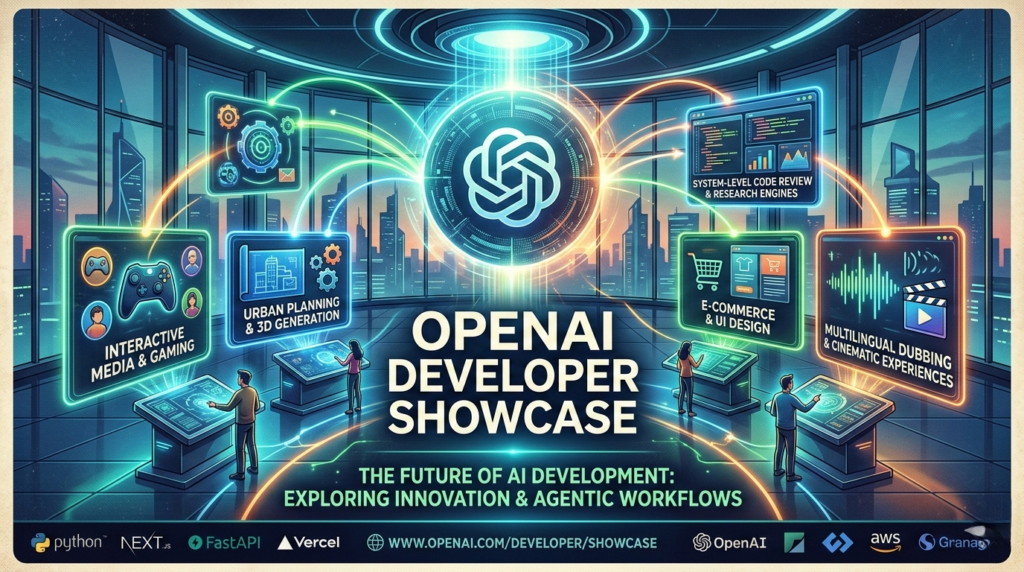
1. Interactive Media and Gaming
One of the most vibrant sections of the OpenAI Developer Showcase involves procedural generation and immersive storytelling.
- Turn-based RPGs: Projects that turn GPT-5.4 into dynamic dungeon masters.
- Procedural City Generators: Using 3D browser-based environments to create infinite urban landscapes.
- Cinematic Experiences: Demos like the “Golden Gate Experience,” where users fly through AI-generated environments in real-time.
2. Enterprise and Productivity Tools
Companies are moving beyond simple chatbots to “Agentic Workflows.” The OpenAI Developer Showcase highlights how major players like Cisco, BNY, and Datadog are integrating AI into the core of their operations.
- System-Level Code Review: Using Codex to automate security audits and architectural reviews.
- AI Research Engines: Bespoke tools built by firms like Balyasny Asset Management to synthesize massive datasets for investment insights.
- Multilingual Dubbing: Applications like Descript that enable video dubbing at scale using the Speech API.
3. E-commerce and Design
Modern retail is being redefined by AI-driven personalization and automated UI generation.
- Retail Storefront Demos: Full-stack e-commerce sites featuring product browsing and shopping flows generated entirely through prompts.
- Arcade Landing Pages: Minimalist design templates for local businesses, showcasing the speed of GPT-powered frontend development.
Technical Analysis: The Stack Behind the Innovation
To build the projects featured in the OpenAI Developer Showcase, engineers are utilizing a sophisticated mix of modern frameworks and OpenAI’s evolving API landscape.
| Component | Popular Technologies in the Showcase |
| OpenAI Models | GPT-5.4, Realtime API, gpt-image-1.5, GPT-4o-mini |
| Frontend Frameworks | Next.js, React, Streamlit, Gradio |
| Backend & Deployment | FastAPI, Python, Hugging Face Spaces, Vercel |
| Design & Assets | Figma (with Codex integration), Sora (Video API) |
| Data Handling | MCP (Model Context Protocol), Vector Databases, RAG |
Actionable Insight: The Rise of Coding Agents
A recurring theme in the building process descriptions within the OpenAI Developer Showcase is the use of “coding agents.” Developers are no longer just writing code; they are managing agents that suggest architectures, debug in real-time, and even generate entire UI components from Figma designs. If you want your project to stand out, documenting your collaboration with these agents is key.
How to Get Your Project Featured
Submitting to the OpenAI Developer Showcase is a strategic move for any developer looking to build authority in the AI space. Here is a step-by-step checklist to prepare a high-quality submission:
- Define Your Capability: Are you showcasing Realtime Speech-to-speech, Structured Outputs, or Image Generation? Be specific.
- Document the Tech Stack: List everything from your primary language (e.g., Python) to your specific OpenAI models (e.g., GPT-5.3-Codex).
- Show, Don’t Just Tell: Provide a hosted URL so the community can try your project without setup. If it’s open-source, ensure your GitHub repo is well-documented with clear
READMEfiles. - Focus on Use Cases: Whether it’s education, finance, or customer service, explain the real-world problem your project solves in under 255 characters.
- Create a Visual Hook: A clear screenshot or a “cinematic” cover image is essential for the gallery overview page.
The Strategic Value of the OpenAI Developer Showcase
Why should you care about the OpenAI Developer Showcase? Beyond inspiration, it serves as a benchmark for “production-grade” AI.
- Benchmarking Performance: See how other developers handle token costs and latency, especially with newer models like GPT-5.4.
- Networking: Many of the authors listed in the showcase are lead engineers at top-tier startups or tech giants.
- Future-Proofing: By watching the “Recent” section of the showcase, you can identify which APIs (like the Realtime API or Sora) are becoming the new standard for consumer apps.
The OpenAI Developer Showcase is more than a list; it is the pulse of the developer community. By studying these projects, you aren’t just looking at the present—you are looking at the blueprint for the next decade of software.