The AI revolution isn’t waiting. And neither should you.
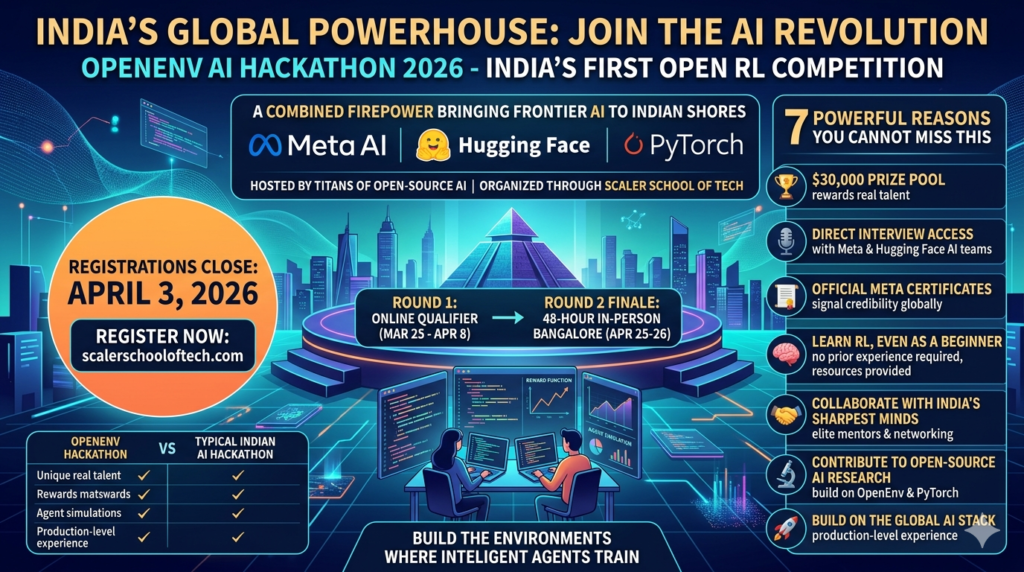
India’s developer community has long been a global powerhouse — and now, for the first time, Meta, Hugging Face, and PyTorch are bringing their combined firepower directly to Indian shores with the OpenEnv AI Hackathon — India’s very first open reinforcement learning competition.
This isn’t just another coding contest. The OpenEnv AI Hackathon is a career-defining opportunity with a $30,000 prize pool, direct interview access with Meta and Hugging Face AI teams, and the chance to build something that shapes the future of intelligent agents.
Registrations close on April 3, 2026. If you’re a developer, researcher, or AI enthusiast in India, read every word of this post before you miss what could be the biggest opportunity of your career.
What Is the OpenEnv AI Hackathon? {#what-is}
The OpenEnv AI Hackathon is India’s first competition centered around OpenEnv — Meta’s open-source reinforcement learning (RL) framework. Participants are challenged not just to use AI, but to build the environments that power the next generation of intelligent agents.
Rather than building apps on top of existing AI tools, this hackathon asks you to go deeper. Participants create reinforcement learning environments — the training grounds where AI agents learn to make decisions. Think of it as building the gym where the world’s smartest AI athletes train.
The event runs from March 25 to April 26, 2026, and combines an online qualifying round with a high-stakes 48-hour in-person finale in Bangalore.
Important: No prior reinforcement learning experience is required. Learning resources are provided to all participants.
Who Is Hosting This Hackathon? {#who-is-hosting}
The OpenEnv AI Hackathon is hosted by an extraordinary trio of organizations — each a titan in the AI ecosystem:
- Meta AI — The company behind LLaMA, PyTorch, and some of the most impactful open-source AI research in history.
- Hugging Face — The world’s leading open-source AI model hub with millions of developers and researchers.
- PyTorch Foundation — The home of the most popular deep learning framework globally, now under the Linux Foundation.
The event is organized through Scaler School of Tech, ensuring structured support, mentorship, and a smooth experience for participants across India.
This is not a third-party imitation. This is the real deal — directly sanctioned and promoted on PyTorch’s official events calendar.
Why This OpenEnv AI Hackathon Is Unlike Any Other in India {#why-unlike-any-other}
India hosts hundreds of hackathons every year. So what makes the OpenEnv AI Hackathon exceptional?
The difference lies in what you’re building and who’s watching.
Most hackathons ask you to build a product using AI. The OpenEnv AI Hackathon asks you to build the infrastructure that trains AI — specifically, reinforcement learning environments. This is frontier work. It’s what researchers at DeepMind, OpenAI, and Meta’s FAIR lab do on a daily basis.
And who’s watching? The very teams at Meta and Hugging Face who are defining the next decade of AI. Finalists get direct interview opportunities — not referrals, not LinkedIn DMs, but actual structured access to AI hiring pipelines at two of the world’s most coveted employers.
7 Powerful Reasons You Should Not Miss the OpenEnv AI Hackathon 2026 {#7-reasons}
1. 🏆 A $30,000 Prize Pool That Rewards Real Talent
The OpenEnv AI Hackathon offers a $30,000 prize pool — one of the largest for a developer hackathon in India’s AI space. This is not a token prize; it signals that Meta and Hugging Face are investing seriously in sourcing the best Indian talent.
2. 🎙️ Direct Interview Access With Meta & Hugging Face AI Teams
This is the headline benefit most people overlook. Winning — or even performing well — gives you direct interview opportunities with the AI teams at Meta and Hugging Face. For developers who dream of working at a global AI company, this is a door that rarely opens twice.
3. 📜 Official Meta Certificates
Every participant who completes the hackathon receives official Meta certificates — credentials that signal credibility and hands-on experience with frontier AI tooling to any employer or recruiter worldwide.
4. 🧠 Learn Reinforcement Learning, Even as a Beginner
The OpenEnv AI Hackathon explicitly states that no prior RL experience is required. Meta and Hugging Face will provide learning resources so participants can upskill in real-time. This isn’t just a competition — it’s an accelerated learning program with elite mentors.
5. 🤝 Collaborate With India’s Sharpest AI Minds
The in-person Bangalore finale brings together top AI developers from across the country. The networking, collaboration, and friendships formed during a high-pressure 48-hour hackathon are often more valuable than the prize itself.
6. 🔬 Contribute to Open-Source AI Research
Work created during the OpenEnv AI Hackathon contributes directly to how intelligent agents are trained. You’re not just competing — you’re making a real contribution to the open-source AI ecosystem through the PyTorch and OpenEnv framework.
7. 🚀 Build on the Same Stack the World’s Best AI Teams Use
Meta’s OpenEnv, PyTorch, and Hugging Face’s tooling are the backbone of modern AI research and production. Working with these tools during the hackathon gives you production-level, portfolio-grade experience that speaks directly to what top AI teams look for.
What You Will Actually Build: Reinforcement Learning Environments {#what-you-will-build}
The core challenge of the OpenEnv AI Hackathon is building reinforcement learning (RL) environments using OpenEnv, Meta’s open-source RL framework.
So what exactly is an RL environment?
In reinforcement learning, an agent learns by interacting with an environment. The environment defines the rules, the observations the agent can see, the actions it can take, and the rewards it receives. Famous examples include:
- The Atari game environments used to train DeepMind’s DQN agent
- OpenAI Gym environments like CartPole and MuJoCo
- Custom simulation environments for robotics, logistics, and financial trading
Building a well-designed RL environment requires thinking about:
- Observation spaces — what information does the agent see?
- Action spaces — what can the agent do?
- Reward functions — how is the agent incentivized?
- Episode logic — when does a round start and end?
Meta’s OpenEnv framework provides the scaffolding, but the creativity and engineering are entirely yours. The best environments will be novel, well-structured, technically sound, and potentially useful for real-world AI research.
For developers who haven’t worked with reinforcement learning before, learning resources will be provided — including documentation, tutorials, and community support through the PyTorch ecosystem. You can start by exploring the PyTorch tutorials portal to get comfortable with the underlying framework.
OpenEnv AI Hackathon: Round-by-Round Breakdown {#round-breakdown}
The OpenEnv AI Hackathon is structured in two distinct phases:
Round 1: Online Qualifier (March 25 – April 8)
- Format: Online, remote participation
- Goal: Build and submit your reinforcement learning environment
- Who can participate: All registered developers across India
- Learning resources: Provided by Meta, Hugging Face, and PyTorch
This round allows you to work at your own pace, consult learning materials, and iterate on your submission. Expect the criteria to assess code quality, environment design, novelty, and technical depth.
Round 2 Finale: 48-Hour In-Person Hackathon in Bangalore (April 25–26)
- Format: In-person, high-intensity 48-hour sprint
- Location: Bangalore, India
- Who attends: Top performers from Round 1
- Prizes, interviews & certificates: Awarded at this stage
The in-person finale is where the competition heats up. You’ll be surrounded by India’s top AI developers, working under time pressure, and potentially presenting your work directly to Meta and Hugging Face team members.
Comparison: OpenEnv AI Hackathon vs. Other AI Competitions in India {#comparison-table}
| Feature | OpenEnv AI Hackathon | Typical Indian AI Hackathon |
|---|---|---|
| Organizers | Meta, Hugging Face, PyTorch | Startups, colleges, EdTech platforms |
| Prize Pool | $30,000 USD | ₹50,000 – ₹5,00,000 |
| Interview Access | Direct Meta & Hugging Face interviews | None or informal referrals |
| Certificates | Official Meta certificates | Participation certificates |
| Focus Area | Reinforcement Learning (frontier research) | App development, NLP, CV |
| Prior Experience Required | No — learning resources provided | Often yes |
| Format | Online + In-person Bangalore finale | Usually fully online |
| Prestige Level | Global (Meta-endorsed) | Regional or national |
| Open-Source Contribution | Yes — contributes to OpenEnv ecosystem | Rarely |
The data speaks for itself. The OpenEnv AI Hackathon operates at a level that simply doesn’t compare to most competitions in India’s current landscape.
How to Prepare: Actionable Steps for Beginners and Experts {#how-to-prepare}
Whether you’re an RL veteran or completely new to the field, here’s a structured preparation plan:
For Beginners
- Register immediately at scalerschooloftech.com — registrations close April 3.
- Learn PyTorch basics through the official PyTorch tutorials.
- Explore RL fundamentals — understand concepts like state, action, reward, and policy. Spinning Up by OpenAI is a great free resource.
- Experiment with OpenAI Gym — even before OpenEnv materials arrive, Gym environments give you a feel for RL environment design.
- Join the PyTorch community forums at discuss.pytorch.org to ask questions and connect with other participants.
For Intermediate Developers
- Study Meta’s OpenEnv documentation as soon as it’s shared post-registration.
- Build a prototype environment early — don’t wait until the last day of Round 1.
- Focus on reward function design — this is often the hardest and most evaluated part.
- Document your design decisions clearly; judges value explainable choices.
- Test your environment with a simple RL agent to verify it trains correctly.
For Advanced Practitioners
- Think novel, not familiar — avoid environments too similar to existing Gym classics.
- Consider multi-agent or hierarchical environments for differentiation.
- Optimize for sample efficiency — design environments where agents can learn with fewer steps.
- Contribute to OpenEnv’s GitHub during the hackathon — it demonstrates real open-source engagement.
- Prepare a compelling pitch for the Bangalore finale — your ability to explain your design matters.
What Happens After the Hackathon? {#what-happens-after}
The OpenEnv AI Hackathon doesn’t end at the prize ceremony. Here’s what the best outcomes look like for serious participants:
Career opportunities: Top performers receive direct interview invitations with AI teams at Meta and Hugging Face — two of the most sought-after employers in global AI. Even reaching the Bangalore finale is a signal strong enough to impress any recruiter.
Open-source portfolio: The environments you build can be shared publicly, forming a concrete portfolio artifact. In an AI job market where “show me your work” matters more than résumé lines, this is invaluable.
Community building: The PyTorch and Hugging Face communities are active, global, and genuinely collaborative. Participating in a Meta-endorsed event gives you a meaningful entry point into these ecosystems — connections that last well beyond the hackathon.
Potential research directions: Well-designed RL environments sometimes evolve into research publications, course materials, or tools adopted by the broader ML community. Building something during the OpenEnv AI Hackathon could be the seed of something much larger.
Frequently Asked Questions {#faq}
Q: Who can participate in the OpenEnv AI Hackathon? Any developer based in India can participate. Students, working professionals, and independent researchers are all welcome.
Q: Do I need a team or can I participate solo? The official listing does not specify team requirements. Check the registration page at scalerschooloftech.com for the latest details.
Q: Is prior experience with reinforcement learning required? No. The organizers explicitly state that no prior RL experience is required and that learning resources will be provided to all participants.
Q: What is OpenEnv? OpenEnv is Meta’s open-source reinforcement learning framework, designed to make it easier for researchers and developers to build and share RL environments.
Q: What is the registration deadline? Registrations close on April 3, 2026. Do not delay.
Q: Are there costs to participate? No registration cost is mentioned. Check the official page for confirmation.
Q: What does the Bangalore finale involve? It’s a 48-hour in-person hackathon from April 25–26 in Bangalore, attended by the top participants from the online qualifier.
Q: Can I still participate if I can’t attend the Bangalore finale in person? Round 1 (March 25 – April 8) is fully online. For the finale, in-person attendance in Bangalore appears to be required based on the event description.
Final Thoughts: Your Gateway to the Global AI Stage {#final-thoughts}
The OpenEnv AI Hackathon is, quite simply, one of the most significant opportunities to land in front of Indian developers this year.
Meta, Hugging Face, and PyTorch aren’t running this event as a marketing exercise. They’re actively looking for talented developers to contribute to the future of reinforcement learning — and potentially bring into their organizations.
The prize pool of $30,000 is real. The interview access is real. The official Meta certificates are real. And most importantly, the opportunity to build something meaningful that contributes to open-source AI is real.
Registrations close April 3, 2026. That’s not much time.
Register now at the official Scaler School of Tech page and take the first step toward a career in frontier AI.
The next generation of AI is being built right now. The question is: will you be part of building it?
OpenEnv AI Hackathon 2026: The Comprehensive FAQ
Navigating a frontier AI competition can be daunting. Whether you are a student in Chennai or a senior dev in Gurgaon, these answers will help you understand exactly what to expect from India’s first Open Reinforcement Learning event.
General Event Information
1. What exactly makes the OpenEnv AI Hackathon different from a standard AI hackathon? Most Indian hackathons focus on Application Layer AI—using APIs to build a chatbot or a wrapper. The OpenEnv AI Hackathon focuses on the Infrastructure Layer. You are building the environments (the “gyms”) where Reinforcement Learning (RL) agents are trained. This is high-level research work typically reserved for labs like Meta FAIR or Google DeepMind.
2. Is this an official event or a community-run initiative? This is a high-prestige, official collaboration. It is directly sanctioned and supported by Meta AI, Hugging Face, and the PyTorch Foundation. It is listed on official global event calendars and organized on the ground via Scaler School of Tech.
3. What is the timeline for the competition? The event moves fast. Registrations close on April 3, 2026.
- Round 1 (Online): March 25 – April 8. Build and submit your RL environment.
- Round 2 (Finale): April 25 – 26. An intense 48-hour in-person sprint in Bangalore for the top finalists.
Eligibility & Skill Requirements
4. I have never worked with Reinforcement Learning. Can I still participate? Absolutely. One of the core goals of this event is to grow India’s RL talent pool. Meta and Hugging Face are providing dedicated learning resources, documentation, and tutorials to all registered participants. If you have a solid grasp of Python and basic Machine Learning, you can learn the RL specifics during the qualifier round.
5. Is there a registration fee? No. Participation in the OpenEnv AI Hackathon is completely free of cost. The organizers are looking for raw talent, not entry fees.
6. Can I participate solo, or do I need a team? While team collaborations are highly encouraged for the in-person finale (usually teams of 2–4), solo developers are welcome to register and prove their mettle during the Round 1 online qualifier. Check the official Scaler dashboard post-registration for specific team-merging features.
Technical Specifics
7. What is “OpenEnv” and why are we using it? OpenEnv is Meta’s specialized framework for building RL environments. It simplifies the process of defining states, actions, and rewards, making it easier for developers to create complex simulations that are compatible with PyTorch-based training loops.
8. What kind of environments are the judges looking for? Innovation is key. Don’t just recreate a basic game. Think of real-world utility:
- Logistics: Simulating a warehouse where robots must avoid collisions.
- Sustainability: Managing a power grid’s energy distribution.
- Finance: Creating a trading floor simulation with market volatility. The more unique and technically sound your “world” is, the higher you will score.
Prizes & Career Impact
9. How does the “Direct Interview Access” work? This isn’t a generic referral. The top performers from the Bangalore finale will be fast-tracked into the hiring pipelines for Meta AI and Hugging Face. You will interact directly with their engineering and research teams, bypassing the initial resume-screening hurdles that often stop even the best candidates.(OpenEnv hackathon India 2026)
10. What do I get if I don’t win the grand prize? Beyond the $30,000 prize pool, there is immense value in:
- Official Meta Certificates: A global credential for your LinkedIn and Resume.
- Open-Source Contributions: Your code could be integrated into the OpenEnv ecosystem.
- Networking: Meeting the sharpest AI minds in Bangalore—the Silicon Valley of India.
11. Is the Bangalore finale mandatory? Yes. To be eligible for the main prize pool and the direct interview opportunities, you must be present for the 48-hour in-person finale in Bangalore on April 25–26.(OpenEnv AI Hackathon)