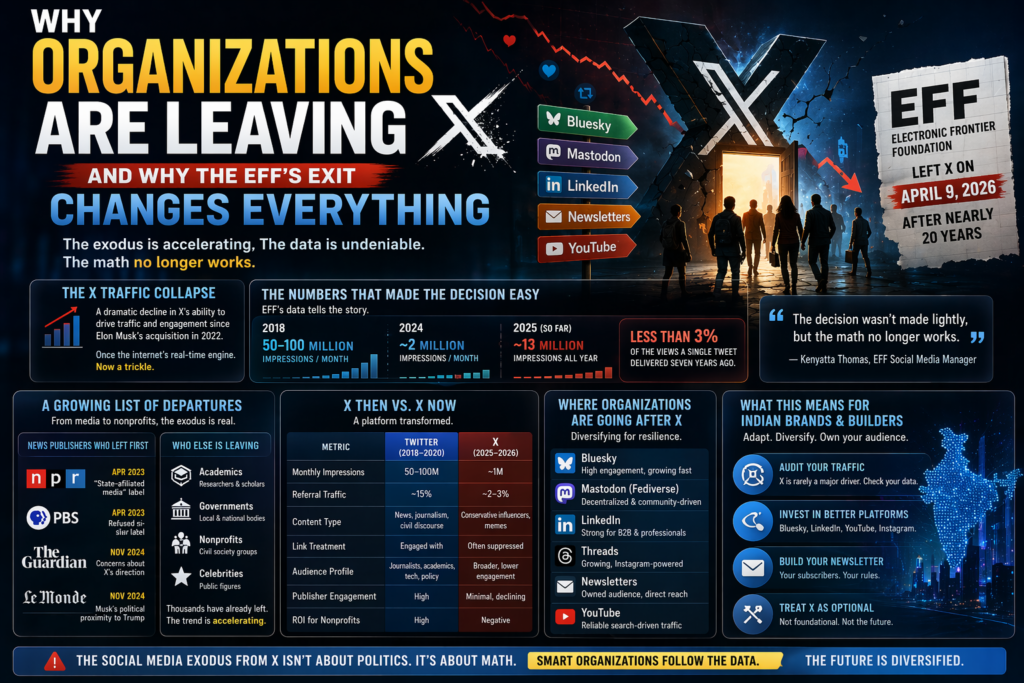
The exodus is accelerating. The Electronic Frontier Foundation (EFF), one of the internet’s most respected digital rights organizations, officially left X on April 9, 2026 — and the data behind that decision is a warning sign every brand, publisher, and developer community should take seriously. Organizations leaving X is no longer a political statement; it is a rational business calculation rooted in collapsing engagement and negligible traffic returns.
If you manage a social media presence for a tech brand, a publication, or a nonprofit, this article will tell you exactly what is happening, why it matters, and what to do next.
What Is the X Traffic Collapse?
Definition: The X traffic collapse refers to the dramatic, measurable decline in the platform’s ability to drive referral traffic and impressions to external websites and organizations — a trend that has accelerated since Elon Musk’s acquisition of Twitter in 2022.
For nearly a decade, Twitter was the internet’s most reliable real-time distribution channel for journalism, civil society, and technical communities. Today, that pipeline has narrowed to a trickle. The platform’s algorithmic changes, shifting user demographics, and a growing preference for keeping users on-platform rather than sending them off-site have combined to hollow out the value proposition that once made Twitter indispensable.
For organizations dependent on outreach, awareness, and traffic, this is not a platform evolution — it is a platform failure.
EFF Leaves X After Nearly 20 Years — What Happened?
The EFF announced on April 9, 2026 that it was departing X after almost two decades on the platform. TechCrunch The decision, communicated by EFF’s social media manager Kenyatta Thomas in a blog post, was framed not as a political protest but as a pragmatic response to deteriorating returns.
Thomas wrote that the decision wasn’t made lightly, but explained that the math no longer worked in the organization’s favor. TechCrunch
The EFF’s departure is significant precisely because of who they are. This is not a celebrity rage-quitting after a bad interaction with a troll. This is a 36-year-old nonprofit that has defended civil liberties in the digital age — an organization whose mission depends on reaching people. When they conclude that X can no longer deliver that reach, the rest of us should pay attention.
The Numbers That Made the Decision Easy
The data EFF shared is striking in its specificity:
In 2018, EFF’s posts to Twitter earned between 50 and 100 million impressions per month. By 2024, its 2,500 posts on the platform generated around 2 million impressions per month. Last year, EFF’s 1,500 posts earned roughly 13 million impressions for the entire year. TechCrunch
As Thomas put it, an X post today receives less than 3% of the views a single tweet delivered seven years ago. TechCrunch
That is not a dip. That is a collapse. And it reframes the entire debate around organizations leaving X: you are not abandoning your audience; your audience has already left.
Organizations Leaving X — A Growing List
The EFF is far from alone. The wave of organizations leaving X spans media companies, public broadcasters, academic institutions, governments, and civil society groups. What started as isolated departures in 2023 has become a structural trend in 2026.
News Publishers Who Left First
The first major wave of organizations leaving X was driven by editorial integrity concerns:
- NPR departed in April 2023 after Musk falsely labelled it “state-affiliated media” — a designation typically reserved for propaganda outlets of countries like Russia and China that lack editorial independence. TechCrunch
- PBS followed NPR out the door for similar reasons, refusing to accept a label that implied government editorial control.
- The Guardian departed in November 2024, citing concerns about the platform’s direction under Musk’s ownership.
- Le Monde, the French newspaper of record, left in reaction to Musk’s political proximity to Donald Trump.
For some of these publishers, leaving was easier because traffic from X had already dropped so significantly that there was little to lose. TechCrunch That calculus is now spreading to every sector.
Academics, Governments, and Nonprofits Follow
Beyond news publishers, academics, celebrities, local governments, and nonprofit organizations have also departed X in significant numbers. TechCrunch The common thread is the same: X is no longer generating the engagement, reach, or referrals that once justified the effort of maintaining an active presence.
The Bier vs. Silver Debate — Is X Still a Traffic Engine?
The week of EFF’s exit was marked by a public argument that crystallized the broader crisis facing publishers on X. X’s head of product, Nikita Bier, and data analyst Nate Silver of FiveThirtyEight fame feuded publicly over whether X was still capable of sending traffic to publishers. TechCrunch
Bier’s position was that news outlets were using the platform incorrectly — that rather than posting a headline and a link, organizations like The New York Times should be generating conversation on X to grow engagement. The implication: poor traffic returns are a strategy problem, not a platform problem.
Silver dismantled this argument with his own numbers. He noted that even when he did the additional work to generate on-platform conversation, the conversion to off-site traffic was “very middling” — around 2–3% of his readership for a newsletter article, rather than the roughly 1% he’d get otherwise. TechCrunch By comparison, Twitter once delivered FiveThirtyEight around 15% of its total traffic. TechCrunch
The Bier argument — essentially “post better” — is a deflection that asks organizations to invest more effort for diminishing returns. The social media exodus from X accelerates precisely because this cost-benefit calculation keeps coming up negative.
A NiemanLab analysis involving 18 large publishers’ most recent posts generally supported Silver’s conclusions, finding that newsrooms publishing links alongside X posts were seeing poor engagement — including on future posts. TechCrunch
Comparison: X Then vs. X Now
The following table captures how dramatically the value proposition of X has shifted for organizations:
| Metric | Twitter (2018–2020) | X (2025–2026) |
|---|---|---|
| Monthly impressions (EFF example) | 50–100 million | ~1 million/month |
| Referral traffic (FiveThirtyEight) | ~15% of total site traffic | ~2–3% of readers |
| Dominant content type | Breaking news, journalism, civil discourse | Conservative influencer content, memes |
| Link treatment | Links shared organically, engaged with | Suspected algorithmic suppression of external links |
| Audience profile | Journalists, academics, policy, tech | Broader but lower-engagement demographics |
| Publisher engagement | High — major traffic driver | Minimal, declining |
| Cost-benefit for nonprofits | High ROI on posting effort | Negative ROI on posting effort |
The gap between what X was and what it is today explains why the list of organizations leaving X keeps growing — and why the EFF’s departure is a signal, not an anomaly.
Why Are Organizations Leaving X Now, Not Earlier?
A fair question: if the decline started in 2022 or 2023, why are so many organizations leaving X in 2025 and 2026?
The answer is the same logic that keeps a struggling restaurant open for months after the warning signs appear: sunk cost, audience inertia, and the fear of abandoning reach you still technically have.
For many organizations, X retained a veneer of relevance. It was still where journalists were. It was still where press releases landed. It was still part of the assumed social media playbook. Leaving felt like admitting defeat or missing out.
But the math has caught up. Consider the forces converging simultaneously:
- AI-driven traffic cannibalization. AI usage is ramping up and killing traffic to publishers at the same time that news sites are seeing declining referrals from search engines and Facebook, leaving many newsrooms to fold under financial pressure or conduct layoffs. TechCrunch In this environment, every traffic source matters — and a platform delivering under 3% of its former value cannot compete for limited social media resources.
- The link suppression question. While X claims it stopped downranking posts with links, the NiemanLab data suggests external links still hurt engagement. Whether algorithmic or behavioral, the effect is real.
- The influencer monoculture problem. X is now dominated by conservative influencers, and many top accounts in terms of engagement are low-quality. TechCrunch For civil society organizations, nonprofits, and research institutions, this is a brand safety and mission alignment concern, not just a reach problem.
When you combine negative ROI, brand safety risk, and an algorithm that seems to work against external links, the decision to leave stops being about ideology and starts being about basic organizational survival.
Where Are Organizations Going After X?
The good news for digital communicators is that the alternatives have matured significantly. Organizations departing X are not simply going dark — they are redistributing their presence across a more diverse, and arguably more resilient, set of channels.
Top destinations for organizations leaving X:
- Bluesky — Rapidly growing decentralized platform; popular with journalists, academics, and tech communities. Strong engagement-to-impression ratios compared to X.
- Mastodon / the Fediverse — Preferred by open-source communities, activists, and digital rights organizations like EFF itself, which will continue to maintain a Mastodon presence.
- LinkedIn — For professional and B2B content, LinkedIn has seen a significant uptick in publisher traffic and organic reach.
- Threads — Meta’s X alternative has grown steadily and benefits from Instagram’s existing user base.
- Newsletters and owned channels — The smartest organizations are doubling down on email lists, RSS feeds, and direct subscriber relationships that no platform algorithm can touch.
- YouTube — For organizations with video capacity, YouTube continues to deliver reliable search-driven traffic.
EFF itself confirmed it will continue posting on Facebook, Instagram, TikTok, YouTube, and elsewhere on the open social web, noting that its presence on a platform is not an endorsement of those services. TechCrunch
The broader lesson from the social media exodus is that platform diversification is not a contingency plan — it is a survival strategy. No single platform should own your audience.
What This Means for Indian Brands and Tech Builders
For the Indian developer and tech ecosystem, the wave of organizations leaving X carries specific implications that are worth thinking through.
Twitter — and X after it — was never as dominant in India as it was in the US or UK. Indian digital culture has always been more WhatsApp-centric, with YouTube and Instagram playing outsized roles compared to Western markets. That means Indian tech brands and developer communities were already less reliant on X as a traffic and engagement driver.
But the EFF story illustrates a principle that translates directly: always build on owned land where possible.
Here is what the X traffic decline should prompt for Indian tech publishers, startups, and developer communities:
- Audit your social traffic. Pull your Google Analytics referral data. What percentage of your traffic actually comes from X? For most Indian tech sites, it will be negligible. That frees you to reallocate resources immediately.
- Invest in Bluesky and LinkedIn. For developer communities, Bluesky’s culture closely mirrors what early Twitter offered: genuine conversation, high signal-to-noise ratio, and intellectually engaged users.
- Build your newsletter. An email subscriber is 10x more valuable than a Twitter follower — they opted in, they receive your content directly, and no algorithm stands between you and them.
- Treat X as optional, not foundational. If you have an active audience there, engage them. But do not build content calendars, editorial plans, or community strategies around a platform whose trajectory is this clearly downward.
The Twitter engagement drop that organizations like EFF quantified in Western markets has a parallel in Indian digital media: the platforms that drove growth five years ago are not the platforms that will drive growth in 2026.
Frequently Asked Questions
Why did EFF leave X? EFF left X because the platform’s ability to deliver impressions and engagement had collapsed to less than 3% of what it provided seven years ago. With 1,500 posts generating only ~13 million impressions in all of 2025, the return on investment was too poor to justify the effort.
What organizations have left X? Major organizations that have departed X include NPR, PBS, The Guardian, Le Monde, and now EFF. Thousands of academics, local governments, celebrities, and nonprofits have also left. The trend spans media, civil society, and academic institutions globally.
Is X losing traffic permanently? Current data suggests the X traffic decline is structural rather than cyclical. Algorithmic suppression of external links, shifting user demographics toward lower-engagement conservative influencer content, and the rise of AI-driven traffic cannibalization all point to a long-term erosion of X’s value as a distribution platform.
What is the best alternative to X for tech organizations? For tech and developer communities, Bluesky offers the closest cultural equivalent to early Twitter. LinkedIn is strong for B2B and professional content. For long-term resilience, newsletters and owned channels remain the gold standard.
Should Indian brands still post on X? Yes, if they already have an engaged audience there — but they should not invest heavily in growing that audience. Indian digital consumption patterns (WhatsApp, YouTube, Instagram) mean X was never the primary engine for most Indian brands. Resources are better deployed in those channels and in owned properties like email newsletters and SEO-optimized content.
What did NiemanLab find about links on X? NiemanLab’s analysis of 18 large publishers found that posting links alongside X posts was associated with poor engagement — not only on the linked post, but on future posts as well, suggesting a possible lasting algorithmic penalty for link-heavy posting behavior.
Conclusion: Why Organizations Leaving X Signals a Permanent Shift
The rise in organizations leaving X is no longer a temporary reaction—it represents a deeper, structural transformation in how digital communication works in 2026. What started as isolated exits has evolved into a widespread movement, driven not by opinion but by measurable outcomes. When major institutions begin reevaluating their presence, it forces everyone—from startups to global publishers—to confront a critical question: is X still worth the investment?
At the center of this shift is the undeniable X traffic decline. Platforms are valuable only as long as they deliver reach, engagement, and meaningful audience interaction. For years, X (formerly Twitter) acted as a real-time distribution engine, sending millions of users to external websites. Today, that model is breaking down. As more data surfaces, it becomes increasingly clear why organizations leaving X are making this decision. Engagement has dropped, referral traffic has weakened, and the return on effort has diminished significantly.
The departure of EFF is a powerful example. When we talk about EFF leaves X, we are not just referring to a single organization exiting a platform—we are witnessing a symbolic moment that reflects a broader industry reality. The numbers shared by EFF highlight a dramatic Twitter engagement drop, reinforcing what many organizations have already experienced firsthand. When impressions fall to a fraction of their previous levels, continuing to invest in the platform becomes difficult to justify.
This is why the conversation around organizations leaving X has shifted from “why now?” to “why stay?” For many brands, nonprofits, and publishers, the answer is becoming increasingly clear. Maintaining a presence on X requires time, content, and strategic effort. But when that effort produces minimal results, the cost-benefit balance turns negative. This is the driving force behind the ongoing social media exodus—a migration based on performance, not perception.
However, the story does not end with departure. In fact, the most important takeaway from the rise of organizations leaving X is what comes next. Organizations are not disappearing from social media—they are diversifying. Platforms like Bluesky, LinkedIn, Threads, and Mastodon are gaining traction because they offer something X currently struggles to provide: consistent engagement and a more reliable connection to audiences. At the same time, there is a renewed focus on owned channels such as newsletters and websites, where organizations have full control over distribution.
For businesses and creators, especially in fast-growing digital markets like India, the trend of organizations leaving X presents a valuable opportunity. Instead of relying heavily on a single platform, brands can build a more balanced ecosystem. This includes investing in SEO, strengthening email lists, and leveraging platforms that align better with their audience behavior. The ongoing X traffic decline serves as a reminder that no platform is guaranteed to deliver results forever.
Another key insight from the current social media exodus is the importance of adaptability. The digital landscape evolves rapidly, and platforms that dominate today may lose relevance tomorrow. Organizations that succeed are those that monitor performance metrics closely and are willing to pivot when necessary. The increase in organizations leaving X demonstrates that smart decision-making is driven by data, not habit.
Looking ahead, the implications are clear. The era of depending on a single platform for visibility is over. The decline in Twitter engagement drop and the continued X traffic decline highlight the risks of centralized distribution. As more organizations reassess their strategies, the focus will shift toward building direct, sustainable relationships with audiences.
In conclusion, organizations leaving X is not just a headline—it is a turning point. It reflects a broader evolution in digital strategy, where diversification, ownership, and adaptability take priority over platform loyalty. For those paying attention, this moment offers a clear roadmap: follow the data, invest in stronger channels, and never rely entirely on a platform whose value can change overnight.