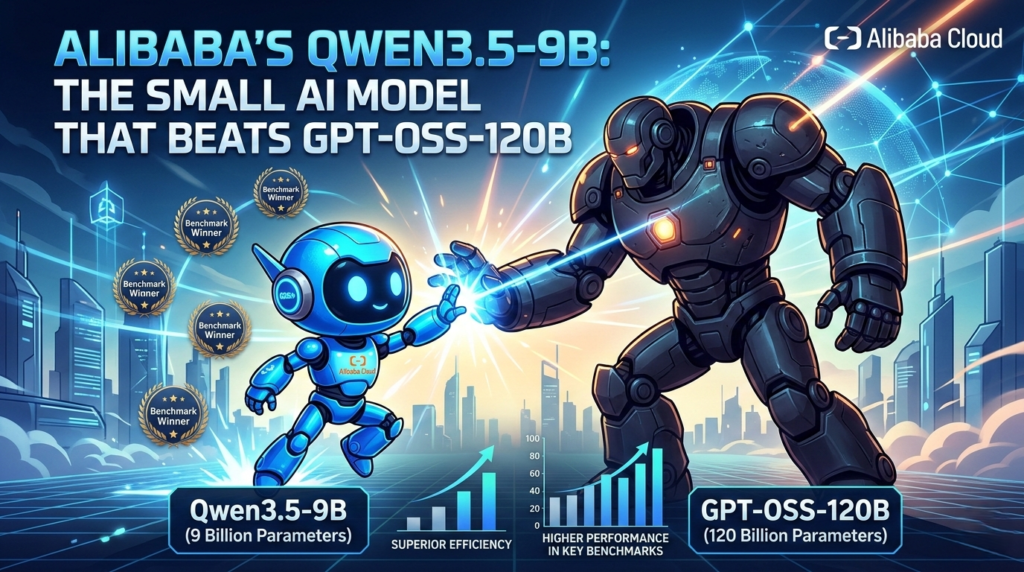
The AI world just witnessed a “David vs. Goliath” moment. Alibaba has officially released its Qwen3.5-9B, a compact 9-billion parameter model that doesn’t just compete with larger rivals—it crushes them. In a landscape where “bigger is better” has been the mantra for years, Alibaba’s latest open-source breakthrough proves that architectural efficiency and data quality are the new kings of the hill.
The most shocking revelation? The Qwen3.5-9B model has outperformed OpenAI’s massive GPT-OSS-120B in key reasoning and knowledge benchmarks. This isn’t just a win for the developers; it’s a massive leap for the open-source community, enabling high-tier AI performance on consumer-grade hardware.
Why This New Release is a Game Changer for Open Source AI
For a long time, developers faced a trade-off: use a small, fast model with mediocre intelligence, or a massive, slow model that required a small fortune in GPU clusters to run. This Qwen3.5-9B release breaks this cycle. By leveraging advanced architectural optimizations and a massive pre-training dataset, the system delivers “frontier-level” intelligence in a package that fits on a standard desktop.
Breaking Down the Benchmarks: Efficiency vs. The Giants
When we look at the raw data, the efficiency of the Qwen3.5-9B becomes clear. It isn’t just “good for its size”; it is objectively superior in several difficult reasoning tasks compared to models ten times its size.
- GPQA Diamond (Graduate-Level Reasoning): Alibaba’s small-scale champion scored an impressive 81.7, while the much larger GPT-OSS-120B trailed at 71.5.
- MMMU-Pro (Multimodal Understanding): The 9B architecture achieved a score of 70.1, setting a new standard for compact multimodal efficiency.
- HMMT Feb 2025: With a score of 83.2, it solidified its place as the current leader in compact reasoning models.
The Secret Sauce: How Alibaba Built Such Power
How does a 9B model beat a 120B model? It comes down to a “Smarter, Not Bigger” philosophy. While some labs focus on increasing parameter counts, the research team focused on three specific pillars that make the Qwen3.5-9B so potent.
1. Massive, High-Quality Pre-training
The model was trained on a colossal dataset of over 20 trillion tokens. More importantly, this wasn’t just raw web-scraped data. The team utilized curated, domain-specific corpora including:
- Advanced scientific literature.
- Extensive high-quality code repositories.
- Diverse multilingual data covering 29+ languages.
2. Native Multimodal Support
Unlike many models that “patch in” vision or audio capabilities, this 9-billion parameter tool features native multimodal architecture. This allows the system to process different data types—text, images, and audio—within a single, unified framework, leading to much higher coherence in complex tasks.
3. Advanced Post-Training (RLHF & GRPO)
The weights underwent rigorous reinforcement learning from human feedback (RLHF) and Group Relative Policy Optimization (GRPO). This ensures that the Qwen3.5-9B doesn’t just provide “technically correct” answers but follows complex instructions with a high degree of nuance and safety.
Compact Power vs. Massive Scale: Comparison Table
To visualize the massive efficiency gap, look at how the Qwen3.5-9B stacks up against one of the industry’s largest open-source models.
Practical Applications: What Can You Do with This Model?
The beauty of the Qwen3.5-9B being open-source and small is that it democratizes AI. You no longer need to pay for expensive API calls to get high-level reasoning.
Local Coding Assistants
Because this specific iteration excels in coding benchmarks (outperforming many 30B+ models), it is the perfect candidate for a local IDE extension. You can have a “private” coding assistant that doesn’t leak your proprietary code to the cloud while maintaining top-tier logic.
Edge Device Deployment
With the right quantization (like 4-bit or 8-bit), the Qwen3.5-9B can run on high-end laptops and edge devices. This opens doors for:
- Privacy-first personal assistants.
- On-device data analysis for medical or legal professionals.
- Real-time translation without internet dependency.
Agentic Workflows
The high instruction-following score of this compact model makes it ideal for “Agentic AI.” It can serve as the “brain” for a multi-agent system where it handles planning, tool use, and self-correction without the high latency of larger models.
Actionable Insights for Developers and AI Enthusiasts
If you are looking to integrate the Qwen3.5-9B into your workflow, here are three steps to get started:
- Host Locally via Ollama or vLLM: You can run the model today using tools like Ollama. It is light enough that even an 8GB or 12GB VRAM card can handle it comfortably with quantization.
- Fine-tune for Specific Niches: Since the model is open-weight, you can fine-tune it on your own dataset (e.g., your company’s documentation) to create a hyper-specialized expert for a fraction of the cost of fine-tuning a 70B model.
- Leverage the 128K Context Window: Use the long context capability of the Qwen3.5-9B to summarize entire books or analyze large codebases in a single prompt.
Conclusion: The Future of Efficient AI
The release of this 9B model marks a turning point in the AI arms race. It proves that the “Open Source” movement is no longer playing catch-up—in many ways, it is now leading the charge in efficiency. By beating a 120-billion parameter giant, Alibaba has set a new benchmark for what a “small” model can achieve.
Whether you are a developer looking for a cheaper inference option or an enterprise seeking a private, high-performance LLM, the Qwen3.5-9B is currently the most compelling model in its weight class.