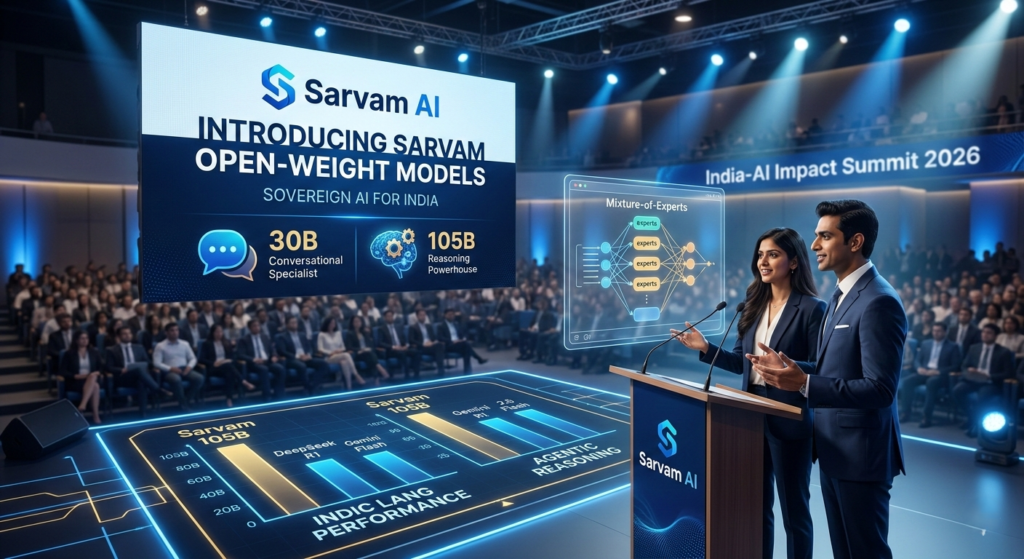
The global landscape of Artificial Intelligence is shifting from monolithic, Western-centric systems to more localized, efficient, and accessible architectures. At the forefront of this revolution is India, which recently marked a historic milestone at the India-AI Impact Summit 2026. The homegrown startup Sarvam AI has officially released its highly anticipated Sarvam AI open-weight models, signaling a bold step toward “Sovereign AI.”
By launching these foundational models under an open-source license, Sarvam is not just contributing to the developer community; it is challenging the dominance of global giants like Google’s Gemini and the efficiency benchmarks set by China’s DeepSeek. This move provides Indian enterprises and developers with the tools to build AI solutions that are culturally, linguistically, and economically optimized for the Indian subcontinent.
What Are the Sarvam AI Open-Weight Models?
The Sarvam AI open-weight models consist of two primary Large Language Models (LLMs) built from the ground up: a 30-billion parameter model (30B) and a 105-billion parameter model (105B). Unlike “closed” models that reside behind proprietary APIs, these open-weight versions allow developers to download, inspect, and fine-tune the model weights for specific commercial and research applications.
The 30B Model: The Conversational Specialist
The 30B model is designed for agility and real-time interaction. It powers Sarvam’s conversational agent, Samvaad, and is optimized for high throughput and low-latency responses.
The 105B Model: The Reasoning Powerhouse
The 105B model serves as the foundation for the Indus AI assistant. It is engineered for complex, multi-step reasoning and “agentic” workflows, where the AI must perform tasks across different platforms or tools.
The Architecture: Efficiency Meets Innovation
One of the most impressive aspects of the Sarvam AI open-weight models is their technical sophistication. Both models utilize a Mixture-of-Experts (MoE) transformer architecture. Instead of activating every parameter for every query, MoE only engages a fraction of the total parameters, drastically reducing the computational cost and energy consumption.
Key Technical Features
- Context Windows: The 30B model offers a 32,000-token context window, while the 105B model expands this to 128,000 tokens, allowing it to process massive documents or long conversations.
- Memory Optimization: The 105B model employs Multi-head Latent Attention (MLA), a technique popularized by DeepSeek, which significantly reduces the memory footprint required during long-context inference.
- GQA Integration: The 30B model uses Grouped Query Attention (GQA) to maintain high performance while minimizing KV-cache memory usage.
Comparing Sarvam AI Open-Weight Models vs. Global Competitors
How do these Indian-made models stack up against the likes of DeepSeek R1, Gemini 2.5 Flash, and OpenAI’s o4-mini? According to benchmark data released during the summit, the results are promising, particularly in reasoning and task completion.
| Feature / Model | Sarvam 105B | DeepSeek R1 | Gemini 2.5 Flash |
| Architecture | Mixture-of-Experts (MoE) | MoE / MLA | Proprietary |
| Focus | Indic Languages / Reasoning | Efficiency / Coding | Multimodal / General |
| Availability | Open-Weight (Apache 2.0) | Open-Weight | API Only |
| Reasoning (Tau 2) | Outperforms | Competitive | Lagging |
| Coding (SWE-Bench) | Room for Improvement | Leading | Strong |
The Sarvam AI open-weight models specifically shine in “agentic reasoning”—the ability to follow complex instructions to achieve a goal. On the Tau 2 Benchmark, the 105B model reportedly outperformed DeepSeek R1 and Gemini 2.5 Flash, making it a top-tier choice for developers building autonomous AI agents.
Breaking the Language Barrier: The Indic Tokenizer
A common criticism of global models like Gemini or GPT-4 is their relative inefficiency with Indian languages. They often require more “tokens” to represent a single Hindi or Tamil word compared to English, making them more expensive and slower to run in Indic contexts.
The Sarvam AI open-weight models solve this through a custom-built tokenizer. This tokenizer was trained on all 22 scheduled Indian languages across 12 different scripts. By achieving a superior “fertility score” (the ratio of tokens to words), Sarvam ensures that its models are faster and more cost-effective for Indian users than almost any other open-source alternative.
Actionable Insights for Developers and Enterprises
The release of the Sarvam AI open-weight models opens up several strategic opportunities for the Indian tech ecosystem:
- Lower Operational Costs: Because the models are optimized for hardware efficiency, they can be deployed on standard GPUs provided by providers like Yotta or even on high-end local workstations, bypassing the high costs of US-based cloud APIs.
- Sovereign Data Privacy: Enterprises dealing with sensitive data (FinTech, Healthcare, GovTech) can host the Sarvam AI open-weight models on-premise, ensuring that no data leaves their secure environment.
- Niche Fine-Tuning: Developers can take these base models and fine-tune them on specialized datasets—such as Indian legal documents, regional dialects, or specific industrial terminologies—to create hyper-accurate local solutions.
- Hardware Versatility: Sarvam has optimized these models to run across a variety of hardware, including laptops, making AI more accessible to smaller startups that lack massive server farms.
The Road to Sovereign AI: Government and Infrastructure Support
The development of the Sarvam AI open-weight models was not a solitary effort. It represents a successful public-private partnership. The models were trained using computing power made available through the IndiaAI Mission, a ₹10,372-crore government initiative.
Infrastructure support from Yotta Data Services and technical collaboration with Nvidia provided the necessary GPU muscle. This collaboration ensures that the Sarvam AI open-weight models are not just a technical feat but a strategic asset for India’s digital independence.
Safety, Ethics, and Open-Weight Questions
With great power comes the need for robust safety. Sarvam AI has addressed this by fine-tuning the Sarvam AI open-weight models on a specialized dataset that covers both global and India-specific risk scenarios. This includes adversarial red-teaming to prevent “jailbreaking” and ensuring the model adheres to policy-aligned, safe completions.
However, the “open-weight” nature of the release has sparked a debate in the tech community. If a “Sovereign AI” model is open for anyone in the world to download and modify, does it remain truly sovereign? Sarvam’s stance is that sovereignty lies in the capability to build and control the foundation, rather than gatekeeping the technology itself. By releasing the Sarvam AI open-weight models, they are empowering the entire nation to build upon a secure, home-grown foundation.
Conclusion: A New Era for Indian AI
The launch of the Sarvam AI open-weight models at the India-AI Impact Summit 2026 is a watershed moment. By outperforming global benchmarks in reasoning and offering unprecedented efficiency for Indic languages, Sarvam has proven that Indian startups can compete at the highest level of foundational AI development.
For developers, the message is clear: the tools to build the next generation of intelligent, agentic, and localized applications are now in your hands. Whether you are building a customer service bot for a rural cooperative or a complex reasoning engine for a global enterprise, the Sarvam AI open-weight models provide a powerful, efficient, and “sovereign” starting point.