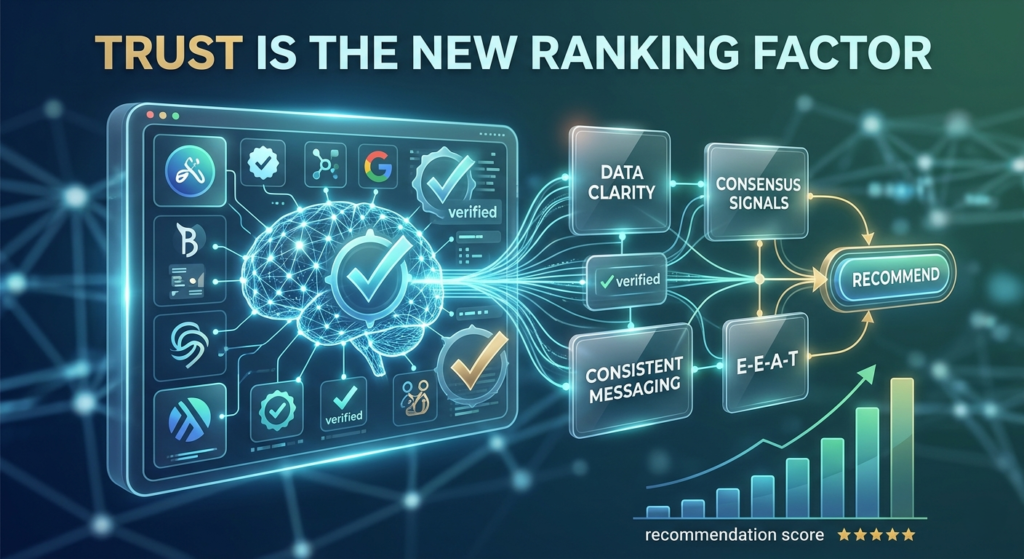
Trust is the new ranking factor in the rapidly evolving world of agentic commerce. For over two decades, the goal of digital marketing was simple: be findable. We optimized for “blue links,” obsessing over keyword placement and backlink counts to climb the search engine results pages (SERPs). But as we enter the era of AI-driven decision-making, the game has fundamentally changed. Today, the most critical question facing your brand isn’t “How do I rank?” but rather “Why would an AI agent trust me enough to recommend me?”
When users ask ChatGPT, Gemini, or Claude for a product suggestion, they aren’t looking for a list of options to browse; they are delegating a decision. In this new landscape, trust is the new ranking factor. AI agents have become the new gatekeepers, and they prioritize brand credibility and “recommendability” over traditional SEO tricks.
For over two decades, the goal of digital marketing was simple: be findable. We optimized for “blue links,” obsessing over keyword placement and backlink counts to climb the search engine results pages (SERPs). But as we enter the era of agentic commerce, the game has fundamentally changed. Today, the most critical question facing your brand isn’t “How do I rank?” but rather “Why would an AI agent trust me enough to recommend me?”
When users ask ChatGPT, Gemini, or Claude for a product suggestion, they aren’t looking for a list of options to browse; they are delegating a decision. In this new landscape, trust is the new ranking factor. AI agents have become the new gatekeepers, and they prioritize brand credibility and “recommendability” over traditional SEO tricks.
Understanding the Shift from Visibility to Eligibility
In traditional search, the platform carries very little risk. If you search for a CRM, click a result, and buy a product that fails, your frustration is with the vendor, not Google. However, when an AI agent independently evaluates, selects, and recommends a brand, the risk transfers to the AI.
If an agent recommends a $50,000 software solution that turns out to be a disaster, the user loses trust in the agent itself. To survive, AI agents must be conservative. They won’t recommend you because of a clever meta tag; they will recommend you because you are the safest, most defensible choice. This is why trust is the new ranking factor—it is the architecture of risk management for artificial intelligence.
The “Trust Architecture” of AI Recommendation
To understand how these systems work, we must look at the three core pillars of AI decision-making:
- Reasoning and Goal Alignment: AI agents must understand the user’s specific constraints (budget, integration needs, compliance) and explain why a specific brand fits.
- Uncertainty Reduction: Agents favor brands that provide clear, unambiguous data. If your pricing or SLAs are hidden behind a “Contact Us” form, the AI sees uncertainty and moves to a competitor.
- Consensus Signals: AI models cross-check information across the web. If multiple reputable sources, reviews, and industry experts mention your brand, the AI treats it as a verified entity.
Core Signals: How AI Agents Evaluate Your Brand
If trust is the new ranking factor, how exactly do machines measure it? Unlike humans, who rely on “vibes,” AI agents look for machine-readable evidence of reliability.
1. Brand Consistency Across the Web
AI agents are pattern-recognition engines. They evaluate whether your brand messaging, NAP (Name, Address, Phone) data, and value propositions are consistent across your website, social media, and third-party directories. Inconsistency signals a lack of professional maturity, which lowers your “recommendability” score.
2. The Depth of “Proof Points”
Modern agents act more like consultants than search engines. They probe for edge cases. Does your content address specific implementation hurdles? Do you have nuanced comparisons? Brands with deep topical authority—specifically those providing first-hand insights and case studies—are cited nearly 3x more often in AI overviews than generic “ultimate guides.”
3. External Validation and Citations
The AI ecosystem is largely built on consensus. Mentions in industry publications, Reddit discussions, and niche forums act as “trust votes.” Interestingly, data shows that branded web mentions often outperform traditional domain rating (DR) as a predictor of AI visibility. Because trust is the new ranking factor, your PR strategy is now effectively your SEO strategy.
AI Agents vs. Traditional Search: A Comparison
The transition to an AI-first world doesn’t mean traditional SEO is dead, but it does mean it has a new objective.
| Feature | Traditional SEO | AI Agent Recommendation |
| Primary Goal | Rank #1 for specific keywords. | Be the “safest” recommended choice. |
| Core Metric | Organic traffic and click-through rate. | Citation frequency and brand sentiment. |
| Content Strategy | Keywords and backlink volume. | Data clarity, E-E-A-T, and structured data. |
| Risk Factor | Low (User chooses from a list). | High (Agent makes the decision). |
| Key Advantage | High volume of content. | High “trust” and verified authority. |
Actionable Strategies to Build “Algorithmic Trust”
To win in the era of agentic AI, you must stop “catching attention” and start “proving reliability.” Here is how to optimize your brand when trust is the new ranking factor.
Make Your Data Legible
Design your website for machines as much as for humans. Use extensive Schema markup (Structured Data) to define your products, people, and services. Ensure that your technical specifications, pricing tiers, and return policies are easily extractable by AI crawlers.
Strengthen Your Digital Footprint
Since AI agents rely on consensus, you must cultivate mentions outside of your own domain.
- Engage in Community Hubs: Be active on platforms like Reddit, Quora, and industry-specific forums where AI agents “ground” their knowledge.
- Earned Media: Secure placements in reputable industry publications. A single mention in a trusted news outlet is worth more to an AI agent than a hundred low-quality backlinks.
Prioritize E-E-A-T (Experience, Expertise, Authoritativeness, Trust)
Google and other AI engines now prioritize content that demonstrates “lived experience.” Instead of writing abstractly about a topic, publish:
- Lessons learned from real projects.
- Specific mistakes to avoid.
- Measurable outcomes and data-driven case studies.
The Eligibility Era: Measuring What Matters
As trust is the new ranking factor, old KPIs like “keyword rankings” are becoming less relevant. Instead, marketers must shift toward measuring “Share of Model.”
- Citation Frequency: How often does an AI agent mention your brand when asked about your niche?
- Branded Search Volume: Are people searching for your brand specifically? High branded search volume is a massive trust signal to AI models.
- Narrative Accuracy: When an AI summarizes your brand, is it accurate? If not, you likely have a “data clarity” problem that needs fixing.
Conclusion: Preparing for the Future of Search
The shift toward AI-driven recommendations is not just a technical update; it is a cultural one. We are moving from the “Visibility Era”—where the loudest voice won—to the “Eligibility Era,” where the most trusted brand wins.
By focusing on data transparency, external validation, and deep topical authority, you can ensure that when an AI agent is asked for a recommendation, your brand is the one it stands behind. Remember, in this new world, trust is the new ranking factor. If you haven’t started building it, you’re already falling behind.