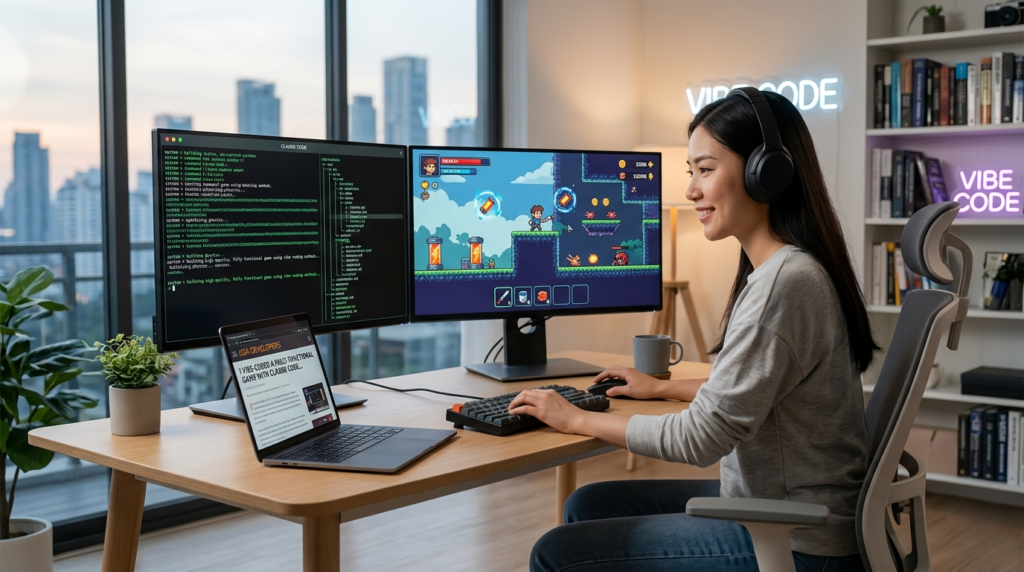
The landscape of software engineering has shifted beneath our feet. In early 2025, Andrej Karpathy coined a term that would soon become the anthem of a new era: Vibe Coding. It describes a transition from the meticulous, line-by-line syntax of traditional programming to a high-level, intent-driven flow where the “vibe” of the project dictates the output.
But while many dismissed the concept as a tool for “toy” apps or broken prototypes, a recent breakthrough featured on XDA-Developers has proven otherwise. By using Claude Code, a professional-grade command-line interface (CLI) tool from Anthropic, a developer managed to produce a fully functional, polished game that defies the “low-effort” reputation of AI-generated software.
In this guide, we’ll dive deep into the mechanics of this workflow, how Claude Code facilitates this transformation, and how you can leverage these techniques to build complex projects without getting bogged down in boilerplate.
What is Vibe Coding?
At its core, vibe coding is the practice of building software by describing your desired outcome in natural language and allowing an LLM (Large Language Model) to handle the implementation, debugging, and refactoring. It is less about “writing” code and more about “steering” an intelligent agent.
The Evolution of the Developer Role
In a traditional workflow, a developer is an author. In a modernized development environment, the developer becomes a System Architect and Editor.
- The Intent: You define the features, the aesthetic, and the logic.
- The Execution: The AI (like Claude Code) writes the files, installs dependencies, and runs tests.
- The Loop: You provide feedback based on the result, and the AI iterates.
Why Claude Code is the Ultimate Tool for this Era
While web-based interfaces like ChatGPT or the standard Claude.ai are great for snippets, they lack the “agentic” power required for a professional project. Claude Code changes the game by living directly in your terminal.
Key Features of Claude Code
- File System Awareness: It doesn’t just suggest code; it reads your entire directory, understands how
index.jsrelates tostyles.css, and edits them simultaneously. - Command Execution: It can run
npm install, execute build scripts, and even fix errors that appear in the terminal output. - Context Management: Unlike standard LLMs that “forget” previous turns, Claude Code maintains a persistent understanding of the project’s state.
Case Study: Building a Game That Doesn’t Look “AI-Generated”
The XDA report highlights a crucial distinction: most projects feel “off” because the AI takes the path of least resistance. However, with the right prompts, the result can be indistinguishable from a manually coded product. This is where high-level vibe coding separates itself from simple prompting.
The “One Change” Rule
One of the most effective strategies for maintaining quality is the One Change Rule. Instead of asking the AI to “build a platformer game,” you break the project into atomic steps:
- “Create a basic HTML5 canvas with a controllable square.”
- “Add gravity and collision detection.”
- “Replace the square with a sprite sheet and add walking animations.”
This iterative approach prevents the “architectural drift” that often plagues AI projects.
Comparison: Modern vs. Traditional Coding
| Feature | Traditional Coding | Vibe Coding (with Claude Code) |
| Speed | Slow, syntax-dependent | 10x faster prototyping |
| Error Handling | Manual debugging | AI-driven log analysis and fixing |
| Learning Curve | High (years of syntax study) | Low (focus on logic and intent) |
| Maintenance | Clear, but time-consuming | Risk of “Black Box” code if not managed |
| Boilerplate | Manually written | 100% automated |
Actionable Insights for Professional Workflows
To ensure your project stays professional and scalable, follow these industry best practices:
1. Start with a “Specification” (CLAUDE.md)
Before you type your first prompt, create a file called CLAUDE.md. This acts as the “source of truth” for the AI. List your tech stack, your naming conventions, and the core goals of the project. Claude Code will read this file every time it runs, ensuring consistency.
2. Use “Direct Deployment”
The workflow doesn’t end at the code. Tools like Replit or Google Cloud Run allow you to take the code generated and push it to a live environment with a single command. This creates a tight feedback loop with real users, a core benefit of vibe coding.
3. Review for “Hallucinated” Vulnerabilities
Statistics suggest that while this method increases speed by 41%, nearly 45% of AI-generated code can contain security vulnerabilities. Always ask Claude Code to:
“Audit the functions you just wrote for security flaws like SQL injection or hardcoded secrets.”
The Future of Programming in 2026
By 2026, vibe coding has moved from a hobbyist trend to a corporate standard. Major tech firms report that up to 30% of their production code is now AI-generated. The secret to staying relevant isn’t learning more syntax; it’s learning how to communicate complex architectural intent to models like Claude 3.7 and Gemini 3.0.
Summary of the Workflow
- Define Intent: Use natural language to describe the goal.
- Scaffold: Let Claude Code set up the directory and dependencies.
- Iterate: Use the “One Change Rule” to build feature-by-feature.
- Test/Debug: Provide terminal error logs directly to the AI.
- Audit: Perform a final pass for security and performance.
The Ultimate Vibe Coding & Claude Code FAQ: Deep Dive [2026 Edition]
As the boundary between “writing code” and “prompting intent” continues to blur, thousands of developers are turning to vibe coding. This comprehensive FAQ explores every nuance of this shift.
Section 1: The Foundations
What exactly is Vibe Coding, and why is it trending in 2026?
It is a philosophy where the human’s primary role is to set the functional intent and logical flow, while an AI agent handles the syntax. In 2026, vibe coding has trended because LLMs have reached a level of “agentic reasoning” where they understand the entire project structure.
Is this just another name for “Low-Code”?
No. While they share the goal of democratization, they are fundamentally different. This method produces actual, raw source code. You have the full power of a professional codebase, but the “writing” is done through dialogue.
Who coined the term?
The term was popularized by Andrej Karpathy. He noted that as models become more capable, the “vibe” of the prompt—how clearly you describe your vision—becomes more important than memorizing syntax.
Section 2: Technical Implementation
How does Claude Code differ from a standard chatbot?
Claude Code has agency; it can read your local files, write new ones, and run terminal commands. If a command fails, it sees the error message and automatically attempts a fix.
Does it support all programming languages?
Yes. Because it is built on top of the latest models, it possesses “polyglot” capabilities. Whether you are working in Python or Rust, vibe coding remains effective.
Section 3: Professional Workflow
How do I prevent “hallucinations”?
Hallucinations are the biggest hurdle. To minimize this, always provide context via a CLAUDE.md file and use step-by-step prompts. Terminal verification is also essential for successful vibe coding.
Can I use it on large-scale repositories?
Absolutely. Claude Code uses a sophisticated indexing system to map out large codebases, making it highly effective for refactoring enterprise-grade software.
Section 4: Game Development
Why is this revolutionary for indie developers?
Traditional game development requires mastery of complex physics engines. This approach lowers the barrier, allowing developers to describe mechanics in plain English.
Can I build 3D games?
Yes, using frameworks like Three.js or Unity. You describe the scene and the logic, and the AI generates the scripts.
Section 5: Security & Ethics
Is the generated code secure?
AI-generated code is only as secure as the oversight provided. Always audit your vibe coding output for vulnerabilities like insecure API keys.
Will this replace software engineers?
The consensus in 2026 is no. Instead, it is evolving the role. The “Syntactician” is being replaced by the “Architect.”
How does this affect technical SEO?
For developers, vibe coding allows for the rapid creation of interactive code playgrounds, which increases “dwell time” on technical blogs.
Section 6: Advanced Troubleshooting
What if the AI gets stuck in a “Logic Loop”?
Interrupt the process and give a more specific prompt. Sometimes the AI needs a “nudge” to try an alternative library.
How do I handle API costs?
To save costs during vibe coding, use a .claudeignore file to prevent the AI from reading unnecessary folders like node_modules.
Final Thoughts
The experiment on XDA-Developers proves that quality is no longer a compromise. With tools like Claude Code, the distance between a “vibe” and a “product” has vanished. Successful developers in 2026 won’t be those who type the fastest, but those who utilize vibe coding to its fullest potential.