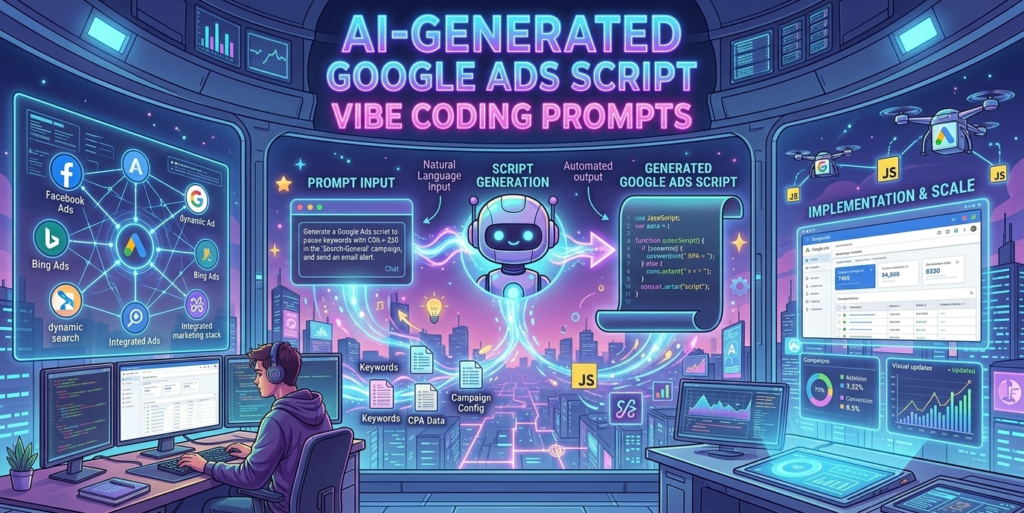
Vibe coding for PPC is the ultimate “cheat code” for students and aspiring digital marketers who want to dominate the search engine landscape without spending years learning to write Python or JavaScript. If you’ve ever felt sidelined because you couldn’t build your own Google Ads scripts, vibe coding for PPC is your ticket to the big leagues. This isn’t just about using AI; it’s about a fundamental shift from being a manual laborer to being a software architect.
With the advent of GPT-5 and its capability for full-scale program generation, the competitive advantage in the marketing world has shifted. It no longer belongs to the person who knows the most code, but to the student who masters vibe coding for PPC. As Frederick Vallaeys, the former Google Ads visionary, recently proved, you can now build custom automation in minutes rather than months.
What Exactly is Vibe Coding for PPC?
For a student, the term “coding” usually sounds like a mountain of syntax, brackets, and debugging. Vibe coding for PPC flips that script. Instead of writing lines of logic, you describe the “vibe”—the intent, the goal, and the desired outcome—in plain English. The AI acts as your senior developer, translating your marketing strategy into a functional tool.
Imagine you are in a marketing internship. Your boss asks for a way to track competitor ad spend across five different industries. Traditionally, you’d be stuck with a spreadsheet. With vibe coding for PPC, you simply tell an AI tool: “Build me a dashboard that pulls these search terms and visualizes the spend gap.” Within 60 seconds, you have a working prototype.
Why Students Must Adopt Vibe Coding for PPC Now
- Zero Barrier to Entry: You don’t need a CS degree.
- Speed of Execution: Build “throwaway” software for a single class project or a one-time client task.
- Competitive Edge: Most entry-level marketers only know how to use the Google Ads interface. By mastering Prompt-Based Automation, you provide custom technical solutions.
Case Study 1: The AI-Powered Seasonality Analysis Tool
In our first example of vibe coding for PPC, a student with no technical background was tasked with analyzing seasonal trends for a retail client. Instead of manually auditing two years of data, she used vibe coding for PPC to build a custom forecaster.
- The Workflow: She gathered transcripts from PPC expert podcasts and fed them into Claude.
- The Prompt: “Use these expert insights to build a seasonality analysis tool that predicts holiday spikes in search volume.”
- The Result: The AI didn’t just give her an answer; it built a browser-based application with interactive charts.
- The Lesson: Prompt-Based Automation allows you to turn “static knowledge” into “active tools.” You aren’t just reading about marketing; you are building the infrastructure to execute it.
Case Study 2: Creating a “Panel of Experts” for Ad Copy
As a student, you often lack a team of senior copywriters to check your work. Vibe coding for PPC solves this by allowing you to build a “virtual agency.”
Frederick Vallaeys demonstrated this by using V0.dev to create a tool where multiple AI personas review a single piece of content. One AI acts as a “Conversion Specialist,” another as a “Brand Voice Guard,” and a third as an “SEO Optimizer.”
By applying vibe coding for PPC, you can build a web app where you paste your ad headlines and receive a consolidated report of improvements. This ensures your PPC campaigns are professionally vetted before you ever spend a dollar of a client’s budget. This is the power of vibe coding for PPC: it democratizes professional-grade feedback.
Case Study 3: The Custom Chrome Extension for Client Demos
Presenting live data can be risky. You might want to show a potential employer your work without revealing private account IDs or spend numbers.
Using vibe coding for PPC, Vallaeys built a Chrome extension that automatically blurs sensitive numbers on any webpage.
- Student Use Case: You can prompt an AI: “Build me a browser extension that highlights ‘Low Quality Score’ keywords in bright red so I can find them faster during my weekly audit.”
- The Implementation: Because vibe coding for PPC handles the manifest files and background scripts, you only need to focus on what you want the tool to do.
The “On-Demand Software” Revolution
Sam Altman of OpenAI recently noted that we are moving toward “on-demand software.” This means that in 2026, the most valuable marketers won’t be those who own software, but those who can summon it. Vibe coding for PPC is the skill of summoning software on demand.
The Old Way vs. The Vibe Coding Way
| Feature | The Old Scripting Way | The Vibe Coding for PPC Way |
| Logic | Deterministic (Rigid If/Then) | Flexible (Probabilistic/Nuanced) |
| Build Time | Weeks or Months | 15 to 30 Minutes |
| Skill Level | Expert Programmer | Creative Marketer (Student) |
| Cost | Thousands in Dev Fees | Free/Subscription AI Tools |
By using vibe coding for PPC, you can handle nuanced questions that traditional code can’t. For example, a traditional script struggles to identify if “Apple” refers to the fruit or the tech company. Vibe coding for PPC utilizes the LLM’s reasoning to make that distinction instantly.
5 Essential Tools for Your Vibe Coding Journey
To get started with vibe coding for PPC, you don’t need a high-end setup. You just need access to the right AI models:
- Claude/ChatGPT: Excellent for generating the initial logic and basic data calculators.
- Lovable / Bolt.new: These are the “heavy hitters” for vibe coding for PPC. They allow you to build full-stack apps with databases in a single prompt.
- V0.dev: Best for building beautiful user interfaces (UI) so your custom tools look professional.
- Replit: Great for hosting your scripts so they run automatically in the cloud.
- Cursor: An AI-first code editor that helps you learn as you build.
How to Master Your First “Vibe” Prompt
When you start vibe coding for PPC, your prompt is your blueprint. Follow these three rules to ensure your AI builds exactly what you need:
1. Give it a Role and a Use Case
Instead of saying “write a script,” say: “You are an expert PPC Developer. Build a vibe coding for PPC tool that analyzes search term reports for negative keyword opportunities.”
2. Describe the User Interface
If you want a button that exports data to a CSV, tell it! Vibe coding for PPC is as much about the “feel” of the tool as it is the function.
3. Iterate, Don’t Start Over
If the AI builds a tool that is 80% correct, don’t delete it. Simply say: “This is great, but now make the table sortable by Conversion Rate.” That is the essence of vibe coding for PPC—a continuous conversation with your software.
Why Vibe Coding for PPC is the Future of Marketing Education
The traditional way of teaching marketing is dying. You shouldn’t just be learning about “Return on Ad Spend” (ROAS); you should be building tools that calculate and optimize ROAS automatically. Vibe coding for PPC empowers students to move from theory to execution instantly.
When you sit down for a job interview in 2026, don’t just bring a resume. Bring a suite of tools you built using vibe coding for PPC. Show them the seasonality tool you built for a mock project. Show them the Chrome extension you created to streamline keyword research.
This demonstrates that you aren’t just a user of technology—you are a creator. Vibe coding for PPC levels the playing field, allowing a student with a laptop and a “vibe” to outperform an agency with a million-dollar budget.
Conclusion: Start Your First Vibe Coding Project Today
The world of search engine marketing is changing. You aren’t competing against AI; you are competing against other students who use vibe coding for PPC better than you do. The first time you describe a tool and see it come to life in 20 seconds, your mind will be blown.
Don’t wait for a syllabus to tell you to learn this. Go to ChatGPT or Lovable right now. Type: “Build me a PPC persona scorer that evaluates how well an ad copy resonates with a Gen Z audience.” Experience the magic of vibe coding for PPC for yourself.