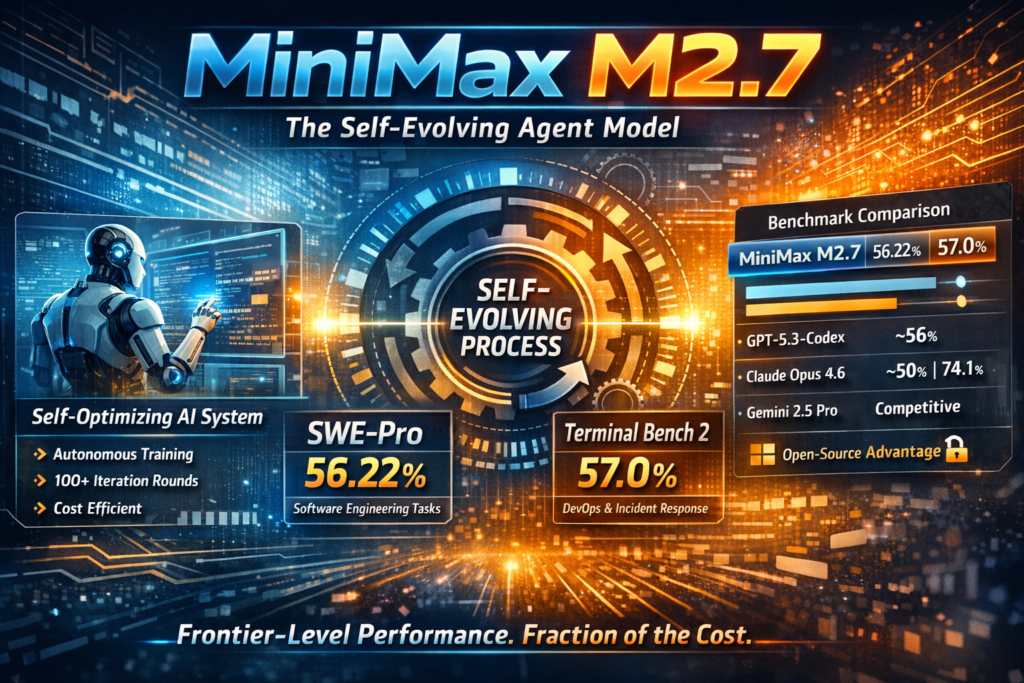
MiniMax M2.7 is the first open-source large language model to actively participate in its own development cycle — and it scores 56.22% on SWE-Pro and 57.0% on Terminal Bench 2, matching or exceeding frontier models at a fraction of the cost. If you’re evaluating agentic AI systems for software engineering, enterprise workflows, or multi-agent orchestration in 2026, this is the release you can’t afford to skip.
What Is MiniMax M2.7?
Definition: MiniMax M2.7 is a next-generation, open-source Mixture-of-Experts (MoE) large language model developed by Shanghai-based AI lab MiniMax. It was originally announced on March 18, 2026, and has since had its model weights made publicly available on Hugging Face under an MIT license.
Expansion: Unlike most model releases that follow a straightforward train-then-deploy cycle, MiniMax M2.7 is designed around three core capability pillars: professional software engineering, professional office productivity, and native multi-agent collaboration (what MiniMax calls “Agent Teams”). What makes it genuinely novel, however, is not what the model does — it’s how the model was built. Earlier versions of M2.7 were used to construct the very training harnesses that shaped the final release, creating a feedback loop that MiniMax describes as a “self-evolving” development process.
This is not marketing language. The model ran over 100 autonomous optimization rounds during its training process, analyzing failure trajectories, modifying scaffold code, and reverting unsuccessful changes — without human intervention at each step.
The Self-Evolving Architecture: How MiniMax M2.7 Trains Itself
What Does “Self-Evolving” Actually Mean?
This is one of the most asked questions about the MiniMax M2.7 release, and it deserves a precise answer.
Self-evolving, in this context, means: An internal version of M2.7 was tasked with building and iteratively improving the reinforcement learning (RL) harness used to train the final model. The harness — called OpenClaw — supports data pipelines, training environments, infrastructure management, cross-team collaboration, and persistent memory.
The model then autonomously executed a loop of:
- Analyze failure trajectories
- Plan scaffold modifications
- Modify scaffold code
- Run evaluations
- Compare results
- Keep or revert changes
This cycle ran for over 100 rounds, achieving a reported 30% performance improvement on internal evaluations. In total, MiniMax M2.7 handled between 30% and 50% of its own RL development workflow — a figure that moves recursive self-improvement from theoretical discussion to documented production practice.
Why This Matters for AI Development
The traditional LLM development loop requires human researchers to analyze benchmark failures, hypothesize improvements, modify training procedures, and re-evaluate. MiniMax M2.7 compressed significant portions of that loop into autonomous agent execution. This isn’t merely automation of rote tasks; the model reasoned over experimental results and modified the harness responsible for training and evaluating itself — a qualitative distinction from scripted pipelines.
For ML engineers and AI researchers, this represents a concrete reference architecture: use an earlier-generation model as a research agent, let it iterate on the training harness, and feed those improvements back into the next training run.
Benchmark Performance: What the Numbers Actually Mean
MiniMax M2.7 earns its headlines on real-world benchmarks, not synthetic toy tasks. Here’s what each score actually measures and why it matters.
SWE-Pro: 56.22%
What it tests: SWE-Pro covers multi-language software engineering tasks — log analysis, bug troubleshooting, code security review, and machine learning workflow debugging. Critically, SWE-Pro is pass/fail at the issue level: the model either resolves the GitHub issue or it doesn’t. There are no partial scores.
What 56.22% means: At this score, MiniMax M2.7 matches GPT-5.3-Codex and approaches the performance ceiling of current frontier models. For engineering teams, this translates to a model capable of autonomously closing production bugs — not just generating plausible-looking diffs.
Terminal Bench 2: 57.0%
What it tests: Terminal Bench 2 evaluates DevOps-level system comprehension: parsing logs, writing runbooks, responding to incidents, and executing sequential tool use with minimal tolerance for hallucinated command flags.
What 57.0% means: In live incident scenarios, MiniMax reports that M2.7 has reduced recovery time for production system incidents to under three minutes on multiple occasions — correlating monitoring metrics, conducting trace analysis, pinpointing missing index migration files, and submitting merge requests autonomously.
Additional Benchmark Highlights
- SWE Multilingual: 76.5 — strong cross-language generalization
- Multi-SWE Bench: 52.7 — multi-file, multi-repository engineering tasks
- VIBE-Pro: 55.6% — end-to-end project delivery (Web, Android, iOS, simulation)
- NL2Repo: 39.8% — natural language to full repository generation
- GDPval-AA ELO: 1495 — the highest score among open-source-accessible models across 45 evaluated systems
- Artificial Analysis Intelligence Index: 50/100, ranked #1 out of 136 models (field average: 19)
MoE Architecture: Power Without the Price Tag
What Is a Mixture-of-Experts Model?
Definition: A Mixture-of-Experts (MoE) architecture routes each inference pass through only a subset of total model parameters, rather than activating all parameters for every token. This makes MoE models significantly faster and cheaper to serve than dense models of comparable output quality.
Expansion: MiniMax M2.7 has 230 billion total parameters but activates only 10 billion during any given inference pass. This means you get output quality competitive with much larger dense models while maintaining lower latency and dramatically reduced cost.
At $0.30 per million input tokens and $1.20 per million output tokens, MiniMax M2.7 is priced competitively even against lightweight models. It also includes automatic prompt caching — no manual configuration needed — which drops the effective blended cost to approximately $0.06 per million tokens for workloads with stable system prompts or repeated document prefixes.
For teams currently running Claude or GPT-5-class coding agents at scale, M2.7’s cost structure can reduce monthly AI spend by an order of magnitude on agentic coding tasks, with benchmarks suggesting no meaningful performance regression.
Agent Teams & Real-World Capabilities
Native Multi-Agent Collaboration
MiniMax M2.7 is purpose-built for agentic deployments. “Agent Teams” is MiniMax’s term for the model’s native ability to coordinate with other agent instances — maintaining stable role boundaries, managing adversarial reasoning scenarios, and adhering to collaboration protocols across long-horizon task chains.
Key agentic metrics:
- 97% skill adherence across 40 complex skills, each exceeding 2,000 tokens in specification length
- Handles 30–50% of MiniMax’s internal RL team workflows autonomously
- Supports dynamic tool search, persistent memory, and complex skill orchestration
The OpenRoom Demo
Alongside the MiniMax M2.7 model weights, MiniMax open-sourced OpenRoom — an interactive agent demonstration that moves AI interaction beyond plain text streams into a Web GUI environment where everything is interactive. Notably, most of the OpenRoom codebase was written by M2.7 itself, serving as a practical proof of its end-to-end coding capability.
Production Incident Response
One of the most compelling real-world demonstrations of MiniMax M2.7 is its performance in production incident response scenarios. The model can:
- Correlate monitoring metrics with deployment timelines to perform causal reasoning
- Conduct statistical analysis on trace sampling and propose precise root-cause hypotheses
- Proactively connect to databases to verify root causes
- Pinpoint missing index migration files in the code repository
- Use non-blocking index creation to stop the bleeding before submitting a merge request
This capability profile positions MiniMax M2.7 not as a code-completion tool but as an autonomous SRE collaborator.
MiniMax M2.7 vs. Competitors: Benchmark Comparison Table
| Model | SWE-Pro | Terminal Bench 2 | Context Window | Input Cost (per 1M tokens) | Open Source |
|---|---|---|---|---|---|
| MiniMax M2.7 | 56.22% | 57.0% | 205K tokens | $0.30 | ✅ (weights) |
| GPT-5.3-Codex | ~56% | Not listed | Varies | ~$3.00+ | ❌ |
| Claude Opus 4.6 | ~50% | ~74.1%* | 200K tokens | ~$15.00 | ❌ |
| Gemini 2.5 Pro | Competitive | Competitive | 1M tokens | $1.25 | ❌ |
| MiniMax M2.5 | Lower | Lower | 205K tokens | $0.30 | ✅ |
*Independent third-party estimates; figures may vary by evaluation methodology.
Key takeaway: On the specific benchmarks MiniMax M2.7 targets — production software engineering and system-level comprehension — it achieves parity with closed, proprietary frontier models at 10–50x lower cost, with open model weights available for local deployment.
Who Should Use MiniMax M2.7?
Best Fit Use Cases
Agentic coding pipelines at scale: If your team is running coding agents for automated PR generation, bug triage, or CI/CD integration, MiniMax M2.7’s SWE-Pro performance and low cost make it a compelling backbone. Teams spending $5,000+/month on frontier models for coding agents could realistically reduce that to $100–$300 with comparable or better agentic performance.
DevOps and SRE automation: Terminal Bench 2 performance speaks directly to log parsing, runbook generation, and incident response. The model’s 97% skill adherence on complex, multi-step tool chains makes it suitable for on-call automation and monitoring integration.
Enterprise document workflows: With the highest GDPval-AA ELO score among open-source-accessible models, M2.7 is competitive for complex Excel, PowerPoint, and Word editing tasks with multi-round fidelity requirements.
ML research teams: For teams that want to replicate MiniMax’s own self-evolving development loop, M2.7 is both the tool and the proof of concept.
Not the Best Fit
- Applications requiring multimodal input (images, audio, video) — M2.7 is text-only by design
- Creative writing or brand voice content where stylistic nuance is the primary success criterion
- Compliance-sensitive deployments requiring specific vendor certifications or safety frameworks tied to a particular lab
- Teams whose workloads are dominated by “vibe coding” (fast, loosely-specified natural language to code) — on BridgeBench, M2.5 outperformed M2.7
Limitations and Honest Caveats
No model review is complete without acknowledging the gaps. Here’s what you should know before deploying MiniMax M2.7:
1. Verbosity and token costs: M2.7 generated 87 million tokens running the Artificial Analysis Intelligence Index benchmarks — 4.35x the field average. This verbosity drives its benchmark depth but also translates to higher output costs in production. Developers should implement output length controls for cost-sensitive workloads.
2. “Self-evolving” framing: The self-evolution narrative is accurate but strategically framed. What MiniMax describes is reinforcement learning from AI-generated feedback — a well-established technique used across major labs. The results are real; the terminology amplifies novelty that is, in technical terms, iterative RL training with high automation.
3. BridgeBench regression: On vibe-coding evaluations specifically, M2.7 (19th) underperformed M2.5 (12th). The shift toward production engineering came at some cost to natural-language-to-code fluency.
4. Proprietary vs. open-source nuance: The model weights are open-source under MIT license, but M2.7 is also available as a proprietary API product. Benchmark scores may vary between the open weights version and the API-served version. Verify benchmark replication in your specific deployment environment.
Frequently Asked Questions
Q: Is MiniMax M2.7 fully open source? Yes, the model weights are publicly available on Hugging Face under an MIT license. The API is also available via the MiniMax Open Platform and OpenRouter, currently free for a limited time.
Q: How does MiniMax M2.7 compare to Claude Opus 4.6 on coding tasks? On SWE-Pro, M2.7 (56.22%) exceeds Claude Opus 4.6 (~50%) on available benchmarks. On VIBE-Pro, M2.7 (55.6%) is nearly on par with Opus. However, Claude Opus 4.6 leads on creative writing, multimodal handling, and compliance-sensitive deployments.
Q: What is the context window of MiniMax M2.7? MiniMax M2.7 supports a 205,000-token context window — roughly equivalent to a 500-page book or a medium-sized codebase — with automatic prompt caching.
Q: Can I run MiniMax M2.7 locally? Yes. MiniMax recommends using SGLang to serve the model. The full 230B parameter model requires significant GPU infrastructure; the 10B activated parameter profile means inference is efficient, but the full weight set demands high-capacity hardware.
Q: What is the OpenClaw framework? OpenClaw is MiniMax’s internal agent harness used during the development of M2.7. It enabled the model to autonomously run over 100 rounds of scaffold optimization during training. MiniMax has also open-sourced the OpenRoom project, built on a similar framework.
Conclusion
MiniMax M2.7 represents one of the most significant open-source model releases of 2026 — not because it tops every benchmark in every category, but because of what it signals. A model that ranks #1 on the Artificial Analysis Intelligence Index across 136 evaluated systems, matches frontier coding performance on SWE-Pro, and demonstrably participated in its own training loop is not incremental progress. It is a proof of concept for a new development paradigm.
For engineering teams evaluating agentic AI infrastructure, MiniMax M2.7 deserves serious evaluation. The combination of open model weights, frontier-competitive SWE-Pro and Terminal Bench 2 scores, and a price point dramatically below closed competitors creates a deployment window that is genuinely rare in the current AI landscape.
The self-evolving architecture that defines MiniMax M2.7 is still in its early stages — MiniMax calls it “Early Echoes of Self-Evolution.” But if the next iteration runs even deeper autonomous development loops, the trajectory is unmistakable.