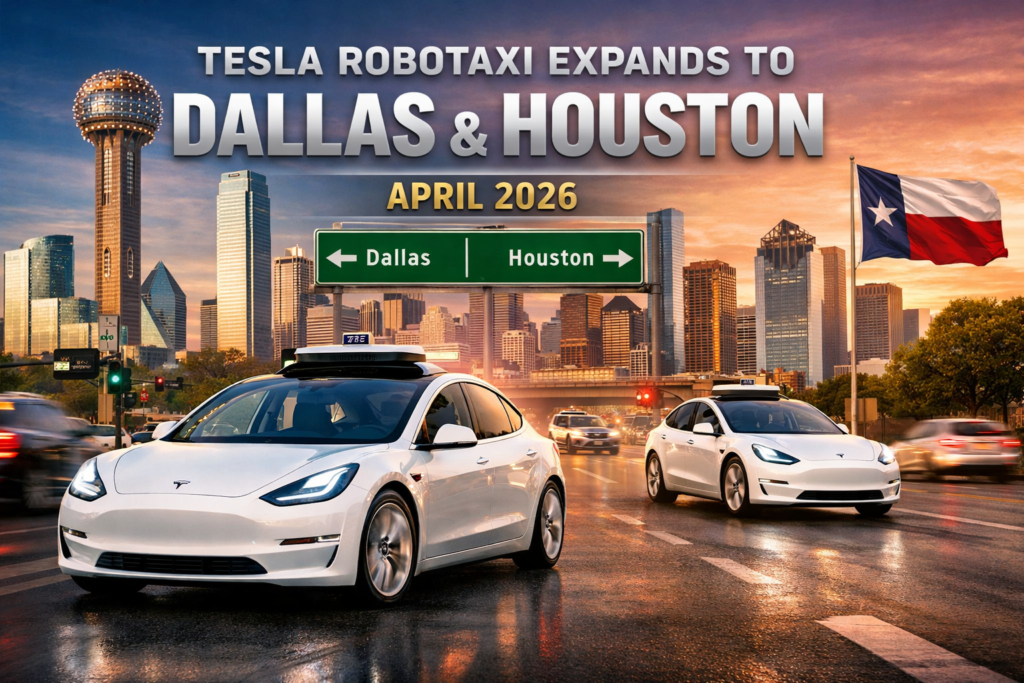
Tesla’s robotaxi service is now live in Dallas and Houston — making Texas the first and only state in America with fully driverless commercial ride-hailing operating across three major cities. If you’ve been watching the autonomous vehicle race heat up, this expansion is the clearest sign yet that Tesla is accelerating its ambitions beyond Austin.
What Is Tesla’s Robotaxi Service?
Tesla robotaxi is a fully autonomous, app-based ride-hailing service that operates Tesla vehicles with no human driver or safety monitor in the front seat. It is Tesla’s commercial deployment of its Full Self-Driving (FSD) technology in a shared mobility context — meaning passengers book a ride through Tesla’s app and are transported entirely by AI.
This is distinct from Tesla’s driver-assistance features available on consumer vehicles. The robotaxi fleet is operated by Tesla directly as a transportation service, not sold to private owners for ride-sharing. The vehicles themselves are Model 3s and Model Ys running Tesla’s latest FSD stack, dispatched and monitored remotely by Tesla’s operations teams.
Tesla Robotaxi Expands to Dallas and Houston
What the Announcement Actually Says
On April 18, 2026, Tesla announced via social media that its robotaxi service is “now rolling out in Dallas & Houston,” accompanied by a short video showing Tesla vehicles operating without human monitors or drivers in the front seat. TechCrunch
The post was brief and characteristically light on operational details — no specific launch zones, no pricing information, and no details on fleet size were included in the announcement. However, the video confirmed what many had anticipated: the Tesla robotaxi is now operating in two of the largest cities in the United States without any human safety redundancy onboard.
This makes Tesla’s robotaxi commercially available in three Texas cities simultaneously: Austin, Dallas, and Houston.
How Many Vehicles Are Currently Deployed?
Here’s where the scale question gets interesting. Crowdsourced data from the Robotaxi Tracker website showed only a single active Tesla vehicle registered in each of the two new markets at the time of launch, compared to 46 active vehicles logged in Austin. TechCrunch
That’s a small number — but it follows the same gradual rollout pattern Tesla used in Austin, where the service started with a handful of vehicles and expanded over months. Expect fleet size in Dallas and Houston to grow incrementally as Tesla’s remote operations teams gain confidence in the local road environments.
How Does Tesla Robotaxi Work?
Fully Driverless — No Safety Monitor
The defining feature of the current Tesla robotaxi deployment is the absence of any human in the front seat. Tesla began offering rides without safety drivers in Austin in January 2026 TechCrunch, after initially launching with human monitors onboard when the Austin service first opened in June 2025. The Dallas and Houston expansions launched directly into the driverless configuration — skipping the safety-driver phase entirely.
This is a significant operational leap. Most autonomous vehicle companies — including Waymo, which operated with safety drivers for years before going fully driverless — treat the removal of the human monitor as a major milestone. Tesla is now treating it as the default starting point for new markets.
How Does a Passenger Book a Ride?
Passengers in eligible zones can request a Tesla robotaxi through Tesla’s dedicated app. The ride experience is described as similar to any standard ride-hail service: select a destination, confirm pickup, and the vehicle arrives autonomously. There is no driver to tip, no in-car conversation, and no human to escalate issues to mid-ride — Tesla’s remote monitoring teams handle any intervention needs.
Pricing details have not been officially published by Tesla for any of the three markets.
Tesla Robotaxi vs. Waymo: How Do They Compare?
The autonomous ride-hailing space in 2026 is effectively a two-horse race between Tesla and Waymo. Here’s how the two services compare across the key dimensions that matter to riders, investors, and regulators:
| Feature | Tesla Robotaxi | Waymo One |
|---|---|---|
| Sensor Suite | Vision-only (cameras + FSD neural net) | Multi-sensor (LiDAR + radar + cameras) |
| Safety Driver | No (fully driverless from launch) | No (driverless in core markets) |
| Markets (US) | Austin, Dallas, Houston (TX) | San Francisco, Phoenix, LA, Austin |
| Fleet Scale | ~46 vehicles (Austin); 1–2 (new markets) | Hundreds of vehicles per market |
| Consumer App | Tesla App | Waymo One App |
| Mapping Approach | Real-time AI perception (no HD maps) | Pre-mapped HD maps + real-time data |
| Crash History | 14 reported incidents (Austin, since launch) | Data available via NHTSA filings |
| Regulatory Status | Operating under Texas state framework | Multiple state/city permits |
The fundamental technology difference is the most consequential one. Tesla’s vision-only approach — relying entirely on cameras and AI inference without LiDAR — is either a brilliant cost-reduction strategy or a reliability risk, depending on who you ask. Waymo’s sensor-redundant approach costs more per vehicle but provides additional fallback layers in low-visibility conditions.
Tesla’s Austin Track Record: What the Crash Data Tells Us
Before evaluating the Dallas and Houston launches, it’s worth grounding the conversation in Austin’s real-world performance data — the only market with enough operational history to draw from.
According to a February 2026 regulatory filing, Tesla’s Austin robotaxis have been involved in 14 crashes since the service launched. TechCrunch That figure comes from NHTSA-required reporting and was widely covered as a concerning milestone.
What does that number actually mean? Context matters significantly here:
- The 14 incidents occurred over roughly eight months of commercial operation across a growing fleet.
- Not all reported “crashes” involve injuries — minor contact events, fender-benders, and incidents where the Tesla was struck by another driver all count under NHTSA reporting requirements.
- Comparative data from Waymo and other AV operators shows that incident rates tend to front-load early in deployment, as the AI encounters novel scenarios it hasn’t optimized for yet.
None of this excuses safety lapses, but it does mean the 14-crash figure needs to be understood within the broader framework of AV operational data — not in isolation. Regulators and safety advocates are right to track it closely. What the data doesn’t show is a catastrophic safety failure that should pause deployment; if it did, the service would already be under regulatory order to halt.
Why Texas? The Strategic Logic Behind Tesla’s Expansion
Regulatory Friendliness
Texas has emerged as the most permissive regulatory environment in the United States for autonomous vehicle deployment. Unlike California — where Waymo and other AV companies must navigate the DMV’s stringent AV permit system — Texas operates under a lighter-touch state framework that doesn’t require pre-approval for fully driverless commercial operations.
This isn’t accidental. Tesla’s entire Tesla robotaxi commercial strategy has been built around Texas as a proving ground, precisely because it allows faster iteration without regulatory bottlenecks.
Road Infrastructure and Geography
Dallas and Houston are two of the most car-centric metros in America. Both cities were purpose-built around automobile infrastructure: wide arterial roads, flat terrain, minimal pedestrian density in suburban zones, and highway-heavy commuting patterns.
For a Tesla robotaxi fleet that relies on camera-based perception, these environments offer relatively predictable road conditions compared to dense urban grids like Manhattan or San Francisco. Wide lanes, good lighting infrastructure, and lower pedestrian unpredictability reduce the edge-case frequency the AI needs to handle.
Scale Ambitions
Tesla CEO Elon Musk has repeatedly framed the Tesla robotaxi program as the company’s most important long-term revenue driver — potentially worth more than the entire existing vehicle business. The Texas multi-city footprint is the first real-world infrastructure that could support that thesis. Three cities, unified under one operational framework, allow Tesla to build remote monitoring capacity, refine the FSD stack under real-world commercial conditions, and demonstrate to investors that geographic scaling is feasible.
What Comes After Dallas and Houston?
Will Tesla Robotaxi Expand Beyond Texas?
The short answer: almost certainly yes, but the timeline is unclear. Tesla has not announced any non-Texas markets for its Tesla robotaxi service. However, the company has separately been pursuing ride-hail permits in the San Francisco Bay Area, where it already offers a more limited service using human drivers. TechCrunch
The Bay Area human-driver service looks like a regulatory staging ground — Tesla building relationships with California’s AV permitting apparatus before eventually attempting a fully driverless deployment there. California remains the most valuable AV market in the country due to tech industry density, but its regulatory bar is significantly higher than Texas.
The Cybercab Question
The current Tesla robotaxi fleet runs on standard Model 3 and Model Y vehicles retrofitted for autonomous commercial operation. Tesla has separately unveiled the Cybercab — a purpose-built two-seat robotaxi vehicle designed without a steering wheel or pedals. Mass production timelines for the Cybercab have not been confirmed, but the vehicle represents Tesla’s longer-term vision: a dedicated robotaxi platform built from the ground up for driverless operation, rather than a converted consumer car.
When Cybercab production begins, the Dallas and Houston markets will likely be among the first to receive the new platform.
Key Takeaways
Here’s a concise summary of what the Dallas and Houston expansion means for the autonomous vehicle landscape:
- Tesla robotaxi is now in three Texas cities — Austin, Dallas, and Houston — all operating without a safety driver onboard.
- Fleet sizes in the new markets are minimal at launch (approximately one vehicle each), following the same gradual scaling playbook used in Austin.
- Tesla’s vision-only FSD approach sets it apart from sensor-heavy competitors like Waymo, with implications for both cost structure and safety reliability.
- Texas’s permissive regulatory environment is the single biggest reason Tesla chose to concentrate its early robotaxi rollout in the state.
- 14 crashes in Austin since launch represent a data point worth monitoring — but not a signal of systemic failure by current AV industry standards.
- The Cybercab purpose-built platform remains the longer-term commercial vehicle for the service, with production timelines still TBD.
- California and other major metros are likely on Tesla’s expansion roadmap, pending regulatory progress.
Frequently Asked Questions
Is the Tesla robotaxi service available to the public?
Yes — in Austin, Dallas, and Houston, Texas. Riders in eligible zones can book a Tesla robotaxi through Tesla’s app. Availability is currently limited by fleet size, particularly in the newer Dallas and Houston markets.
How is Tesla robotaxi different from Tesla’s Autopilot or FSD for personal vehicles?
Tesla’s consumer FSD is a driver-assistance feature sold to private vehicle owners — the human driver remains legally responsible and must stay attentive. The Tesla robotaxi is a commercial service where Tesla operates the vehicle as a fully autonomous transportation provider. There is no driver to monitor; Tesla’s remote operations team handles oversight.
Has anyone been injured in a Tesla robotaxi crash?
Tesla’s NHTSA filings report 14 incidents in Austin since launch. The filings do not provide a comprehensive injury breakdown in public summaries reviewed at the time of writing. NHTSA filings are publicly available for those seeking detailed incident-level data.
Will Tesla robotaxi expand to cities outside Texas?
Tesla has not made a formal announcement regarding non-Texas expansion for its fully driverless Tesla robotaxi service. The Bay Area human-driver ride service suggests California is a long-term target, but regulatory approvals remain a significant hurdle.