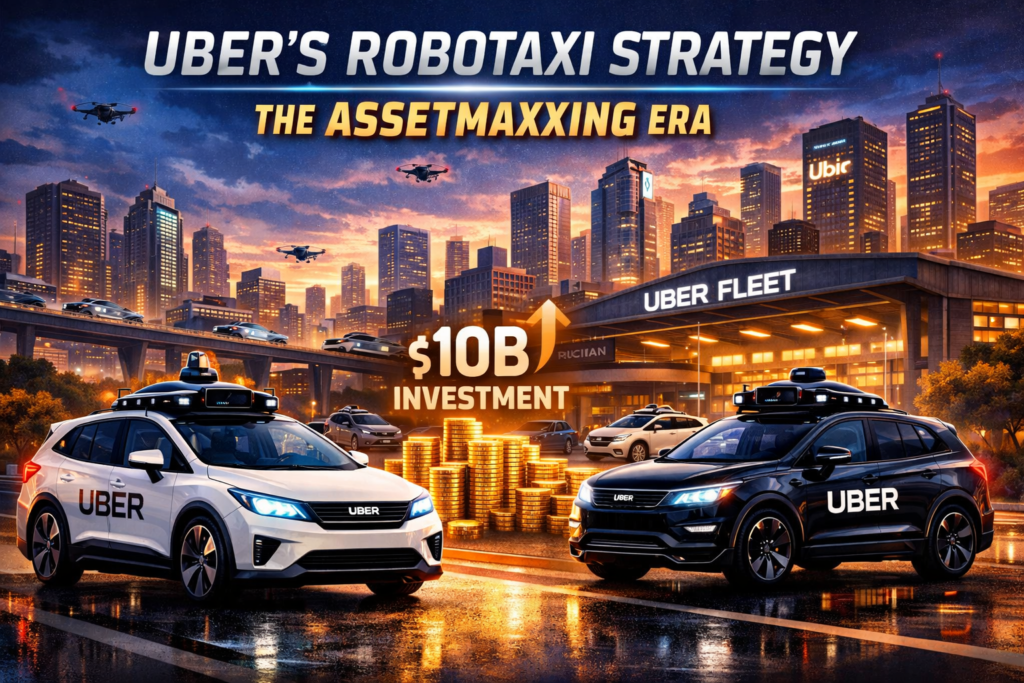
Uber’s robotaxi strategy has shifted dramatically — the company is no longer just a marketplace for rides; it is becoming a fleet owner investing over $10 billion in autonomous vehicles. If you want to understand who will dominate the self-driving future, the answer increasingly runs through Uber’s balance sheet. Uber robotaxi strategy
Over the past 18 months, Uber has quietly assembled the most ambitious autonomous vehicle investment portfolio of any ride-hailing company in the world. This post breaks down exactly what Uber is doing, why it matters, and what it signals for the robotaxi market in 2026 and beyond.
What Is Uber’s Robotaxi Strategy in 2026?
Definition: Uber’s robotaxi strategy in 2026 is a pivot from being a purely asset-light software platform to becoming an active owner and financier of autonomous vehicle fleets — a posture sometimes called “assetmaxxing.”
Rather than developing self-driving technology in-house, Uber is committing massive capital to purchase robotaxis built by third-party AV companies and take equity stakes in the startups developing that technology. According to Financial Times reporting in April 2026, Uber has committed more than $10 billion toward this goal — approximately $2.5 billion in direct equity investments and a further $7.5 billion earmarked for purchasing autonomous vehicles over the coming years.
This is not your 2015 Uber. The company that once evangelized the “asset-light” model — owning no cars, employing no drivers — is now betting its future on owning physical hardware.
From Asset-Light to Assetmaxxing — A Brief History
To fully understand Uber’s current robotaxi strategy, you need to appreciate the arc of the company’s relationship with physical assets.
The Moonshot Era (2015–2018)
Between 2015 and 2018, Uber went on an ambitious, asset-heavy spending spree. It launched:
- Uber ATG — an in-house autonomous vehicle research division
- Uber Elevate — an electric air taxi program
- Otto — a self-driving trucking startup acquired in 2016 for a reported $680 million
- Jump — a micromobility/bike-share startup acquired in 2018
The logic was vertical integration: own the full stack from software to hardware to vehicle.
The Great Sell-Off (2020)
In 2020, under pressure to reach profitability and battling the economic shockwaves of the COVID-19 pandemic, Uber reversed course entirely. It sold:
- Uber ATG → to Aurora Innovation
- Jump → to Lime
- Uber Elevate → to Joby Aviation
The company retained equity stakes in all three, but strategically stripped away the operational burden of running these moonshots. Former CEO Travis Kalanick has since called the decision to exit AV development a mistake, stating Uber “screwed up” by not maintaining an autonomous ride-sharing product.
The Return to Assets (2024–2026)
Uber is now entering its third — and arguably most consequential — asset-heavy chapter. This time, it is not building the technology. Instead, it is buying the vehicles that technology will power, and investing in the companies that will supply them.
The $10 Billion Bet — What Uber Is Buying
Uber’s robotaxi strategy centers on a portfolio of investments and purchase commitments across the autonomous vehicle ecosystem. Here are the confirmed major deals as of April 2026:
Key Autonomous Vehicle Partners
- WeRide — Uber invested $100 million to fuel robotaxi expansion across 15+ additional cities globally.
- Lucid & Nuro — A multi-million dollar investment to co-develop a dedicated robotaxi service vehicle.
- Rivian — A deal worth up to $1.25 billion for Rivian to build robotaxis, announced in March 2026.
- Wayve — A strategic investment in the UK-based AI driving software company to further develop self-driving technology compatible with Uber’s network.
- Delivery Hero — Uber increased its stake by 4.5% in April 2026, signaling continued expansion beyond passenger rides into autonomous delivery.
The $7.5 billion in vehicle purchase commitments represents a fundamental change in Uber’s business model. The company is essentially placing pre-orders on entire fleets of robotaxis it does not yet manufacture or operate.
Uber’s Robotaxi Strategy vs. Competitors: A Comparison
How does Uber’s “assetmaxxing” approach stack up against the other major players racing for the robotaxi market?
| Company | AV Technology Approach | Fleet Ownership | Revenue Model | Key Advantage |
|---|---|---|---|---|
| Uber | Third-party partnerships + equity stakes | Buying/leasing 3rd-party robotaxis | Platform fee + fleet revenue | Scale of existing rider network |
| Waymo (Alphabet) | Full in-house development | Owns all vehicles | Ride fare | Most mature commercial robotaxi operation |
| Tesla | In-house FSD software | Shared owner-fleet model | Software subscription + fares | Largest existing autonomous-capable vehicle fleet |
| Lyft | Partnership model (lighter) | No direct ownership | Platform fee | Lower capital exposure |
| WeRide | In-house AV stack | Company-owned + partnerships | Ride fare | Strong international footprint |
Key takeaway: Uber’s robotaxi strategy occupies a unique middle position — it is more capital-committed than Lyft but more partnership-dependent than Waymo or Tesla. Its edge is network effects: no other player has Uber’s existing demand infrastructure across hundreds of global cities.
Why Own the Fleet Instead of the Tech?
The core insight behind Uber’s robotaxi strategy is that the distribution layer — not the technology layer — may be the most durable moat in the autonomous vehicle industry.
Building self-driving technology is extraordinarily expensive and technically complex. Waymo has spent over a decade and tens of billions of dollars reaching commercial scale in just a handful of U.S. cities. By contrast, Uber already has the rider demand, driver infrastructure, app ecosystem, and regulatory relationships in place across hundreds of markets.
Owning robotaxis supplied by multiple technology partners means Uber is not betting on any single AV stack succeeding. If Wayve’s AI wins, Uber benefits. If Rivian’s robotaxi platform wins, Uber benefits. If WeRide scales internationally, Uber benefits. It is a diversified bet on the commercialization of autonomy, not on any single technical approach.
There are three structural reasons this strategy makes sense now:
- AV technology is maturing fast. The “build vs. buy” calculus has shifted as third-party AV systems approach commercial-grade reliability.
- Capital is the scarce resource. Many AV startups have strong technology but lack the capital and distribution to scale. Uber provides both.
- Platform economics favor aggregators. In most technology markets — from cloud to mobile apps — the platform that aggregates supply tends to capture more value than individual suppliers.
Risks and Challenges of Uber’s Asset-Heavy Pivot
Uber’s robotaxi strategy is not without significant risks. Here is an honest assessment of what could go wrong.
Technology risk: Uber is dependent on its AV partners delivering production-ready vehicles on schedule. Delays or safety incidents at any partner company directly affect Uber’s fleet deployment timeline.
Balance sheet exposure: The $7.5 billion in vehicle purchase commitments represents a major liability. Unlike software investment, physical vehicles depreciate, require maintenance, and create ongoing operational costs. This is a very different risk profile than Uber’s traditional business.
Regulatory fragmentation: Robotaxi regulations vary dramatically by city, state, and country. A vehicle approved in one jurisdiction may face a multi-year approval process in another. Uber’s global ambitions are constrained by highly localized regulatory processes.
Competitive disruption: Tesla’s Full Self-Driving ambitions and the potential launch of a competing Tesla robotaxi network in 2026–2027 could undercut Uber’s strategy if Tesla’s existing vehicle fleet reaches sufficient autonomy at scale.
Partner concentration risk: Despite multiple deals, a significant portion of Uber’s autonomous vehicle investment is concentrated in a small number of startups. If key partners like WeRide or Wayve face existential challenges, Uber’s timeline is disrupted.
What This Means for the Future of Ride-Hailing
Uber’s robotaxi strategy signals that the ride-hailing industry is undergoing a fundamental restructuring — from a labor marketplace to a capital-intensive logistics infrastructure business.
The implications extend beyond Uber itself:
- For drivers: The transition to autonomous fleets does not happen overnight, but Uber’s $10 billion commitment confirms that the long-term trajectory points toward significantly fewer human drivers on the platform.
- For investors: Uber’s balance sheet will look increasingly different over the next three to five years, with large vehicle asset positions that require new valuation frameworks.
- For AV startups: Uber’s willingness to commit billions in purchase orders is a lifeline for the autonomous vehicle startup ecosystem, which has been consolidating rapidly since 2023.
- For passengers: Competitive robotaxi pricing could ultimately make autonomous rides cheaper than human-driven rides, accelerating consumer adoption.
- For cities: As robotaxi fleets grow, urban planners will need to revisit parking, curb management, and traffic flow policies designed around privately owned vehicles.
The “assetmaxxing” era is not simply a financial story. It is the moment Uber chose to bet that the future of mobility is autonomous — and decided it wants to own as much of that future as possible.
❓ Frequently Asked Questions (FAQ)
1. What is Uber robotaxi strategy in 2026?
The Uber robotaxi strategy in 2026 refers to a major shift in how Uber approaches autonomous transportation. Instead of remaining purely a marketplace connecting riders with drivers, Uber is now actively investing in and acquiring fleets of autonomous vehicles. This Uber robotaxi strategy signals a move toward owning and financing robotaxis while still leveraging its global ride-hailing platform.
At its core, the Uber robotaxi strategy combines partnerships with leading autonomous vehicle companies and large-scale capital investment. Uber is not building self-driving technology from scratch anymore; instead, it is focusing on scaling deployment through partnerships and fleet ownership. This makes the Uber robotaxi strategy unique compared to competitors who either fully build their own technology or remain asset-light.
The goal of the Uber robotaxi strategy is to dominate the distribution layer of autonomous mobility. By controlling demand, infrastructure, and now parts of the supply through owned fleets, Uber is positioning itself as a central player in the robotaxi ecosystem.
2. Why is Uber investing heavily in robotaxis?
The Uber robotaxi strategy is driven by long-term economic and technological trends. Labor costs remain one of the biggest expenses in ride-hailing, and autonomous vehicles offer a path to significantly reduce those costs. By investing early, the Uber robotaxi strategy aims to secure a competitive advantage in a future where self-driving cars dominate urban transport.
Another reason behind the Uber robotaxi strategy is market positioning. Autonomous vehicles are expected to redefine the ride-hailing industry, and Uber wants to ensure it remains relevant. By committing billions, the Uber robotaxi strategy ensures that Uber is not left behind as competitors scale their own robotaxi networks.
Additionally, the Uber robotaxi strategy reflects a shift in capital allocation. Instead of spending heavily on uncertain R&D, Uber is investing in proven or near-commercial technologies through partnerships. This reduces risk while still allowing the company to benefit from advancements in autonomy.
3. How does Uber robotaxi strategy differ from competitors?
The Uber robotaxi strategy stands out because it blends elements of both asset-heavy and asset-light models. Companies like Waymo focus on building and operating their own autonomous technology and fleets, while others like Lyft maintain a lighter approach with minimal ownership. The Uber robotaxi strategy, however, sits in the middle.
Uber’s approach involves owning or leasing vehicles while relying on third-party technology providers. This allows the Uber robotaxi strategy to remain flexible and diversified. If one technology provider fails, Uber can pivot to another without rebuilding its entire system.
Another key difference in the Uber robotaxi strategy is its reliance on network effects. Uber already has millions of users globally, giving it a distribution advantage. This means the Uber robotaxi strategy can scale faster once vehicles are deployed, compared to competitors who must build both supply and demand simultaneously.
4. What is “assetmaxxing” in Uber robotaxi strategy?
“Assetmaxxing” is a term used to describe Uber’s shift toward owning more physical assets as part of its Uber robotaxi strategy. Historically, Uber was known for its asset-light model, where it did not own vehicles but simply connected drivers and riders. Now, the Uber robotaxi strategy embraces asset ownership as a competitive advantage.
In the context of the Uber robotaxi strategy, assetmaxxing means investing billions into purchasing or financing robotaxi fleets. This includes agreements with manufacturers and autonomous vehicle companies to secure large numbers of vehicles for future deployment.
The concept of assetmaxxing within the Uber robotaxi strategy highlights a broader industry shift. As autonomous technology matures, controlling physical infrastructure becomes increasingly important. Uber’s decision reflects its belief that ownership will play a critical role in long-term profitability.
5. Who are Uber’s key partners in its robotaxi strategy?
The Uber robotaxi strategy relies heavily on partnerships with leading companies in the autonomous vehicle space. These partnerships allow Uber to access cutting-edge technology without developing it internally. Some of the most important collaborators in the Uber robotaxi strategy include companies specializing in AI driving systems, electric vehicle manufacturing, and robotics.
Through these partnerships, the Uber robotaxi strategy gains access to diverse technologies and global markets. This diversification reduces risk and ensures that Uber can adapt as the industry evolves. Each partner contributes a different piece of the puzzle, from vehicle design to software integration.
The collaborative nature of the Uber robotaxi strategy also accelerates deployment. Instead of waiting years to build proprietary systems, Uber can quickly integrate partner technologies into its platform and begin scaling operations.
6. What are the biggest risks of Uber robotaxi strategy?
While the Uber robotaxi strategy offers significant opportunities, it also comes with notable risks. One of the primary concerns is technological dependency. Since Uber relies on external partners, any delays or failures in their systems could impact the overall success of the Uber robotaxi strategy.
Financial risk is another major factor. The Uber robotaxi strategy involves billions of dollars in investment, particularly in vehicle purchases. Unlike software, these physical assets depreciate over time and require maintenance, which could affect profitability.
Regulatory challenges also pose a threat to the Uber robotaxi strategy. Autonomous vehicle laws vary widely across regions, and gaining approval can be a slow process. This could delay the rollout of robotaxi services and limit the effectiveness of the Uber robotaxi strategy in certain markets.
7. How will Uber robotaxi strategy impact drivers?
The Uber robotaxi strategy is expected to have a significant impact on drivers over time. As autonomous vehicles become more prevalent, the need for human drivers may decrease. However, the transition driven by the Uber robotaxi strategy is likely to be gradual rather than immediate.
In the short term, the Uber robotaxi strategy may create hybrid models where human drivers and robotaxis coexist. This allows Uber to maintain service levels while gradually introducing autonomous fleets. Over time, the Uber robotaxi strategy could shift the workforce toward roles in fleet management, maintenance, and support.
Despite concerns, the Uber robotaxi strategy does not eliminate drivers overnight. Instead, it represents a long-term transformation of the ride-hailing ecosystem, where human involvement evolves alongside technology.
8. What does Uber robotaxi strategy mean for passengers?
For passengers, the Uber robotaxi strategy could bring several benefits. One of the most significant advantages is cost reduction. Without driver-related expenses, rides could become more affordable, making the Uber robotaxi strategy attractive to price-sensitive users.
Safety is another important aspect of the Uber robotaxi strategy. Autonomous vehicles are designed to minimize human error, which is a leading cause of accidents. As technology improves, the Uber robotaxi strategy could lead to safer transportation experiences.
Convenience will also improve under the Uber robotaxi strategy. With autonomous fleets operating around the clock, passengers may experience shorter wait times and more consistent service. This aligns with Uber’s goal of enhancing user experience through innovation.
9. How does Uber robotaxi strategy affect the future of ride-hailing?
The Uber robotaxi strategy is set to redefine the ride-hailing industry. By transitioning from a labor-based model to a technology-driven one, Uber is changing how transportation services are delivered. The Uber robotaxi strategy signals a shift toward automation and scalability.
This transformation could lead to increased competition as more companies enter the autonomous vehicle space. However, the Uber robotaxi strategy provides a strong foundation due to its existing user base and global reach. This gives Uber a competitive edge in capturing market share.
Ultimately, the Uber robotaxi strategy represents the future of mobility. As technology advances and adoption increases, ride-hailing will likely become more efficient, accessible, and cost-effective.
10. Is Uber robotaxi strategy a long-term success?
The success of the Uber robotaxi strategy depends on several factors, including technological progress, regulatory approval, and market adoption. While the strategy is ambitious, it aligns with broader industry trends toward automation and digital transformation.
In the long run, the Uber robotaxi strategy has the potential to generate significant returns. By combining fleet ownership with platform dominance, Uber can capture value across multiple layers of the ecosystem. This integrated approach makes the Uber robotaxi strategy a compelling long-term play.
However, success is not guaranteed. The Uber robotaxi strategy must navigate challenges such as competition, costs, and public acceptance. If executed effectively, it could position Uber as a leader in the autonomous mobility revolution.
11. How soon will Uber robotaxi strategy become mainstream?
The timeline for widespread adoption of the Uber robotaxi strategy depends on multiple variables, including technological readiness and regulatory approval. While pilot programs are already underway in some regions, full-scale deployment may take several years.
The Uber robotaxi strategy is designed to scale gradually. Early adoption will likely occur in cities with supportive regulations and advanced infrastructure. As these deployments prove successful, the Uber robotaxi strategy can expand to additional markets.
In the next decade, the Uber robotaxi strategy could become a dominant force in urban transportation. While the transition may not be immediate, the direction is clear, and Uber is positioning itself at the forefront of this transformation.
What is Uber’s robotaxi strategy?
Uber’s robotaxi strategy is to invest over $10 billion in purchasing autonomous vehicles from third-party manufacturers and taking equity stakes in AV technology companies — effectively building a robotaxi fleet without developing the underlying self-driving software itself.
How much is Uber investing in autonomous vehicles?
As of April 2026, Uber has committed more than $10 billion toward its robotaxi strategy: roughly $2.5 billion in direct equity investments in AV companies and $7.5 billion earmarked for purchasing robotaxi vehicles over the next several years.
Who are Uber’s key autonomous vehicle partners?
Uber’s major AV partners include WeRide, Wayve, Rivian, Lucid & Nuro, and Delivery Hero. Each partnership represents a different aspect of the autonomous vehicle value chain, from passenger robotaxis to delivery and freight.
How does Uber’s robotaxi strategy differ from Waymo’s?
Waymo builds its own autonomous driving technology end-to-end and operates its own fully owned fleet. Uber’s robotaxi strategy relies on buying vehicles from multiple third-party AV developers and partnering with several technology stacks simultaneously, betting on distribution and scale rather than proprietary technology.
What are the biggest risks to Uber’s robotaxi ambitions?
The primary risks include technology delays from AV partners, significant balance sheet exposure from vehicle purchase commitments, regulatory fragmentation across global markets, and potential competition from Tesla’s own robotaxi network.
Uber’s robotaxi strategy represents one of the most significant corporate pivots in tech history — a company that built its entire identity around owning nothing deciding to own billions of dollars in physical vehicles. Whether “assetmaxxing” becomes the winning playbook for the autonomous vehicle era, or a cautionary tale about overextension, will define the next decade of ride-hailing.