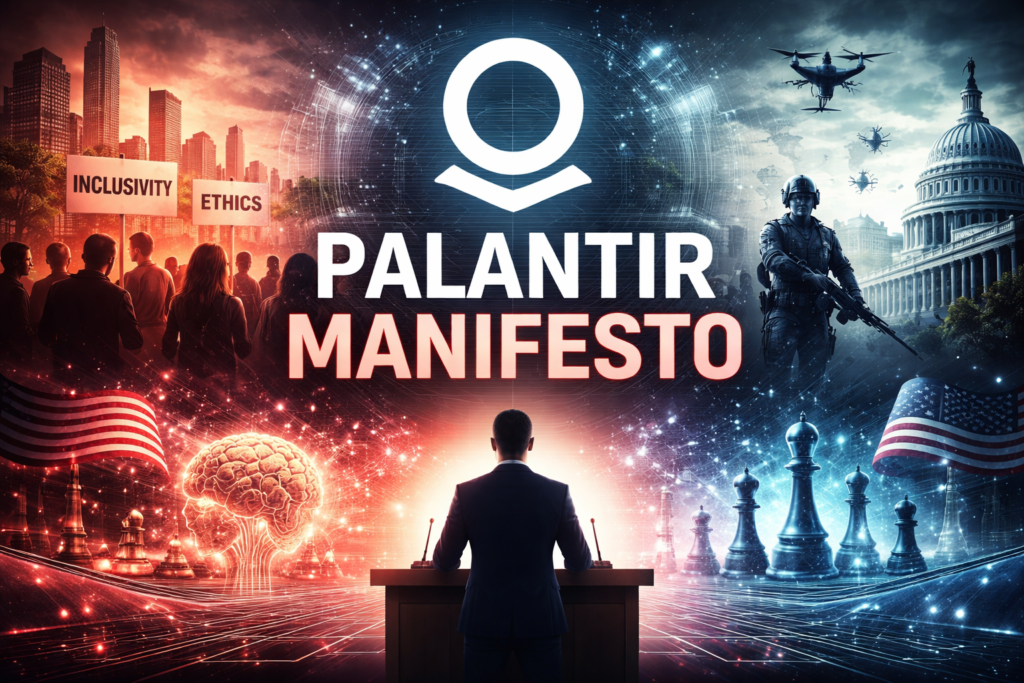
Palantir’s 22-point manifesto is the most politically charged corporate statement Silicon Valley has seen in years — and understanding it requires reading between the lines of every point. Published in April 2026 as a summary of CEO Alex Karp’s book The Technological Republic, the Palantir manifesto openly rejects pluralism, criticizes inclusivity culture, and frames the company as a defender of Western civilization against what it calls “regressive and harmful” cultures.
This is not a routine corporate statement. It’s an ideological declaration by one of America’s most powerful defense-tech companies — one that actively supplies AI and surveillance tools to the U.S. government.
What Is the Palantir Manifesto?
Definition: The Palantir manifesto is a 22-point public statement posted on Palantir’s official social media in April 2026. It summarizes the central arguments of The Technological Republic, the book co-authored by CEO Alex Karp and head of corporate affairs Nicholas Zamiska.
According to the company, the summary was posted “because we get asked a lot” — a casual framing for a document that touches on geopolitics, military AI ethics, immigration, and Western cultural decline.
The Palantir manifesto is notable not just for what it says, but for who is saying it: a publicly traded company with deep contractual ties to the U.S. Department of Defense, Immigration and Customs Enforcement (ICE), and intelligence agencies worldwide.
The 22-Point Summary — Key Claims Decoded
The full Palantir manifesto covers a wide range of topics. Here are the most consequential arguments it makes, broken into three major themes.
On Western Civilization and Silicon Valley’s “Moral Debt”
The manifesto opens with a direct challenge to Silicon Valley’s sense of self-satisfaction. Palantir argues that “Silicon Valley owes a moral debt to the country that made its rise possible” and that “free email is not enough.”
This is a pointed critique aimed at consumer tech companies — Google, Meta, Amazon — that have largely retreated from direct military and national security work under pressure from employees and activists. Palantir’s position is essentially: if you benefited from American prosperity and freedom, you owe something back beyond ad-funded apps.
The document also links cultural health to economic performance: “The decadence of a culture or civilization… will be forgiven only if that culture is capable of delivering economic growth and security for the public.” This is a transactional view of legitimacy — cultures earn their survival through output.
On AI, Military Power, and Deterrence
Perhaps the most consequential section of the Palantir manifesto concerns artificial intelligence and warfare.
“The question is not whether A.I. weapons will be built; it is who will build them and for what purpose,” the document states. This is a direct rebuttal to tech ethics debates and employee protest movements that have pushed companies like Google to exit military AI contracts.
Palantir frames the choice starkly: America’s adversaries will not pause for ethical debate, therefore American companies must not either. The manifesto also declares that “the atomic age is ending” while “a new era of deterrence built on A.I. is set to begin.”
This has direct business relevance. Palantir is one of the primary beneficiaries of Pentagon AI contracts, and this ideological framing functions simultaneously as a sales narrative and a geopolitical argument.
On Pluralism, Inclusivity, and “Regressive” Cultures
This is the most culturally provocative element of the Palantir manifesto, and the part that generated the most immediate backlash.
The document criticizes “the shallow temptation of a vacant and hollow pluralism,” arguing that blind devotion to pluralism and inclusivity “glosses over the fact that certain cultures and indeed subcultures… have produced wonders. Others have proven middling, and worse, regressive and harmful.”
The manifesto does not specify which cultures it considers “regressive.” That ambiguity is itself significant — it allows for multiple interpretations while avoiding the direct liability of naming them.
The document also criticizes a culture that “almost snickers at Elon Musk’s interest in grand narrative,” positioning grand ambition and mission-driven thinking as virtues being suppressed by a skeptical, irony-drenched cultural establishment.
Why the Palantir Manifesto Is Controversial
The Palantir manifesto drew immediate, widespread criticism for several reasons. Understanding each of them separately helps clarify what’s actually at stake.
It conflates culture ranking with corporate ideology. When a company that sells operational tools to police, immigration agencies, and military forces publicly declares that some cultures are “regressive,” it raises legitimate questions about how that ideology shapes product development and deployment decisions.
It uses philosophical language to justify existing commercial interests. Critics — including investigative journalism founder Eliot Higgins — noted that the 22 points aren’t floating philosophy. They are the stated public ideology of a company whose revenue depends on the very political arrangements it is advocating for.
It rejects deliberation and pluralism as democratic values. Higgins argued that the manifesto attacks key pillars of democratic governance: verification, deliberation, and accountability. In his reading, Palantir isn’t just being provocative — it’s making an argument that these friction-generating processes are a liability in a world of strategic competition.
It arrives at a politically charged moment. The Palantir manifesto was published while congressional Democrats were actively demanding answers about Palantir’s role in Trump administration deportation operations via ICE surveillance tools. The timing makes the document impossible to read in a vacuum.
Palantir Corporate Ideology vs. Mainstream Tech Culture
How does the Palantir manifesto stack up against the broader cultural norms of the tech industry? The contrast is stark.
| Dimension | Palantir’s Position | Mainstream Tech Industry Norm |
|---|---|---|
| Military AI | Actively embrace; adversaries won’t wait | Cautious; many firms exited DoD contracts after employee protests |
| Inclusivity & DEI | Criticized as “hollow pluralism” | Broadly affirmed as core company values |
| Cultural relativism | Rejected; some cultures produce “wonders,” others are “regressive” | Avoided; most companies avoid ranking cultures publicly |
| National duty | Silicon Valley owes a “moral debt” to America | Generally framed as global citizens; international customer bases |
| Grand narrative | Embraced; the West must be defended | Often avoided; tech companies prefer neutral, apolitical branding |
| Government surveillance work | Core to the mission; civic responsibility | Controversial; often resisted by engineering staff |
| Democratic deliberation | Implicitly seen as slowing critical work | Broadly valued as a societal good |
This table illustrates that the Palantir manifesto is not a slight deviation from industry norms — it is a comprehensive counter-ideology, touching nearly every major cultural debate in the tech sector.
The Business Context You Cannot Ignore
To understand the Palantir manifesto fully, you must understand Palantir’s revenue model. The company is not a consumer product business. Its customers are governments.
Its two primary platforms — Palantir Gotham (used by intelligence and defense agencies) and Palantir Foundry (used by commercial clients and government bodies) — are embedded in some of the most sensitive operational environments in the world.
Key business facts that frame the manifesto’s significance:
- Palantir has active contracts with the U.S. Department of Defense, including AI targeting and logistics platforms.
- It has contracts with ICE that are currently under congressional scrutiny, with lawmakers requesting transparency about the role of Palantir’s tools in the Trump administration’s immigration enforcement strategy.
- CEO Alex Karp has become one of the most visible and vocal proponents of Western military technological supremacy among Silicon Valley figures.
- Palantir’s government revenue has grown significantly, making the ideological alignment between the manifesto and its client base commercially rational, not merely philosophical.
The Palantir manifesto, in this light, is also a signal to potential government clients: we share your worldview, we will not retreat under pressure, and we are building the tools required to act on these convictions.
What Critics and Observers Are Saying
The response to the Palantir manifesto was swift and divided — largely along predictable ideological lines, though some of the most incisive criticism came from unexpected places.
Eliot Higgins (Bellingcat CEO) offered one of the most analytically sharp responses. He argued the manifesto is not simply a “defense of the West” but rather an attack on verification, deliberation, and accountability — the three mechanisms that make democratic governance correctable. His point: the manifesto frames these mechanisms as weaknesses, not strengths.
Congressional Democrats are currently demanding more transparency around Palantir’s ICE contracts, framing the company’s work as enabling aggressive and potentially rights-violating deportation operations. The manifesto arrived in the middle of this scrutiny.
One Bloomberg critic reviewed the original book, calling it “not a book at all, but a piece of corporate sales material.” That framing suggests the manifesto summary should be read not as philosophy but as marketing — a carefully crafted signal to the political and governmental constituencies Palantir depends on.
Supporters of Palantir’s position — primarily within defense-aligned communities and among those skeptical of DEI initiatives — praised the manifesto as a rare instance of corporate honesty. They argue that most tech companies hold similar views privately but lack the courage to state them publicly.
What Does a Corporate Manifesto Actually Signal?
What is a corporate manifesto? A corporate manifesto is a public declaration of a company’s values, worldview, and the principles that guide its decisions — going beyond mission statements to make explicit ideological commitments.
Corporate manifestos are rare because they are risky. They alienate customers, employees, and investors who disagree. Most companies prefer vague, inclusive language precisely to avoid the kind of polarization the Palantir manifesto has generated.
So why publish one? Three possible explanations:
- Identity consolidation. The Palantir manifesto may be designed to attract and retain the specific type of employee, investor, and client who shares this worldview — and to filter out those who don’t. Ideological clarity, in this view, is a talent and culture strategy.
- Political signaling. With government contracts under congressional scrutiny, publishing a manifesto that aligns with the current administration’s ideology may be a deliberate effort to reinforce Palantir’s position as a preferred vendor.
- Genuine conviction. Alex Karp is not a typical tech CEO. He studied philosophy at Goethe University Frankfurt under Jürgen Habermas. The Technological Republic may represent a genuine intellectual project, not just a PR exercise.
Whatever the motive, the effect is the same: Palantir has made itself impossible to ignore, and impossible to be neutral about.
Frequently Asked Questions About the Palantir Manifesto
What is the Palantir manifesto about?
The Palantir manifesto is a 22-point document summarizing CEO Alex Karp’s book The Technological Republic. It argues that Silicon Valley has a moral obligation to support Western defense, that AI weapons must be built by democratic nations before adversaries do, and that pluralism and inclusivity — when treated as absolute values — produce cultural mediocrity or harm.
Who wrote the Palantir manifesto?
The underlying book was co-authored by Alex Karp (Palantir’s CEO) and Nicholas Zamiska (Palantir’s head of corporate affairs). The 22-point summary was posted publicly by Palantir’s official account in April 2026.
Is Palantir’s manifesto connected to its government contracts?
Yes. Palantir holds significant contracts with U.S. defense and immigration agencies, including ICE. Critics argue the manifesto is inseparable from those commercial relationships — that it publicly advocates for the very political arrangements that generate Palantir’s revenue.
Why did the Palantir manifesto generate controversy?
The document’s rejection of pluralism and its claim that certain cultures are “regressive and harmful” drew immediate criticism. Combined with Palantir’s active role in immigration surveillance and military AI, observers noted that this is not abstract corporate philosophy — it is the public ideology of a company with operational influence over law enforcement and defense systems.
What did Palantir say about AI and warfare?
The Palantir manifesto argues that the “atomic age is ending” and a new era of AI-based deterrence is beginning. It states that adversaries will build AI weapons regardless of ethical debates, and therefore democratic nations — and companies like Palantir — must proceed without hesitation.
The Bottom Line
The Palantir manifesto is many things simultaneously: a philosophical statement, a marketing document, a political signal, and a cultural provocation. What it is not is accidental or casual.
In posting a 22-point rejection of pluralism, inclusivity, and democratic deliberation, Palantir has made an explicit choice to be a company with a declared worldview — one that happens to align precisely with the governments it sells to and the political moment it operates in.
Whether you view the Palantir manifesto as a courageous act of intellectual honesty or a dangerous conflation of corporate ideology with institutional power, one thing is clear: the era of tech companies hiding behind neutral, apolitical branding is ending. Palantir has chosen its side. The rest of Silicon Valley will have to decide what to do about that.