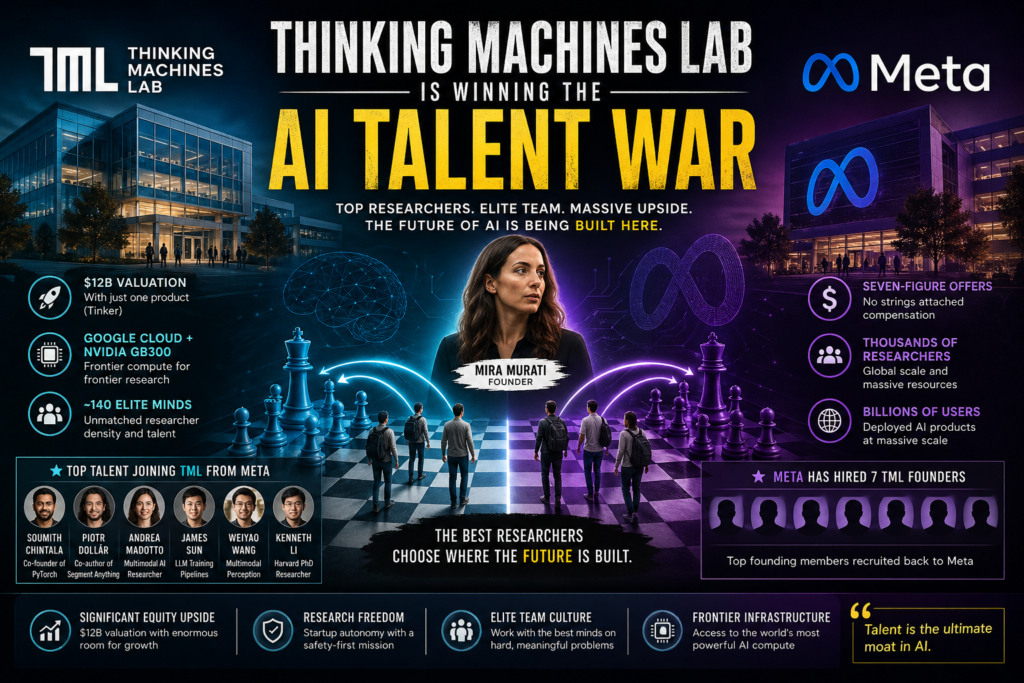
Thinking Machines Lab has quietly become the most aggressive talent magnet in artificial intelligence. If you want to understand where the global AI talent war is being fought in 2026, look no further than the revolving door between Meta’s AI research division and Mira Murati’s fast-rising startup.
What Is Thinking Machines Lab?
Definition: Thinking Machines Lab (TML) is an AI research startup founded by Mira Murati, the former CTO of OpenAI, launched in 2025 with a mission to build advanced AI systems with a focus on safety and scientific rigor.
Expansion: Despite having released just one product to date — a tool called Tinker — Thinking Machines Lab has already achieved a valuation of $12 billion, closed a multibillion-dollar cloud deal with Google, and assembled a roster of some of the most decorated AI researchers in the world. Its headcount now stands at around 140 people, but the quality-per-seat ratio may be unmatched anywhere in the industry.
The Google deal, announced at Google Cloud Next in April 2026, gives TML access to Nvidia’s latest GB300 chips, placing the startup in the same infrastructure tier as Anthropic and Meta. For a company that has barely launched a product, this is a remarkable position to occupy.
The AI Talent War Between Meta and Thinking Machines Lab
The competition for AI talent between large tech incumbents and well-funded startups is nothing new. But the specific dynamic between Meta and Thinking Machines Lab has taken on the character of a full-scale proxy war — with researchers moving in both directions and billions of dollars at stake on each side.
Meta reportedly held acquisition talks with Thinking Machines Lab around early 2025, but that deal never materialized. Since then, Meta has been systematically hiring away TML’s founding members — Business Insider reported that Meta has poached seven of TML’s founders — while TML has been aggressively counter-recruiting from Meta’s own research ranks.
At least based on a review of LinkedIn profiles, TML has been hiring more researchers from Meta than from any other single employer.
Who Has Thinking Machines Lab Poached from Meta?
The caliber of researchers Thinking Machines Lab has pulled from Meta reads like a highlights reel of the company’s most consequential AI work:
- Soumith Chintala — TML’s CTO. Spent 11 years at Meta and co-founded PyTorch, the open-source deep learning framework that now underpins the majority of the world’s AI research. Left Meta in late 2025.
- Piotr Dollár — 11-year Meta veteran, former research director, and co-author of the landmark Segment Anything model. Now on TML’s technical staff.
- Andrea Madotto — Research scientist from Meta’s FAIR division, specializing in multimodal language models. Joined TML in December 2025.
- James Sun — Software engineer with nearly nine years at Meta working on LLM pre- and post-training pipelines.
- Weiyao Wang — Eight-year Meta veteran who helped build multimodal perception systems and contributed to open-world segmentation projects including SAM3D. Joined TML in April 2026.
- Kenneth Li — Harvard PhD who spent 10 months at Meta before making the move to TML this month.
This list is not exhaustive. The pattern is consistent: senior, technically accomplished researchers who built some of Meta’s most important AI infrastructure are choosing Thinking Machines Lab.
Who Has Meta Poached from Thinking Machines Lab?
Meta has not been passive. Using its famously generous compensation packages — reportedly reaching seven figures with no strings attached — the company has successfully recruited seven of TML’s founding members. The specifics of those individuals have not been fully disclosed, but the scale signals that Meta views TML as a serious competitive threat, not just a talent competitor in the abstract.
The bidirectional nature of this talent exchange is unusual. Most startup-versus-incumbent talent battles run predominantly one way. The fact that researchers are moving in both directions at this level of seniority suggests that Thinking Machines Lab is genuinely competitive with Meta on dimensions beyond compensation alone.
TML vs. Meta: AI Career Destination Comparison
| Factor | Thinking Machines Lab | Meta AI |
|---|---|---|
| Valuation / Stability | $12B (seed stage, high upside) | Public company, stable |
| Compensation | Competitive equity-heavy packages | Seven-figure cash, no strings attached |
| Infrastructure | Google Cloud + Nvidia GB300 chips | World-class proprietary infrastructure |
| Research Freedom | Startup autonomy, founding-team culture | Large org, more defined roles |
| Upside Potential | Significant equity appreciation possible | Limited equity upside |
| Team Density | ~140 people, elite concentration | Thousands of researchers globally |
| Product Stage | Pre-scale, building foundational systems | Multiple deployed products at billions of users |
| Mission Clarity | Focused on advanced AI + safety | Broad mandate across social, VR, AI |
Why Are Top AI Researchers Choosing Thinking Machines Lab Over Big Tech?
The obvious question is: why leave a Meta paycheck — potentially worth millions annually, unconditionally — for a 140-person startup? The answer is multi-layered, and it tells us something important about how elite AI talent evaluates opportunity in 2026.
Financial Upside: The Equity Calculus
Thinking Machines Lab is currently valued at $12 billion. That figure would have been unimaginable for a pre-product company in any previous technology cycle. Yet compared to the valuations of OpenAI (reportedly over $300 billion) and Anthropic (over $60 billion), there remains substantial room for appreciation.
For a researcher joining TML at this stage with meaningful equity, the financial upside of being early to a company that could 10x its valuation is real. Meta stock offers stability; TML equity offers a lottery ticket with unusually good odds — written by Mira Murati, who helped build one of the most valuable AI companies in history.
Infrastructure Access: No Longer a Startup Handicap
Historically, one of the strongest arguments for staying at a large tech company was access to compute. Training frontier AI models requires enormous infrastructure, and startups simply couldn’t compete.
That dynamic is eroding. The Google Cloud deal gives Thinking Machines Lab access to Nvidia’s GB300 chips — among the most powerful AI accelerators currently available — making it one of the first startups to run on this hardware. Combined with an earlier partnership with Nvidia, TML now operates at an infrastructure level that would have been exclusive to hyperscalers just two years ago.
For researchers whose work depends on compute, this removes a critical barrier to joining.
Founding-Team Culture and Intellectual Density
The third factor is harder to quantify but arguably the most powerful: the quality of the people in the room.
Thinking Machines Lab has assembled a team that includes the co-founder of PyTorch, a co-author of Segment Anything, a three-time gold medalist at the International Olympiad in Informatics (Neal Wu, formerly of Cognition), and researchers who have previously held positions at OpenAI, Anthropic, Waymo, Windsurf, Apple, and Microsoft’s AI Superintelligence team.
At 140 people, TML has a researcher-to-noise ratio that large organizations structurally cannot replicate. Many of the world’s best AI researchers want to work with other world-class researchers on hard, open problems — and Thinking Machines Lab is building exactly that environment.
Beyond Meta: The Broader Talent Picture at TML
While the Meta dynamic dominates the headlines, Thinking Machines Lab is pulling talent from across the AI ecosystem:
- Neal Wu — Three-time gold medalist at the International Olympiad in Informatics; founding member of AI coding startup Cognition. Joined TML early 2026.
- Jeffrey Tao — Came via Waymo, Windsurf, and OpenAI.
- Muhammad Maaz — Previously held a research fellowship at Anthropic.
- Erik Wijmans — Arrived from Apple.
- Liliang Ren — Spent two and a half years on Microsoft’s AI Superintelligence team pre-training OpenAI models for code before joining in March 2026.
This diversity of origin reinforces the conclusion that Thinking Machines Lab is not simply a Meta alternative — it is becoming the destination of choice for researchers leaving elite AI positions across the entire industry.
What This Means for the Broader AI Industry
The talent dynamics around Thinking Machines Lab reveal several important truths about where the AI industry is heading.
Elite talent is the real moat. In a world where compute is increasingly available through cloud partnerships and open-source model weights proliferate, the concentration of exceptional researchers may be the most defensible competitive advantage. TML understands this, and its hiring strategy reflects it.
Startups can now compete on infrastructure. The Google Cloud deal demonstrates that the infrastructure gap between frontier labs and hyperscalers is narrowing for well-capitalized startups. This will accelerate the movement of talent away from big tech, as one of the primary non-compensation reasons to stay — compute access — weakens.
The AI talent war has no clear winner yet. Meta’s ability to attract seven of TML’s founders shows that cash remains a powerful force. But TML’s ability to recruit back from Meta — and from OpenAI, Anthropic, Apple, and Microsoft — shows that something more than money is driving decisions. The outcome of this war will shape which organizations produce the most significant AI advances over the next decade.
Valuation gravity matters. At $12 billion with one product, Thinking Machines Lab has created a self-reinforcing signal of credibility. Each high-profile hire makes the next one easier. Each infrastructure deal makes the equity more credible. The company is in a virtuous cycle that makes it increasingly difficult for other startups — and even some big tech companies — to compete for the same talent.
Frequently Asked Questions
What is Thinking Machines Lab? Thinking Machines Lab is an AI research startup founded by Mira Murati, former CTO of OpenAI. Valued at $12 billion, the company is focused on building advanced AI systems and has signed major infrastructure deals with Google and Nvidia.
Why are Meta researchers joining Thinking Machines Lab? Researchers are drawn to Thinking Machines Lab for a combination of reasons: significant equity upside given its current valuation, access to frontier compute infrastructure through Google Cloud, and the opportunity to work in a small, high-density team of elite researchers.
How many people has Thinking Machines Lab hired from Meta? Based on a review of LinkedIn profiles, TML has hired at least six senior researchers and engineers from Meta, including Soumith Chintala (co-founder of PyTorch), Piotr Dollár (co-author of Segment Anything), and several others with deep LLM and multimodal AI expertise.
Has Meta hired from Thinking Machines Lab? Yes. Meta has reportedly hired seven of TML’s founding members, using its well-known seven-figure compensation packages to attract talent back to the company.
Is Thinking Machines Lab a good company to work for? By most signals available — the caliber of its hires, the infrastructure deals it has closed, and the valuation it has achieved pre-product — Thinking Machines Lab appears to be one of the most compelling opportunities in AI research for researchers who prioritize intellectual density, equity upside, and startup autonomy.
The Bottom Line
The AI talent war playing out between Thinking Machines Lab and Meta is not just a story about compensation or even company prestige. It is a story about where the future of AI is being built — and by whom.
Thinking Machines Lab has demonstrated that a well-led, well-capitalized AI startup can credibly compete for the best researchers in the world, even against companies spending hundreds of millions on compensation alone. By combining a compelling equity story, frontier infrastructure, and an extraordinarily dense founding team, TML has created an environment that the best researchers in the world are actively choosing over Big Tech.
The talent war is far from over. But right now, Thinking Machines Lab is winning a disproportionate share of it.