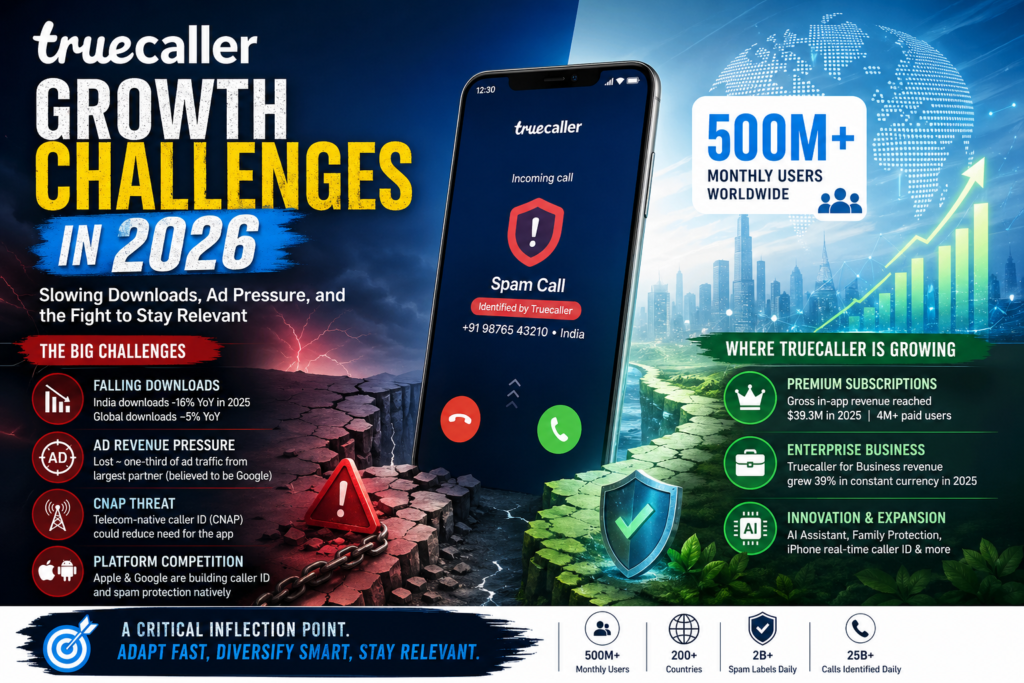
Truecaller’s growth challenges are real and accelerating — downloads are falling, its top ad partner cut traffic by a third, and both telecom networks and smartphone makers are now building the features that made Truecaller famous. Yet the company’s in-app revenue is rising sharply, its enterprise segment grew 39% in 2025, and it still commands over 500 million monthly users. Whether Truecaller can navigate this inflection point depends on how fast it diversifies away from the two things threatening it most: ad dependency and single-market concentration. (Truecaller growth challenges 2026)
This article unpacks every dimension of Truecaller’s current position — the threats, the numbers, and the strategic moves the company is making in response.
What Are Truecaller’s Growth Challenges in 2026?
Definition: Truecaller’s growth challenges refer to the convergence of slowing user acquisition, advertising revenue disruption, platform-level competition from Apple and Google, and the emergence of telecom-native caller ID systems — all arriving simultaneously as the company’s core India market matures.
For most of its history, Truecaller operated in a relatively uncrowded space: it solved a real problem (spam and unknown calls) in a market where telecom infrastructure alone couldn’t solve it. That moat is narrowing. The Truecaller growth challenges of 2026 are not one crisis but several overlapping pressures compressing at the same time.
The company went public in 2021 at significant optimism. Since then, its shares have fallen approximately 78%, and are down roughly 37% in 2026 alone — a signal that investors are actively reassessing the long-term business model.
The Download Decline — What the Numbers Show
Truecaller’s download trajectory tells a clear story. According to data from Appfigures, global downloads peaked at 175 million in 2021, dropped sharply through 2022, and have since stabilized at around 120 million annually — a structural plateau, not a blip.
More pointedly, Sensor Tower data shared with TechCrunch shows:
- India downloads fell 16% year-over-year in 2025
- Global downloads declined 5% in the same period
- This marks a reversal after several consecutive years of growth
These Truecaller growth challenges at the acquisition level are significant because Truecaller’s business model depends on scale. Advertising revenue — which accounts for 65–70% of total revenue — is a function of monthly active users and engagement. Fewer new users means a slower growth ceiling for ads.
India’s Shrinking Share
India accounts for over 350 million of Truecaller’s 500+ million monthly users — roughly 70% of its global base. But India’s share of new downloads has declined from over 70% at its peak to the mid-50s in recent years. The app is still deeply embedded in Indian communication culture, but the country is no longer the engine of net new growth it once was.
This geographic concentration is itself one of Truecaller’s structural vulnerabilities. When a single market represents the majority of both users and revenue, a slowdown there doesn’t just dent results — it threatens the entire growth narrative.
The Ad Revenue Crisis — The Most Immediate Threat
While download deceleration is a slow-moving problem, Truecaller’s advertising challenge is acute and immediate. With 65–70% of revenue coming from ads, the business is fundamentally an advertising platform that happens to offer caller ID — and that platform just lost a significant chunk of its traffic.
The Google Algorithm Problem
In August 2025, Truecaller lost approximately one-third of its ad traffic from its largest ad partner — a partner that analysts on the company’s earnings call identified as Google. Truecaller CEO Rishit Jhunjhunwala attributed the drop to an unresolved “algorithm issue.” CFO Odd Bolin confirmed that this partner still accounts for more than a third of total revenue.
This is the most pressing of all Truecaller’s growth challenges in the near term. Losing a third of traffic from a partner that represents a third of revenue is a material hit. The math is severe: if a partner representing ~35% of revenue sends 33% less traffic, total revenue could theoretically decline by 10–12% from that factor alone — before any other headwinds.
The broader issue is structural dependency. Advertising is intensely competitive; brands can allocate budgets across Facebook, Google, Instagram, YouTube, and dozens of other platforms. Truecaller is competing for spend it cannot fully control.
Building an In-House Ad Exchange
Truecaller’s response is to reduce reliance on any single partner. The company is actively adding new ad partners and building its own in-house ad exchange — a move that would give it more control over inventory, pricing, and fill rates.
However, building a competitive ad exchange is a long-term play. It requires attracting advertisers directly, building the tooling, and establishing the trust that programmatic platforms take years to develop. Analyst Bharath Nagaraj of Cantor Fitzgerald told TechCrunch that advertising remains highly competitive regardless of platform ownership: “You can show your ads on Truecaller, but you can also show them on Facebook.”
CNAP and Platform-Level Caller ID — The Structural Threats
Beyond advertising, Truecaller’s growth challenges extend to the core product itself. Two forces are converging that could diminish the need for a standalone caller ID app: telecom-native CNAP and OS-level spam protection.
What Is CNAP and How Does It Affect Truecaller?
CNAP (Calling Name Presentation) is a telecom-layer feature, pushed by India’s telecom regulator (TRAI), that displays a caller’s name — derived from their KYC records — directly on the receiving phone, without requiring any third-party app. Indian telecom operators are currently running pilot programs.
The critical distinction is where the identification happens: at the network level, not the application layer. This matters because it sidesteps Truecaller entirely for basic caller name display.
| Feature | Truecaller | CNAP |
|---|---|---|
| Data Source | Crowdsourced + user-generated database | KYC records from telcos |
| Spam Detection | Advanced, AI-powered, community-flagged | Limited or none initially |
| Business Identity | Verified business caller ID available | Not included |
| App Required | Yes | No |
| Accuracy | High for known numbers, broad coverage | Accurate for verified subscribers only |
| Global Reach | 500M+ users, international | India-specific telecom rollout |
| AI Features | AI Assistant, call screening | None currently |
Truecaller’s Jhunjhunwala has pushed back on the CNAP threat, calling it “validation of the problem” rather than disruption: Truecaller operates with a much richer intelligence layer — spanning spam detection, fraud prevention, business identity, and user context across calls and messages. Nagaraj of Cantor Fitzgerald agrees that CNAP is more likely to slow user growth than to materially disrupt Truecaller’s core business in the near term.
The more accurate framing: CNAP removes a key acquisition trigger (basic caller ID) without replicating Truecaller’s deeper features. New users who might have downloaded Truecaller for name display alone may no longer feel compelled to. That affects growth more than retention.
Apple and Google Are Moving In
Separate from CNAP, smartphone platforms are building caller ID and spam-blocking capabilities natively:
- Apple expanded call-screening capabilities in iOS 26, which could reduce the need for third-party caller ID apps among iPhone users
- Google has been rolling out AI-based spam protection on Android, with Airtel also deploying its own AI spam detection
Truecaller’s iOS presence has grown from under 5% of downloads in 2020–2021 to around 11–12% recently — a sign that the company is gaining higher-value iPhone users. But Apple’s own call-screening expansion creates friction at exactly the moment Truecaller is investing in its iOS offering.
This is the long-term structural risk: as caller ID becomes a commodity feature built into every phone and every network, the standalone value proposition of Truecaller must migrate to features that platforms cannot or will not replicate.
Truecaller vs. Competitors — A Comparison
Understanding Truecaller’s growth challenges also requires knowing what it’s competing against on multiple fronts simultaneously.
| Competitor Type | Example | Main Threat to Truecaller |
|---|---|---|
| Telecom Network Feature | CNAP (India) | Replaces basic caller ID without app |
| OS-Level Feature | iOS Call Screening, Android Spam Protection | Reduces need for third-party app |
| Regional Caller ID Apps | Hiya, Mr. Number (US market) | Limits international expansion |
| Enterprise Communication Platforms | Truecaller’s own segment (B2B) | Internal cannibalization risk is low |
| Ad Networks | Google, Meta | Compete for the same advertiser budgets |
The multi-front nature of competition is what makes Truecaller’s position uniquely complex. Most companies face one dominant competitor. Truecaller faces: telecom operators, smartphone OSes, regional apps, and ad networks — all simultaneously.
Where Truecaller Is Finding New Revenue
Not everything is under pressure. The Truecaller growth challenges narrative is complicated by the fact that two of its three revenue streams are growing strongly.
In-App Subscriptions Are Surging
Despite download stagnation, gross in-app revenue has risen dramatically:
- 2017: $600,000
- 2025: $39.3 million
- 2026 (through April 20): $13.4 million already — on pace for its biggest year
Monthly in-app revenue is now consistently above $2 million per month, per Appfigures. This growth comes from Truecaller’s premium subscription tier, which offers features including:
- Advanced spam protection
- AI-based call screening
- Ad-free experience
- Family Protection (screening calls on behalf of family members)
The company has over 4 million paid subscribers globally. While that’s a fraction of its 500 million monthly users, the conversion trend is moving in the right direction — and premium subscribers generate far more revenue per user than ad-supported free users.
The shift also signals something strategically important: Truecaller is demonstrating willingness to pay exists for its features. That’s the foundation of a more durable Truecaller monetization strategy.
Enterprise: The B2B Growth Engine
Truecaller for Business is the company’s fastest-growing segment. It enables companies to verify their identity and reach customers through verified calls and messaging — essentially, enterprise-grade caller authentication.
Key metrics:
- Revenue grew 39% in constant currency in 2025
- The platform is expanding globally
- New chat services are being opened to partners
This segment addresses a real and growing need: as AI makes voice scams and deepfake calls more sophisticated, businesses need verified identity infrastructure to maintain customer trust. Truecaller’s database of 500+ million users and its spam-detection intelligence are genuine competitive assets in this space.
Unlike the consumer ad business, enterprise relationships are stickier. A company that integrates Truecaller for Business into its customer communication stack doesn’t churn because of a Google algorithm update.
Can Truecaller Adapt? What the Outlook Looks Like
Truecaller’s growth challenges are real, but so is its adaptation. The company is simultaneously: building an in-house ad exchange, expanding enterprise globally, growing a premium subscriber base, investing in AI features (AI Assistant, Family Protection), and launching real-time caller ID on iPhone.
The central question is timing. Can these new revenue streams grow fast enough to compensate for ad revenue pressure and decelerating user growth before investor patience runs out? The stock’s 78% decline since its 2021 IPO suggests the market’s current answer is skeptical.
There are also unresolved questions about Truecaller’s data practices. An investigation by The Caravan raised concerns about consent and data collection in India, where privacy laws have historically been less stringent. As India’s data protection framework evolves, compliance costs and reputational risk could become an additional variable in the Truecaller growth challenges equation.
The most optimistic scenario: CNAP delivers only limited disruption, the in-house ad exchange reduces dependency on Google, enterprise revenue sustains 30%+ growth, and premium subscriptions cross 10 million paid users. In this scenario, Truecaller has successfully transitioned from a single-product consumer app to a multi-revenue communication intelligence platform.
The risk scenario: CNAP accelerates faster than expected, Apple’s call-screening features further erode Truecaller’s iPhone value proposition, and the in-house ad exchange fails to attract sufficient advertiser demand. In this case, declining ad revenue is not offset by subscription and enterprise growth fast enough to satisfy markets.
The honest answer is that Truecaller is in a transition — and transitions are the most uncertain periods for any technology company.
Frequently Asked Questions
What are Truecaller’s biggest growth challenges in 2026?
Truecaller’s growth challenges in 2026 include: a 16% year-over-year decline in India downloads, loss of roughly one-third of ad traffic from its largest partner (believed to be Google), increasing competition from telecom-native CNAP caller ID, and expanding OS-level spam protection from Apple and Google. These pressures arrive simultaneously as the company’s primary market matures.
Is CNAP a serious threat to Truecaller?
CNAP is a meaningful headwind for user acquisition — it removes the basic caller ID trigger that drives many new downloads. However, analysts currently view it as a growth-slowing risk rather than an existential threat, since CNAP lacks Truecaller’s spam detection, business identity, and AI features.
How does Truecaller make money?
Truecaller’s monetization strategy has three pillars: advertising (currently 65–70% of revenue), premium consumer subscriptions (over 4 million paid users globally), and Truecaller for Business (enterprise caller identity and verified communication). The company is actively trying to shift its revenue mix away from advertising dependency.
Why has Truecaller’s stock fallen so much?
Truecaller’s shares have declined approximately 78% since its 2021 IPO and are down ~37% in 2026. Investors are concerned about slowing user growth, the impact of CNAP in India, ad revenue dependency and the loss of a major ad partner, and the structural risk of OS-level caller ID features replacing the need for third-party apps.
What is Truecaller doing to grow its revenue beyond ads?
Truecaller is investing in three areas: building an in-house ad exchange to reduce dependence on Google, scaling its premium subscription business (which saw gross in-app revenue rise to $39.3 million in 2025), and expanding Truecaller for Business globally — an enterprise segment that grew 39% in constant currency in 2025.
Conclusion: Navigating the Turning Point in Truecaller’s Journey
The Truecaller growth challenges 2026 represent a defining moment in the company’s evolution, not just a temporary slowdown. What makes the Truecaller growth challenges 2026 particularly significant is the convergence of multiple pressures at once—declining downloads, heavy reliance on advertising revenue, and increasing competition from telecom providers and smartphone platforms. Unlike past hurdles, the Truecaller growth challenges 2026 are structural, signaling a shift in how the market values caller identification and communication intelligence.
At the core of the Truecaller growth challenges 2026 is the reality that its original value proposition is being commoditized. Features that once made Truecaller indispensable—like caller ID and spam detection—are now being integrated directly into operating systems and telecom infrastructure. This means the Truecaller growth challenges 2026 are not just about growth slowing down, but about redefining relevance in a rapidly changing ecosystem.
However, the Truecaller growth challenges 2026 also highlight the company’s resilience and adaptability. The sharp rise in premium subscriptions and the strong performance of its enterprise segment show that Truecaller is not standing still. Instead, it is actively building new revenue streams that could reduce its dependence on advertising. In many ways, the Truecaller growth challenges 2026 are forcing the company to evolve into a more diversified and sustainable business model.
Another critical aspect of the Truecaller growth challenges 2026 is geographic concentration. With a significant portion of its user base in India, any slowdown in that market has an outsized impact. This makes global expansion not just an opportunity but a necessity. Successfully addressing the Truecaller growth challenges 2026 will depend heavily on how well the company can replicate its success in other regions while adapting to different regulatory and competitive environments.
The role of innovation cannot be overlooked when analyzing the Truecaller growth challenges 2026. Features like AI-powered call screening, family protection, and verified business communication are not just add-ons—they are essential to maintaining differentiation. If executed effectively, these innovations could transform the narrative around the Truecaller growth challenges 2026 from one of decline to one of reinvention.
Ultimately, the Truecaller growth challenges 2026 are a test of strategic execution. The company has the scale, brand recognition, and data advantage to remain a key player in the communication ecosystem. But success will depend on how quickly and effectively it can shift its focus from being a caller ID app to becoming a comprehensive communication intelligence platform.
In conclusion, the Truecaller growth challenges 2026 are not the end of the road—they are a crossroads. Companies that survive such transitions often emerge stronger, more focused, and better aligned with future market demands. Whether Truecaller can achieve that transformation will determine if it remains relevant in the years ahead or becomes a case study in missed opportunities.