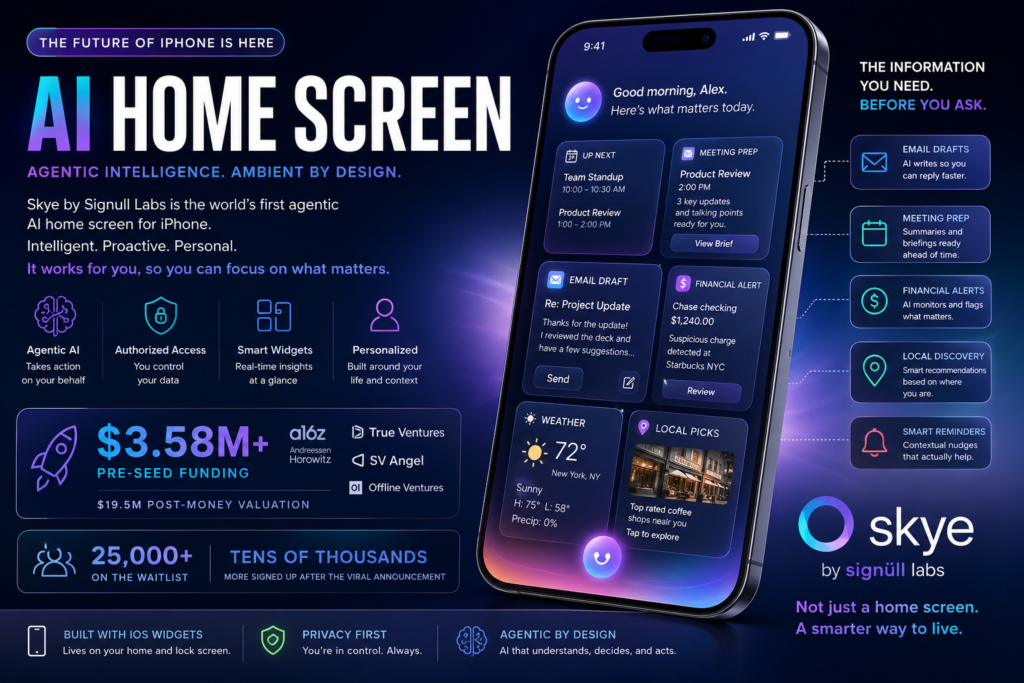
The way you interact with your iPhone is about to fundamentally change. Skye, the AI home screen app built by Signull Labs, has already attracted $3.58 million in pre-seed funding and tens of thousands of waitlist signups — before a single public user has downloaded it. Here’s everything you need to know about why this matters.
What Is an AI Home Screen — and Why It Matters Now
An AI home screen is not just another chatbot widget bolted onto your phone. It is a fundamentally different paradigm for how a smartphone surfaces information, takes action, and anticipates your needs — without you ever having to open a single app.
Traditional iPhone home screens are static grids of icons. You decide what to open, when to open it, and what to do inside it. The AI home screen flips that model. Instead of you going to the information, the information — curated, contextual, and intelligent — comes to you.
Think of it as the difference between a filing cabinet and a sharp personal assistant. The filing cabinet holds your stuff. The assistant knows what you need before you ask.
As AI systems grow more capable of understanding personal context — your calendar, your location, your bank activity, your health data — the AI home screen becomes the natural place to surface that intelligence. Not buried inside an app. Right there, on your lock screen or home screen, as a living, breathing interface.
This is why Skye has generated such intense investor and consumer interest, and why the concept is now drawing comparisons to a new category of AI-native devices altogether.
Skye by Signull Labs: The App Redefining the iPhone Experience
Skye is being developed by Signull Labs, a New York-based startup founded by Nirav Savjani (who goes by “signüll” on X). The app, currently in private testing, describes itself as an “agentic homescreen” for the iPhone — a term that neatly captures what makes it different from everything else in the App Store.
According to TechCrunch’s April 2026 report, Signull Labs has raised over $3.58 million in a pre-seed round that closed in September 2025, with backers including Andreessen Horowitz (a16z), True Ventures, SV Angel, and Offline Ventures. The company’s post-money valuation is listed at $19.5 million on Pitchbook.
Savjani previously worked at Google and Meta, though he has maintained a deliberately low public profile. After a viral launch announcement on X, the app accumulated “tens of thousands” of new waitlist signups on top of an existing 25,000+ — suggesting that demand for a smarter AI home screen is very real.
How the Agentic Home Screen Works
Skye uses iOS widgets as its primary interface layer. Rather than launching a dedicated app, the AI home screen lives on your existing iPhone home screen and lock screen through these widgets, delivering ambient intelligence in real time.
The data powering Skye’s widgets is pulled from authorized connections the user grants — email accounts, calendars, banking apps, health data, and location services. This authorized-access model is crucial: it means the AI has the context it needs to be genuinely useful, while the user retains explicit control over what data is shared.
The “agentic” part of the name is equally important. Agentic AI doesn’t just display information — it takes action on your behalf. Skye is designed to go beyond passive dashboards and actually do things for you within the boundaries you set.
What Skye Can Actually Do
Based on Signull Labs’ public announcements, the Skye AI home screen is capable of a range of tasks that span information display, proactive assistance, and light task execution:
- Personalized weather and context: Hyper-local weather information matched to your current location and daily schedule.
- Email drafting: AI-generated reply drafts surfaced directly in a widget, so you can respond without opening your mail app.
- Meeting preparation: Summaries and briefings pulled together ahead of calendar events.
- Smart reminders: Contextual reminders that factor in your schedule and location.
- Financial monitoring: Flagging suspicious charges in bank accounts linked through authorized connections.
- Local discovery: Location-specific recommendations for businesses, restaurants, neighborhoods, and attractions while you’re out and about.
Each of these features represents the AI home screen doing what a traditional home screen cannot: synthesizing data from multiple sources and surfacing the right information at the right moment.
Why Investors Are Betting on the AI Home Screen Trend
Pre-seed rounds for consumer apps that haven’t launched publicly are rare. Pre-seed rounds from top-tier firms like a16z for such apps are rarer still. So what is driving the investment thesis behind Skye and the AI home screen concept more broadly?
The answer lies in where smartphones are stuck.
Despite massive leaps in AI model capability over the last two years, the fundamental UX of the iPhone has barely changed since 2007. You still tap icons. You still navigate menus. AI assistants like Siri remain reactive — they answer when you speak, but they don’t anticipate.
Investors are recognizing that the next major unlock in consumer technology is not a better model — it’s a better interface. The AI home screen is that interface. It embeds intelligence at the operating system layer, or as close to it as Apple’s iOS allows, making AI a constant ambient presence rather than a tool you consciously reach for.
There is also a broader market signal at play. The buzz around OpenAI’s rumored AI smartphone — a device where AI agents replace traditional apps — shows that the industry is actively searching for the post-app paradigm. Skye and the AI home screen concept are a software-native answer to that same question: what does the phone look like when AI is the primary interface?
For early-stage investors, getting in on that answer at a $19.5 million post-money valuation — before any public launch — is a calculated bet on a category shift, not just a single product.
AI Home Screen vs. Traditional iPhone Interface
Understanding why the AI home screen matters requires a direct comparison with the status quo.
| Feature | Traditional iPhone Home Screen | AI Home Screen (Skye) |
|---|---|---|
| Interface type | Static grid of app icons | Dynamic, context-aware widgets |
| User posture | Active — user initiates all interactions | Ambient — information surfaces proactively |
| Data integration | Siloed within individual apps | Cross-app, authorized data synthesis |
| AI presence | Siri (reactive, voice-triggered) | Always-on, embedded intelligence |
| Task execution | Manual — user navigates to each app | Agentic — AI acts on user’s behalf |
| Personalization | Wallpaper, icon arrangement | Behavioral, contextual, real-time |
| Notification model | Push alerts from individual apps | Curated, prioritized AI-filtered insights |
| Ideal for | App-heavy, high-intent tasks | Low-friction, ambient daily life management |
The gap between these two columns represents the market opportunity Skye is pursuing. The AI home screen is not a feature — it is a different philosophy of what a smartphone interface should be.
The Broader Shift: From AI Chatbots to Ambient Intelligence
To understand the Skye phenomenon in context, it helps to zoom out to the trajectory of consumer AI since 2022.
Phase 1 — Chatbots (2022–2023): AI became accessible to mainstream consumers through conversational interfaces. ChatGPT, Claude, and Gemini taught people that AI could answer questions, write content, and assist with reasoning tasks. But the interaction model was still a chat window — deliberate, text-based, initiated by the user.
Phase 2 — AI-native apps (2024–2025): Developers began embedding AI into standalone applications — AI-powered productivity suites, AI coding assistants, AI note-taking tools. AI moved from a destination to a feature layer inside existing app categories.
Phase 3 — Ambient intelligence (2026 onwards): The logical next step, which Skye represents, is AI that dissolves into the background of daily life. The AI home screen is Phase 3 made tangible. You don’t go to the AI. The AI is already there, on your home screen, updating in real time, acting on your behalf within boundaries you define.
This trajectory maps closely to how previous computing platforms matured. The web started as a destination you navigated to. Then it became an ambient presence through notifications, background sync, and always-on connectivity. AI is following the same arc — and the AI home screen is the inflection point.
Why This Is Different from a Smart Widget
A legitimate question: isn’t this just a fancy widget? Can’t you already get weather, calendar events, and email previews on your iPhone today?
The difference is intelligence and agency. Existing iPhone widgets display data. The AI home screen interprets data, synthesizes it across sources, acts on it, and learns from your behavior over time. A weather widget tells you it will rain. The Skye AI home screen tells you to leave 20 minutes early for your meeting because traffic is bad and it knows your commute from your calendar and Maps history.
That is not a widget. That is an AI home screen.
What This Means for the Future of Smartphone UX
The launch of Skye — even in its pre-public, waitlist-only state — is sending a clear signal to the broader smartphone ecosystem. Several implications are worth tracking closely:
Apple’s response will be decisive. The AI home screen concept is fundamentally enabled by iOS widgets and authorized data access. Apple controls how much third-party apps can do at the OS layer. If Skye gains traction, Apple faces a choice: restrict this category of apps (as it has done before with apps that competed with core iPhone functionality) or accelerate its own ambient AI roadmap. Given Apple’s announcements around Apple Intelligence, the latter seems more likely — but Skye’s success could set the pace.
The concept validates AI-native hardware. The buzz around Skye correlates with growing speculation about AI-first devices — phones where traditional app grids are replaced entirely by AI-mediated interfaces. Skye is a proof of concept in software. A dedicated device that bakes the AI home screen into the hardware layer would remove the iOS constraints entirely.
Personalization and privacy will be the central battleground. The AI home screen only works if it has rich access to personal data. Users who trust that access will have dramatically more useful experiences. Those who don’t will opt out. Building a compelling AI home screen that users actually trust to handle their email, finances, and location data is both a product challenge and a trust problem — and solving it is worth billions.
The app paradigm is genuinely at risk. If the AI home screen matures into the dominant interface, the value of individual apps diminishes. Why open your banking app if the AI home screen already flags suspicious charges and surfaces your balance? Why open your email app if draft replies appear in a widget? The AI home screen doesn’t just supplement the App Store — it starts to absorb it.
Key Takeaways
For readers who want to understand the Skye story and the AI home screen trend at a glance, here is what matters most:
- Skye is an iPhone app from Signull Labs building an agentic, widget-based AI home screen — still in private beta as of April 2026.
- Funding: $3.58M+ pre-seed from a16z, True Ventures, SV Angel, and others; $19.5M post-money valuation.
- Traction: 25,000+ person waitlist before launch, tens of thousands more added after the viral X announcement.
- Core concept: The AI home screen surfaces personalized, cross-app intelligence proactively — email drafts, financial alerts, meeting prep, local discovery — through iOS widgets.
- Why it matters: It represents a genuine phase shift from reactive AI chatbots to ambient, agentic intelligence embedded in your daily device interface.
- Bigger picture: Skye’s success (or failure) will influence how Apple, OpenAI, Google, and hardware manufacturers think about the next generation of AI-native devices.
The AI home screen is not a feature update. It is a reframing of what the smartphone is for. And with serious investors, a viral reception, and a clear product vision, Skye is the clearest example of that reframing yet.
Frequently Asked Questions (FAQ) About AI Home Screen
1. What is an AI home screen?
An AI home screen is a next-generation smartphone interface that replaces static app grids with dynamic, intelligent widgets powered by artificial intelligence. Instead of manually opening apps, the AI home screen proactively surfaces relevant information—such as emails, reminders, weather updates, and financial alerts—based on your behavior, preferences, and real-time context. It acts more like a personal assistant than a traditional interface, continuously learning and adapting to your daily routine.
2. How is an AI home screen different from traditional widgets?
Traditional widgets display static or pre-defined data from a single app, such as weather or calendar events. An AI home screen, on the other hand, goes far beyond this by synthesizing data from multiple sources. It doesn’t just show information—it interprets it, prioritizes it, and even takes action. For example, instead of just showing your next meeting, it can prepare a summary, suggest talking points, and notify you when to leave based on traffic conditions.
3. Is an AI home screen safe to use with personal data?
Security and privacy are critical for AI home screens because they rely on sensitive data like emails, banking activity, and location. Most modern AI home screen systems operate on an authorized-access model, meaning users explicitly grant permissions for what data can be used. Ideally, the data is encrypted, and users maintain full control over what the AI can access or revoke at any time. However, trust in the platform and transparency from developers will play a major role in adoption.
4. Can an AI home screen replace mobile apps completely?
Not entirely—at least not yet. While an AI home screen can handle many everyday tasks like reading emails, setting reminders, or checking finances, complex interactions will still require full apps. However, over time, as AI becomes more capable and agentic, the reliance on individual apps may decrease significantly. The AI home screen could become the primary interface, with apps running more in the background rather than being directly accessed.
5. Does the AI home screen work on all smartphones?
Currently, most advanced AI home screen concepts are being developed for platforms like iPhone due to their widget ecosystems and secure data frameworks. However, Android devices, with their open architecture, may adopt similar or even more flexible implementations. As the concept matures, it’s likely that AI home screens will become a standard feature across both major mobile operating systems.
6. What are the main benefits of using an AI home screen?
The biggest advantage is efficiency. An AI home screen reduces the need to constantly switch between apps, saving time and effort. It also enhances personalization by tailoring information to your habits and preferences. Additionally, it introduces proactive assistance—alerting you to important events, drafting responses, or even making decisions on your behalf. Overall, it simplifies daily digital interactions and makes your smartphone feel more intuitive.
7. Is this the future of smartphones?
All signs point to yes. As artificial intelligence continues to evolve, the demand for smarter, more intuitive interfaces will grow. The AI home screen represents a major step toward ambient computing, where technology blends seamlessly into everyday life. While still in early stages, it has the potential to redefine how we interact with our devices entirely.
Conclusion: The AI Home Screen Is Just the Beginning
The rise of the AI home screen marks a pivotal moment in the evolution of smartphones. For years, mobile innovation has largely focused on hardware improvements—better cameras, faster processors, and sleeker designs. Yet, the fundamental way we interact with our devices has remained surprisingly unchanged. We still tap icons, open apps, and manually navigate through layers of information. The AI home screen challenges this long-standing paradigm and introduces something far more intuitive, efficient, and intelligent.
At its core, the AI home screen represents a shift from reactive to proactive computing. Instead of waiting for user input, the interface anticipates needs, delivers insights, and takes action. This transformation is not just about convenience—it’s about redefining the relationship between humans and technology. Your smartphone is no longer just a tool; it becomes a digital assistant that understands your habits, preferences, and context in real time.
What makes this shift particularly compelling is its timing. Advances in large language models, contextual AI, and data integration have finally reached a point where such an interface is not only possible but practical. The AI home screen leverages these advancements to create an experience that feels seamless and almost invisible. You don’t think about using AI—it simply works in the background, enhancing every interaction.
However, this transformation is not without challenges. Privacy and trust will be the defining factors in determining how widely AI home screens are adopted. Users must feel confident that their data is handled securely and transparently. Developers and companies will need to prioritize ethical AI practices, clear consent mechanisms, and robust security measures to build that trust.
Another key consideration is user behavior. While the AI home screen promises to simplify interactions, it also requires users to relinquish a certain level of control. Not everyone may be comfortable with an AI making decisions or surfacing information autonomously. Striking the right balance between automation and user control will be crucial for long-term success.
Despite these challenges, the potential upside is enormous. The AI home screen has the power to reduce digital friction, improve productivity, and create a more personalized digital experience than ever before. It could eventually diminish the importance of individual apps, transforming them into background services rather than primary interfaces. This would fundamentally reshape the mobile ecosystem and open up new opportunities for innovation.
Looking ahead, the AI home screen is likely just the first step in a broader shift toward ambient intelligence. As technology continues to evolve, we can expect even deeper integration of AI into our daily lives—across devices, environments, and experiences. The boundaries between hardware, software, and intelligence will continue to blur, creating a world where technology feels less like a tool and more like a natural extension of ourselves.
In conclusion, the AI home screen is not merely a feature or a trend—it is a glimpse into the future of computing. It signals a move toward smarter, more adaptive interfaces that prioritize user needs above all else. Whether through apps like Skye or future innovations from tech giants, one thing is clear: the way we interact with our smartphones is on the verge of a profound transformation. And this time, it’s not just an upgrade—it’s a complete reimagination of the experience.
Stay ahead of the AI interface revolution. Bookmark this post and share it with anyone building or investing in the next generation of AI-native consumer products.