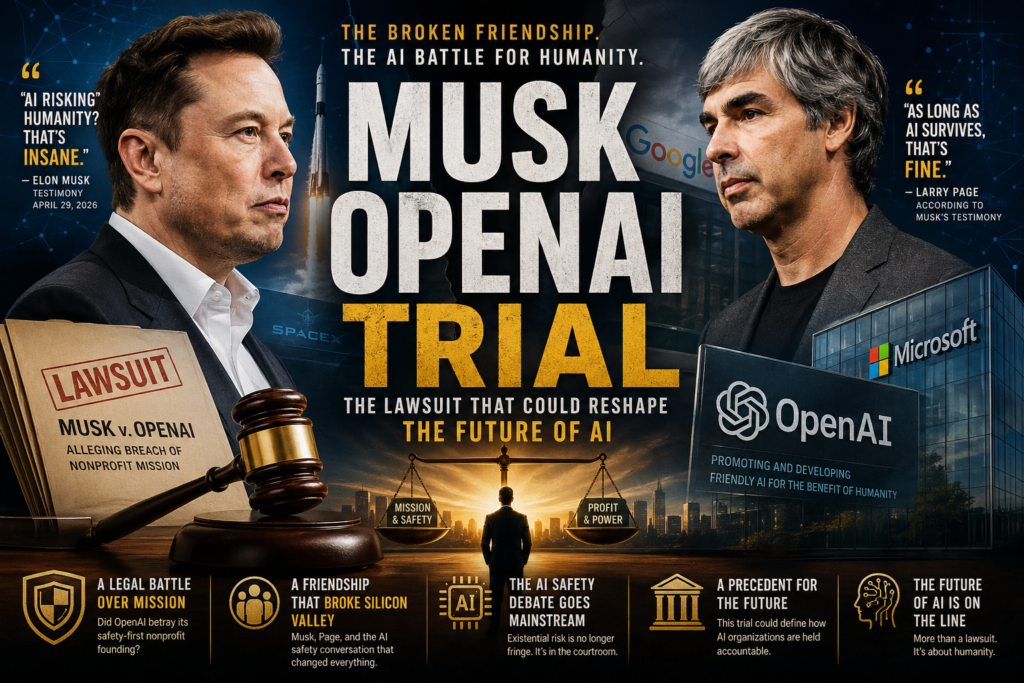
The Musk OpenAI trial isn’t just a courtroom drama — it’s a window into the ideological fault lines that determined who controls artificial intelligence today. At the heart of Elon Musk’s April 2026 testimony lies a story that predates OpenAI itself: a friendship shattered by a single conversation about whether AI wiping out humanity is “fine.”
What Is the Musk OpenAI Trial About?
Definition: The Musk OpenAI trial refers to the ongoing legal battle in which Elon Musk is suing OpenAI and its leadership, alleging that the organization abandoned its founding nonprofit mission — developing AI for the benefit of humanity — in favor of commercial profit.
Musk co-founded OpenAI in 2015 alongside Sam Altman, Greg Brockman, and other AI luminaries. His lawsuit contends that OpenAI’s pivot to a “capped-profit” structure and its deepening commercial relationship with Microsoft constitutes a betrayal of the principles on which the organization was built. Musk argues he donated significant time and resources under the belief that OpenAI would remain a safety-first, open, nonprofit research lab.
The trial is being watched closely by the broader tech and AI community — not just because of who is involved, but because its outcome could set legal precedents for how AI organizations are held accountable to their founding charters. (Musk OpenAI trial, Elon Musk OpenAI lawsuit, OpenAI nonprofit mission, Musk Larry Page AI feud, OpenAI founding story 2026)
The Friendship That Shaped the AI Industry
To understand the Musk OpenAI trial, you first need to understand what came before it: one of Silicon Valley’s most consequential and ultimately doomed friendships.
Larry Page, Elon Musk, and the “Speciest” Argument
For years, Elon Musk and Google co-founder Larry Page were among the closest allies in Silicon Valley. Fortune magazine included them on its 2016 list of secretly best-friend business leaders. Musk was so comfortable in Page’s company that he regularly stayed at Page’s home in Palo Alto. Page once told interviewer Charlie Rose that he would rather hand his fortune to Musk than donate it to charity — an extraordinary statement of personal trust between two of the world’s most powerful technologists.
That closeness made the eventual falling-out all the more significant.
At the center of their rupture was a conversation about existential AI risk — the kind of discussion that, at the time, was still considered fringe speculation. Musk testified in the trial that he raised concerns about AI potentially wiping out humanity and Page dismissed those fears, indicating it would be acceptable as long as AI itself survived. When Musk pushed back, Page reportedly called him a “speciest” — a neologism implying that Musk’s preference for human survival over silicon-based consciousness was a form of irrational bias.
Musk called the attitude “insane.” The conversation, as he described it under oath, revealed a fundamental and irreconcilable difference in how the two men viewed the relationship between humanity and the machines they were building.
How the Falling-Out Led to OpenAI’s Creation
The ideological break with Page became one of Musk’s stated motivations for co-founding OpenAI. If Google — one of the world’s most powerful technology companies and a leading AI research hub — harbored leadership that was indifferent to human survival, Musk reasoned that an independent, safety-focused counterweight was urgently needed.
This origin story matters enormously to the Musk OpenAI trial. Musk’s legal team argues that he didn’t build OpenAI as a business venture. He built it as a response to what he perceived as an existential threat being mismanaged by the existing powers in AI. Under that framing, OpenAI’s current commercial trajectory represents not just a breach of contract but a betrayal of the mission that made the organization worth funding in the first place.
What Musk Said Under Oath
April 29, 2026 marked a pivotal moment in the Musk OpenAI trial: Elon Musk took the witness stand and testified about events that have been speculated about for years but never formally entered into the legal record.
The AI Safety Conversation That Changed Everything
Musk has recounted his falling out with Larry Page in several public contexts — including in Walter Isaacson’s bestselling biography — but Tuesday was the first time he made these claims under oath. That distinction matters legally. Sworn testimony carries consequences for perjury that public interviews do not, lending these statements a different weight than prior retellings.
Critically, Page has not commented publicly on Musk’s account. The absence of a rebuttal doesn’t confirm Musk’s version of events, but it does leave his testimony largely uncontested in the public sphere as the trial proceeds.
The AI safety argument also arrives in a radically different context than it would have even five years ago. In 2015, when OpenAI was founded, serious concern about AI existential risk was confined to a small community of researchers and philosophers. By 2026, it has become a mainstream policy debate, with governments, international bodies, and major AI labs all grappling with questions of alignment, control, and oversight. Musk’s framing of his motivations resonates differently in this environment.
Ilya Sutskever and the Moment Page Cut Contact
Musk’s testimony also shed light on why the Page-Musk friendship didn’t merely cool — it ended. When Musk recruited Ilya Sutskever, one of Google Brain’s most prominent researchers and a protégé of AI pioneer Geoffrey Hinton, to help launch OpenAI in 2015, Page reportedly felt personally betrayed.
Sutskever was not just any researcher. He was a key figure at Google’s AI division, and his departure to a new competitor was seen by Page as Musk using their close friendship to poach talent from inside his house. Page cut off contact.
This detail is significant to the Musk OpenAI trial for a subtle reason: it establishes that the breach between Page and Musk predates any later commercial or competitive dynamics between Google and OpenAI. Musk’s decision to recruit Sutskever — a decision motivated, by his account, by genuine safety concerns — is what severed the relationship, not any cynical power play.
Musk vs. OpenAI — The Legal Arguments, Explained
The Musk OpenAI trial encompasses a range of legal claims, some more straightforward than others. Here is a comparison of the core positions each side has staked out:
| Dimension | Musk’s Position | OpenAI’s Position |
|---|---|---|
| Founding Mission | OpenAI was founded as a safety-first nonprofit; commercialization betrays that mission | The organization has evolved in response to the enormous resources required to develop frontier AI safely |
| Charitable Contribution | Musk donated time, resources, and reputation under specific representations about OpenAI’s purpose | Musk’s contributions were voluntary; he later departed the board voluntarily |
| Microsoft Partnership | The exclusive partnership and capped-profit structure constitutes a violation of nonprofit obligations | The partnership is essential to OpenAI’s ability to compete and pursue its mission |
| Talent and Competition | OpenAI has become a for-profit entity competing directly with Musk’s own AI company, xAI | Competition in AI is healthy; Musk’s suit is motivated by rivalry, not principle |
| Public Benefit | The original nonprofit structure was a legal and moral commitment to the public | OpenAI continues to pursue its mission of broadly beneficial AI; the structure change is a legal business decision |
| Testimony Specifics | The Page conversation reveals Musk’s genuine, long-standing fear of unchecked AI development | Prior statements made outside of court are being cherry-picked for litigation strategy |
What makes the Musk OpenAI trial legally complex is that nonprofit law is not typically built to adjudicate disputes at this scale, involving these kinds of assets and this level of technological ambiguity. Courts are being asked not just to interpret contracts, but to rule on the nature of organizational purpose in an industry that barely existed when the relevant documents were signed.
Why the Musk OpenAI Trial Matters for the Future of AI
Regardless of how the Musk OpenAI trial resolves, the case is already reshaping conversations about AI governance, organizational accountability, and the meaning of “safety-first” as an institutional commitment.
It Sets a Precedent for AI Nonprofit Accountability
No major AI organization has previously faced a legal challenge of this scope over the fidelity of its founding mission. If Musk prevails on any of his central claims, it could open the door to similar challenges against other organizations that have shifted their structures as they scaled — a pattern that is increasingly common in AI development.
It Forces a Public Reckoning With AI Safety Culture
The core of Musk’s testimony — that a leading technology executive dismissed human extinction risk as acceptable collateral damage for AI progress — is not a minor footnote. It reflects a real tension that exists within AI development culture today. How much weight should organizations give to speculative but catastrophic risks versus near-term capabilities and commercial viability?
The Musk OpenAI trial, by putting this question into sworn testimony and legal briefs, is forcing it into the public record in a way that op-eds and podcasts cannot.
It Reveals the Fragility of Founding Visions
One of the most underappreciated dimensions of the Musk OpenAI trial is what it reveals about the life cycle of technology organizations. Founding documents, nonprofit charters, and verbal commitments made between co-founders in 2015 are now being stress-tested against the commercial realities of 2026. The AI landscape has changed so dramatically in a decade that the original frameworks may simply be inadequate — legally and conceptually — to govern the entities that emerged.
That gap between founding vision and operational reality is not unique to OpenAI. It is a structural challenge for every major AI lab. The trial is forcing the industry to confront it openly.
The Human Story Behind the Legal Battle
It would be easy to lose the human dimension of this story in the procedural details of the Musk OpenAI trial. But underneath the legal filings is a story about a genuine friendship — one that shaped decisions that in turn shaped the AI industry as we know it.
As recently as 2023, Musk told technology podcaster Lex Fridman that he still wanted to repair his relationship with Larry Page: “We were friends for a very long time.” That sentiment — offered publicly, not strategically — suggests that whatever else this trial is about, it also involves real loss.
Page built a fortune and a company that changed how the world accesses information. Musk built rockets that reach orbit, electric vehicles that reshaped the automotive industry, and now an AI company of his own. They were, by almost any account, genuine friends — the kind who talk late into the night about the fate of civilization.
The conversation about AI wiping out humanity wasn’t an abstract philosophical debate for Musk. It was the moment he concluded that his friend — one of the most powerful people in technology — didn’t share his most fundamental value: that human life is worth prioritizing. That realization became OpenAI. And now OpenAI itself has become the subject of a lawsuit that is, at its core, about whether anyone in this industry is truly committed to what they say they believe.
Key Takeaways: What to Know About the Musk OpenAI Trial
For readers following the Musk OpenAI trial or trying to understand its broader implications, here is what matters most:
- The lawsuit centers on mission drift, not just money. Musk argues OpenAI abandoned its safety-first nonprofit charter for commercial advantage.
- The Page testimony is new legal territory. Musk has told this story before, but April 2026 marks the first time he said it under oath, making it legally consequential.
- The Sutskever recruitment was the friendship’s final breaking point. Poaching Page’s key AI researcher ended a relationship that had been one of Silicon Valley’s most consequential.
- The trial may set precedent for AI nonprofit accountability, establishing whether organizations can be held to their founding missions as they scale.
- No ruling yet. The trial is ongoing. The full implications of the Musk OpenAI trial will depend on how courts interpret nonprofit law in the context of a rapidly evolving technology sector.
- The broader AI safety debate is now on trial. Musk’s core argument — that some AI leaders are dangerously indifferent to existential risk — is no longer a fringe concern. It is sworn testimony in a federal case.
Frequently Asked Questions About the Musk OpenAI Trial
What is Elon Musk’s main claim in the OpenAI lawsuit? Musk claims that OpenAI violated its founding mission as a nonprofit dedicated to developing AI safely and openly. He argues that its commercial pivot — particularly its relationship with Microsoft — constitutes a legal and ethical breach of the commitments under which he co-founded and supported the organization.
What did Musk say about Larry Page in his testimony? Musk testified that Page dismissed concerns about AI posing an existential risk to humanity, allegedly saying it would be acceptable as long as AI survived. Page called Musk a “speciest” for prioritizing human survival. Musk said this conversation was a key reason he felt compelled to found OpenAI.
Why does the Musk OpenAI trial matter for the AI industry? The trial is forcing public and legal scrutiny of questions that have largely been handled internally within AI organizations: What does “safety-first” actually mean as a legal and institutional commitment? Can founding missions be enforced? And who is accountable when a nonprofit transforms into a commercial entity?
Has OpenAI responded to Musk’s claims? OpenAI has consistently argued that its mission remains intact and that structural changes were necessary to compete in an increasingly resource-intensive field. The organization contends that Musk’s lawsuit is motivated by his own competitive interests in AI through his company xAI.
Conclusion: A Trial That Transcends the Courtroom
The Musk OpenAI trial is, on its surface, a legal dispute over contracts, nonprofit obligations, and the definition of organizational mission. But strip away the filings and the courtroom procedure, and what remains is something far more consequential: a public reckoning with the values, promises, and personalities that shaped the most transformative technology of our era.
Elon Musk didn’t just co-found OpenAI. He funded it out of fear — a genuine, deeply held conviction that artificial intelligence, left in the wrong hands or guided by the wrong philosophy, could end human civilization as we know it. That fear was born, in part, from a late-night conversation with a man he considered one of his closest friends. When Larry Page shrugged off the prospect of human extinction as an acceptable outcome of AI progress, something broke — not just a friendship, but Musk’s confidence that the existing powers in Silicon Valley could be trusted to navigate what he saw as an existential crossroads.
OpenAI was his answer. And now OpenAI itself is on trial.
What the Musk OpenAI trial ultimately forces us to confront is a question that the AI industry has been quietly avoiding: do founding principles matter once the stakes — and the valuations — get high enough? Can a safety-first mission survive contact with the commercial realities of frontier AI development? And if it cannot, what does that say about every other organization that has made similar promises?
There are no clean answers yet. The legal proceedings will continue, the arguments will sharpen, and a judgment will eventually arrive. But regardless of the verdict, the trial has already accomplished something the industry rarely allows: it has made private convictions, broken promises, and ideological fault lines part of the official public record.
The story of AI’s formative years is no longer being written only in blog posts, biographies, and podcast interviews. It is being written under oath. And that changes everything about how history will read this moment — and how the industry must reckon with itself going forward.