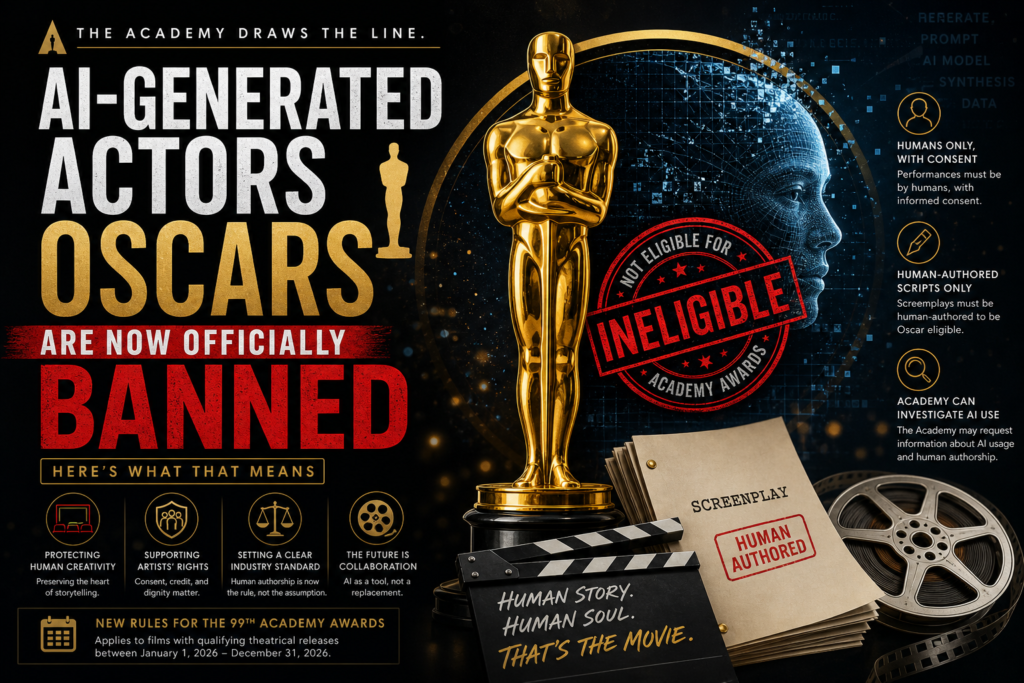
AI-generated actors are no longer eligible for Academy Awards. The Academy of Motion Picture Arts and Sciences made it official on May 1, 2026, when it published its rules for the 99th Oscars — drawing one of the clearest lines Hollywood has ever seen between human creativity and machine output.
This isn’t a rumor, a proposal, or a pilot program. It is binding policy. And it arrives at a moment when AI-generated actors are starring in real films, AI-written scripts are circulating through studios, and the entire entertainment industry is navigating an existential reckoning with generative technology.
If you’re a filmmaker, studio executive, screenwriter, actor, or simply someone watching how artificial intelligence is reshaping culture, this ruling changes the game. Here is a complete, authoritative breakdown of what the new rules say, why they were passed, and what they mean for everyone in the industry. (AI-generated actors Oscars, Oscar eligibility rules AI, Academy Awards AI policy, AI-written scripts Oscars, generative AI Hollywood.)
What the New Oscar Rules Actually Say
The Academy’s Board of Governors approved the updated awards rules on May 1, 2026, ahead of the 99th Academy Awards cycle, which covers films with qualifying theatrical releases between January 1, 2026, and December 31, 2026.
The rules address generative AI in three specific, substantive ways.
The Acting Category Rule: Humans Only, With Consent
The Academy’s new rule for the Acting category states that only roles “credited in the film’s legal billing and demonstrably performed by humans with their consent” will be considered eligible for nomination.
This two-part requirement is significant:
- Human performance — The performance must be demonstrably carried out by a human being, not generated by an AI model or synthesized from existing footage.
- Informed consent — The actor must have consented to the performance in question. This directly addresses the concern about deceased or non-consenting actors being recreated digitally.
The rule effectively disqualifies AI-generated actors from Oscar consideration — no matter how convincing the performance, no matter how prominent the role.
The Writing Category Rule: Human-Authored Screenplays Only
In the Writing categories, the Academy has now codified that screenplays must be “human-authored” to be eligible. The word “codified” is important here — it means this standard is now explicit, enforceable, and part of the official rulebook rather than an assumed norm.
This bars scripts generated entirely or primarily by large language models from competing for the Best Original Screenplay or Best Adapted Screenplay awards. (AI-generated actors Oscars, Oscar eligibility rules AI, Academy Awards AI policy, AI-written scripts Oscars, generative AI Hollywood.)
The Academy’s Right to Investigate AI Usage
Perhaps the most forward-looking element of the new rules is this: under Eligibility Rule Two, the Academy reserves the right to request more information about the nature of a film’s AI usage and human authorship.
This gives the Academy an enforcement mechanism — a structured pathway to audit, question, and potentially disqualify films that claim human authorship but cannot demonstrate it. It is a policy with teeth.
Why the Academy Drew the Line Now
The timing of the AI-generated actors Oscars ban is not accidental. It reflects months — arguably years — of mounting pressure from actors, writers, and directors who have watched AI encroach on their livelihoods.
Several specific developments appear to have accelerated the Academy’s decision:
- The Val Kilmer AI film. An independent production is currently in development featuring an AI-generated likeness of Val Kilmer. The actor, who died in 2025 after a long battle with throat cancer, cannot provide fresh consent. The project has ignited fierce debate about digital resurrection and posthumous rights.
- The rise of AI “actress” Tilly Norwood. A fully artificial performer with no human behind her, Tilly Norwood has attracted mainstream media coverage — and fierce criticism — as a symbol of what AI acting could become.
- New video generation models. Tools like Seedance 2.0 have enabled filmmakers to generate high-quality video content with minimal human input, leading some directors to publicly express alarm.
- The 2023 actors’ and writers’ strikes. The Hollywood labor stoppages of 2023, in which AI was a central negotiating issue, established the precedent that the industry would fight to protect human creative work.
The Academy’s action is, in many ways, the formal institutional culmination of what guilds and unions have been demanding for years. (AI-generated actors Oscars, Oscar eligibility rules AI, Academy Awards AI policy, AI-written scripts Oscars, generative AI Hollywood.)
AI in Hollywood — A Timeline of Tension
Understanding the AI-generated actors Oscars ban requires context. This didn’t happen overnight.
| Year | Event |
|---|---|
| 2023 | SAG-AFTRA and WGA go on strike; AI protections become a core demand |
| 2023 | Both unions reach agreements with studios that include initial AI safeguards |
| 2025 | Val Kilmer passes away; AI resurrection projects begin development |
| 2026 (Jan) | Science fiction writers’ groups declare AI-assisted works ineligible for their awards |
| 2026 (Mar) | AI “actress” Tilly Norwood goes viral; publisher pulls horror novel over AI concerns |
| 2026 (May 1) | Academy officially bans AI-generated actors and AI-authored scripts from Oscar eligibility |
This timeline reveals a consistent pattern: industry bodies have been forced to react, policy by policy, to an accelerating technological shift that outpaced existing frameworks.
AI vs. Human Creativity: What’s Actually at Stake?
The debate about AI-generated actors at the Oscars is, at its core, a debate about what creativity means and who it belongs to. Let’s look at this comparison clearly.
| Dimension | Human Performance | AI-Generated Performance |
|---|---|---|
| Emotional authenticity | Lived experience, embodied emotion | Pattern synthesis from training data |
| Consent | Explicit and ongoing | Impossible for fully synthetic actors; complex for digital replicas |
| Economic impact | Pays actors, supports industry ecosystem | Replaces labor; concentrates value with tech companies |
| Legal clarity | Well-established rights frameworks | Largely unresolved; ongoing litigation globally |
| Award eligibility (Oscars) | Fully eligible under new rules | Explicitly ineligible as of 2026 |
| Creative ownership | Clear attribution to individual artist | Disputed; varies by jurisdiction |
| Audience trust | Default assumption of authenticity | Growing skepticism; disclosure debates |
The Academy’s stance is unambiguous: the Oscar, as an institution, is a celebration of human cinematic achievement. That is a values statement, not merely a technical rule.
How Other Awards Bodies Are Responding
The Oscars are not alone. A broader pattern is emerging across the creative industry in which awards bodies are formalizing their positions on AI-generated work.
- Science fiction and fantasy writing awards — Multiple prominent organizations in the sci-fi and fantasy literary space announced in early 2026 that AI-generated or AI-assisted works would be ineligible for their awards.
- Comic conventions and genre communities — Similar declarations have come from fan communities and convention organizers who curate awards for illustrated and written fiction.
- Publishing — At least one major publisher has pulled a horror novel from shelves after concerns emerged about undisclosed AI usage in its production.
The through-line is consistent: disclosure, consent, and human authorship are becoming the baseline expectations across creative industries, not just film.
What remains unresolved is the middle ground — work that uses AI as a tool (for color grading, sound design, or visual effects assistance) rather than as a primary creative author. The Academy’s rules acknowledge this nuance by reserving the right to investigate AI usage rather than banning all AI from film production entirely.
What This Means for Filmmakers, Studios, and AI Startups
The AI-generated actors Oscars ban sends a clear signal to every corner of the entertainment ecosystem. Here is what different stakeholders should take away.
For Independent Filmmakers
The rules apply to films seeking Oscar consideration. If your film uses AI-generated performances or AI-written scripts, it will not be eligible for nomination — full stop. For prestige-oriented projects, this is a decisive constraint.
However, the Academy is not regulating all film production. AI tools remain legal to use in production; the eligibility rules govern only what can compete for awards. A film can still be commercially released, critically reviewed, and financially successful without Oscar eligibility.
For Major Studios
Studios pursuing awards campaigns — which drive significant ancillary revenue through home video, streaming, and talent deals — now have a compliance obligation. They must be able to demonstrate human authorship in both performance and writing if they want to stay in the awards conversation.
This will likely accelerate internal AI usage policies at major studios and may lead to contractual language changes with both talent and AI vendors.
For AI Startups and Technology Companies
Companies building AI tools for Hollywood face a nuanced reality. Tools that assist humans — in post-production, visual effects, sound, or pre-visualization — are not the target of these rules. The ban is specifically on AI as a replacement for human performance and writing, not AI as a collaborator with human artists.
Smart AI companies in the entertainment space will position their products accordingly: augmentation, not substitution.
For Actors and Writers
This is a meaningful institutional victory. The Academy has aligned itself with the guild positions established during the 2023 strikes. Human actors and writers now have explicit Oscar eligibility protections that didn’t formally exist before.
That said, the rules do not address the broader commercial market. An AI-generated actor can still appear in a Netflix series, a YouTube film, or a theatrical release — just not one seeking Academy recognition. The fight for broader protections continues in contract negotiations and legislative lobbying.
Key Provisions at a Glance
Here’s a quick-reference summary of the AI-related Oscar rule changes for the 99th Awards:
- Acting: Only performances by humans, credited in legal billing and given with consent, are eligible for nomination
- Writing: Screenplays must be human-authored; this is now codified in the rules, not merely assumed
- Enforcement: The Academy may request documentation of AI usage and human authorship for any submitted film
- Scope: Applies to films with qualifying theatrical releases between January 1, 2026, and December 31, 2026
- Not covered: AI tools used in non-performance, non-writing capacities (e.g., VFX assistance, sound processing) are not addressed by these specific rules
Frequently Asked Questions About AI-Generated Actors and the Oscars
Q: Can a film that uses AI visual effects still be eligible for Oscars?
Yes. The rules target AI-generated performances and AI-authored screenplays. A film that uses AI for visual effects, color grading, or other technical functions is not disqualified by these specific rules. The Visual Effects category, in fact, has its own separate rules and voting process.
Q: What if an actor uses AI tools to enhance their performance?
The key phrase in the rules is “demonstrably performed by humans.” If a human actor delivers a performance that is then enhanced with AI post-production tools (deepfake smoothing, voice enhancement, etc.), the eligibility of that performance will depend on whether it can still be “demonstrably” attributed to the human actor. This is a gray area the Academy may need to clarify over future awards cycles.
Q: Does this rule apply to AI-generated likenesses of deceased actors?
Yes. The requirement for human performance “with their consent” means a deceased actor — who cannot provide consent — cannot be the basis for an eligible performance, even if a human actor physically portrayed them and AI was used only to alter their appearance.
Q: What happens if a studio lies about AI usage?
Under the new rules, the Academy reserves the right to request more information about AI usage and human authorship. Providing false information in pursuit of an award would expose studios and productions to serious reputational and potentially legal consequences, and would result in disqualification.
Q: Are these rules permanent?
No. Awards rules are updated annually by the Academy’s Board of Governors. These rules apply specifically to the 99th Academy Awards. The Academy has stated that all rules and dates are subject to change.
The Bottom Line
The Academy’s decision to block AI-generated actors Oscars eligibility is not just another rule update tucked away in an annual policy document. It is a major cultural signal about where the entertainment industry is drawing its boundaries in the age of automation. For years, Hollywood has experimented with digital doubles, CGI de-aging, synthetic voice tools, and machine-assisted editing. But with the new AI-generated actors Oscars rules, the Academy has made one thing unmistakably clear: when it comes to awards recognition, human creativity remains the center of gravity.
This matters because awards are not only symbolic—they shape the economics of the industry. A film associated with Oscar buzz often receives increased box office attention, stronger streaming demand, higher licensing value, and long-term prestige. By making AI-generated actors Oscars ineligible, the Academy is effectively creating a financial incentive for studios and filmmakers to keep human performers and writers at the core of their storytelling process.
The decision also directly addresses one of the biggest ethical concerns surrounding generative AI: consent. Without clear rules, studios could theoretically recreate actors using old footage, voice samples, or facial scans with little clarity around permission, compensation, or creative control. The updated AI-generated actors Oscars framework pushes back against that uncertainty by requiring demonstrable human performance and consent. In practical terms, that means the Academy is not only protecting awards integrity but also setting a stronger standard for digital rights.
For actors, this is a meaningful win. During the 2023 Hollywood strikes, AI became one of the most contentious issues between talent unions and studios. Performers feared being scanned once, paid once, and reused endlessly. Writers feared being reduced to editors cleaning up machine-generated drafts. The new AI-generated actors Oscars policy reinforces what those labor battles were fundamentally about: protecting creative labor from becoming infinitely replicable and cheaply replaceable.
At the same time, this is not a blanket rejection of AI in filmmaking. That distinction is important. The AI-generated actors Oscars rule does not ban AI-powered workflows, post-production tools, or technical enhancements. AI can still help with visual effects, animation assistance, sound cleanup, subtitle generation, previs, and other efficiency tasks. What the Academy is restricting is substitution—not augmentation. That nuance will likely shape how technology companies position their tools going forward.
For AI startups, the message is strategic. Building products that aim to replace actors or writers entirely now comes with reputational, regulatory, and awards-related friction. But tools that help filmmakers work faster, reduce costs, or enhance production quality without displacing authorship remain commercially attractive. In other words, the AI-generated actors Oscars decision may actually accelerate a more sustainable AI business model inside Hollywood: one based on collaboration with artists rather than replacement of them.
Independent filmmakers should pay close attention as well. While not every project is chasing Academy recognition, prestige still matters. Festivals, distributors, investors, and critics all take cues from institutional standards. If the Academy has formally ruled on AI-generated actors Oscars, other organizations are likely to follow. Film festivals, guild awards, streaming platforms, and international academies may soon publish similar guidelines, creating a ripple effect across the industry.
There is also an audience trust component here. Moviegoers are increasingly aware of AI-generated media, and not all reactions are positive. Many audiences still associate acting with emotional vulnerability, lived experience, and human interpretation. A synthetic performer may be technically impressive, but that does not automatically translate into emotional legitimacy. By enforcing AI-generated actors Oscars restrictions, the Academy is reinforcing an implicit promise to audiences: the performances being celebrated come from real people.
Still, the long-term debate is far from over. Edge cases will become more common. What happens when a human actor performs but their face is partially altered by AI? What about voice enhancement? What about resurrecting a historical figure with consent from an estate but not from the performer directly? The AI-generated actors Oscars rules answer today’s most obvious questions, but tomorrow’s gray areas are already forming.
That is why the enforcement mechanism may be the most important part of all. The Academy now reserves the right to investigate AI use and request proof of authorship or performance details. Without verification, rules are mostly decorative. With enforcement, the AI-generated actors Oscars policy becomes a real compliance issue for studios and awards campaigns.
Ultimately, this decision is about more than trophies. It is about defining what counts as authorship, performance, and originality in a world where machines can increasingly imitate all three. The Academy is betting that audiences and artists still value human intention enough to defend it institutionally.
The bigger takeaway is simple: technology may keep evolving, but culture still decides what deserves recognition. The AI-generated actors Oscars ban is Hollywood’s first major institutional line in the sand. It will not stop AI from entering entertainment, nor should it. But it does establish a hierarchy: tools can assist, systems can optimize, and algorithms can accelerate—but the heart of cinema must still come from people.
As generative tools become more sophisticated, expect more industries to adopt similar standards. Publishing, gaming, music, advertising, and journalism are all confronting versions of the same question. The Academy just answered it first for film.
And for now, at least, the answer is clear: AI-generated actors Oscars eligibility is off the table, human storytelling remains the benchmark, and Hollywood’s most prestigious award is still reserved for real human achievement.