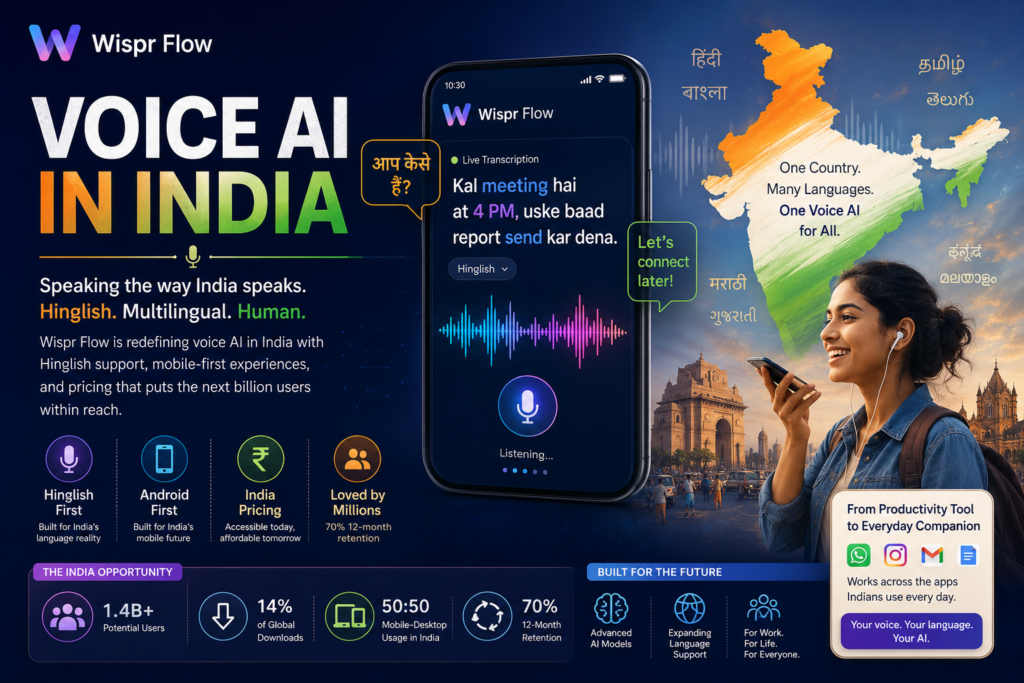
India is the world’s largest and most linguistically complex opportunity for voice AI — and startups are only beginning to unlock it. Wispr Flow, a Bay Area-based AI dictation startup, has made India its fastest-growing market by doing what most global AI products never bother with: speaking the way Indians actually speak.
What Is Voice AI and Why India Is the World’s Most Complex Market for It
Voice AI refers to software that converts spoken language into text, commands, or structured output using machine learning models. It powers everything from dictation tools and voice search to conversational assistants and real-time transcription.
India is not just another large market for this technology — it is, as Counterpoint Research VP Neil Shah put it, “the ultimate stress test for voice AI.” Here is why:
- 22 official languages and hundreds of dialects exist across the country.
- Most urban Indians don’t speak in one language — they code-switch, blending Hindi, English, Tamil, Bengali, and others mid-sentence.
- Network infrastructure varies dramatically between metros and tier-2 cities.
- Purchasing power is a fraction of Western markets, making standard global SaaS pricing a non-starter.
Despite these barriers, the behavioral foundation for voice AI in India is arguably stronger than anywhere else. Indians already rely heavily on voice notes (WhatsApp processes billions of voice messages daily), voice search, and multilingual messaging. The habit is there. The product has to catch up.
This is the exact tension that makes voice AI in India simultaneously the hardest and most consequential frontier in consumer AI.
Wispr Flow’s Bet — How One Startup Is Cracking the Code
Wispr Flow builds AI-powered voice input software — essentially a smarter, context-aware dictation layer that works across apps. A user speaks; the app transcribes, cleans up, and formats the output in real time, across email clients, messaging apps, documents, and more.
Founded in the Bay Area, the startup initially found traction among white-collar professionals in the US. Then India surprised them. It is now Wispr Flow’s second-largest market by both users and revenue, and it is growing faster than any other geography the company operates in.
The Hinglish Breakthrough
The single most important product decision Wispr Flow made for India was building a Hinglish voice model — a model trained specifically for the code-switched blend of Hindi and English that is the default spoken register for hundreds of millions of Indians, particularly in urban and semi-urban areas.
Most global voice AI products treat language-switching as noise or error. Wispr Flow built it as a feature. The result: after launching Hinglish support in beta earlier this year and rolling it out more broadly, the company saw its India growth rate jump from approximately 60% month-over-month to around 100%.
CEO and co-founder Tanay Kothari noted that the biggest behavioral shift has been users expanding beyond work-focused dictation into personal apps — WhatsApp, Instagram, social media — where Hindi-English mixing is most natural. That shift from productivity tool to everyday communication layer is significant. It means the product is becoming habitual, not just useful.
Wispr Flow currently employs two full-time linguistics PhDs dedicated to refining its multilingual voice models and expanding support for additional Indian language combinations — a signal that this is not a superficial localization effort.
Android-First, Price-First Strategy
Early versions of Wispr Flow launched on Mac and Windows, followed by iOS in 2025. The India push required something more fundamental: an Android app, launched in February 2026. Android commands the overwhelming majority of India’s smartphone market, and without an Android presence, any India growth strategy is effectively capped.
Wispr Flow’s pricing structure for India reflects a serious commitment to mass-market access:
- Global standard pricing: $12/month
- India pricing (annual plan): ₹320/month (~$3.40)
- Long-term target pricing for India: ₹10–20/month (~$0.10–0.20)
That final number — ten to twenty rupees per month — is not a rounding error. It is a deliberate signal that Wispr Flow wants to reach not just urban professionals but students, older adults, and rural users being onboarded by tech-savvy family members. The startup acknowledges this will happen “slowly and steadily,” but the direction is set.
The Numbers Behind the Growth
The data available on Wispr Flow’s India performance tells a revealing story — particularly when you look at the gap between usage and monetization.
| Metric | India | United States |
|---|---|---|
| App Download Share (Oct 2025–Apr 2026) | 14% of global installs | Largest single market |
| In-App Purchase Revenue Share | ~2% of global IAP | Dominant |
| Desktop vs. Mobile Usage Split | ~50:50 | ~80% desktop, 20% mobile |
| Monthly Growth Rate (post-India campaign) | ~100% MoM | Not disclosed |
| 12-Month Retention Rate | ~70% (same as global) | ~70% |
Source: Sensor Tower data shared with TechCrunch; company disclosures.
The standout figure here is the chasm between download share (14%) and revenue share (2%). This is not a product failure — it is the monetization reality of operating in a market where even ₹320/month is a meaningful spend for many users. It also illustrates the fundamental challenge every voice AI company faces in India: engagement is strong, but converting that engagement into sustainable revenue at global margins is genuinely hard.
The 70% twelve-month retention rate, however, is the metric that matters most for long-term viability. If users who adopt the product stay, the unit economics can work even at lower price points — it just requires patient capital and a long arc.
Why Voice AI in India Is Still Hard — The Real Challenges
Acknowledging that voice AI in India is a large opportunity is easy. Actually building for it exposes a set of deep, structural challenges that are worth naming clearly.
Linguistic and Acoustic Complexity
India’s languages don’t just differ in vocabulary — they differ in phonology, script, syntax, and rhythm. Hindi, Tamil, Telugu, Bengali, Marathi, and Kannada are not variations of each other; they are distinct language families. Building one voice model that handles all of them — and their mixed-language variants — is a fundamentally different engineering challenge from building a model for English with regional accents.
Hinglish is the most tractable starting point because it is the most widely spoken code-switched variety. But “Tanglish” (Tamil-English), “Benglish” (Bengali-English), and similar mixes each require their own model investment.
Accent and Speaker Variation
Even within a single language, India’s speaker diversity is enormous. An AI model trained on formal Hindi will fail on Bhojpuri-inflected speech. A model tuned for Mumbai English will struggle with Hyderabadi English. Robust voice AI in India requires extensive, geographically diverse training data — which is expensive and slow to collect.
Infrastructure and Latency
Voice AI that processes audio in the cloud requires low-latency connectivity. In metro areas, 4G and 5G penetration is strong. Outside those zones, the experience degrades in ways that make real-time dictation frustrating and unreliable. On-device processing is a partial solution, but it requires more capable hardware than the median Indian smartphone.
Monetization Patterns
India’s digital economy is characterized by high engagement and low willingness to pay for software. The freemium model that works in the US — where a meaningful percentage of free users convert to paid plans at $10–15/month — doesn’t translate directly. Pricing has to be restructured from the ground up, which compresses margins even as infrastructure and localization costs grow.
Who Else Is Building Voice AI for India?
Wispr Flow is not operating in isolation. The voice AI in India market has attracted a layered competitive field spanning global giants, well-funded startups, and local founders with deep contextual knowledge.
Global players with India ambitions:
- ElevenLabs — the AI audio company has publicly identified India as a key growth market and is expanding Hindi language support. It has explored opening a local office.
- Google (Assistant / Gemini) — Google has invested heavily in Indian language support across its products and holds significant distribution advantages through Android.
- OpenAI (ChatGPT voice mode) — increasingly capable multilingual voice interaction, though not yet optimized for code-switching in the way dedicated tools are.
India-native voice AI startups gaining traction:
- Gnani.ai — focused on enterprise voice automation, particularly in customer service and BFSI (banking, financial services, insurance).
- Smallest AI — building real-time voice AI tools for developers, with a focus on low-latency performance.
- Bolna — voice AI infrastructure for businesses looking to automate phone-based interactions in Indian languages.
What differentiates Wispr Flow from most of these players is its consumer-facing, cross-app dictation positioning. Rather than building a standalone voice assistant or enterprise call-center product, it embeds into the apps users already live in — which is a meaningfully different distribution strategy.
What This Means for the Future of Multilingual AI Products
The story of voice AI in India is, in many ways, a preview of what the global AI industry will eventually have to confront everywhere outside the English-speaking West.
Most AI products are still fundamentally English-first. Multilingual support is often added as a feature, not designed as a first principle. India — with its scale, its linguistic diversity, and its mobile-native user base — is the proof of concept for whether AI companies can actually build for the world rather than just for the world’s wealthiest markets.
A few implications stand out:
Localization is not translation. Adding Hindi subtitles to an English-language AI product is not the same as building a Hinglish voice model from scratch. The former is a content decision; the latter is a machine learning investment. Companies that treat the two as equivalent will underperform in markets like India.
Usage patterns diverge from Western assumptions. Wispr Flow’s India data shows a 50:50 desktop-mobile split versus an 80:20 desktop-heavy mix in the US. Voice AI products designed primarily for desktop workflows will miss the majority of Indian users, who are mobile-first and increasingly mobile-only.
Retention is the real signal. With monetization suppressed by purchasing power constraints, retention rate becomes the leading indicator of whether a product has genuine market fit. Wispr Flow’s 70% twelve-month retention in India suggests users find the product genuinely useful — not just novel. That is the foundation on which sustainable India-market businesses get built.
The “billion users” thesis requires ₹10/month thinking. Reaching India’s full addressable population — not just its upper-middle class — means building products that are economically viable at a price point so low it would be considered impractical in any Western market. This requires either dramatically lower infrastructure costs, radically different monetization (advertising, enterprise cross-subsidy, bundling), or both.
Key Takeaways for Founders and Investors
What does the Wispr Flow India story actually tell us about building voice AI for emerging markets?
Here are the clearest lessons:
- Start with behavior, not language. Indians already use voice extensively — the product opportunity is to upgrade an existing behavior, not create a new one. This is a lower-friction wedge than most categories.
- Code-switching is a feature, not a bug. Products that treat mixed-language speech as an edge case will lose to products that treat it as the primary use case.
- Android is not optional. In any mobile-first emerging market, a desktop-only or iOS-first product is structurally limited from day one.
- Price localization must go further than you think. Wispr Flow’s ₹320/month is already far below its global $12/month — and the company is targeting ₹10–20/month as a future goal. The delta between “cheaper” and “actually accessible” is enormous.
- Retention is the only metric that matters early. Revenue will be thin until scale is achieved. Proving that users return, habitually, is what earns the right to the monetization conversation.
- Linguistics is a moat. Wispr Flow’s investment in full-time linguistics PhDs is a signal that the hard part of voice AI in India is not engineering — it is language science applied to real-world speaker data.
The opportunity is real, the challenges are genuine, and the companies that treat India as a first-class product priority — rather than an afterthought — will define what AI sounds like for the next billion users.
Frequently Asked Questions
What is Wispr Flow? Wispr Flow is an AI-powered voice dictation tool that transcribes and formats speech across apps in real time. It is available on Mac, Windows, iOS, and Android, with specialized support for Hinglish — the Hindi-English hybrid spoken by millions of Indians.
Why is voice AI in India considered difficult? India presents unique challenges including 22+ official languages, widespread code-switching between languages, diverse accents, inconsistent connectivity infrastructure, and much lower willingness to pay for software compared to Western markets. Each of these requires distinct technical and commercial solutions.
What is a Hinglish voice model? A Hinglish voice model is an AI system trained specifically to recognize and transcribe speech that mixes Hindi and English — a common conversational pattern in urban India. Unlike generic multilingual models, Hinglish models are optimized for the specific phonetic and syntactic patterns of code-switched Indian speech.
Who are Wispr Flow’s competitors in the Indian voice AI market? Key competitors include ElevenLabs (global), Google (via Gemini and Android), and India-native startups such as Gnani.ai, Smallest AI, and Bolna. Each occupies a different segment — enterprise automation, consumer AI, or developer infrastructure.
What is the pricing for Wispr Flow in India? As of early 2026, Wispr Flow offers India-specific pricing at ₹320/month (~$3.40) on an annual plan, compared to its global standard of $12/month. The company has stated a long-term ambition to bring pricing down to ₹10–20/month to reach mass-market users.
Conclusion: Why Voice AI in India Is Becoming the Next Big AI Opportunity
The growth of voice AI in India is no longer an emerging trend that companies can afford to ignore. It is quickly becoming one of the most important frontiers for global AI innovation. India represents a unique combination of scale, diversity, and digital behavior that makes it the perfect testing ground for next-generation speech technology. With hundreds of millions of mobile users, multilingual households, and rising comfort with voice-based interactions, the demand for smarter speech products is stronger than ever. This is exactly why voice AI in India is attracting attention from startups, global technology giants, and investors looking for the next major AI growth market.
Wispr Flow’s rapid adoption highlights a critical lesson for anyone studying voice AI in India. Success in this market does not come from simply translating an English product into Hindi or adding a few regional language options. Instead, winning products are built around how Indians actually communicate. In urban India, users naturally mix Hindi and English in the same sentence, often switching languages multiple times in a conversation. By treating Hinglish as a core use case rather than a technical problem, Wispr Flow positioned itself ahead of many competitors. This is one of the clearest reasons voice AI in India is evolving differently from voice markets in the United States and Europe.
The company’s Android-first approach is another reason its growth is relevant. Since India is overwhelmingly mobile-first, any company entering voice AI in India without strong Android support is immediately limiting its addressable audience. Desktop-first or iOS-first strategies may work in Western countries, but India’s market dynamics require a completely different product mindset. Mobile accessibility is not optional—it is foundational to scaling voice AI in India across professionals, students, creators, and everyday smartphone users.
Pricing is another major factor shaping the future of voice AI in India. Global SaaS pricing models rarely translate well to Indian consumers, where software spending habits are significantly lower. Wispr Flow’s decision to introduce India-specific pricing, along with long-term ambitions to reduce costs further, reflects an important reality: monetization in voice AI in India depends on scale, retention, and affordability rather than high-margin subscriptions. Companies that ignore this economic reality will likely struggle, regardless of product quality.
Despite the opportunity, voice AI in India remains technically challenging. The country’s linguistic diversity is unmatched, with multiple language families, regional accents, and code-switched communication patterns. A model trained for formal Hindi may not work effectively for regional speech patterns or hybrid urban language. This means building high-quality voice AI in India requires more than engineering talent alone. It demands deep linguistic expertise, large training datasets, and continuous iteration based on real user behavior.
What makes this category especially promising is that Indians already have strong voice habits. Voice notes, voice search, and audio messaging are already embedded into daily life. As a result, adoption of voice AI in India is not about teaching people something new—it is about making an existing habit faster, cleaner, and more productive. This lowers friction and increases the probability of long-term engagement, which is why retention metrics matter so much in this market.
Looking forward, the role of voice AI in India will likely expand beyond dictation into education, banking, healthcare, customer support, and digital commerce. Students may use AI voice tools to take notes, professionals may automate workflows, and businesses may use multilingual voice automation to serve customers more efficiently. These practical use cases could make voice AI in India a foundational layer of digital interaction across industries.
In the bigger picture, voice AI in India is more than just a regional business story. It represents a shift in how AI products are designed for global audiences. The future of AI will depend on products that can handle multilingual communication, diverse accents, and mobile-first behavior at affordable price points. That future is already being shaped by the rapid rise of voice AI in India.
For founders, product teams, and investors, the signal is clear. The companies that win in voice AI in India will not just unlock one market—they may define the next era of multilingual AI worldwide.