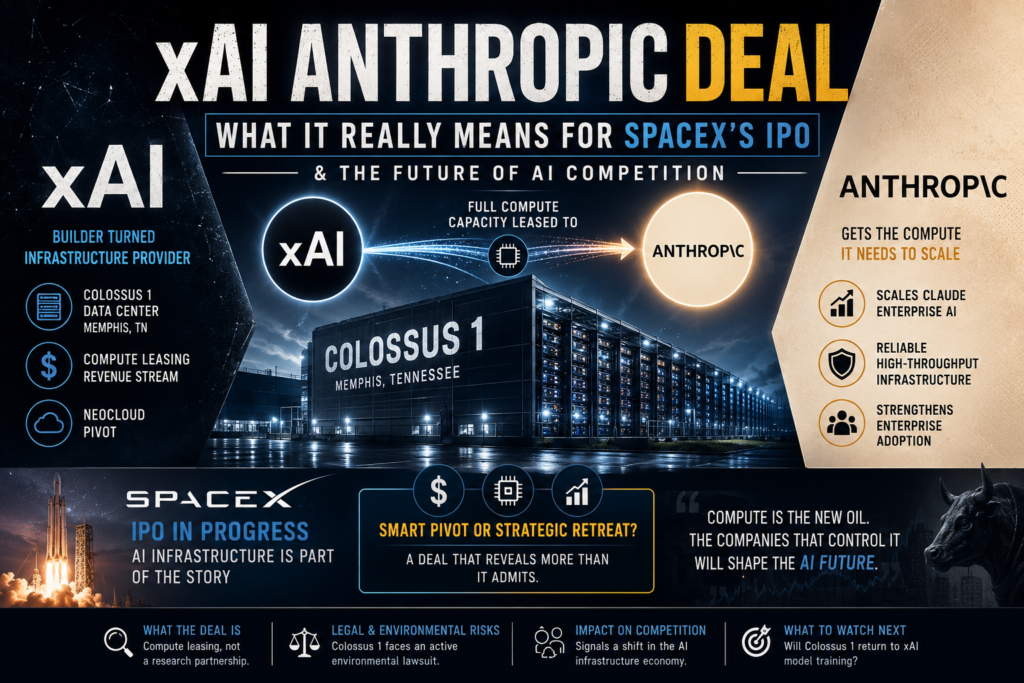
The xAI Anthropic deal is the most revealing moment in AI’s corporate history this year — not because it’s a partnership, but because of what it quietly admits. Anthropic is taking over all compute capacity at xAI’s Colossus 1 data center in Memphis, Tennessee, and in doing so, it has exposed a fundamental crack in Elon Musk’s AI ambitions just as SpaceX races toward a historic IPO.
If you want the short version: Anthropic gets desperately needed compute. xAI gets revenue it wouldn’t otherwise have. SpaceX gets a slightly more believable AI story for Wall Street. And everyone tries not to look too hard at what this arrangement reveals about Grok’s competitive position.
What the xAI Anthropic Deal Actually Is
Definition: The xAI Anthropic deal is a compute-leasing arrangement in which Anthropic, the AI safety company backed by Google and Amazon, gains access to the full GPU capacity of Colossus 1 — xAI’s flagship data center located in Memphis, Tennessee — to power its enterprise-focused AI products and model training workloads.
This is not a research collaboration, a joint venture, or a strategic AI alliance in the traditional sense. It is, at its core, a real estate transaction for compute infrastructure. Anthropic needed more GPUs. xAI had them sitting underutilized. A deal was struck.
The announcement landed with unexpected force, partly because it arrived in the shadow of high-profile legal proceedings involving Elon Musk and OpenAI, and partly because it coincides with Musk’s stated plan to dissolve xAI as a standalone entity and fold it entirely into SpaceX — a move he has begun signaling by rebranding the combined venture as “SpaceXAI.”
Colossus 1 and the Compute Question
Colossus 1 is xAI’s massive data center in Memphis, Tennessee, currently the subject of an environmental lawsuit related to the operation of more than 400 megawatts of gas turbines without proper permits. It was built at extraordinary speed as part of xAI’s ambition to become a leading frontier AI lab.
The critical question the xAI Anthropic deal raises is simple: Why does xAI have so much unused compute capacity? For a company that positioned itself as a frontier model developer challenging OpenAI and Google DeepMind, not fully utilizing your own GPU cluster is a significant signal. It suggests that Grok — xAI’s consumer-facing AI product — is not consuming compute at the rate a genuinely competitive frontier lab would require.
Why Anthropic Needed This Deal
Anthropic’s side of the equation is less ambiguous. The company has been vocal about compute constraints limiting its ability to scale Claude, its family of AI models, particularly for enterprise customers demanding high-throughput API access and low latency. Colossus 1 represents what TechCrunch’s reporting describes as “an escape valve” — a large, immediately available block of GPU capacity that Anthropic could fold into its infrastructure without waiting years for new data centers to come online.
Anthropic’s enterprise focus also makes this compute acquisition strategically coherent. Enterprise AI demands reliability and scale. Getting access to one of the largest AI compute clusters in existence — even through an unusual arrangement with a nominal competitor — is a meaningful operational win.
The Neocloud Pivot: Smart Business or Strategic Retreat?
What Is a Neocloud?
Definition: A neocloud is a company that purchases large quantities of AI-optimized GPUs (primarily from Nvidia) and rents that capacity to other companies rather than using those GPUs to train its own frontier AI models. Neoclouds are, in essence, AI infrastructure landlords.
Traditional cloud providers like AWS, Azure, and Google Cloud are distinct from neoclouds in that they offer a broad ecosystem of services; neoclouds specialize almost entirely in raw GPU-based compute. Companies like CoreWeave have pioneered this model.
By entering the xAI Anthropic deal, xAI has effectively confirmed what many industry observers suspected: it is transitioning, at least partially, toward a neocloud model. Rather than consuming its own compute for aggressive frontier model training, it is renting that compute to a company that will use it instead.
xAI vs. Frontier AI Labs: A Comparative Snapshot
| Dimension | xAI (Post-Deal) | Anthropic | OpenAI | Google DeepMind |
|---|---|---|---|---|
| Primary Revenue Model | Compute leasing + Grok subscriptions | Enterprise API + Claude.ai | Enterprise API + ChatGPT Plus | Google Cloud integration |
| Frontier Model Status | Uncertain / retreating | Active (Claude family) | Active (GPT-4o, o-series) | Active (Gemini family) |
| Own Compute Infrastructure | Yes (Colossus 1), now leased out | Leased / cloud-based | Leased / Microsoft Azure | Google-owned TPU clusters |
| Consumer AI Product | Grok (X-integrated) | Claude.ai | ChatGPT | Gemini |
| Enterprise Adoption | Limited | Growing | Dominant | Growing |
| IPO / Public Status | SpaceX IPO in progress | Private | Private | Subsidiary (Alphabet) |
The table above illustrates why the xAI Anthropic deal is strategically awkward for xAI’s public narrative. Frontier labs pour compute into their own models. A neocloud rents compute out. xAI is doing the latter, which is a fundamentally different business — and a harder story to tell growth-hungry IPO investors.
What This Means for the SpaceX IPO
The Heat-Check Theory
SpaceX is preparing for what could be one of the most anticipated technology IPOs in years, valued at an eye-watering level that incorporates not just the rocket business but the AI ambitions of xAI. The xAI Anthropic deal, viewed through this lens, looks less like a strategic AI partnership and more like what TechCrunch’s Sean O’Kane aptly called “a major heat check before the IPO.”
Here is the logic: If xAI cannot credibly compete as a frontier AI lab — and the evidence increasingly suggests it cannot — then generating reliable revenue from compute leasing is the next best story. A neocloud is a “more believable business in the near term,” as O’Kane put it, even if it lacks the explosive upside that investors typically associate with cutting-edge AI model development.
The timing is not coincidental. The deal lands precisely as SpaceX intensifies its IPO preparations, as xAI co-founders have reportedly departed, and as Musk himself has acknowledged starting AI model development “from scratch” — after SpaceX paid approximately $250 billion to acquire xAI.
The Grok Problem
Grok is the most visible symptom of xAI’s competitive struggles. Despite being deeply integrated into the X (formerly Twitter) platform, Grok has not achieved meaningful penetration in the enterprise market. Reports have even surfaced that xAI’s own employees were using competitor models rather than Grok for internal tasks — a damaging signal about internal confidence in the product.
For enterprise AI buyers — the segment where revenue is largest and stickiest — Grok rarely enters the conversation. When companies evaluate AI for work-critical tasks, the shortlist typically includes Claude, GPT-4, and Gemini. Grok’s association with controversial content moderation decisions on X has also complicated its enterprise positioning.
This competitive reality makes the xAI Anthropic deal comprehensible as a pivot: if Grok cannot generate the compute demand needed to justify Colossus 1’s scale, monetizing that infrastructure through leasing is the rational fallback.
The Environmental and Reputational Wildcards
No analysis of the xAI Anthropic deal is complete without acknowledging what sits underneath it — literally. Colossus 1 is facing an active environmental lawsuit over the operation of more than 400 megawatts of gas turbines that allegedly ran without proper permits.
This creates a layered complication for Anthropic, a company that has positioned itself as the “responsible AI” lab with a focus on safety and long-term societal benefit. Leasing compute capacity from a data center under environmental legal scrutiny is a reputational risk that Anthropic’s communications team will need to manage carefully.
For xAI and SpaceX, the lawsuit adds another layer of uncertainty to an already complicated pre-IPO narrative. Infrastructure assets under active litigation carry valuation risk, and institutional investors conducting due diligence will factor this in.
Bull Case vs. Bear Case: How to Interpret the xAI Anthropic Deal
Bull Case: Pragmatic Capital Efficiency
The optimistic reading of the xAI Anthropic deal goes something like this: xAI built compute infrastructure at extraordinary speed, faster than its model training roadmap could absorb. Rather than leaving billions of dollars in GPU capacity idle, the company found a creditworthy tenant in Anthropic — one of the best-funded and fastest-growing enterprise AI companies in the world. This generates revenue, reduces the carrying cost of Colossus 1, and demonstrates that xAI can operate sophisticated data center infrastructure at scale. For SpaceX’s IPO narrative, a revenue-generating AI infrastructure business is more attractive than a money-losing frontier lab experiment.
Bear Case: Strategic Surrender
The pessimistic reading is harder to dismiss. A company with genuine frontier AI ambitions uses its compute for its own models. The decision to lease Colossus 1 to Anthropic — a direct competitor in the AI assistant and enterprise AI markets — signals that xAI has effectively ceded the frontier model race, at least for now. Dissolving xAI as a separate entity, losing co-founders, acknowledging a restart of AI model development, and now renting out your primary compute asset: these are not the signals of a company accelerating toward AI dominance. They are the signals of a strategic reorganization dressed up as a partnership.
What Should Investors and Industry Watchers Actually Think?
The xAI Anthropic deal is best understood as a Rorschach test for your priors about Elon Musk’s AI ambitions.
If you believe Musk has a credible long-term AI strategy, you read this as a tactical pause — a cash-generating bridge while xAI rebuilds its model development capabilities under SpaceX’s umbrella. The compute leasing revenue funds the next phase.
If you are skeptical, you read this as confirmation that xAI overbuilt, overspent, and overpromised on its ability to compete with OpenAI, Anthropic, and Google in the frontier AI race — and is now quietly retreating to a defensible infrastructure business.
Here are the key questions that will determine which reading ages better:
- Will xAI resume serious frontier model training under the SpaceXAI brand? If yes, Colossus 1 will eventually be reclaimed from Anthropic, and this deal was genuinely tactical.
- Can Grok achieve enterprise adoption? Without meaningful enterprise revenue, xAI’s AI identity becomes difficult to sustain.
- How will the SpaceX IPO price the AI business? If investors assign significant value to the AI segment, the deal helped. If they discount it entirely, the xAI chapter becomes an expensive distraction.
- Does the environmental lawsuit at Colossus 1 escalate? A prolonged legal battle over the data center’s operating permits would complicate both the leasing arrangement and the IPO.
Why the xAI Anthropic Deal Matters Beyond These Two Companies
The significance of the xAI Anthropic deal extends beyond Musk and Dario Amodei’s respective balance sheets. It is a signal about how the AI infrastructure economy is maturing.
The first wave of the AI boom was about who could build the most capable models fastest. The second wave — which this deal exemplifies — is about who can secure and efficiently deploy the compute infrastructure that makes those models possible. Compute is now a strategic asset class in its own right, and the ability to generate revenue from it, even through leasing, is increasingly valuable.
For Anthropic, the deal reflects a broader truth: even well-funded, safety-focused AI labs face compute bottlenecks that constrain their ability to compete. Claude’s growing enterprise adoption is outpacing Anthropic’s ability to provision infrastructure through traditional cloud channels.
For xAI, the deal reflects the other side of the same truth: building frontier-scale compute infrastructure is easier than building frontier-scale AI models that can actually compete.
The AI race is not just about algorithms anymore. It is about infrastructure, and the xAI Anthropic deal is the clearest recent example of how that infrastructure is being reshuffled among the major players.
Conclusion
The xAI Anthropic deal is, on its surface, a straightforward compute-leasing arrangement. Beneath the surface, it is a candid admission about the state of competition in AI: Anthropic needs more compute than it can provision independently, and xAI has compute it cannot yet fully use itself.
Whether this is a shrewd business pivot or a quiet retreat from frontier AI ambitions depends on what xAI does next. The dissolution of xAI as a standalone entity, the departure of key co-founders, and the SpaceX IPO timetable create a pressure-cooker environment in which the next twelve months will be definitive.
For industry watchers, the most important thing to track is not the financial terms of the deal — those remain undisclosed — but whether Colossus 1 eventually returns to xAI’s own model training workloads. If it does, this was a bridge. If Anthropic is still the primary tenant in 2027, the neocloud thesis will have won.
The AI race is still very much alive. But the xAI Anthropic deal suggests that not every company at the starting line is still running it.
Frequently Asked Questions (FAQ) About the xAI Anthropic Deal
1. What is the xAI Anthropic deal?
The xAI Anthropic deal is a compute infrastructure agreement where Anthropic gains access to the full GPU capacity of Colossus 1, xAI’s flagship AI data center in Memphis, Tennessee. Instead of being a traditional partnership focused on AI model development or research, the arrangement is primarily about infrastructure access. Anthropic needs large-scale compute resources to support Claude model training and enterprise workloads, while xAI can monetize underutilized infrastructure.
This makes the xAI Anthropic deal unusual because it involves two companies often viewed as competitors in the broader AI ecosystem. Anthropic is focused heavily on enterprise AI and model safety, while xAI is positioned as Elon Musk’s AI challenger brand with Grok as its flagship product.
2. Why does Anthropic need the xAI Anthropic deal?
Anthropic has been facing compute bottlenecks as demand for Claude models continues to rise among enterprise users. Training and serving large AI models require enormous GPU clusters, and supply constraints across the AI industry have made it difficult for companies to secure enough capacity quickly.
The xAI Anthropic deal gives Anthropic immediate access to one of the largest available GPU clusters without waiting for new infrastructure builds. This helps Anthropic improve inference speed, reduce latency, and support more enterprise customers globally.
For Anthropic, the deal is less about competition and more about practical resource acquisition in a market where compute has become one of the most valuable assets.
3. Why is xAI leasing compute instead of using it?
This is the question driving most analysis around the xAI Anthropic deal. If xAI were fully scaling frontier AI models at maximum pace, observers would expect Colossus 1 to be fully occupied by internal training workloads.
Leasing the full capacity to Anthropic suggests one of several possibilities: xAI overbuilt infrastructure ahead of actual demand, Grok is not consuming expected compute resources, or the company is diversifying into infrastructure monetization.
Supporters argue this is efficient capital allocation. Critics see the xAI Anthropic deal as evidence that xAI may not currently be operating like a traditional frontier AI lab.
4. How does the xAI Anthropic deal affect SpaceX’s IPO?
The xAI Anthropic deal matters because xAI is increasingly connected to SpaceX’s long-term valuation story. Investors considering a future SpaceX IPO will likely examine not just rockets and Starlink, but also AI assets linked to Musk’s broader ecosystem.
A revenue-generating infrastructure business is easier to explain than a cash-burning AI lab with uncertain product-market fit. The deal may help strengthen near-term financial optics by showing that xAI can generate infrastructure revenue.
However, skeptics argue the xAI Anthropic deal may also raise questions about whether xAI is retreating from direct AI competition and repositioning itself as a neocloud business.
5. What is Colossus 1 and why is it important?
Colossus 1 is xAI’s massive GPU data center in Memphis, Tennessee. It was built rapidly to support large-scale AI model training and was presented as a core asset in xAI’s strategy to compete with OpenAI, Anthropic, and Google DeepMind.
The significance of the xAI Anthropic deal is directly tied to Colossus 1. By leasing its capacity to Anthropic, xAI effectively turns Colossus 1 into a monetizable infrastructure asset rather than exclusively an internal AI training resource.
This shift reflects a broader AI industry reality: owning compute is increasingly as important as owning models.
6. Does the xAI Anthropic deal mean xAI is leaving the AI race?
Not necessarily. The xAI Anthropic deal does not automatically mean xAI has abandoned frontier AI ambitions. It could simply be a tactical monetization strategy while xAI restructures, rebuilds models, or reallocates resources.
That said, the optics are complicated. Companies leading the frontier AI race typically absorb as much compute as possible internally. Renting out large-scale GPU clusters can create the perception that xAI is prioritizing infrastructure economics over aggressive model scaling.
Whether this is temporary or strategic depends on what xAI does next with Grok, model releases, and future compute allocation.
7. What is a neocloud, and how is xAI connected to it?
A neocloud is a business model focused on acquiring large quantities of AI GPUs and renting them to customers. Unlike AWS or Google Cloud, neocloud providers are more specialized in AI compute infrastructure.
Many analysts believe the xAI Anthropic deal signals xAI’s partial move toward a neocloud strategy. Instead of relying solely on Grok subscriptions or AI APIs, xAI can create a recurring revenue stream by leasing compute to external companies.
This may improve short-term economics, but it also changes how investors interpret xAI’s long-term identity.
8. Why is the xAI Anthropic deal important for the AI industry?
The xAI Anthropic deal highlights a major shift in AI competition: compute is now as strategic as model quality. The first phase of AI competition focused on model capabilities. The next phase is increasingly about who controls infrastructure.
This agreement shows that even leading AI labs cannot always secure enough compute independently. It also proves that infrastructure ownership can become a standalone business advantage.
In many ways, the xAI Anthropic deal is not just about two companies—it reflects the broader maturation of the AI economy, where compute capacity itself has become a monetizable strategic asset.