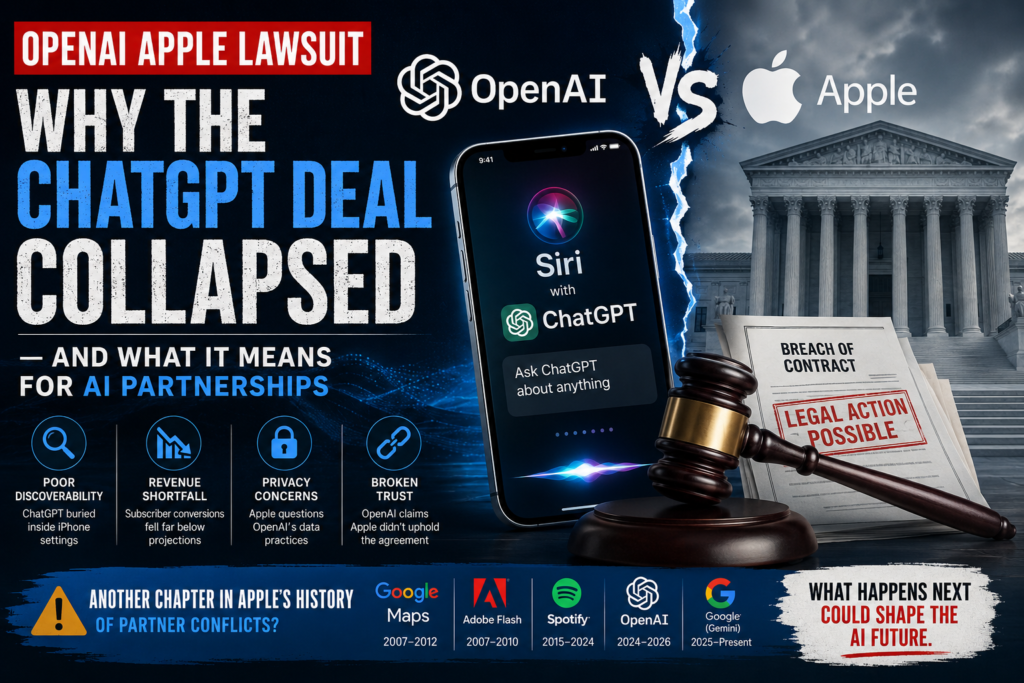
The OpenAI Apple lawsuit is shaping up to be one of the most consequential legal disputes in AI history. OpenAI is reportedly preparing legal action against Apple after its landmark ChatGPT integration on the iPhone dramatically underperformed expectations — and the fallout reveals a dangerous truth about building AI products on platforms you don’t control.
What Is the OpenAI Apple Lawsuit Actually About?
The OpenAI Apple lawsuit stems from a partnership that was supposed to reshape how hundreds of millions of people interact with AI. Instead, it has left OpenAI frustrated, financially disappointed, and reportedly ready to fight back in court.
According to Bloomberg reporting from May 2026, OpenAI has enlisted an outside law firm to assess its legal options against Apple. Those options could include sending a formal breach-of-contract notice — a serious escalation that signals OpenAI believes Apple violated the terms of their original deal. A full lawsuit remains possible but would likely wait until after the conclusion of OpenAI’s ongoing trial with Elon Musk.
The 2024 ChatGPT Apple Integration Deal
To understand the OpenAI Apple lawsuit, you need to go back to June 2024, when Apple’s Worldwide Developers Conference unveiled what looked like a game-changing partnership. Apple announced it would weave ChatGPT directly into its operating systems — as an option within Siri and as part of iPhone’s “Visual Intelligence” feature, which lets users point their camera at objects, analyze their surroundings, and send photos to ChatGPT for AI-powered answers.
For OpenAI, the deal looked like a golden ticket. The iPhone reaches over a billion active users globally. Getting ChatGPT embedded at the OS level — not just as a downloaded app, but as a native system feature — promised an unmatched distribution advantage. Industry analysts and OpenAI executives alike expected the partnership to eventually generate billions of dollars in new ChatGPT Plus subscriptions.
Why OpenAI Says the Deal Failed
The reality, according to Bloomberg’s reporting, has been starkly different. OpenAI has reportedly grown increasingly aggravated with Apple over several specific grievances:
- Poor discoverability: The ChatGPT integration was buried deep within Siri and iPhone settings, making it difficult for everyday users to find and engage with.
- Revenue shortfall: Subscriber conversions from the Apple integration have come in far below projections, with the financial upside OpenAI expected failing to materialize.
- Lack of transparency: OpenAI executives have described being told to “take a leap of faith and trust” Apple — advice that, in retrospect, they feel was not well-founded.
- Feature visibility: The integration lacked the prominent placement that OpenAI believed was part of the deal’s value proposition.
One OpenAI executive summarized the frustration bluntly in Bloomberg’s reporting: “They basically said, ‘OpenAI needs to take a leap of faith and trust us.’ It didn’t work out well.”
This combination of factors is the core grievance behind what has become the OpenAI Apple lawsuit scenario unfolding today.
Apple’s Side of the Story
Apple is not simply a passive defendant in this unfolding dispute. According to Bloomberg, the company has its own list of frustrations with OpenAI.
Chief among Apple’s concerns are privacy standards. Apple has long positioned privacy as a core brand pillar, and the company is said to have reservations about how OpenAI handles user data flowing through the ChatGPT integration. In a world where regulators are scrutinizing AI data practices with increasing intensity, this is not a trivial concern for a company of Apple’s profile.
Apple is also reportedly irritated by OpenAI’s aggressive push into hardware — a space Apple considers its own. That hardware initiative is being led by former Apple executives, including ex-Chief Design Officer Jony Ive, which adds a layer of personal dimension to what is already a tense commercial relationship.
In Apple’s view, the iPhone platform is its sovereign domain. Partners who use that platform do so on Apple’s terms. When those partners begin building competing products — especially ones staffed by ex-Apple talent — the relationship naturally becomes fraught.
A History of Apple Burning Its Tech Partners
What makes the OpenAI Apple lawsuit particularly striking is that it is not an isolated incident. Apple has a well-documented history of embracing tech partners, extracting value from those relationships, and then effectively pushing those partners out when commercial interests diverge. OpenAI is simply the latest chapter in a long and recurring story.
Google Maps (2012): The Most Famous Falling-Out
No case illustrates Apple’s partner dynamics more vividly than Google Maps. When the original iPhone launched in 2007, Google Maps was one of its most celebrated features — Apple used it as a centerpiece selling point. The relationship between Apple and Google was, at that point, genuinely collaborative; Google’s then-CEO Eric Schmidt even sat on Apple’s board.
The fracture began when Google launched Android in 2008, turning a partner into an existential rival. By 2012, Apple was ready to assert independence and removed Google Maps from iOS entirely, replacing it with its own mapping product. The result was catastrophic. Apple Maps launched with severe errors — bridges leading nowhere, misplaced landmarks, entire cities wrong. CEO Tim Cook issued a rare public apology, something virtually unprecedented for Apple’s leadership at the time. Google Maps returned to iOS, but the episode made clear that no partner, however beloved by users, was immune to displacement when Apple’s strategic interests demanded it.
Adobe Flash (2010): Steve Jobs Kills a Technology
Adobe Flash powered much of the interactive web experience of the 2000s. It was the default platform for online video, games, and rich media. But when Apple launched the iPhone and later the iPad, Steve Jobs refused to support Flash — a decision he explained in a famous 2010 open letter entitled “Thoughts on Flash.”
Jobs argued that Flash was proprietary, battery-draining, and a security risk. Critics noted that a more important dynamic was at play: Flash apps could potentially bypass Apple’s App Store, routing revenue around Apple’s ecosystem. Whatever the motivation, Flash never recovered its foothold on mobile. The technology’s decline accelerated rapidly from that point, and Adobe formally discontinued Flash in 2020. Adobe, for its part, spent years absorbing what was effectively a unilateral technology death sentence handed down by one company’s strategic decision.
Spotify and the App Store (2015–2024): A Decade of Friction
When Apple launched Apple Music in 2015, Spotify found itself competing against the very platform it depended on for distribution. Spotify’s long-running complaint was that Apple’s App Store rules required Spotify to pay a 30% commission on subscriptions purchased through the App Store — a fee Apple Music naturally did not pay to itself. This structural disadvantage, Spotify argued, made fair competition impossible.
Spotify filed a formal complaint with the European Commission, which agreed with the music streaming company’s argument. In March 2024, the European Commission fined Apple nearly €1.8 billion for anti-competitive behavior in the music streaming market — a landmark ruling that validated years of Spotify’s complaints. Yet the underlying App Store dynamics that created the friction in the first place remain deeply embedded in how Apple runs its platform.
Apple’s Major Tech Partner Disputes: A Comparison
Understanding the pattern requires seeing it all at once. Here is how the most significant Apple partner disputes compare:
| Partner | Period | Core Dispute | Outcome |
|---|---|---|---|
| Google Maps | 2007–2012 | Apple replaced Google Maps with its own inferior product after Android rivalry intensified | Tim Cook public apology; Google Maps returned as third-party app |
| Adobe Flash | 2007–2010 | Apple refused to support Flash on iOS, effectively killing the technology on mobile | Flash’s mobile decline accelerated; formally discontinued in 2020 |
| Spotify | 2015–2024 | Apple used App Store rules to disadvantage rival music streaming services after Apple Music launched | EU fined Apple €1.8 billion in 2024 for antitrust violations |
| OpenAI / ChatGPT | 2024–2026 | ChatGPT integration buried, underperformed financially; OpenAI claims breach of contract | Legal action reportedly being prepared; formal breach-of-contract notice possible |
| Google (AI) | 2025–present | Google’s Gemini now powers Apple Intelligence features in a new deal | Apple paying Google ~$1B/year; partnership ongoing |
The table reveals a consistent dynamic: Apple partners gain initial access to massive distribution, then find themselves squeezed, replaced, or outmaneuvered when Apple’s own interests evolve. The OpenAI Apple lawsuit is the newest entry in this pattern — but with a new dimension, since OpenAI is fighting back legally rather than quietly absorbing the outcome.
What Happens Next in the OpenAI Apple Lawsuit?
What is the current status of the OpenAI Apple lawsuit? As of May 2026, OpenAI has retained an outside law firm to evaluate its legal options, including the possibility of sending Apple a formal breach-of-contract notice. No lawsuit has been filed yet, and OpenAI’s legal team is expected to wait until the Elon Musk trial concludes before making any major moves.
Several possible scenarios could play out from here:
Scenario 1 — Negotiated settlement. Apple and OpenAI quietly restructure the partnership terms, giving ChatGPT more prominent placement in exchange for OpenAI dropping its legal threats. This is the most commercially convenient outcome for both sides and should not be ruled out. Apple has strong incentives to keep a functional AI partnership in place while its own Apple Intelligence capabilities continue to develop.
Scenario 2 — Formal breach-of-contract notice. OpenAI sends a legal notice formally documenting its grievances and demanding remedy. This creates a record, applies pressure, and may force Apple to negotiate in good faith without yet triggering full litigation.
Scenario 3 — Full lawsuit. OpenAI proceeds to sue Apple for breach of contract. This would be an extraordinarily aggressive move — and an unprecedented one between two of the most powerful companies in the technology industry. It would also invite significant reputational and commercial risk for OpenAI, which still depends on Apple’s platform to reach iPhone users.
Scenario 4 — Apple pivots to a different AI partner. Apple’s deal with Google, announced in January 2026, already demonstrates that the company is diversifying its AI infrastructure. Apple could respond to OpenAI’s legal pressure by deepening its Gemini partnership and reducing its dependence on ChatGPT entirely.
The Bigger Picture: Platform Risk in the AI Era
The OpenAI Apple lawsuit is not just a bilateral corporate dispute. It is a defining case study in what strategists call platform risk — the danger that companies face when they build their growth strategy on infrastructure controlled by a competitor or a gatekeeper.
This risk is particularly acute for AI companies right now. The companies building large language models and AI-powered products are racing to achieve scale. Distribution on Apple’s iOS and Google’s Android represents the fastest path to hundreds of millions of users. But that distribution comes at a price: the platform owner sets the rules, controls the visibility, and can change the terms at will.
For OpenAI, the ChatGPT Apple integration was supposed to be a shortcut to mass adoption. Instead, it has become a cautionary tale about the limits of trusting platform partners with your growth strategy. The OpenAI Apple lawsuit encapsulates a tension that every AI company building on top of someone else’s infrastructure will eventually have to confront.
What is “platform risk” for AI companies? Platform risk refers to the strategic vulnerability that occurs when a company’s business performance is dependent on distribution channels, marketplaces, or infrastructure controlled by another entity — often one with competing commercial interests.
Several structural factors make this risk especially severe in the current AI landscape:
- Opacity: AI integrations are complex and often buried inside other features, making it easy for a platform owner to de-emphasize a partner’s contribution without any explicit policy change.
- Data control: Platform owners determine what user data AI partners can access, which directly affects the quality and personalization of the AI product.
- Switching costs are asymmetric: For AI companies, losing a major platform deal can be existential. For platform owners like Apple, replacing one AI partner with another (as the Google Gemini deal illustrates) is operationally manageable.
- Contract ambiguity: AI partnerships are novel enough that what constitutes “adequate prominence” or “reasonable promotion” in a contract is genuinely contested territory — exactly the ground on which the OpenAI Apple lawsuit will be fought.(OpenAI Apple partnership, Apple AI partnerships, platform risk in AI)
Key Takeaways
The OpenAI Apple lawsuit offers clear lessons for the broader technology and AI industry:
- OpenAI is exploring legal action against Apple after its ChatGPT integration on iPhone failed to deliver the subscriber growth and financial returns the companies anticipated when the partnership launched in 2024.
- The core dispute centers on claims that Apple buried the ChatGPT integration, made it difficult for users to find, and failed to promote it in ways that OpenAI says were part of their agreement.
- Apple has its own grievances, including concerns about OpenAI’s privacy standards and irritation at OpenAI’s push into hardware led by former Apple design chief Jony Ive.
- This is not an isolated incident. Apple has a documented history of partner disputes, including the removal of Google Maps, the blocking of Adobe Flash, and the App Store friction with Spotify that resulted in a €1.8 billion EU antitrust fine.
- The broader implication is about platform risk in the AI era: companies that achieve scale by partnering with platform gatekeepers are vulnerable to having those partnerships undermined when the gatekeeper’s interests evolve.
- What happens next will depend on the outcome of OpenAI’s Musk trial, the strength of the contractual language in the original Apple deal, and whether either company sees more commercial value in settlement than in litigation.
The OpenAI Apple lawsuit is still developing, but its implications are already reshaping how the technology industry thinks about AI distribution deals, platform dependency, and who really controls the AI future.
Frequently Asked Questions (FAQ)
What is the OpenAI Apple lawsuit about?
The OpenAI Apple lawsuit refers to the reported legal dispute developing between OpenAI and Apple after the ChatGPT iPhone integration failed to meet commercial expectations. OpenAI reportedly believes Apple did not provide the level of product visibility, feature promotion, or integration prominence originally expected from their 2024 partnership. The OpenAI Apple lawsuit is centered on whether Apple’s implementation of ChatGPT inside Siri and iPhone tools limited discoverability and reduced subscription conversions.
Why did the ChatGPT iPhone partnership fail?
The partnership reportedly struggled because ChatGPT was not presented as a highly visible standalone experience. Instead, users had to discover it through Siri permissions, settings, or Apple Intelligence workflows. According to reports, OpenAI expected stronger conversion from iPhone users into paid subscribers. The weak performance is now a major trigger behind the OpenAI Apple lawsuit and broader concerns about platform dependency.
Has OpenAI officially sued Apple?
As of May 2026, no formal complaint has been publicly filed. However, reports suggest OpenAI has hired outside legal counsel to evaluate options, including a breach-of-contract notice. This means the OpenAI Apple lawsuit is currently in the preparation or pre-litigation stage rather than active courtroom litigation.
Why is the OpenAI Apple lawsuit important for the AI industry?
The OpenAI Apple lawsuit matters because it highlights the risks AI companies face when relying on third-party platforms for user growth. Apple controls iPhone distribution, interface visibility, and ecosystem rules. If OpenAI cannot influence how ChatGPT is surfaced to users, it becomes dependent on Apple’s priorities. This makes the OpenAI Apple lawsuit a major case study in platform risk, partnership power imbalance, and AI monetization strategy.
Could Apple replace OpenAI with another AI provider?
Yes. Apple has already expanded AI partnerships beyond OpenAI. Reports indicate Apple is also working with Google’s Gemini for certain Apple Intelligence functions. This increases pressure on OpenAI and makes the OpenAI Apple lawsuit even more strategically significant, since Apple has alternatives.
What happens next in the OpenAI Apple lawsuit?
Possible next steps include a negotiated settlement, a formal breach notice, or a full lawsuit after OpenAI resolves other major legal matters. Regardless of the legal path, the OpenAI Apple lawsuit is already reshaping how AI companies think about platform partnerships, distribution deals, and long-term growth control.