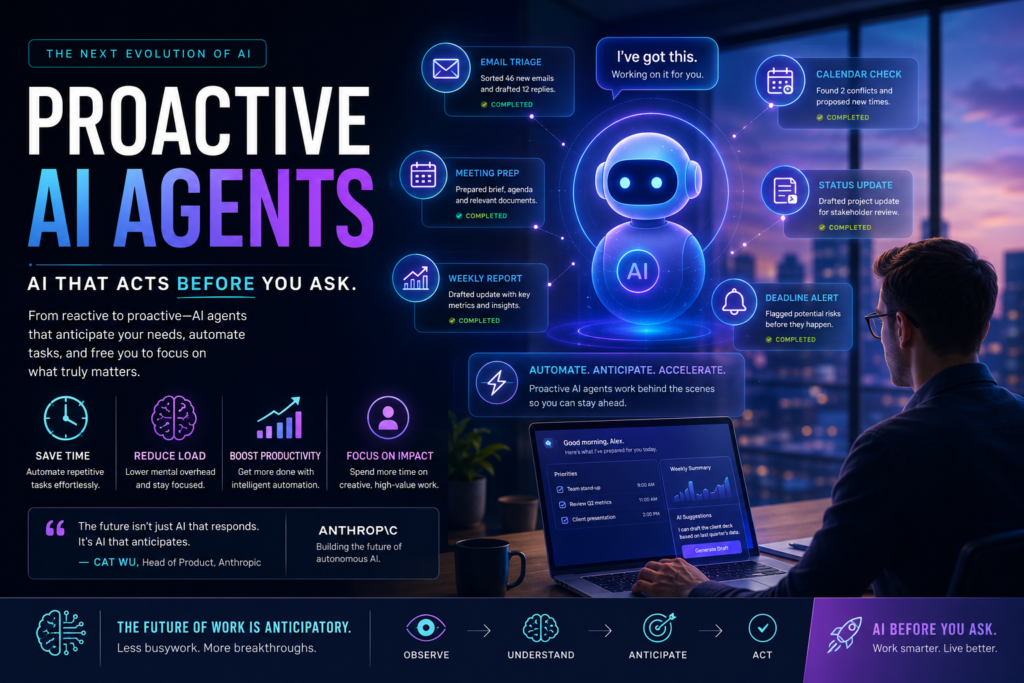
The next era of artificial intelligence isn’t just smarter — it’s earlier. Proactive AI agents are designed to act on your behalf before you even realize you need something done, and according to Anthropic’s head of product Cat Wu, this shift is the most significant development coming to AI in the near future.
If you’ve ever wished your AI assistant would just handle the repetitive parts of your day without being told — the follow-up emails, the recurring reports, the scheduled check-ins — that future is closer than you think.
What Are Proactive AI Agents?
Definition: Proactive AI agents are autonomous AI systems that initiate tasks, workflows, and actions based on learned context and patterns — without waiting for an explicit user prompt.
Unlike a traditional chatbot, which responds only when spoken to, a proactive AI agent monitors your work patterns, understands what you typically need at certain times or under certain conditions, and executes relevant tasks automatically. Think of the difference between a reactive assistant who waits for instructions and a trusted colleague who notices a deadline approaching and prepares the draft before you ask.
This is a fundamental departure from the “prompt-response” model that has defined AI interaction since the launch of ChatGPT in 2022. Proactive AI agents don’t just answer questions — they ask themselves the questions on your behalf.
From Reactive to Proactive — The Three Stages of AI Evolution
To appreciate why proactive AI agents represent such a leap, it helps to map the broader trajectory AI has taken over the past few years:
| Stage | Mode | User Action Required | Example |
|---|---|---|---|
| Stage 1: Informational AI | Reactive | Always | “Summarize this document for me.” |
| Stage 2: Agentic AI (Routines) | Semi-autonomous | Sometimes | “Every Monday, draft my team update.” |
| Stage 3: Proactive AI | Anticipatory | Rarely | AI drafts the update because it knows Monday is approaching and context signals suggest it’s needed. |
Cat Wu, Anthropic’s head of product for Claude Code and Cowork, described this progression clearly in a May 2026 interview with TechCrunch. She noted that the industry moved through “synchronous development” last year, then into “routines” — where users automate recurring tasks like responding to customer support tickets. The next step, she said, is that “Claude understands what you work on, and just sets up some of these automations for you.”
That third stage — where the AI configures its own automations based on observed context — is what makes proactive AI agents genuinely transformative.
Why Proactivity Is the Next Frontier, According to Anthropic
The Shift from Synchronous to Autonomous Workflows
For most of 2024 and early 2025, the dominant use case for AI was synchronous: a human sends a message, the AI responds, the human acts on the response. This model is powerful, but it still puts the cognitive load of task initiation squarely on the human.
The “routines” phase that followed introduced a meaningful improvement: users could schedule AI actions and automate recurring workflows. A sales team might set Claude to summarize inbound support tickets each morning. A developer might configure an agent to run a code review every time a pull request is opened. These automations are valuable, but they still require humans to design them explicitly.
Proactive AI agents eliminate even that design step. The system observes that you run a code review every Tuesday, notices you haven’t set one up this week, and either sets it up or prompts you to confirm — whichever level of autonomy you’ve granted it. The cognitive work of workflow design becomes the AI’s job, not yours.
What Cat Wu’s Vision Means for Everyday Users
Wu used a telling example in the TechCrunch interview: email. “For me, it’s responding to emails,” she said, describing the part of her job that feels tedious. “I think everyone has this part of their life.” Her hope is that proactive AI agents absorb those friction-heavy tasks, freeing humans to spend time on work they actually find meaningful or creatively demanding.
This framing is important because it reorients the conversation away from AI-as-threat and toward AI-as-relief. Proactive AI agents, in this vision, don’t replace professionals — they eliminate the administrative drag that prevents professionals from doing their best work.
How Proactive AI Agents Will Change the Way You Work
Automations You Didn’t Know You Needed
One of the underappreciated implications of proactive AI agents is that they surface automation opportunities users wouldn’t have identified on their own. Most people are too busy doing their routines to step back and notice that those routines are automatable. Proactive AI changes that dynamic.
Here are concrete examples of the kinds of automations proactive AI agents are expected to handle:
- Email triage and response drafting — detecting patterns in the emails you receive and preparing drafted replies for your review, or routing messages to the right folder automatically.
- Meeting prep packages — noticing a calendar event approaching and pulling together relevant documents, past notes, and action items before you open the invite.
- Status report generation — observing your weekly pattern of sending project updates and generating a draft populated with data from connected tools.
- Deadline early-warning — tracking project dependencies and surfacing risks before they become blockers, not after.
- Customer support automation — routing, categorizing, and drafting responses to inbound tickets based on prior resolution patterns.
Each of these represents a case where the AI acts not because it was told to, but because context made the action obviously useful.
Managing Agent Fleets — A New Professional Skill
Wu was direct about one important caveat: proactive AI agents don’t eliminate the need for human expertise — they transform it. “I think it is extremely hard to manage agents if you can’t do the job yourself,” she said. “The managers still need to be experts in their domain.”
Managing a fleet of proactive AI agents will require a distinct skill set:
- Debugging agent behavior — understanding why an agent made a particular decision or took an unexpected action.
- Instruction specification — crafting clear enough context and constraints that agents operate within intended boundaries.
- Output auditing — reviewing agent-generated work for accuracy and alignment before it reaches stakeholders.
- Escalation judgment — knowing when to override an agent and handle a task manually.
Wu drew an explicit parallel to people management: “Managing agents is actually very similar to being a manager of people, in the sense that you have to understand, like, why did the agent make this mistake? Did it misinterpret my instruction? Was my request under-specified?”
This means that while proactive AI agents reduce time spent on execution, they increase the value placed on strategic judgment, communication clarity, and domain fluency. The professionals who thrive will be those who can think at the system level, directing fleets of agents rather than completing individual tasks themselves.
Benefits and Challenges of Proactive AI Agents
Key Benefits
For individuals:
- Dramatically reduced time on repetitive, low-cognitive-value tasks
- Faster reaction to emerging priorities (the AI spots them first)
- Lower mental overhead from task management
- More time and energy for creative, high-judgment work
For teams and organizations:
- Consistent execution of recurring workflows without human coordination overhead
- Faster onboarding — agents codify institutional knowledge and processes
- Reduced error rates in rule-based tasks
- Scalable output without proportional headcount growth
Real Challenges to Acknowledge
Proactive AI agents also introduce legitimate concerns that builders and adopters need to take seriously:
Autonomy calibration is the central design challenge. An agent that acts too freely will take unwanted actions; one that asks permission too often defeats the purpose. Finding the right threshold — and giving users granular control over it — is still an open problem.
Privacy and context access raise important questions. For an AI to anticipate your needs, it needs to observe your behavior. That means access to emails, calendars, documents, and communications. The data governance implications are significant, and organizations will need clear policies before deploying proactive agents at scale.
Accountability gaps emerge when an agent takes an action nobody explicitly authorized. Establishing clear audit trails and human checkpoints for high-stakes decisions is essential to responsible deployment.
Skill atrophy is a longer-term concern. If AI handles enough of a domain, will professionals maintain the expertise Wu says is necessary to manage those agents effectively? This tension — between offloading and expertise — is one the industry hasn’t fully resolved.
What to Expect in the Next 12 Months
Based on Anthropic’s public roadmap signals and Cat Wu’s commentary, here’s what the near-term evolution of proactive AI agents is likely to look like:
Mid-2026: Deeper integration of AI agents with productivity suites (email, calendar, project management tools), with more sophisticated context-awareness and user-configurable automation triggers.
Late 2026: Broader rollout of agent-to-agent collaboration, where proactive AI agents coordinate with each other on multi-step tasks — a support agent flagging an issue to a scheduling agent, which then books a follow-up call.
Early 2027 and beyond: More autonomous agents operating with minimal prompt-level oversight, with human review concentrated at decision points rather than execution steps.
Anthropic has already laid groundwork through products like Claude Code (for developer workflows) and Cowork (for broader knowledge work automation). The proactive layer — where the AI configures its own routines — is the logical next step on top of this infrastructure.
Frequently Asked Questions About Proactive AI Agents
What is the difference between a proactive AI agent and a chatbot? A chatbot responds when you speak to it. A proactive AI agent acts on your behalf without needing to be asked, based on observed patterns and context. The key distinction is who initiates the interaction — with proactive AI, the system does.
Are proactive AI agents safe to use in a business setting? Safety depends heavily on implementation. Responsible deployment involves clear audit trails, human oversight checkpoints for consequential actions, data governance policies, and well-specified instructions. The technology is maturing, and best practices are still being established across the industry.
Will proactive AI agents replace jobs? The more accurate framing, based on Anthropic’s vision, is that proactive AI agents will absorb the repetitive, low-judgment portions of jobs — freeing humans to focus on complex, creative, and interpersonal work. However, the economic effects across industries will vary, and the transition will require real investment in reskilling.
What skills do I need to work effectively alongside proactive AI agents? Domain expertise, instruction clarity, and systems thinking are the core skills. You need to understand your field well enough to evaluate agent output, communicate precisely enough to specify what good results look like, and think structurally enough to design workflows that agents can execute reliably.
How is Anthropic approaching the development of proactive AI? According to Cat Wu, Anthropic’s product strategy is focused on “staying on the exponential” — continuously improving models and expanding what agents can do — rather than reacting to competitors. The proactive layer is the company’s stated near-term priority.
The Bottom Line: Proactive AI Agents Are the Next Platform Shift
The history of technology is punctuated by moments when tools stop waiting to be used and start anticipating what you need. The smartphone didn’t just put the internet in your pocket — it learned your location, your calendar, and your habits and began surfacing information before you searched for it. Proactive AI agents represent a similar inflection point for knowledge work.
Cat Wu’s vision, articulated at Anthropic’s Code with Claude conference in May 2026, is that AI will move from answering questions to eliminating the need to ask most of them. The friction of task initiation — of remembering to send the update, of scheduling the review, of drafting the reply — will increasingly be absorbed by AI systems that understand your work well enough to act on your behalf.
The professionals who engage with this shift thoughtfully — who develop the judgment to direct agents, the clarity to specify good instructions, and the expertise to audit what comes back — will be the ones who benefit most from what proactive AI agents make possible.
The AI isn’t just getting smarter. It’s getting earlier.