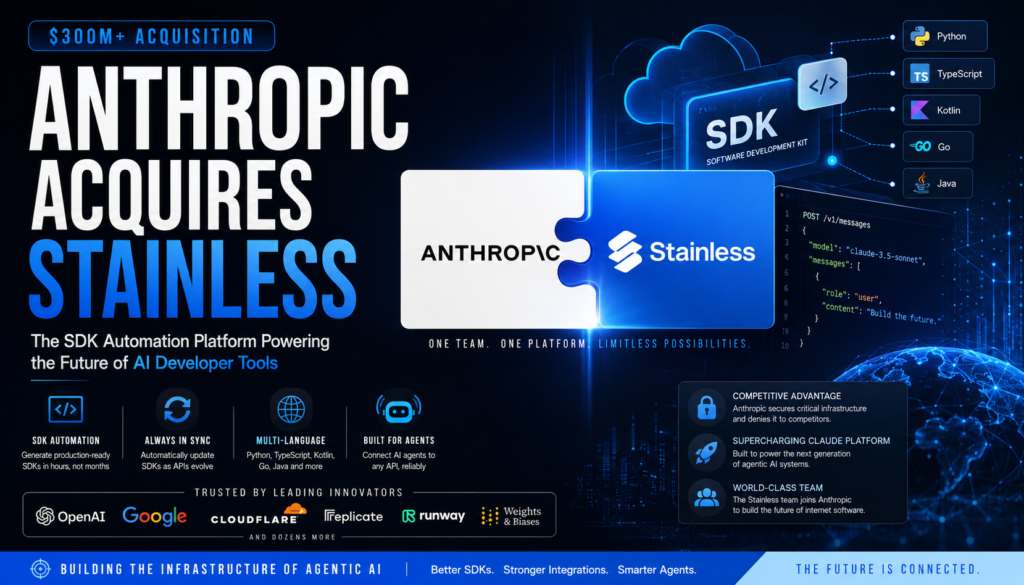
Anthropic acquires Stainless — and in doing so, quietly pulls a critical piece of AI infrastructure away from OpenAI, Google, and Cloudflare all at once. If you build with AI APIs, this deal changes the landscape you’re operating in.
What Is Stainless — and Why Did Anthropic Want It?
Stainless is a New York-based developer tools startup founded in 2022 by Alex Rattray, a former Stripe engineer. Its core product automates the creation and ongoing maintenance of software development kits (SDKs) — the code libraries that developers use to connect applications to APIs.
Before Stainless, maintaining SDKs was a painful, time-consuming manual process. Rattray’s platform changed that by ingesting an API specification and automatically generating production-ready SDKs across multiple programming languages — Python, TypeScript, Kotlin, Go, and Java — and keeping them in sync as the underlying API changed.
The result was a tool so good that Stainless’s customers included some of the biggest names in the AI industry: OpenAI, Google, Cloudflare, Replicate, Runway, Weights & Biases, and Anthropic itself. Backed by Sequoia Capital and Andreessen Horowitz, the startup had become genuine critical infrastructure for the AI developer economy.
The SDK Problem Stainless Was Born to Solve
What is an SDK? An SDK (Software Development Kit) is a packaged set of tools, libraries, and documentation that allows a developer to interact with an API in a specific programming language. Instead of writing raw HTTP requests, developers import an SDK and call clean, typed functions.
Why do SDKs need maintenance? APIs change constantly. Every time a company adds a new model, endpoint, parameter, or authentication method, every SDK in every language must be updated manually — or developers are left working with broken or outdated integrations. For a company like Anthropic or OpenAI shipping frequent API updates, this is a significant operational burden.
Stainless solved this with automation: define your API once, and the platform regenerates and updates your SDKs automatically. According to Stainless’s own estimates, roughly a quarter of the world’s professional software developers have used an SDK or documentation site built on Stainless technology. That scale is why Anthropic acquires Stainless made instant strategic sense.
What the Acquisition Deal Looks Like
Anthropic announced the acquisition on May 18, 2026. The company did not disclose the financial terms publicly, but reporting by The Information indicated the deal was valued at more than $300 million — a significant price for a four-year-old startup, and a clear signal of how much Anthropic values ownership over this infrastructure layer.
Key facts about the deal:
- Acquirer: Anthropic
- Target: Stainless Software, Inc.
- Founded: 2022, New York
- Reported deal value: $300M+
- Investors pre-acquisition: Sequoia Capital, Andreessen Horowitz
- Anthropic’s stated plan: Wind down all hosted Stainless products and fold the team into the Claude Platform
Stainless founder Alex Rattray noted that Anthropic was among Stainless’s oldest and closest partners, having used the platform to generate every official Anthropic SDK since the earliest days of the Claude API. “There’s no better place for the Stainless team to build the future of internet software,” Rattray said in the acquisition announcement.
Why This Move Is a Strategic Masterstroke for Anthropic
Locking Competitors Out of Key Infrastructure
The most immediate and dramatic consequence of this deal is competitive denial. By acquiring Stainless, Anthropic does not just gain a great internal tool — it removes that tool from the hands of every rival that depended on it.
Stainless has confirmed it is winding down all hosted products, including its SDK generator. New signups, projects, and SDKs are no longer being created on the platform. That means OpenAI, Google, Cloudflare, and every other Stainless customer must now find, build, or commission alternative solutions for SDK generation and maintenance — a capability that previously took Rattray and a dedicated startup to build.
This is a classic infrastructure play: acquire the picks-and-shovels supplier before your competitors realize what’s happening. In the AI race, where developer experience is a primary competitive moat, this matters enormously.
Supercharging the Claude Platform for Agentic AI
Beyond competitive denial, the acquisition gives Anthropic direct ownership of SDK generation capabilities at exactly the moment they are most strategically valuable.
The AI industry is rapidly shifting from chatbot interfaces toward agentic AI systems — autonomous agents that can connect to external APIs, retrieve data, execute actions, and complete complex multi-step tasks on behalf of users. For agents to do this reliably, the APIs they call must have well-maintained, type-safe, predictable SDKs in every language a developer might use.
Stainless’s technology is precisely what enables this. Anthropic has stated that its plans for the Stainless team are focused on “Claude Platform capabilities and connecting agents to APIs” — a direct acknowledgment that SDK infrastructure is foundational to the agentic future Anthropic is building toward.
In short: when Anthropic acquires Stainless, it is not just buying a dev tool. It is acquiring the connective tissue of the AI agent economy.
What Happens to Existing Stainless Customers?
If you or your company has been using Stainless to generate and maintain SDKs, here is what you need to know:
- Ownership of existing SDKs is yours. Anthropic has confirmed that all SDKs generated on Stainless prior to the acquisition remain the property of the customer. You retain full rights to modify, extend, and redistribute them.
- The hosted platform is shutting down. As of the acquisition announcement, Stainless is no longer accepting new signups or generating new SDKs through its hosted product.
- A transition guide is available. Stainless is directing affected customers to
app.stainless.com/transitionfor help moving from Stainless-managed products to alternative workflows. - No automatic migration. Customers will need to take active steps to maintain their SDKs going forward, whether by building in-house tooling, using open-source alternatives, or contracting with other providers.
- API documentation sites built on Stainless may also be affected; customers should check the transition portal for specifics on the documentation platform.
The timeline for full product wind-down has not been publicly specified, so customers with active dependencies should treat this as an urgent transition priority.
Stainless vs. Manual SDK Maintenance: Why It Mattered
To understand the full weight of what Stainless built — and what Anthropic is now acquiring — it helps to compare the two approaches to SDK development and maintenance side by side.
| Dimension | Manual SDK Maintenance | Stainless-Automated SDKs |
|---|---|---|
| Initial build time | Weeks to months per language | Hours (API spec-driven generation) |
| Languages supported | Limited by team capacity | Python, TypeScript, Kotlin, Go, Java (and more) |
| Update process when API changes | Manual edits across all language versions | Automatic regeneration from updated spec |
| Consistency across languages | Varies by contributor | Enforced by platform logic |
| Risk of SDK/API drift | High — frequent manual process failures | Low — automation keeps parity |
| Maintenance overhead | Ongoing, significant engineering time | Near-zero once spec is maintained |
| Cost model | Internal engineering salary | SaaS subscription (now unavailable) |
| Documentation sync | Manual, often lagging | Automated alongside SDK generation |
This table illustrates why companies like OpenAI, Google, and Anthropic paid for Stainless rather than build in-house: the efficiency gap between automated and manual SDK maintenance is enormous at enterprise scale.
What This Means for the Broader AI Developer Ecosystem
The Anthropic acquires Stainless deal sends several signals worth watching for developers, API companies, and investors alike.
For developers building on AI APIs: Your SDK experience may shift. Anthropic is likely to pour more resources into the quality and reliability of official Claude SDKs now that it owns the underlying generation platform. Developers building with competitors’ APIs, however, may see slower SDK updates or reduced language coverage as those teams scramble to replace Stainless.
For API companies that relied on Stainless: The transition window is short. Companies like OpenAI, Cloudflare, Replicate, and others must now solve the SDK maintenance problem in-house or find a replacement vendor. A gap in the market will almost certainly attract new entrants — expect to see new SDK automation startups or open-source projects emerge in response to Stainless’s exit from the market.
For AI infrastructure investors: This deal validates a thesis that has been building for some time: the most durable competitive moats in AI are not at the model layer alone, but at the developer tooling and infrastructure layer. Companies that own the workflows developers rely on every day earn a degree of stickiness that raw model performance cannot guarantee.
For the agentic AI race specifically: SDK quality is not a footnote — it is a prerequisite. Reliable, well-typed, auto-updating SDKs are what make it feasible for AI agents to connect to the hundreds of external APIs they need to operate effectively in the real world. By controlling this layer, Anthropic gains a meaningful structural advantage in building the agentic platforms that will define the next phase of the AI industry.
Key Takeaways at a Glance
Here is a concise summary of everything you need to know about the Anthropic and Stainless acquisition:
- What happened: Anthropic acquired Stainless, a startup that automates SDK generation and maintenance, for a reported $300M+.
- Who Stainless served: OpenAI, Google, Cloudflare, Replicate, Runway, Weights & Biases, and dozens of others — in addition to Anthropic itself.
- Why it matters: Anthropic gains exclusive ownership of key AI developer infrastructure while simultaneously denying that infrastructure to competitors.
- What Stainless built: A platform that converts API specifications into production-ready, multi-language SDKs and keeps them updated automatically — a capability that previously required significant manual engineering effort.
- What happens to Stainless products: All hosted Stainless products are being wound down. No new SDKs will be generated on the platform.
- What happens to customer SDKs: Existing SDKs belong to the customers that generated them. Rights to modify and extend them are fully retained.
- Strategic purpose: Anthropic plans to use the Stainless team to strengthen Claude Platform capabilities, with a focus on connecting AI agents to external APIs.
- Broader signal: This deal confirms that developer tooling is a first-class competitive weapon in the AI industry, not an afterthought.
Final Verdict: A Bet on the Infrastructure of Agentic AI
The decision by Anthropic to acquire Stainless is one of the shrewdest infrastructure plays in recent AI industry history. On the surface, it looks like a developer tooling acquisition. Look deeper, and it is a calculated move to own the SDK automation layer at the precise moment that SDK quality becomes essential to the agentic AI products every major lab is racing to build.
For Anthropic’s competitors, the loss is immediate and practical: a trusted, automated SDK pipeline that underpinned their developer experience is gone overnight. For Anthropic, the gain is compounding: better internal tooling, a talented team already deeply familiar with the Claude API, and a structural advantage in the agent-to-API connectivity that defines the next generation of AI products.
Whether you are a developer, a product leader, or an investor, this acquisition deserves to be on your radar — not just as a business story, but as a signal about where the real leverage points in the AI industry actually lie.
Frequently Asked Questions: Anthropic Acquires Stainless
1. Why did Anthropic acquire Stainless?
The biggest reason Anthropic acquires Stainless is strategic infrastructure control. Stainless was not just another startup building developer tools—it had become essential infrastructure for companies building and maintaining APIs. Its platform automated SDK generation across multiple programming languages, making it easier for developers to integrate APIs without manually maintaining libraries.
When Anthropic acquires Stainless, it gains direct ownership over the SDK automation technology already used to power Anthropic’s official developer ecosystem. This means Anthropic no longer depends on a third-party vendor for one of the most important layers of developer experience.
Another reason Anthropic acquires Stainless is competitive positioning. Stainless previously served major customers including OpenAI, Google, Cloudflare, and other API-driven companies. By acquiring the company and winding down hosted products, Anthropic effectively removes a valuable infrastructure tool from competitor hands.
So, when people ask why Anthropic acquires Stainless, the short answer is simple: better developer infrastructure, stronger Claude platform capabilities, and reduced competitor access to critical SDK tooling.
2. What is Stainless, and why is it important?
Stainless is a developer tools startup founded in 2022 by Alex Rattray. The company focused on automating SDK creation and maintenance for APIs.
Normally, when companies launch APIs, they need SDKs for Python, TypeScript, Java, Go, Kotlin, and other languages. Maintaining these manually is expensive and time-consuming. Stainless solved this problem by automatically generating production-ready SDKs from API specifications.
The reason Anthropic acquires Stainless is because this automation is incredibly valuable in the AI era. AI companies release API changes constantly—new models, parameters, tools, endpoints, and authentication systems.
Without automation, SDK maintenance becomes a nightmare.
That is why Stainless became critical infrastructure for the AI ecosystem, and why Anthropic acquires Stainless instead of continuing to rent access.
3. How much did Anthropic pay to acquire Stainless?
Anthropic did not officially disclose the acquisition price publicly. However, multiple reports suggest the deal value exceeded $300 million.
This is a significant number considering Stainless was founded only a few years ago. The fact that Anthropic acquires Stainless at a $300M+ valuation shows just how valuable developer infrastructure has become.
Many people assume AI value exists only at the model layer, but this deal proves otherwise. When Anthropic acquires Stainless, it sends a message to the market that developer tooling is now a strategic moat.
This acquisition is not just about buying software—it is about controlling workflows developers depend on daily.
4. What happens to existing Stainless customers?
A major concern after the news that Anthropic acquires Stainless is what happens to current Stainless users.
According to public statements:
- Existing SDKs generated on Stainless remain customer-owned
- Customers retain rights to modify and extend generated SDKs
- Hosted Stainless products are shutting down
- New signups and projects are no longer accepted
This means companies previously relying on Stainless must now transition away from the platform.
Because Anthropic acquires Stainless, competitors like OpenAI and other API companies now need alternative SDK automation solutions or in-house tooling.
This creates immediate operational challenges, especially for teams dependent on automated SDK updates.
5. How does this acquisition affect OpenAI and Google?
The impact is substantial.
Before Anthropic acquires Stainless, OpenAI, Google, and other companies benefited from Stainless SDK automation technology. Their developer teams could automate SDK generation and reduce maintenance costs.
Now that Anthropic acquires Stainless, those competitors lose access to hosted Stainless products.
This means competitors may face:
- Higher SDK maintenance costs
- Slower developer tooling updates
- Increased engineering workload
- Need to build internal alternatives
The reason this matters is simple: developer experience is now a competitive advantage.
When Anthropic acquires Stainless, it is not just strengthening itself—it is increasing friction for rivals.
That is why many analysts see this as one of the smartest infrastructure plays in AI this year.
6. How does this help Claude and Anthropic’s API ecosystem?
A major benefit after Anthropic acquires Stainless is tighter integration between SDK automation and the Claude platform.
Anthropic already relied on Stainless to generate official SDKs. Owning the platform means:
- Faster SDK releases
- Better API consistency
- Improved documentation syncing
- Stronger developer onboarding
Developers building on Claude will likely benefit the most.
Because Anthropic acquires Stainless, Claude developers can expect a more reliable and polished API ecosystem over time.
This is especially important as Anthropic pushes deeper into enterprise AI and developer adoption.
7. What does this mean for agentic AI?
One overlooked reason Anthropic acquires Stainless is agentic AI.
AI is moving beyond chatbots into autonomous agents that connect to APIs, retrieve data, and execute actions.
For this to work, agents need reliable SDKs.
Poor SDK quality creates:
- Integration failures
- Broken workflows
- API inconsistencies
- Security risks
When Anthropic acquires Stainless, it gains infrastructure specifically useful for scaling agent-to-API interactions.
This is likely the long-term strategic vision behind the acquisition.
Anthropic is not just buying developer tools—it is buying infrastructure for future AI agents.
That is why the fact that Anthropic acquires Stainless matters far beyond SDK automation.
8. Could new competitors replace Stainless?
Yes, and probably soon.
Whenever a major platform exits a market, new opportunities emerge.
Since Anthropic acquires Stainless and shuts down hosted products, a gap now exists in SDK automation.
Possible replacements may include:
- Open-source SDK generators
- New SaaS SDK platforms
- In-house developer tooling startups
Investors will likely fund new alternatives quickly because demand remains high.
However, Stainless had strong market trust, and replacing that reputation will take time.
That is why Anthropic acquires Stainless creates both disruption and opportunity.
9. Is this acquisition good or bad for developers?
It depends on which ecosystem you use.
If you build on Claude, the fact that Anthropic acquires Stainless is likely positive. Better SDK tooling usually means faster updates and stronger documentation.
If you relied on Stainless independently or through competitors, the acquisition is more disruptive.
You may now need migration plans, replacement tools, or engineering resources.
So when asking whether Anthropic acquires Stainless is good or bad, the answer depends on where you sit in the ecosystem.
10. Why is everyone talking about this deal?
Because Anthropic acquires Stainless is bigger than a normal acquisition headline.
This deal combines three major trends:
- AI platform competition
- Developer tooling consolidation
- Agentic AI infrastructure investment
It is rare to see a startup become critical infrastructure so quickly.
The fact that Anthropic acquires Stainless shows how much leverage exists outside the model layer.
Models get attention, but infrastructure wins markets.
That is the real lesson behind why Anthropic acquires Stainless has become such an important AI industry story.