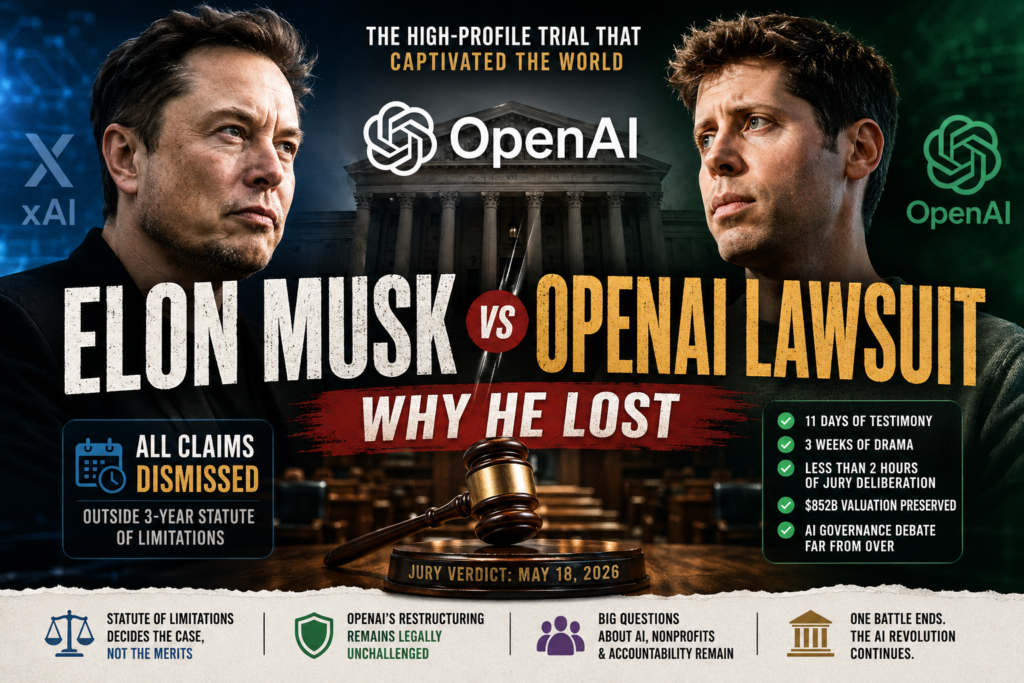
Elon Musk lost his landmark lawsuit against OpenAI and CEO Sam Altman on May 18, 2026, after a unanimous jury verdict in Oakland, California found that all of his claims had been filed too late. The trial ran for 11 days, drew worldwide attention, and ended not with a ruling on whether OpenAI had betrayed its nonprofit mission — but on a clock.
Here is everything you need to know about why the Elon Musk OpenAI lawsuit failed, what it revealed about Silicon Valley’s most dramatic feud, and what happens next for AI governance.
What Was the Elon Musk OpenAI Lawsuit About?
The Elon Musk OpenAI lawsuit centered on one core accusation: that Sam Altman, co-founder Greg Brockman, and OpenAI itself had broken a foundational promise — to develop artificial intelligence for the benefit of humanity, not for profit.
Musk filed his first lawsuit in February 2024, alleging that OpenAI had committed breach of charitable trust and unjust enrichment by transitioning from a nonprofit structure into a for-profit enterprise while retaining the public goodwill, talent, and donor contributions (including Musk’s own) that the nonprofit had built. (OpenAI lawsuit verdict 2026 Sam Altman trial verdict OpenAI nonprofit mission AI governance laws
)
The Founding of OpenAI and Musk’s Role
OpenAI was co-founded in 2015 by Musk, Altman, Brockman, and several others. Its founding mission was born out of a shared concern among the founders about the potentially negative consequences of AI being controlled by any one person or for-profit company. Musk was among its earliest and most prominent backers.
By 2017, the founders became convinced they needed to set up a for-profit arm of OpenAI to raise money and attract researchers in order to be competitive. Musk wanted control over this restructured entity. The others disagreed. Musk cofounded OpenAI with Altman in 2015 but left before the company took off — specifically in 2018 — and went on to found the competing AI startup xAI in 2023.
The Core Legal Claims
When Musk filed the Elon Musk OpenAI lawsuit in 2024, he leveled several specific accusations:
- Breach of charitable trust — that OpenAI’s shift to for-profit operations violated its founding commitments to donors and the public.
- Unjust enrichment — that Altman, Brockman, and Microsoft profited unfairly from assets built under the nonprofit structure.
- Fraud — that Musk had been misled about the long-term direction of the organization.
OpenAI’s lawyers portrayed the lawsuit as Musk’s attempt to kneecap a rival after he failed to gain control of it. They also argued that Musk’s donations were not restricted in any way, and that restructuring the business was the only way to compete in a costly race against Google DeepMind.
How the Trial Unfolded
The trial took place at the Ronald V. Dellums Federal Building in Oakland, California, presided over by U.S. District Judge Yvonne Gonzalez Rogers. It lasted approximately three weeks, with 11 days of testimony, and drew enormous scrutiny from the tech industry, legal scholars, and AI policy advocates.
The verdict means Altman, co-founder Greg Brockman and OpenAI are not liable on all claims after a blockbuster three-week trial that has captivated the tech industry and could have reshaped the race to develop artificial intelligence.
Musk himself was on the witness stand for three days — an extraordinarily rare occurrence for someone of his stature — and the question of whether he had waited too long to file the suit became a central focus throughout.
Key Arguments on Both Sides
Musk’s legal team argued:
- OpenAI made binding promises to donors, including Musk, about its nonprofit status.
- The $10 billion deal between OpenAI and Microsoft in 2023 was the key event that triggered Musk’s awareness of harm — and therefore the statute of limitations clock should have started there.
- The restructuring was effectively “stealing a charity,” enriching private individuals at the expense of the public mission they’d promised to serve.
OpenAI and Altman’s legal team argued:
- Altman and OpenAI, now a company valued at $852 billion, argued there was never a promise to keep the company nonprofit permanently.
- Musk was fully aware of the structural changes happening at OpenAI years before he filed his lawsuit — and the statute of limitations had long expired.
- They showed Musk had floated a for-profit structure on the condition that he retain control, even pushing the company at one point to fold into Tesla.
The Verdict: Why Did Musk Lose?
The Statute of Limitations Explained
Definition: A statute of limitations is the maximum period of time after an event within which legal proceedings may be initiated. Once this window closes, a claim is time-barred — regardless of whether the underlying allegations have merit.
In California, where this case was tried in federal court, the relevant statute of limitations was three years.
The advisory jury’s verdict, which came after less than two hours of deliberations, was immediately adopted by District Court Judge Yvonne Gonzalez Rogers. The court did not address whether Musk’s claims of “breach of charitable trust” were valid, but instead found they fell outside of a three-year statute of limitations.
In plain terms: the jury decided that Musk knew — or reasonably should have known — about the alleged harm to the charitable mission more than three years before he filed his 2024 lawsuit. That made every claim he brought legally untimely, no matter how compelling they might otherwise be.
Judge Yvonne Gonzalez Rogers agreed with the jury’s finding. She noted from the bench: “There’s a substantial amount of evidence to support the jury’s finding, which is why I was prepared to dismiss on the spot.”
How Fast Did the Jury Decide?
The jury delivered a unanimous verdict after deliberating for less than two hours on Monday morning, following 11 days of testimony and arguments in Oakland, California. The speed of the deliberation was itself a signal — the evidence that Musk had filed too late was, in the jury’s view, overwhelming.
Musk’s Claims vs. Court’s Findings: A Comparison
| Claim by Musk | Court’s Finding | Outcome |
|---|---|---|
| Breach of charitable trust | Claim filed outside 3-year window | Dismissed as untimely |
| Unjust enrichment (Altman & Brockman) | Statute of limitations exceeded | Dismissed as untimely |
| Fraud in restructuring | Evidence of prior knowledge by Musk | Dismissed as untimely |
| Microsoft complicity | Same statute of limitations bar | Dismissed as untimely |
| Injunction to halt for-profit conversion | Previously denied; moot after verdict | Not addressed |
Note: The court made no ruling on the underlying merits of any of these claims.
What Musk Said After the Verdict
Musk did not accept the outcome quietly. Shortly after the ruling, he posted on X (formerly Twitter) that the verdict was nothing but a “calendar technicality” and vowed to appeal the decision.
Musk said: “Regarding the OpenAI case, the judge & jury never actually ruled on the merits of the case, just on a calendar technicality. There is no question to anyone following the case in detail that Altman & Brockman did in fact enrich themselves by stealing a charity.”
However, the judge suggested Musk may have an uphill battle because whether the statute of limitations ran out before Musk sued was a factual issue. When a jury unanimously finds a factual question against you, appeals courts give those findings enormous deference.
Microsoft, which was also named as a defendant, welcomed the ruling. Microsoft said in a statement: “The facts and the timeline in this case have long been clear, and we welcome the jury’s decision to dismiss these claims as untimely.”
What This Means for OpenAI and the Future of AI Governance
OpenAI’s Restructuring Is Now Legally Unchallenged
The verdict preserves the status quo for OpenAI, the company behind ChatGPT and one of the most valuable privately held tech startups in the world. In March, OpenAI said it was worth $852 billion after it raised a fresh round of $122 billion from outside investors. OpenAI completed a restructuring last year that left a nonprofit foundation in charge of its business operations while confirming large ownership stakes for outside investors, including Microsoft.
With the Elon Musk OpenAI lawsuit now disposed of, OpenAI can execute its commercial roadmap — including its landmark personal finance chatbot integration and potential further partnerships — without the legal cloud that has hung over it since 2024.
A “Calendar Technicality” — or Smart Legal Strategy?
The outcome raises a legitimate question that will generate debate among AI ethicists and legal scholars for years: Was there genuine wrongdoing at OpenAI that went unpunished simply because Musk filed too late?
From a purely legal standpoint, the answer is irrelevant. Statutes of limitations exist for good reason — they prevent parties from sitting on their rights, ensure that evidence is fresh, and provide defendants with certainty that old disputes won’t be relitigated indefinitely. Musk was a sophisticated legal actor with access to counsel from the moment he left OpenAI in 2018.
From a policy standpoint, however, the case surfaced serious unresolved questions:
- What obligations do nonprofits have to their donors when they restructure? OpenAI’s transformation from a nonprofit into a $852 billion commercial enterprise is unprecedented in scale. The legal frameworks governing this territory remain underdeveloped.
- Who holds AI labs accountable for mission drift? The Elon Musk OpenAI lawsuit, whatever its flaws, forced a public accounting of how OpenAI’s stated values evolved alongside its commercial ambitions.
- Can donors enforce charitable promises? Courts have traditionally been reluctant to let individual donors enforce the terms of charitable gifts. This trial did not change that landscape — but it didn’t settle it either, since the merits were never reached.
What Happens to OpenAI’s Counterclaims?
OpenAI countersued Musk over alleged fraudulent business practices in California. Those counterclaims are separate from the claims decided by Monday’s verdict. It remains to be seen whether OpenAI will pursue those aggressively now that its defensive position has been vindicated — or whether both sides will quietly de-escalate.
Frequently Asked Questions About the Elon Musk OpenAI Lawsuit
Q: Did the jury decide that OpenAI did nothing wrong?
No. The jury never ruled on the merits of Musk’s claims. The sole finding was that his lawsuit was filed after the statute of limitations had expired. Whether OpenAI breached its charitable mission remains, legally speaking, undecided.
Q: What was the statute of limitations in this case?
Three years under California law. The jury found that Musk knew or should have known about the alleged harms more than three years before he filed his 2024 lawsuit.
Q: Will Musk appeal?
Musk has said he intends to appeal. However, overturning a unanimous jury’s factual finding on a statute of limitations issue is exceptionally difficult. The judge herself indicated the evidentiary record was strong.
Q: What was OpenAI worth at the time of the verdict?
OpenAI was valued at approximately $852 billion following a $122 billion funding round earlier in 2026, making it one of the most valuable private companies in history.
Q: How long did the trial last?
The trial lasted approximately three weeks, with 11 days of testimony. Jury deliberations took less than two hours.
Q: What is xAI, Musk’s competing AI company?
In 2023, Musk started his own competing AI lab, xAI, which is now part of SpaceX. xAI’s flagship product, Grok, competes directly with OpenAI’s ChatGPT.
The Bigger Picture: One Battle Ends, the War Continues
The Elon Musk OpenAI lawsuit was never just another Silicon Valley courtroom drama. While headlines focused on the clash between two of tech’s most recognizable figures, the deeper conflict exposed by the Elon Musk OpenAI lawsuit reaches far beyond one legal defeat. At its core, this case symbolized a growing tension between idealism and commercialization in artificial intelligence.
When OpenAI launched in 2015, it positioned itself as a nonprofit research lab dedicated to ensuring artificial general intelligence would benefit all of humanity. That mission attracted global attention, elite researchers, and financial support from major technology leaders, including Elon Musk. In many ways, the founding narrative of OpenAI was built on trust: trust that advanced AI would not become concentrated in the hands of a few corporations or investors.
The Elon Musk OpenAI lawsuit challenged whether that trust had been broken.
Although Musk ultimately lost because the claims were ruled untimely under California’s statute of limitations, the legal loss did not erase the broader concerns raised during the trial. In fact, the Elon Musk OpenAI lawsuit may be remembered less for its courtroom outcome and more for forcing a public debate on questions the tech industry has largely avoided.
AI Companies Are No Longer Just Startups
One of the biggest takeaways from the Elon Musk OpenAI lawsuit is that AI labs are no longer niche research organizations experimenting in relative obscurity. OpenAI has transformed into one of the most valuable private companies in the world, reportedly worth over $852 billion after its latest funding round.
That scale changes everything.
When a company influences how millions of people work, search for information, write code, create content, and interact online, it is no longer simply a startup. It becomes infrastructure.
The Elon Musk OpenAI lawsuit highlighted this shift clearly. Musk argued that OpenAI had evolved from a public-interest nonprofit into a commercial powerhouse driven by investor returns and strategic partnerships. Whether or not courts ever validate that criticism, the perception itself matters.
People are beginning to ask difficult questions:
- Should companies building frontier AI be allowed to restructure without stronger public oversight?
- What happens when organizations founded with nonprofit language become commercial empires?
- Who gets to define whether an AI company is still aligned with its original mission?
The Elon Musk OpenAI lawsuit did not answer these questions. But it ensured they can no longer be ignored.
The Legal System Is Struggling to Keep Up
Another lesson from the Elon Musk OpenAI lawsuit is how poorly existing legal frameworks map onto modern AI governance.
This was not a traditional contract dispute. It was not a simple shareholder disagreement. Instead, the Elon Musk OpenAI lawsuit sat at the intersection of nonprofit law, charitable trust doctrine, venture financing, corporate restructuring, and emerging AI ethics.
That combination is rare—and messy.
Courts are designed to apply existing laws to disputes, not invent entirely new governance frameworks for unprecedented technologies. The Elon Musk OpenAI lawsuit showed the limitations of relying on litigation alone to regulate AI companies.
Even if Musk had filed earlier and survived the statute of limitations challenge, the case would still have faced legally complex questions:
- Can a donor enforce a nonprofit’s original mission years later?
- Does a nonprofit’s restructuring automatically violate donor expectations?
- Are public mission statements legally enforceable promises?
These issues remain unresolved because the Elon Musk OpenAI lawsuit ended on procedural grounds rather than substantive legal findings.
That outcome may frustrate critics, but it also reveals something important: society is moving faster than regulation.
OpenAI Emerges Stronger—For Now
From a business perspective, the Elon Musk OpenAI lawsuit ended as a major victory for OpenAI.
The verdict effectively removes one of the largest legal overhangs hanging above the company since 2024. With the lawsuit dismissed, OpenAI can continue executing its aggressive commercial strategy, expanding enterprise products, deepening partnerships, and investing further in AI infrastructure.
For Sam Altman and OpenAI leadership, the Elon Musk OpenAI lawsuit is now a reputational and strategic win. They defended the company’s evolution without courts finding liability on any claim.
That matters enormously in investor circles.
A legal loss could have introduced uncertainty around governance, funding structures, and future commercialization plans. Instead, the dismissal allows OpenAI to maintain momentum in one of the most competitive sectors on earth.
Still, victory does not mean immunity from scrutiny.
The questions raised by the Elon Musk OpenAI lawsuit will likely follow OpenAI for years, especially as governments worldwide begin examining AI concentration risks, safety obligations, and platform dominance.
Musk’s Loss Doesn’t End the Rivalry
The Elon Musk OpenAI lawsuit may be over, but the competitive battle is very much alive.
After leaving OpenAI, Musk launched xAI as a direct challenger to OpenAI’s dominance. Its chatbot Grok is positioned not only as a technical rival to ChatGPT, but also as a philosophical alternative.
This is what makes the Elon Musk OpenAI lawsuit so fascinating: it was simultaneously a legal battle, a branding battle, and a market battle.
Musk’s courtroom loss does not remove him from the AI race. If anything, it sharpens the rivalry.
Instead of litigating OpenAI’s future, Musk now has stronger incentive to compete with it directly in the marketplace.
That means the next phase of this conflict is unlikely to unfold in courtrooms. It will play out through:
- model releases
- infrastructure investment
- AI platform adoption
- enterprise partnerships
- consumer trust battles
The Elon Musk OpenAI lawsuit was one chapter, not the final act.
Why This Case Matters for Everyone
It is easy to dismiss the Elon Musk OpenAI lawsuit as billionaire drama. That would be a mistake.
The real importance of this case lies in what it revealed about power in the AI era.
Artificial intelligence is rapidly becoming foundational technology—similar to electricity, the internet, and cloud computing. Decisions about who controls it, how it is governed, and what incentives shape its development affect everyone.
The Elon Musk OpenAI lawsuit forced these issues into public view.
Even though the jury ruled on timing rather than substance, the trial spotlighted a reality many observers had already suspected: the governance of frontier AI is still deeply unsettled.
One lawsuit cannot solve that.
But the Elon Musk OpenAI lawsuit has already done something meaningful—it made AI governance impossible to ignore.
One battle has ended. The larger war over the future of artificial intelligence, corporate accountability, and public trust is only beginning.