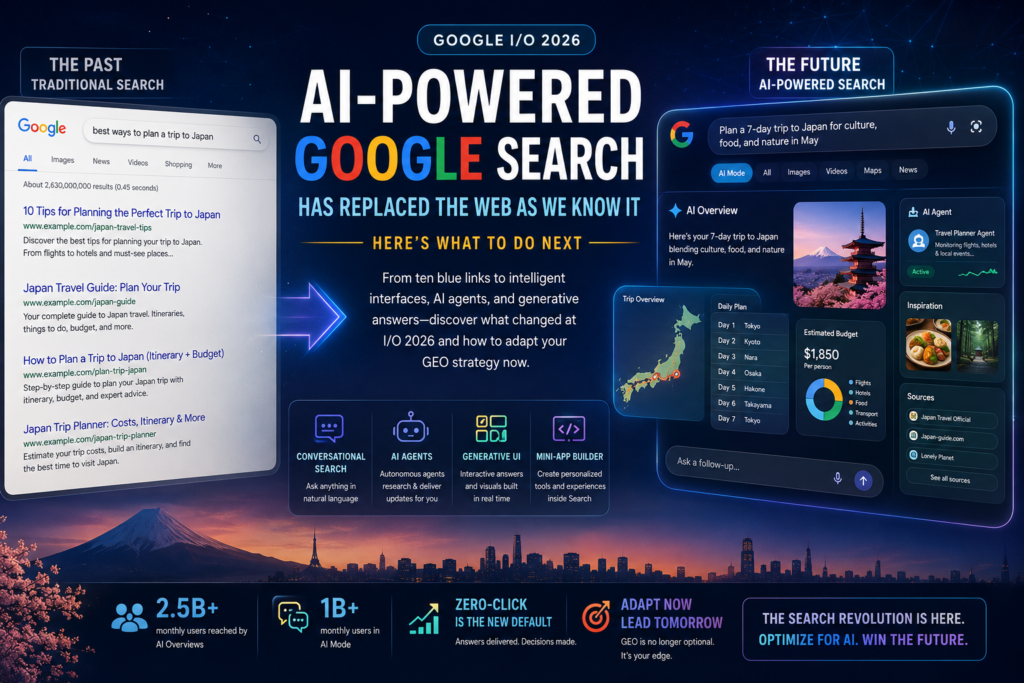
The era of the ten blue links ended on May 19, 2026. Google’s sweeping overhaul at I/O 2026 didn’t just update search — it replaced it with something fundamentally different: a conversational, agentic, generative experience powered by Gemini and Google Antigravity. If you produce content for the web, run an SEO strategy, or depend on organic traffic for revenue, this changes everything. Here is the definitive guide to what happened, why it matters, and how to adapt.
What Just Happened? The Google I/O 2026 Bombshell, Explained
From Ten Blue Links to Intelligent Interfaces
For more than 25 years, Google Search operated on a simple promise: type a query, receive a ranked list of links, click through to the source. That model is now gone.
At Google I/O 2026, the company unveiled what its Head of Search, Liz Reid, described as the biggest change to the search entry point since the search box first debuted. AI-powered Google Search no longer returns a simple list of links. Instead, it drops users into AI-generated interactive experiences, dispatches autonomous agents to gather information on their behalf, and lets them build personalized mini-apps directly inside the search interface.
This is not an incremental update. It is a structural replacement of one paradigm with another.
What Google Actually Announced at I/O 2026
Four features defined the announcement, each compounding the impact of the last:
- The Intelligent Search Box: A reimagined query interface that expands to accommodate longer, conversational prompts — no more keyword-cramming. It also ships with an AI-powered suggestion engine that goes far beyond autocomplete, helping users craft complex, nuanced queries.
- Information Agents: Background AI workers that monitor the web 24/7, track changes based on user-defined parameters, and surface synthesized updates with links for deeper exploration. Think Google Alerts, but powered by a large language model that can interpret what it finds, not just detect it.
- Generative UI: AI-powered Google Search now builds custom widgets, interactive visuals, and dynamic layouts on the fly in direct response to a query. Ask about black holes and get an interactive orrery, not a Wikipedia snippet.
- Mini-App Builder: Users can deploy Google’s Antigravity agentic platform from inside Search to build stateful, personalized tools using plain-language commands — a meal planner that reads your calendar, a fitness coach tuned to your goals.
The new search box began rolling out the same week as the announcement. Generative UI arrives this summer, free to all users. Information agents and mini-app building roll out first to Google AI Pro and Ultra subscribers before broader availability.
How AI-Powered Google Search Actually Works Now
Understanding the new mechanics is essential for anyone trying to remain visible in this environment.
The Intelligent Search Box
What it is: An expanded, conversational query interface with AI-guided query construction.
What it changes: Users no longer need to engineer short keyword strings. The system accommodates long, context-rich questions and actively helps users articulate what they want. For content creators, this means the queries reaching your topic space will be more specific, more intent-dense, and more conversational than anything a traditional keyword tool predicted.
AI Overviews and AI Mode: Already Massive
Before this announcement, AI-powered Google Search had already reshaped behavior at enormous scale. AI Overviews — the short, synthesized summaries that appear above traditional results — now reach more than 2.5 billion monthly users. Google’s conversational AI Mode, launched in 2025, has surpassed 1 billion monthly users.
For comparison: ChatGPT has 900 million weekly active users. Google’s numbers are monthly uniques, not weekly actuals, meaning the two platforms serve different usage patterns — but the sheer scale of AI-powered Google Search adoption is staggering.
With the I/O 2026 updates, AI Overviews now accept follow-up questions inside AI Mode, making the search surface more interactive and reducing the motivation to click through to source content.
AI Search Agents: When the Web Browses Itself
What they are: AI systems that autonomously search, monitor, and synthesize web information based on a user’s defined parameters — continuously, in the background.
Why they matter: When a user sets an information agent to track market movements in a specific sector, the agent maps out a monitoring plan, selects tools and data sources, tracks changes, and delivers a synthesized update with supporting links. The user never performs a search. The user acts on the search.
This represents an inflection point: searching the web is increasingly something AI does, not something humans do. People are shifting from retrieval to decision-making, from browsing to acting on curated intelligence.
Generative UI: Interactive Answers Instead of Pages
What it is: A system built in partnership with Google DeepMind, running on Gemini Flash 3.5, that generates custom interfaces — widgets, visualizations, interactive layouts — directly in the search results in real time.
What it changes: The answer to a query is no longer text pointing to a page. It is a purpose-built, interactive experience assembled on the fly from information Google’s systems have already ingested. Your content may still inform that experience, but the user may never see your URL.
Old Google Search vs. New AI-Powered Google Search
The table below maps the structural differences between the search paradigm that dominated the web for 25 years and the one that replaced it at I/O 2026.
| Dimension | Traditional Google Search | AI-Powered Google Search (2026) |
|---|---|---|
| Primary output | Ranked list of links | AI-generated answers, UI, agents |
| User query style | Short keyword strings | Long, conversational prompts |
| Click behavior | Click-through to source | Answer consumed in-SERP |
| Information agents | Google Alerts (manual, passive) | Autonomous AI agents (active, synthesizing) |
| Personalization | Minimal, based on history | Deep, includes calendar, parameters |
| Publisher referral | High (core traffic driver) | Declining sharply |
| Content format rewarded | Long-form, keyword-rich pages | Modular, answer-first, extractable passages |
| Paid access tier | N/A | Pro/Ultra for agents and mini-apps |
| Rollout timeline | Established | New box: May 2026; Gen UI: Summer 2026 |
| AI integration | AI Overviews (summary layer) | Fully AI-mediated search experience |
The implication for content strategy is stark. The behaviors and signals that drove traditional SEO performance — keyword density, page authority, link acquisition — remain relevant but are no longer sufficient. AI-powered Google Search evaluates content at the passage level, not the page level.
What This Means for Publishers, Marketers, and SEOs
Organic Traffic Will Decline Further — and Faster
AI Overviews had already begun suppressing click-through rates before this announcement. Ad-dependent media operations have already closed as a result. The new features compound this pressure significantly.
When generative UI can answer a question with an interactive visualization built from your content — without sending the user to your page — the referral relationship between Google and publishers is fundamentally broken. The I/O 2026 changes don’t threaten this scenario; they deliver it.
The Value of Content Is Shifting from Ranking to Contribution
In the architecture of AI-powered Google Search, a piece of content’s value is no longer measured primarily by where it ranks. It is measured by how cleanly and authoritatively it contributes to AI-generated answers. Content that is modular, clearly structured, and factually distinct is more likely to be retrieved, surfaced, and attributed inside AI responses — even if it never appears at position one in a traditional results page.
Zero-Click Search Is the Default, Not the Exception
Zero-click search — where a user’s query is resolved entirely on the results page without a click — was already the majority of Google search sessions before 2026. With generative UI, information agents, and expanded AI Overviews now built into ai-powered Google Search, zero-click behavior will extend to even more complex queries that previously required a click to resolve.
For marketers, this means the funnel entry point has moved. Brand exposure and authority now happen inside AI-generated responses, not on landing pages.
How to Optimize for AI-Powered Google Search: GEO Strategies That Work
Generative Engine Optimization (GEO) is the practice of structuring content so that AI retrieval systems can extract, use, and attribute it. The principles below are directly applicable to surviving and thriving in the post-I/O 2026 search environment.
Use Answer-First, Modular Content Structure
AI retrieval systems do not read articles the way humans do. They segment content into passages and evaluate each one independently. A single section of your article competes against every other relevant passage on the web for the same query — including other sections of your own article.
The implication: every H2 and H3 section must be able to stand alone. It must answer a specific question in its first two sentences, require no surrounding context to be understood, and be quotable without editing.
Checklist for modular, answer-first content:
- Does the first sentence of this section directly answer the question implied by the heading?
- Can this section be understood without reading anything above or below it?
- Is the core point clearly distinguishable from supporting detail?
- Does the heading itself signal precisely what question is being answered?
- Is there any introductory padding before the actual answer? (Remove it.)
If you cannot answer yes to all five, your content will be outcompeted by content that can.
Build “Definition + Expansion” Blocks
AI systems are specifically designed to respond to queries that begin with “what is,” “what does,” or “define.” The definition + expansion pattern positions your content as a reference anchor for concepts in your topic space.
How to apply it:
Start every conceptual section with a one-to-two sentence definition that can be quoted independently. Then expand with context, nuance, examples, and implications. The definition is the retrievable unit; the expansion builds depth that supports attribution and topical authority.
For example, rather than opening a section on information agents with “Google has been working on agentic search for several years now, and with the latest announcements…,” open with: “Information agents are AI systems that autonomously monitor the web based on user-defined parameters, synthesize changes, and deliver curated updates without requiring the user to perform a search.”
The second version is extractable by an AI system. The first is not.
Target the Questions AI Search Agents Are Answering
AI-powered Google Search is shifting from a system that responds to queries to a system that anticipates and automates them. This has a direct implication for keyword strategy: the most valuable content to produce is content that answers the questions information agents are likely to be sent to answer.
These are not short-tail keywords. They are specific, parameter-rich information requests: market conditions within a defined sector, regulatory changes affecting a defined category, competitive developments within a specific niche. Content that answers these questions with precision — with named concepts, defined frameworks, and ownable framing — is more likely to be retrieved by agents and attributed in synthesized outputs.
Tactics for targeting agent-level queries:
- Audit your existing content for named frameworks and defined concepts. If you have none, create them.
- Write content that answers questions an analyst or decision-maker would delegate to an AI agent — specific, comparative, time-sensitive.
- Structure comparison content explicitly: side-by-side criteria, direct statements of tradeoffs, clear recommendations. AI agents synthesizing competitive information will prefer content that has already done the comparison.
- Use H3 headings that mirror the phrasing of questions, not generic labels like “Overview” or “Introduction.”
Make Your Content Structurally Distinct
In AI-powered Google Search, generic content is replaceable content. When multiple sources address the same question in similar ways, the retrieval system has no strong signal for which to attribute. Ownable framing — named concepts, distinct terminology, defined models — makes your passages identifiable and harder to substitute.
The goal is not to be different for its own sake. The goal is to provide a level of specific, structured clarity that forces the system to choose you because no one else said it exactly that way.
Is This the End of Organic Traffic?
Organic traffic is not ending. It is being restructured.
The death being reported is not traffic itself but the specific mechanism that delivered it: a user performing a query, seeing a list of links, and clicking through. That mechanism is being replaced — or at minimum, being reserved for a narrowing category of queries where the user still needs to go to the source.
What survives:
- High-trust, high-stakes content where users demand the primary source (medical, legal, financial).
- Long-form research and original reporting that AI systems cite but cannot replicate.
- Content tied to product discovery and transactional intent, where the click remains the point.
- Brand content that builds authority in AI-generated responses over time.
What does not survive unchanged:
- Thin informational content that answers simple questions. AI-powered Google Search already answers these in-SERP.
- Content built primarily around keyword density with no structural clarity.
- Publisher models that depended entirely on AI Overviews-era referral traffic.
The opportunity remains real. But it requires a different kind of content — one designed to contribute to AI answers, not just rank above them.
The Action Plan: What to Do Right Now
Time is short. The new search box is already live. Generative UI arrives this summer. Here is a prioritized response plan.
Immediate (this week):
- Audit your top-traffic pages for modular, answer-first structure. Identify every section where the answer is buried mid-paragraph and move it to the top.
- Rewrite vague headings. “Overview” becomes “What Is [X] and Why Does It Matter in 2026?” Specific headings are retrievable headings.
- Remove introductory padding from every section. AI retrieval systems do not reward wind-ups.
Near-term (next 30 days):
- Build a “definition + expansion” version of every key concept in your topic space. These become your AI-citation anchors.
- Audit for section overlap. If two H2s on the same page answer the same question, consolidate them. Competing passages on the same page weaken each other’s retrieval signal.
- Develop a structured FAQ section on high-value pages. The question → direct answer → context pattern is directly aligned with how AI-powered Google Search retrieves and surfaces information.
Strategic (next quarter):
- Shift content investment toward original research, named frameworks, and primary reporting. These are the content types AI systems cite rather than replace.
- Track branded mentions in AI Overviews and AI Mode responses using tools built for GEO monitoring. Rankings matter less than attribution.
- Build for zero-click authority: the goal is to be the source AI-powered Google Search cites, not the destination it routes users to.
- Develop content that serves information agents specifically — precise, comparative, parameter-rich pieces that answer the questions analysts delegate to AI.
Final Thought: GEO Is Not Optional
The shift announced at Google I/O 2026 is not a future threat. The new AI-powered Google Search is live, it is scaling, and it is being handed to 2.5 billion users who were already receiving AI Overviews. Generative UI and information agents extend that change into every corner of the search experience.
The content strategy that worked in 2023 will not sustain visibility in 2026. Generative Engine Optimization — designing content to be retrieved, extracted, and attributed by AI systems — is no longer a competitive edge. It is the baseline requirement for remaining visible in a search environment that no longer routes users to pages by default.
The brands and publishers that adapt now, before the summer rollout, will hold structural advantages that are difficult to close later. The ones that wait will find themselves optimizing for a search engine that no longer exists.