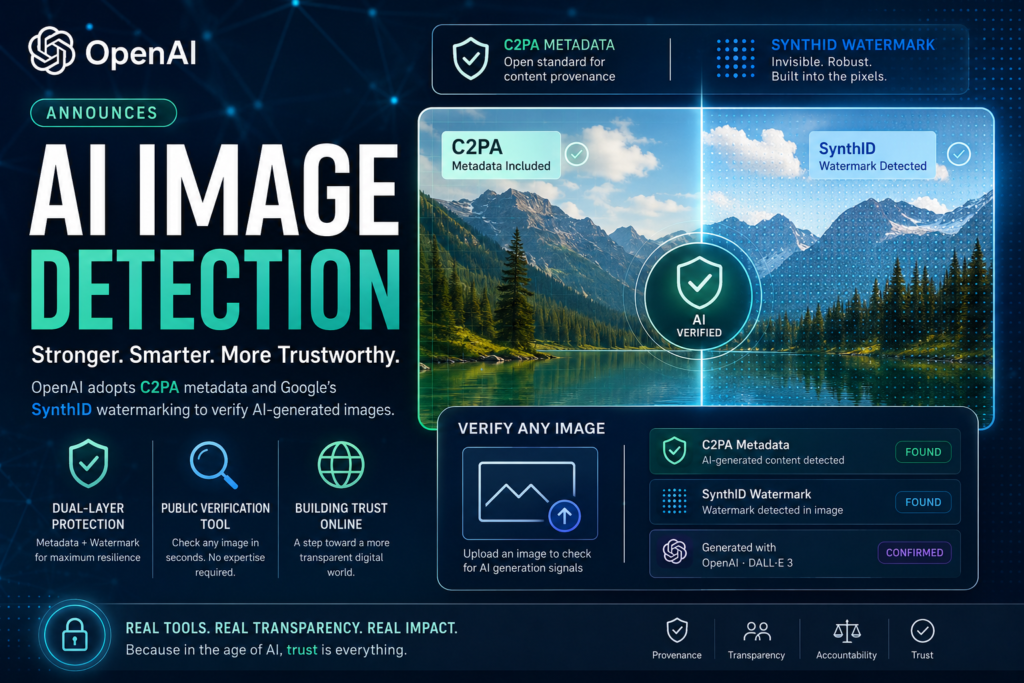
Can you tell if an image was made by AI? As of May 2026, it’s harder than ever — but OpenAI just made it significantly easier. The company announced two complementary tools for AI image detection: adoption of the open C2PA metadata standard and integration of Google’s SynthID invisible watermarking technology, along with a public verification tool anyone can use.
This is one of the most consequential moves in the fight against AI-generated misinformation. Here’s everything you need to know about how it works, why it matters, and what its real-world limitations are.
Why AI Image Detection Has Become Urgent
The volume and quality of AI-generated imagery online has reached a tipping point. Tools capable of producing photorealistic synthetic images are now widely accessible, and the results are increasingly indistinguishable from authentic photographs. The downstream effects are real: manipulated political imagery, non-consensual synthetic media, and viral disinformation spread faster than any fact-checker can intervene.
This is not a hypothetical threat. Elections, financial markets, and public health discourse have all been affected by synthetic media. Yet until recently, the infrastructure for reliable AI image detection remained fragmented, proprietary, or limited to research environments.
The gap between how easily AI images can be created and how reliably they can be detected has widened every year. OpenAI’s announcement represents a serious attempt to close that gap — at least for images produced by its own models.
What OpenAI Announced: Two Layers of Protection
OpenAI’s approach to AI image detection is deliberately dual-layered, combining an open industry standard with a more technically resilient proprietary watermark. Each system addresses weaknesses the other cannot cover alone.
Layer 1 — C2PA Metadata Standard
What is C2PA? The Coalition for Content Provenance and Authenticity (C2PA) is a non-profit standards body founded in 2021. Its mission is to establish open, interoperable methods for embedding verifiable provenance data directly into digital content. When an image carries a C2PA signal, its metadata includes a clear, machine-readable record indicating it was generated by AI — and which system created it.
OpenAI has committed to embedding C2PA metadata in images produced by its models, including those generated through ChatGPT and the DALL-E family of tools. This means any platform or tool that reads C2PA signals — and many major ones already do — can surface that provenance information to users automatically.
How does the C2PA signal work in practice? The metadata travels with the file itself. When you upload or share a C2PA-tagged image, the signal stays attached. Tools that support the standard can then read that tag and display a disclosure — something as simple as “This image was created with AI.”
The C2PA standard has already been adopted across several Google products, and a growing number of platforms, publishers, and camera manufacturers have joined the coalition. OpenAI’s participation strengthens the ecosystem considerably, given the scale at which its image generation tools operate.
Layer 2 — SynthID Watermarking
What is SynthID? SynthID is an invisible watermarking technology developed by Google DeepMind. Rather than embedding information in a file’s metadata — which exists in a separate, editable layer — SynthID encodes a signal directly into the pixel structure of the image itself. This makes it far more resistant to tampering.
OpenAI has partnered with Google to integrate SynthID into its image generation pipeline. Going forward, images produced by OpenAI models will carry both the C2PA metadata tag and the SynthID watermark simultaneously.
The key advantage of SynthID over traditional metadata is durability. If someone takes a screenshot of a C2PA-tagged image, saves it as a new file, or runs it through a basic image editor, the metadata tag may be stripped away. SynthID, by contrast, is specifically engineered to survive common manipulation techniques — including screenshots, resizing, cropping, and many forms of digital processing.
How AI Image Detection Actually Works: C2PA vs. SynthID Compared
Understanding the technical differences between these two approaches is important for assessing where each system excels — and where it falls short.
| Feature | C2PA Metadata | SynthID Watermark |
|---|---|---|
| Signal Location | File metadata (separate layer) | Embedded in pixel data |
| Human Visibility | Not visible to the eye | Not visible to the eye |
| Tamper Resistance | Low — metadata can be stripped | High — survives screenshots, resizing |
| Information Richness | High — can store detailed provenance | Limited — confirms AI origin only |
| Open Standard | Yes — interoperable across platforms | No — proprietary to Google |
| Current Adoption | Broad (Google, Adobe, camera makers) | Growing via OpenAI partnership |
| Detection Tool Required | C2PA-compatible reader or checker | SynthID-specific detector |
As OpenAI noted in its announcement: “Watermarking can be more durable through transformations like screenshots, while metadata can provide more information than a watermark alone. Together, they make provenance more resilient than either layer would be on its own.”
This is a key insight. C2PA is the richer signal — it can identify the specific model, timestamp, and platform — but it’s brittle. SynthID is the sturdier signal — it’s hard to erase — but it carries less contextual information. Used together, they provide a more complete and robust system for AI image detection than either would independently.
OpenAI’s Public Verification Tool
Alongside the dual-watermarking system, OpenAI is previewing a public-facing tool that allows anyone to check whether an image was generated by an OpenAI model. Users can upload a suspicious image and the tool will scan for both the C2PA metadata tag and the SynthID watermark.
This is a meaningful step toward democratizing AI image detection. Previously, verification required either technical expertise or access to specialized software. A consumer-grade tool lowers the barrier significantly — journalists, researchers, educators, and everyday users will all benefit.
In its initial form, the tool is scoped to images generated by OpenAI’s own products. The company has stated it intends to expand coverage over time, potentially encompassing images from other AI systems. That expansion will depend in part on broader industry adoption of compatible standards.
What the tool can tell you:
- Whether an image carries a C2PA provenance tag indicating AI origin
- Whether a SynthID watermark is detected within the image data
- Which OpenAI product or model was used to generate the image (where available)
What the tool cannot (yet) tell you:
- Whether an image was generated by a non-OpenAI AI system
- Whether a human-created image has been significantly manipulated by AI
- The authenticity of images that have had both their metadata stripped and watermark degraded beyond detection
Why This Matters Beyond OpenAI
OpenAI’s move into the AI image detection space carries significance that extends well past its own product ecosystem.
Industry signaling: When a company of OpenAI’s scale adopts an open standard like C2PA, it sends a clear message to the rest of the industry. Competitors, partners, and downstream platforms face increasing pressure to follow suit. Adobe, Microsoft, and camera manufacturers have already adopted C2PA — OpenAI’s participation anchors AI-native image generation within the same provenance framework as hardware-captured photography.
Policy implications: Regulators in the EU and US have been actively working on legislation requiring disclosure of AI-generated content. Having verifiable, machine-readable provenance built into the image itself — rather than relying solely on human disclosure — gives regulators a technically sound foundation to build enforcement mechanisms on.
The SynthID partnership specifically: The collaboration between OpenAI and Google on SynthID is notable given that the two companies are direct competitors in the AI space. Cooperating on a common watermarking standard suggests a shared recognition that the AI image authenticity problem is too important — and too damaging to collective public trust — to be treated as a competitive differentiator.
Trust infrastructure: At a systemic level, what OpenAI is building contributes to what experts call “trust infrastructure” for the digital media ecosystem. Just as HTTPS became the default standard for secure web communication, layered provenance systems like C2PA plus SynthID could become the expected baseline for any responsibly produced AI image.
Limitations You Should Know About
Transparency requires acknowledging where the current system falls short. AI image detection — even with these new tools in place — is not a solved problem.
Coverage gaps are significant. The C2PA and SynthID protections only apply to images generated through OpenAI’s products. The enormous volume of AI-generated imagery flowing from other tools — Midjourney, Stable Diffusion, and countless consumer apps — will carry no such signals unless those platforms adopt compatible standards independently.
Bad actors can still operate outside the system. Nothing prevents someone from using a non-compliant AI tool to generate harmful imagery. The new protections are most effective at ensuring that OpenAI’s tools are not the source of unattributed synthetic content — an important commitment, but not a comprehensive solution.
Metadata stripping remains a concern. While SynthID is more resilient than metadata alone, it is not indestructible. Sufficiently aggressive image processing — extreme compression, heavy filtering, or generative re-editing — could potentially degrade a watermark below the detection threshold.
The verification tool is early-stage. The public checker OpenAI is previewing is limited in scope and may not catch edge cases. AI image detection at scale is a technically demanding problem, and false negatives (missing a watermark that’s present) and false positives (flagging a clean image incorrectly) are both real risks.
These limitations don’t diminish the value of OpenAI’s announcement — they simply define the work still ahead.
What’s Next for AI Image Detection?
The OpenAI announcement should be understood as one milestone within a much longer trajectory. Several developments will shape how AI image detection evolves over the next few years.
Broader C2PA adoption. The standard’s effectiveness scales with how widely it is implemented. Every major AI image generation platform that joins the coalition strengthens the system’s coverage and makes detection more reliable across the board.
Improved watermarking technology. SynthID and similar systems will continue to improve in both resilience and detectability. Research into more robust watermarking techniques — including methods that can survive generative re-editing — is active across academia and industry.
Regulatory mandates. The EU AI Act includes provisions around transparency for AI-generated content. As those rules come into force, AI image detection infrastructure will shift from voluntary best practice to legal requirement for many platforms operating in regulated markets.
Consumer awareness. Technical solutions only work if people know how to use them. Education around provenance signals — what they mean, how to check them, and why they matter — is as important as the technology itself. OpenAI’s public verification tool is a step in this direction.
Cross-industry standards bodies. C2PA is the most mature open standard in this space, but it won’t be the last. Industry consortia, standards bodies, and government-backed initiatives are all developing complementary frameworks. The goal, ultimately, is an interoperable global standard for content provenance that covers AI-generated images, video, and audio alike.
Key Takeaways
For readers who want the distilled version, here is what OpenAI’s announcement means in plain terms:
- Two detection layers are better than one. C2PA metadata and SynthID watermarking address each other’s weaknesses, creating a more robust combined system for AI image detection.
- A public verification tool is coming. Anyone will be able to upload an image and check whether it was generated by an OpenAI model — no technical expertise required.
- Coverage is currently limited to OpenAI products. Images from other AI generators will not carry these signals unless those platforms adopt compatible standards.
- This is industry-shaping. OpenAI’s adoption of C2PA and partnership with Google on SynthID raises expectations across the sector and strengthens the case for mandatory provenance standards.
- AI image detection is a solvable problem — but solving it requires coordination across the entire AI industry, not just action from one company.
The announcement does not end the challenge of synthetic media and deepfake detection. But it meaningfully raises the floor — and demonstrates that major AI developers are willing to treat content provenance as a shared responsibility rather than a competitive advantage.