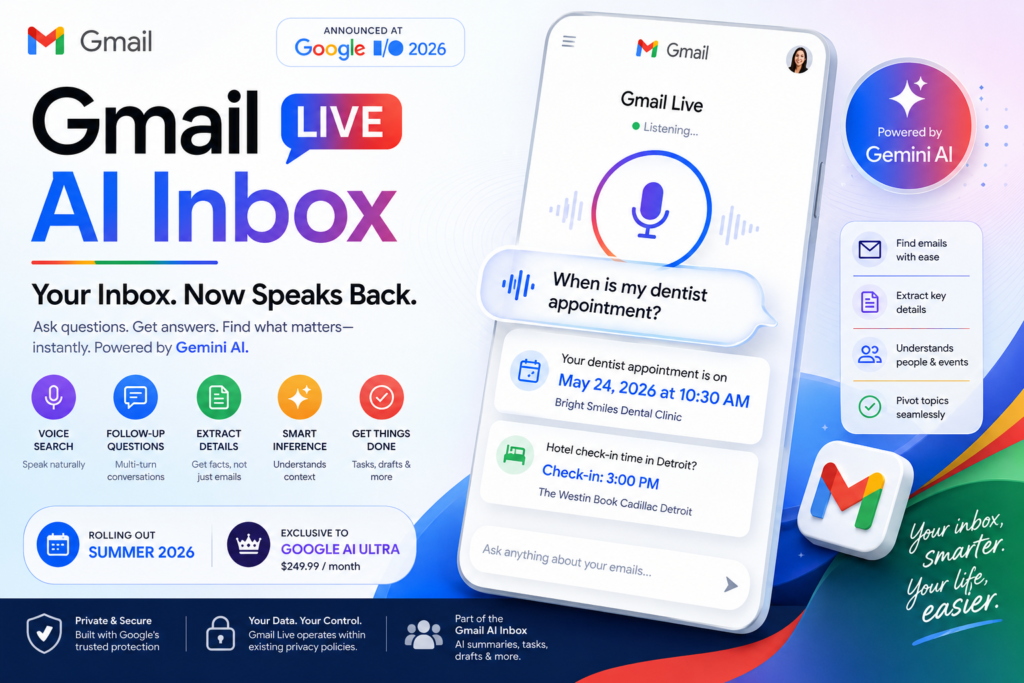
Google just made finding buried emails as simple as asking a question out loud. Gmail Live — announced at Google I/O 2026 on May 19, 2026 — transforms the Gmail AI inbox from a passive organizer into a conversational assistant that listens, understands, and responds in real time.
If you’ve ever typed the wrong keyword into Gmail’s search bar and given up, this changes everything.
What Is Gmail Live? (Definition)
Gmail Live is a conversational AI feature built directly into the Gmail AI inbox. Powered by Google’s Gemini AI model, it allows users to speak naturally to their inbox — asking questions in plain language instead of typing search terms — and receive spoken, contextual answers drawn from their actual emails.
In other words, Gmail Live turns your inbox into a voice-activated AI assistant. It is not a replacement for Gmail’s existing search function; it is an entirely new mode of interaction layered on top of it.
Gmail Live was first previewed publicly at Google I/O 2026 and is scheduled to begin rolling out in the summer of 2026, initially for Google AI Ultra subscribers.
How Gmail Live Works: Core Capabilities
Natural Language Voice Search
Gmail Live enables users to ask questions using the same phrasing they’d use in everyday conversation. Instead of typing “dentist May,” you can ask, “When is my dentist appointment?” and Gmail Live will parse your inbox to surface the answer.
Devanshi Bhandari, product lead for Gmail, demonstrated this at Google I/O 2026, asking the tool about a child’s upcoming class trip, show-and-tell project details, and hotel and flight information for a trip to Detroit — all by speaking naturally, without a single search term typed.
This is a meaningful departure from keyword-based search, which requires users to predict the exact language used in an email. Gmail Live interprets intent, not just strings of text.
Follow-Up Questions and Topic Pivoting
One of the defining features of Gmail Live — and what separates it from a simple voice search — is its ability to handle multi-turn conversation. Users can ask a follow-up question without repeating context, and they can also pivot to an entirely different topic mid-conversation.
This mirrors how users interact with standalone AI chatbots like Gemini or ChatGPT, but the key difference is that Gmail Live is grounded in the actual contents of a user’s inbox, not the open web.
According to the Google I/O demonstration, Gmail Live also understood nuances between related terms — distinguishing, for example, between a “field trip” and a general “trip” in context.
Granular Detail Extraction
Gmail Live doesn’t just retrieve emails — it extracts specific details from within them. It can surface a hotel room number, a door code for a vacation rental, or the time of a doctor’s appointment without requiring the user to open and read the underlying email.
The system can also infer which people or events a user is referring to, even when they aren’t explicitly named in the query. This level of contextual inference is what makes the Gmail AI inbox experience feel conversational rather than mechanical.
Gmail Live vs. Traditional Gmail Search: Side-by-Side Comparison
Understanding the distinction between Gmail Live and the classic search experience helps clarify what this upgrade actually does — and what it doesn’t replace.
| Feature | Traditional Gmail Search | Gmail Live (AI Inbox) |
|---|---|---|
| Input method | Typed keywords | Spoken natural language |
| Query style | Keyword-based | Conversational / intent-based |
| Follow-up queries | New search required | Supported natively |
| Detail extraction | Returns email thread | Pulls specific facts from email |
| Topic pivoting | New search required | Supported mid-conversation |
| Inference of unnamed parties | Not supported | Supported |
| Availability | All Gmail users | Google AI Ultra subscribers (initially) |
| Replaces existing search? | N/A | No — exists alongside it |
The takeaway: Gmail Live is an additive layer. Traditional search is not going away, and for users who prefer typing, nothing changes. Gmail Live is designed for moments when locating information by voice is faster or more convenient.
Who Gets Access to Gmail Live, and When?
Gmail Live will begin rolling out in summer 2026, initially limited to Google AI Ultra subscribers — Google’s premium AI plan priced at $249.99 per month.
The broader AI Inbox experience (which offers an overview of tasks and items to catch up on, all surfaced on one page) is also expanding beyond AI Ultra to include Google AI Pro and Plus subscribers as part of the Google I/O 2026 announcements. That feature first launched earlier in 2026.
Here is a quick breakdown of the access tiers:
- Google AI Ultra — Full Gmail Live access (conversational voice search) plus AI Inbox overview
- Google AI Pro / Plus — AI Inbox overview expanding to these tiers; Gmail Live not yet available
- Free / Workspace users — No confirmed timeline for Gmail Live access at this stage
It is worth noting that Google has a recent precedent for expanding AI features broadly after initial rollouts. The AI Inbox itself started behind a paywall before expanding, suggesting Gmail Live may follow a similar path.
What Else Is New in Gmail’s AI Inbox Upgrade?
Gmail Live was the headline, but Google announced several additional Gmail AI inbox enhancements at Google I/O 2026:
- Ready-to-send drafts — Gmail can now draft replies for users, requiring minimal editing before sending.
- Instant file access — Attachments and documents from emails can be accessed more quickly without navigating through threads.
- Task management from inbox — Users can now mark individual to-dos directly as done from within the Gmail AI inbox view, rather than switching to a separate app.
- Google Keep integration — Similar voice-powered AI features are coming to Google’s to-do list application, Google Keep, extending the conversational experience beyond email.
These updates collectively push Gmail further toward functioning as an AI-native productivity hub rather than a passive message repository.
Why Gmail Live Matters: The Bigger Picture
AI Finds a Practical Use Case
One of the consistent criticisms of the current wave of AI products is that impressive technology demonstrations don’t always translate into tangible, everyday value. Gmail Live addresses this directly.
Nearly every person with an email inbox has experienced the frustration of knowing an important detail — a confirmation number, an appointment time, an address — is buried somewhere in their messages, but being unable to surface it quickly. Gmail Live turns that shared pain point into a solved problem.
The Gmail AI inbox is, in this sense, one of the clearest examples yet of AI improving a product millions already use daily rather than creating an entirely new product category that requires behavior change.
Google Learned from the Google Photos Backlash
Google’s handling of Gmail Live also shows organizational learning. When Google Photos replaced its traditional search with an AI-only experience, the backlash was significant enough that Google eventually reversed course, making AI search optional in that product.
Gmail Live is being deployed as an option — sitting alongside traditional search, not supplanting it. That design choice reflects a more measured approach: offer the AI experience to users who want it, without removing the familiar alternative for those who don’t.
This “additive AI” strategy is likely to become the template for how Google integrates Gemini into its Workspace products going forward.
The Shift from Organizing to Understanding
Traditional inbox tools — folders, labels, filters — were built around the idea that users need to organize email in order to retrieve it later. The Gmail AI inbox inverts this model: rather than asking users to organize first and retrieve second, it puts retrieval intelligence at the center.
This is a structural shift in how productivity software thinks about information management. Instead of creating systems to find things, the system learns to find things for you.
Frequently Asked Questions About Gmail Live
What is Gmail Live? Gmail Live is a conversational AI feature inside the Gmail AI inbox that lets users speak naturally to their inbox to find information buried in emails. It is powered by Google’s Gemini AI model and was announced at Google I/O 2026.
Does Gmail Live replace Gmail’s search bar? No. Gmail Live is a new, optional mode that operates alongside traditional Gmail search. Users who prefer keyword-based search can continue using it exactly as before.
When will Gmail Live be available? Gmail Live is scheduled to roll out in summer 2026. At launch, it will be limited to Google AI Ultra subscribers ($249.99/month). No confirmed date has been announced for broader availability.
What kinds of questions can you ask Gmail Live? You can ask questions like “When is my dentist appointment?”, “What’s the check-in time for my hotel?”, or “What did my kid’s school say about the field trip?” Gmail Live understands natural phrasing, handles follow-up questions, and can pivot between topics in a single session.
Is Gmail Live private? Does Google read my emails? Google’s Gemini AI already powers other Gmail features such as Smart Reply and AI Inbox summaries. Gmail Live operates within the same privacy framework. Google has not announced any new data practices specific to Gmail Live beyond existing Workspace and Gemini policies.
What is the Gmail’s AI-powered inbox? The Gmail AI inbox is a broader feature suite that surfaced an overview of tasks, unread priorities, and inbox summaries on a single page. It launched in early 2026 for AI Ultra subscribers and is now expanding to Pro and Plus tiers. Gmail Live is the voice-powered addition to this experience.
The Bottom Line
The Gmail’s AI-powered inbox is no longer evolving in small, incremental steps. With the launch of Gmail Live at Google I/O 2026, Google is signaling a much bigger transformation — one where email stops behaving like a static archive and starts functioning like an intelligent, conversational assistant that understands what users actually mean.
For years, searching through email has been one of the most frustrating parts of digital productivity. People often remember fragments of information rather than exact keywords. You may remember booking a hotel in Detroit, receiving a dentist appointment reminder, or reading a message from your child’s school — but not the exact words used in the subject line or email body. Traditional search systems depend heavily on keyword precision, which forces users to think like a machine. The Gmail AI inbox flips that dynamic entirely. Instead of adapting yourself to the software, the software adapts to natural human conversation.
That is the real significance of Gmail Live.
Rather than asking users to manually scan inboxes, labels, folders, and archived threads, the Gmail’s AI-powered inbox now allows users to simply ask questions aloud in plain language. The system understands context, extracts relevant details, and returns direct answers without requiring users to open multiple emails. That shift may sound simple on the surface, but it fundamentally changes how people interact with email.
The introduction of conversational voice search also represents one of the clearest examples yet of AI solving a genuinely universal problem. Many AI announcements in recent years have been impressive demonstrations, but not all have translated into practical everyday value. The Gmail’s AI-powered inbox feels different because nearly every internet user already depends on email daily. There is no need for users to learn a completely new platform or change their workflow dramatically. Instead, Google is embedding AI directly into an existing habit that billions of people already have.
This is one reason the announcement generated so much attention at Google I/O 2026. Gmail Live does not feel experimental in the way many AI products do. It feels immediately understandable. The value proposition is obvious the moment users imagine asking questions like:
- “What time is my flight tomorrow?”
- “Where did the hotel send the door code?”
- “When is my dentist appointment?”
- “What did the school say about the field trip?”
These are real-world use cases, not hypothetical demos. The Gmail’s AI-powered inbox succeeds because it addresses moments of everyday friction that users encounter constantly.
Another reason this launch matters is because it reflects a broader change in how productivity software is being designed. Historically, digital productivity systems were built around organization. Users were expected to manually create folders, labels, categories, and filing systems so they could retrieve information later. The assumption was that people needed to organize information first in order to find it efficiently.
The Gmail AI inbox introduces a different philosophy: retrieval intelligence is more important than manual organization. Instead of spending time structuring email perfectly, users can rely on AI to interpret intent and locate information dynamically. In practical terms, that means the future of productivity software may depend less on how well users organize data and more on how effectively AI understands context.
That shift has implications far beyond Gmail itself.
Google’s broader Workspace ecosystem is clearly moving toward AI-native workflows. Features like ready-to-send drafts, AI summaries, task extraction, and Google Keep integration all point toward a future where AI becomes a persistent layer across productivity applications. The Gmail AI inbox is simply one of the first large-scale implementations of this strategy.
Importantly, Google also appears to have learned from earlier AI deployment mistakes. When Google Photos leaned too aggressively into AI-driven search and reduced emphasis on traditional search tools, many users reacted negatively. Some people felt the experience became unpredictable or less controllable. In response, Google restored more traditional functionality rather than forcing users into an AI-only workflow.
That lesson is visible in how the Gmail AI inbox is being positioned. Gmail Live is not replacing the standard search bar. Users can still search manually if they prefer. AI is being presented as an optional enhancement rather than a mandatory replacement. This “additive AI” approach is likely one of the smartest aspects of Google’s strategy because it lowers resistance while still encouraging adoption.
The rollout strategy also says a lot about Google’s confidence in the feature. Initially limiting Gmail Live to Google AI Ultra subscribers gives Google an opportunity to refine the experience with power users before potentially expanding it more broadly. While the $249.99 monthly price tag may initially restrict adoption, Google has already shown a willingness to gradually expand AI features after testing them in premium tiers.
That means there is a strong possibility the Gmail’s AI-powered inbox experience will eventually reach mainstream Gmail users in some form. If that happens, conversational email interaction could quickly become normalized in the same way voice assistants became standard on smartphones.
There are also larger competitive implications here. Google is not just improving Gmail; it is reinforcing Gemini AI’s role inside the broader consumer ecosystem. Microsoft is integrating AI deeply into Outlook and Office through Copilot, while other productivity platforms are racing to add intelligent assistants. The Gmail’s AI-powered inbox is part of a much larger battle over who becomes the dominant AI-powered productivity platform over the next decade.
In many ways, email is an ideal environment for conversational AI because inboxes already contain structured personal context — appointments, receipts, travel details, schedules, reminders, conversations, and documents. Unlike general-purpose AI systems that rely on public internet information, the Gmail’s AI-powered inboxworks against a personalized knowledge base unique to each individual user. That gives it immediate practical relevance.
Of course, the success of Gmail Live will ultimately depend on reliability and trust. Users will expect the system to return accurate answers consistently, especially when dealing with sensitive information like travel itineraries, healthcare appointments, financial records, or work communication. Even small inaccuracies could reduce confidence in the experience. Privacy concerns will also remain central to adoption conversations, particularly as AI systems gain deeper access to personal communication data.
Still, the direction is unmistakable.
The x represents a transition away from static software interfaces toward adaptive conversational systems. Instead of navigating menus, filters, and search operators, users increasingly interact with software through natural language. The interface becomes less about clicking through applications and more about simply asking for outcomes.
That trend extends far beyond Gmail. It reflects the broader trajectory of AI across consumer technology. Search engines are becoming answer engines. Productivity tools are becoming assistants. Applications are becoming conversational environments rather than collections of buttons and menus.
Gmail Live may seem like a relatively small feature update on paper, but it represents a much deeper evolution in how software thinks about information retrieval and human interaction. For decades, email platforms stored communication. Now, the Gemini AI email is beginning to understand it.
And that may ultimately be the biggest takeaway from Google I/O 2026.
The future of email is no longer just about managing messages. It is about transforming the inbox into an intelligent system that can interpret, summarize, retrieve, and communicate information on behalf of the user in real time. With Gmail Live, Google is betting that people do not want to search harder — they want software that understands them instantly.
If the company can deliver that experience reliably at scale, the Gemini AI email could become one of the most important examples yet of AI moving from novelty to necessity in everyday digital life.