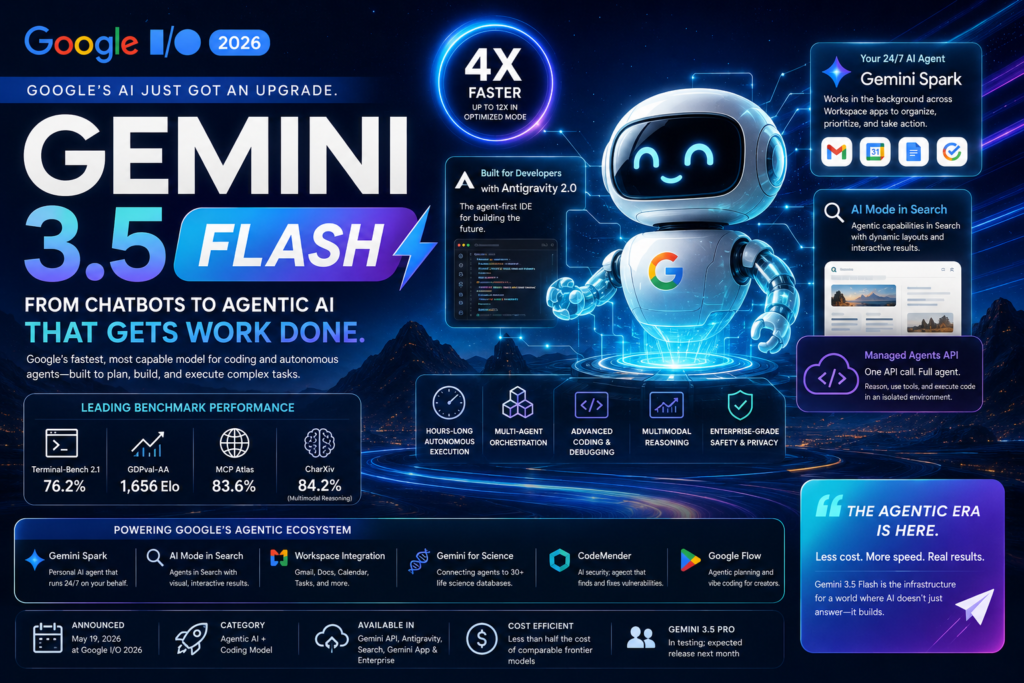
Google’s AI is no longer just answering your questions — it’s doing the work. With the launch of Gemini 3.5 Flash at Google I/O 2026, Google has made its most definitive pivot yet: from conversational AI to autonomous agentic AI that plans, builds, and executes complex tasks with minimal human input. If you want to understand where enterprise AI, developer tooling, and consumer software are heading in 2026 and beyond, this model is the clearest signal yet.
What Is Gemini 3.5 Flash? A Definition That Goes Beyond “Fast”
Gemini 3.5 Flash is Google’s latest AI model, launched on May 19, 2026, at the company’s annual developer conference, Google I/O 2026. It is the first model in the new Gemini 3.5 series, and Google describes it as its strongest model yet for both coding and autonomous AI agents.
But the name “Flash” doesn’t just mean fast (though it is — more on that shortly). It signals Google’s intent: a model purpose-built for high-throughput, long-running, real-world agentic workflows — not polished, turn-by-turn conversations. It is the first major Google model that was co-developed alongside an agentic development platform (Antigravity), a design choice that shapes everything about how it performs.
In a nutshell: Gemini 3.5 Flash is the infrastructure layer for Google’s “agentic era” — the moment Google says its AI stopped being a chatbot and started being a builder.
AI Agents vs. Chatbots: Understanding the Shift
To appreciate why Gemini 3.5 Flash matters, it helps to understand the fundamental difference between chatbots and AI agents. These terms are often used interchangeably, but they describe radically different systems.
| Feature | Chatbot | AI Agent |
|---|---|---|
| Interaction model | Turn-by-turn conversation | Long-horizon autonomous task execution |
| User involvement | Required at every step | Only at decision/permission boundaries |
| Scope of work | Answering a single query | Managing multi-step pipelines and projects |
| Memory/context | Often session-limited | Persistent context across extended tasks |
| Output type | Text responses | Actions, code, file creation, integrations |
| Example | “Summarize this email” | “Monitor my inbox, prioritize tasks, and draft follow-ups” |
| Google’s implementation | Gemini app pre-2026 | Gemini 3.5 Flash + Gemini Spark (2026) |
The chatbot paradigm treats AI as a reactive tool. The agentic paradigm treats AI as a proactive collaborator that can be handed a goal and trusted to pursue it. Gemini 3.5 Flash is Google’s flagship bet on the latter.
Key Capabilities of Gemini 3.5 Flash
Speed and Benchmark Performance
How fast is Gemini 3.5 Flash?
According to Google, Gemini 3.5 Flash runs four times faster than competing frontier models — and an optimized version hits 12 times faster at equivalent quality. This matters enormously in agentic contexts, where multiple AI sub-agents operate simultaneously on parallel workstreams. Latency in that environment doesn’t just slow one task — it compounds across every parallel process.
On benchmarks, Gemini 3.5 Flash outperforms Gemini 3.1 Pro — Google’s previous flagship — across nearly all dimensions:
- Terminal-Bench 2.1: 76.2%
- GDPval-AA: 1,656 Elo
- MCP Atlas: 83.6%
- CharXiv (multimodal reasoning): 84.2%
DeepMind’s chief technologist Koray Kavukcuoglu described the model as offering “an incredible combination of quality and low latency,” and noted it outperforms 3.1 Pro on coding, agentic tasks, and multimodal reasoning simultaneously. That combination — more capable and faster — is unusual; typically models trade off one for the other.
Autonomous Long-Horizon Task Execution
Can Gemini 3.5 Flash really work without human input for hours?
Yes, and this is the capability that most fundamentally distinguishes it from previous generations. Gemini 3.5 Flash can run autonomously for multiple hours at a stretch, pausing only when it reaches a decision point or permission boundary that requires human judgment. It doesn’t just respond — it plans, executes sub-tasks, spawns subordinate agents, and iterates.
In one internal demonstration, agents powered by the model built a full operating system from scratch — not as a toy exercise, but as a multi-agent pipeline where specialized agents handled separate components before integrating the final result. This was the headline moment at Google I/O 2026, positioned explicitly as the inflection point at which Google’s AI became a builder rather than a responder.
Tulsee Doshi, Google’s senior director and head of product for Gemini models, described the broader architecture this way: the more powerful (and slower) Gemini 3.5 Pro serves as the orchestrator and planner, while Gemini 3.5 Flash acts as the fleet of sub-agents that execute specific workstreams at speed. Reasoning power where it’s needed; brute-force tool use where that’s sufficient.
Agentic Coding with Antigravity 2.0
Gemini 3.5 Flash was co-developed alongside Google Antigravity, the company’s agent-first development platform and IDE. Antigravity 2.0, released alongside the model, is a standalone desktop application that provides a native environment where AI agents can “live, work, and execute” — in Google’s own phrasing.
The Antigravity ecosystem now includes:
- A CLI for terminal-first developers who want scriptable agent orchestration
- An SDK for building custom agent behaviors and integrations
- Native integrations with Google AI Studio, Firebase, and Android development tools
- Enterprise access via Google Cloud, with standard data privacy protections inherited by default
- Antigravity in Gemini Enterprise Agent Platform, which connects Antigravity directly to Google Cloud projects
- Vibe coding in AI Studio, including native Android coding via natural language
The combination of Gemini 3.5 Flash and Antigravity 2.0 is Google’s answer to the question of what an “agent-first development environment” actually looks like in practice. The model provides the intelligence and the speed; Antigravity provides the scaffolding that connects that intelligence to real systems.
How Gemini 3.5 Flash Powers Google’s Expanding Agentic Ecosystem
Gemini 3.5 Flash is not a standalone product. It is the foundational model underneath a cluster of new and updated products that together constitute Google’s agentic ecosystem.
Gemini Spark: Your 24/7 Personal AI Agent
Gemini Spark is Google’s new personal AI agent, designed to run continuously — 24 hours a day, 7 days a week — on behalf of consumers and enterprise users. Powered by Gemini 3.5 Flash, Spark integrates with Google Workspace tools (Gmail, Docs, Calendar, Tasks) for context, and can run tasks in the background without requiring the user to stay present in a chat window.
For enterprise and Workspace customers, Spark functions as a persistent digital assistant that takes action under the user’s direction — synthesizing priorities, sending follow-ups, organizing information, and flagging decisions. A related feature, Daily Brief, is a new out-of-box agent in the Gemini app that synthesizes inbox, calendar, and task data into a concise personalized morning digest — not just a summary, but a recommendation of what actually needs attention.
AI Mode in Search: Agents Everywhere
Gemini 3.5 Flash is now the default model globally in both the Gemini app and AI Mode in Google Search — a product that now has over 1 billion monthly active users. Google also announced that Search is getting agentic capabilities directly: users will be able to create, customize, and manage AI agents on the Search platform itself, with dynamic layouts and interactive visuals generated on the fly for individual queries.
Managed Agents API: One Call, Full Agent
For developers, one of the most significant announcements at Google I/O 2026 was the Managed Agents API, accessible via the Gemini API. With a single API call, developers can spin up an agent that reasons, uses tools, and executes code in an isolated Linux environment — without needing to build the orchestration layer themselves. This dramatically lowers the barrier to deploying production-grade agentic workflows.
What This Means for Developers and Businesses
The practical implications of Gemini 3.5 Flash are already taking shape across industries. Google reported that banks and fintechs are using Flash-powered agents to automate multi-week workflows, and data science teams are deploying agents to surface insights that previously required manual investigation.
Here’s what developers and business leaders should pay attention to:
- Cost efficiency at scale. Google notes that Gemini 3.5 Flash delivers its performance at less than half the cost of comparable frontier models — a critical advantage for organizations running high-volume agentic pipelines.
- Reduced orchestration overhead. The Managed Agents API means teams don’t need to build agent scaffolding from scratch. Google handles the execution environment; developers define the goals and tools.
- The orchestrator-agent architecture. The 3.5 Pro + 3.5 Flash model pairing gives enterprise teams a practical framework: use the Pro model for high-stakes reasoning and planning, deploy Flash agents for parallel execution at speed.
- Deeper Workspace integration. For organizations already in the Google Cloud ecosystem, Gemini Spark and the Agent Platform create an agentic layer directly within productivity tools, without requiring separate infrastructure.
- New developer economics. The Google AI Ultra plan, starting at $100/month, offers a 5x higher usage limit in Antigravity compared to the Pro plan — positioning professional AI-native developers as a distinct market segment.
For businesses evaluating which AI platform to build on, the Gemini 3.5 Flash ecosystem represents Google’s most coherent and production-ready agentic stack to date.
Safety and Responsible Agentic AI
More powerful autonomous systems raise legitimate safety questions, and Google has acknowledged them directly. Gemini 3.5 Flash includes strengthened safeguards across several dimensions:
- Cyber and CBRN protections (chemical, biological, radiological, and nuclear) have been specifically reinforced in the 3.5 series.
- The model has been recalibrated to engage with sensitive topics rather than refuse them outright — addressing a long-standing criticism that AI models are over-cautious in ways that limit their usefulness.
- Flash’s autonomous mode includes deliberate permission boundaries: the model is designed to pause and request human input at points requiring judgment calls, rather than proceeding autonomously through ambiguous situations.
These design choices reflect a tension that will define the agentic AI era: systems powerful enough to be genuinely useful need to act with real autonomy, but that autonomy must be scoped and bounded in ways that keep humans meaningfully in control. Google’s approach — autonomous within guardrails, not autonomous without limits — represents one answer to that challenge. How well it works in practice, at scale, across millions of users, will be one of the defining questions of the next 12 months.
The Bigger Picture: Google’s Agentic Era Strategy
Zoom out from the model itself, and Gemini 3.5 Flash is the centerpiece of a coherent strategic repositioning that Google has been building toward for over a year.
The numbers from Sundar Pichai’s I/O 2026 keynote tell the story in quantitative terms: Google now processes more than 3.2 quadrillion tokens per month, a sevenfold increase from the same period a year prior. The Gemini app has grown from 400 million to 900 million active users in one year. AI Overviews has 2.5 billion monthly active users. More than 8.5 million developers build with Google’s models monthly.
These are not chatbot numbers. These are platform numbers — the usage patterns of infrastructure that has become embedded in workflows, not just visited occasionally for queries.
The product moves announced alongside Gemini 3.5 Flash reinforce the same thesis. Gemini for Science connects agentic platforms to more than 30 major life science databases for research acceleration. CodeMender is a dedicated AI security agent that finds and fixes code vulnerabilities autonomously. Google Flow rolls out an agentic planning tool that supports brainstorming, project creation, and what Google calls “vibe coding” of creative tools.
Across consumer, developer, and enterprise surfaces, the same shift is visible: AI moving from a layer that sits on top of workflows to one that runs through them.
The competitive context matters too. Every major AI lab — Anthropic, OpenAI, Meta — is racing to claim the agentic layer as the next durable competitive advantage in AI. Google’s bet with Gemini 3.5 Flash is that speed, ecosystem integration, and cost-efficient infrastructure together form a moat that pure model capability alone cannot. Whether that bet pays off will become clearer as the year progresses and Gemini 3.5 Pro — currently in testing, expected next month — completes the 3.5 family.
Conclusion: Why Gemini 3.5 Flash Is a Turning Point Worth Taking Seriously
Gemini 3.5 Flash is not an incremental upgrade. It is Google’s argument — delivered in model weights, benchmarks, product integrations, and developer tooling — that the next phase of AI is defined by what AI does, not just what it says.
The shift from chatbot to agent is not just a feature change. It is a different theory of what AI is for. Chatbots augment human attention by making information retrieval faster. Agents extend human capacity by taking over the execution of multi-step work. The former saves minutes; the latter potentially reconfigures how teams are structured, how software is built, and how organizations allocate human versus machine effort.
For developers, the Gemini 3.5 Flash + Antigravity 2.0 combination is the most production-ready agentic development environment Google has shipped. For businesses, the Managed Agents API and Gemini Spark offer a practical on-ramp to agentic workflows without requiring teams to build orchestration infrastructure from the ground up. For consumers, Gemini Spark and Daily Brief signal that AI agents will increasingly run in the background of daily digital life — not waiting to be asked, but anticipating and acting.
The question is no longer whether agentic AI is coming. Gemini 3.5 Flash is the announcement that says it has arrived.
Quick Reference: Gemini 3.5 Flash Key Facts
- Model name: Gemini 3.5 Flash
- Announced: Google I/O 2026, May 19, 2026
- Category: Agentic AI + Coding model
- Speed: 4x faster than rival frontier models (up to 12x in optimized mode)
- Availability: Gemini API, Antigravity, Gemini Enterprise, Gemini app, AI Mode in Search
- Key paired platform: Google Antigravity 2.0 (agent-first IDE)
- Personal agent powered by it: Gemini Spark (24/7 background agent)
- Gemini 3.5 Pro status: In testing; expected release next month
- Cost position: Less than half the cost of comparable frontier models