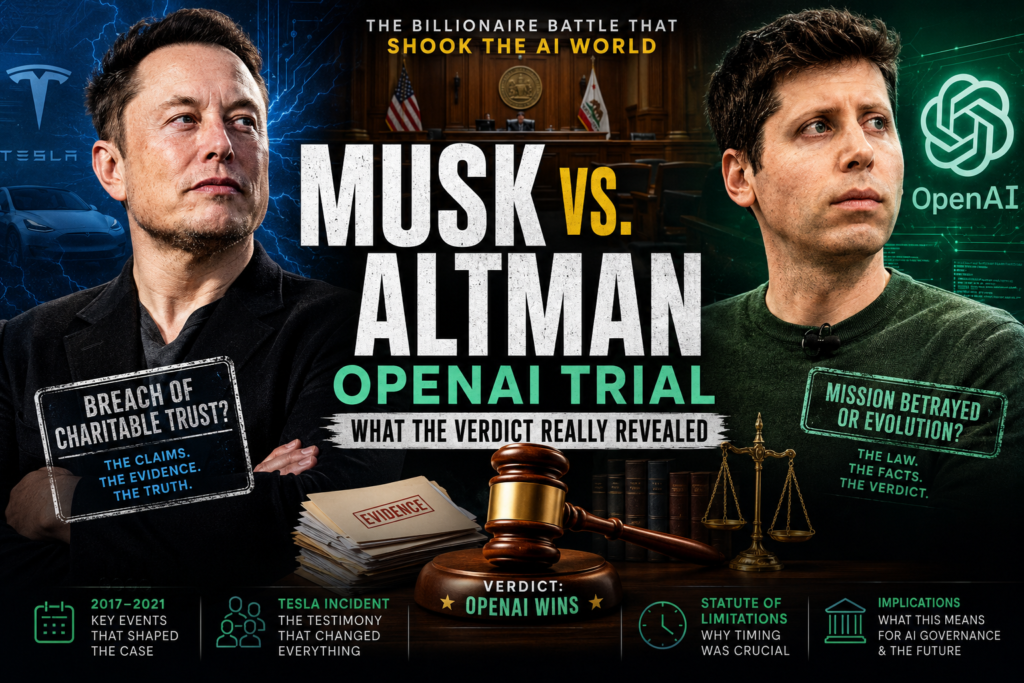
The jury rejected Elon Musk’s lawsuit against Sam Altman and OpenAI in May 2026 — and the trial evidence showed why it was always a difficult case to win. More striking than the verdict itself was what the proceedings exposed: that Musk’s own conduct at OpenAI bore a troubling resemblance to the very behavior he accused his former co-founders of.
This post breaks down the full arc of the Musk vs. Altman OpenAI trial — from the original claims, through the courtroom revelations, to what the outcome means for the future of AI governance and nonprofit accountability.
Background: What Was the OpenAI Nonprofit Lawsuit About?
The Core Legal Claims
Elon Musk’s lawsuit centered on two primary legal theories:
Breach of Charitable Trust — Musk alleged that he donated funds to OpenAI for a specific charitable purpose (developing safe, beneficial artificial general intelligence for humanity) and that Sam Altman, Greg Brockman, and OpenAI’s leadership diverted those resources toward private enrichment instead.
Unjust Enrichment — He further claimed that Altman, Brockman, and others improperly benefited from equity and financial interests in OpenAI’s for-profit arm, which was created after Musk’s departure from the board in 2018.
The lawsuit also named Microsoft as a defendant, given its multi-billion-dollar investment partnership with OpenAI that began accelerating after the nonprofit’s restructuring.
Why This Case Attracted Global Attention
The Musk vs. Altman OpenAI trial wasn’t merely a billionaire grudge match. It touched on some of the most urgent unresolved questions in the AI industry:
- Can a nonprofit legitimately transition into a for-profit enterprise while retaining its original mission?
- What obligations do founders owe to charitable donors?
- How should courts handle AI governance disputes that involve enormous sums and existential stakes?
These are questions courts, regulators, and ethicists are still wrestling with — and the trial put them center stage.
What Happened Inside the Courtroom?
OpenAI’s Defense: The Law Was on Their Side
According to reporting from TechCrunch’s Tim Fernholz, who covered the closing arguments, OpenAI’s legal team methodically walked the jury through how the law supported their client’s position on each of Musk’s claims. By contrast, Musk’s attorneys focused heavily on questioning Altman’s personal credibility rather than dismantling OpenAI’s legal arguments point by point.
The contrast in approach mattered. Juries tend to respond to structured legal reasoning, not character attacks on someone they don’t know personally.
The Statute of Limitations Problem
One of the most decisive factors in the Musk vs. Altman OpenAI trial was procedural: Musk waited too long to file. The jury was asked to consider whether Musk should have known, before August 5, 2021, that OpenAI was operating outside its original mission or launching a for-profit affiliate.
The answer, as the evidence showed, was almost certainly yes — in part because Musk himself had been directly involved in those early discussions about forming a for-profit arm back in 2017.
The statute of limitations isn’t just a technicality. As Columbia Law School professor Dorothy Lund explained to TechCrunch, the limitation period exists because companies and individuals make long-term decisions based on the assumption that their actions are legally permissible. Unwinding years of investment, hiring, and partnerships retroactively can cause harm disproportionate to any just remedy.
The Tesla Incident: When the Evidence Backfired
What Greg Brockman Testified
The most damaging moment of the Musk vs. Altman OpenAI trial for Musk’s case may not have come from OpenAI’s lawyers — it came from Greg Brockman’s testimony about a 2017 incident.
Brockman testified that Musk asked him to bring a team of OpenAI’s top researchers to Tesla’s headquarters to assist with the company’s Autopilot division. The team included some of the most accomplished AI scientists in the world at the time: Andrej Karpathy, Ilya Sutskever, and Scott Grey.
According to Brockman, the arrangement was not optional. A second person familiar with the episode confirmed his account and stated that Tesla did not reimburse OpenAI for the time or effort of its employees. Musk’s family office did not respond to requests for comment.
Why This Undermined Musk’s Entire Argument
This testimony placed Musk in a deeply awkward position. His central claim was that Altman and others misappropriated charitable resources for private gain. But if Musk directed OpenAI’s researchers — paid for by charitable donations — to work for free at his for-profit car company, he was engaging in the same conduct he was suing over.
Dorothy Lund described the arrangement as potentially illegal, telling TechCrunch it was “a bit rich” for Musk to allege breach of charitable trust when he appeared to have redirected charitable assets in ways inconsistent with OpenAI’s mission himself.
The self-driving work did involve AI, but Musk’s own witnesses emphasized that Tesla’s Autopilot project had a very different research agenda from OpenAI’s mission-driven work. That distinction cut both ways — and it cut against Musk.
Musk’s Push for Control of the For-Profit: A Key Contradiction
He Wanted One Too
Perhaps the second-most damaging revelation of the Musk vs. Altman OpenAI trial was evidence showing that in 2017, Musk spent considerable effort trying to gain sole control of a proposed OpenAI for-profit affiliate himself.
His tactics ranged from offering his co-founders free Teslas as incentives to threatening to withhold his promised donations. This is the classic negotiating posture of someone who very much wants a commercial outcome — not someone philosophically opposed to the idea of a for-profit.
The Counterfactual the Jury Likely Considered
Several of Musk’s associates testified that he refuses to invest in any enterprise he cannot control outright. This framing created a plausible alternative reading of events: Musk didn’t object to OpenAI becoming commercial. He objected to OpenAI becoming commercial without him in charge.
As TechCrunch noted, there is a realistic scenario in which Musk accepted one of his co-founders’ equity offers in 2017 and ended up today as one of OpenAI’s largest shareholders — just not the controlling one. His attorneys had to convince the jury there was a meaningful difference between what Musk envisioned and what OpenAI ultimately became. Based on the verdict, that argument failed.
Comparison: What Musk Claimed vs. What the Trial Showed
| Claim | Musk’s Argument | Trial Evidence |
|---|---|---|
| Breach of Charitable Trust | Altman diverted nonprofit funds for private gain | Musk directed OpenAI researchers to work for free at Tesla |
| Unjust Enrichment | Altman and Brockman improperly took equity in for-profit | Musk himself sought sole control of the same for-profit structure in 2017 |
| OpenAI Abandoned Its Mission | The for-profit conversion betrayed donors | Expert testimony showed nonprofits with large commercial arms are common |
| Altman Lacked Credibility | Personal character made him untrustworthy | Legal arguments, not character attacks, are what courts require |
| Statute of Limitations | Claims were timely | Evidence showed Musk knew or should have known about OpenAI’s direction before the 2021 cutoff |
Why the Jury Sided with OpenAI
Five Factors That Shaped the Verdict
The jury’s decision to reject Musk’s claims was reportedly swift. Based on the trial reporting, five factors likely drove the outcome:
- Legal structure of the defense. OpenAI’s attorneys presented a point-by-point legal rebuttal. Musk’s team leaned on narrative and character attacks, a weaker strategy in civil litigation.
- Musk’s own conduct. The Tesla researcher episode directly contradicted the moral core of his case.
- The for-profit ambitions. Evidence that Musk wanted control of a for-profit affiliate in 2017 made his opposition to OpenAI’s commercial evolution look opportunistic rather than principled.
- Statute of limitations. The jury had a procedural reason to reject the claims entirely, without even reaching the merits.
- Expert testimony on nonprofit norms. Witnesses established that nonprofits commonly operate alongside large commercial entities, undermining the claim that OpenAI’s structure was inherently improper.
What Musk Did After the Verdict
Rather than accepting the outcome, Musk publicly criticized Judge Yvonne Gonzalez Rogers, calling her a “terrible activist Oakland judge” in a post he subsequently deleted. He announced plans to appeal and maintained that Altman and Brockman had enriched themselves by exploiting a charity. Legal observers noted the appeal faces an uphill battle given the evidence presented at trial.
What the OpenAI Nonprofit Lawsuit Means for AI Governance
A Mirror for the Industry
The Musk vs. Altman OpenAI trial did something unexpected: it forced a public reckoning with the governance models underpinning the most powerful AI companies in the world. OpenAI was structured as a nonprofit precisely to signal that its mission — safe and beneficial AGI — would not be compromised by investor pressure. The transition to a for-profit structure has long been controversial among AI safety advocates.
The trial didn’t resolve those concerns. But it did establish, at least in one courtroom, that OpenAI’s evolution was legally defensible.
The Broader Implications for AI Nonprofit Structures
The OpenAI nonprofit lawsuit raises questions that extend far beyond this particular dispute:
- Should AI labs be required to maintain nonprofit structures if they claim a safety mission?
- What legal mechanisms exist for donors to enforce charitable intent?
- How should courts evaluate conflicts of interest among co-founders of AI organizations?
Legislators and regulators in the U.S. and EU are watching. California’s attorney general has separately been monitoring OpenAI’s for-profit conversion. That oversight may produce new rules that address some of the governance gaps this trial exposed — even if the lawsuit itself failed.
Frequently Asked Questions
What was the Musk vs. Altman OpenAI trial about?
Elon Musk sued Sam Altman, Greg Brockman, OpenAI, and Microsoft, claiming that OpenAI’s transition from a nonprofit to a for-profit structure violated the charitable trust under which he donated funds to the organization. He also alleged that Altman and Brockman unjustly enriched themselves through equity in the commercial entity.
Who won the OpenAI nonprofit lawsuit?
OpenAI won. The jury rejected all of Musk’s claims in May 2026. The verdict was reportedly reached quickly, suggesting the jury found OpenAI’s legal arguments compelling and Musk’s case insufficiently supported by the evidence.
What was the most damaging evidence against Musk?
Testimony from Greg Brockman that Musk directed OpenAI researchers — including Andrej Karpathy and Ilya Sutskever — to work without compensation at Tesla’s headquarters was widely seen as the most damaging evidence. It directly mirrored the conduct Musk accused Altman of engaging in.
Why did the statute of limitations matter?
The jury was asked whether Musk should have known before August 5, 2021, that OpenAI was spending resources outside its mission or launching a for-profit affiliate. Given that Musk was personally involved in for-profit discussions as early as 2017, the answer was likely yes — making his claims untimely regardless of their underlying merits.
Will Musk appeal the OpenAI verdict?
Musk announced his intention to appeal after the verdict. Legal experts have noted that appeals in civil cases face a high bar, particularly when the trial jury was presented with substantial evidence and reached its decision swiftly.
What does the verdict mean for OpenAI’s for-profit conversion?
The verdict does not settle all questions about OpenAI’s governance or its commercial trajectory. California’s attorney general is separately scrutinizing the nonprofit-to-for-profit transition. The trial did, however, confirm that OpenAI’s legal structure is defensible under current law.
Conclusion: A Trial That Revealed More Than It Resolved
The Musk vs. Altman OpenAI trial ended with a clear legal winner. But its deeper significance lies in what it exposed about the early days of one of the most consequential companies in history — and about the man who sued it.
Musk’s case was built on the premise that Altman and his colleagues betrayed a charitable mission for personal gain. The trial record suggested that the truth was far messier: both sides had commercial ambitions from early on, the main dispute was about control rather than mission purity, and Musk’s own conduct — directing charitable scientists to work for free at his car company — undermined the moral force of his accusations.
The OpenAI nonprofit lawsuit will likely be studied for years, not as a legal landmark, but as a window into the governance failures and personal conflicts that shaped the AI industry’s formative years. How courts, regulators, and AI organizations respond to those lessons may matter far more than the verdict itself.