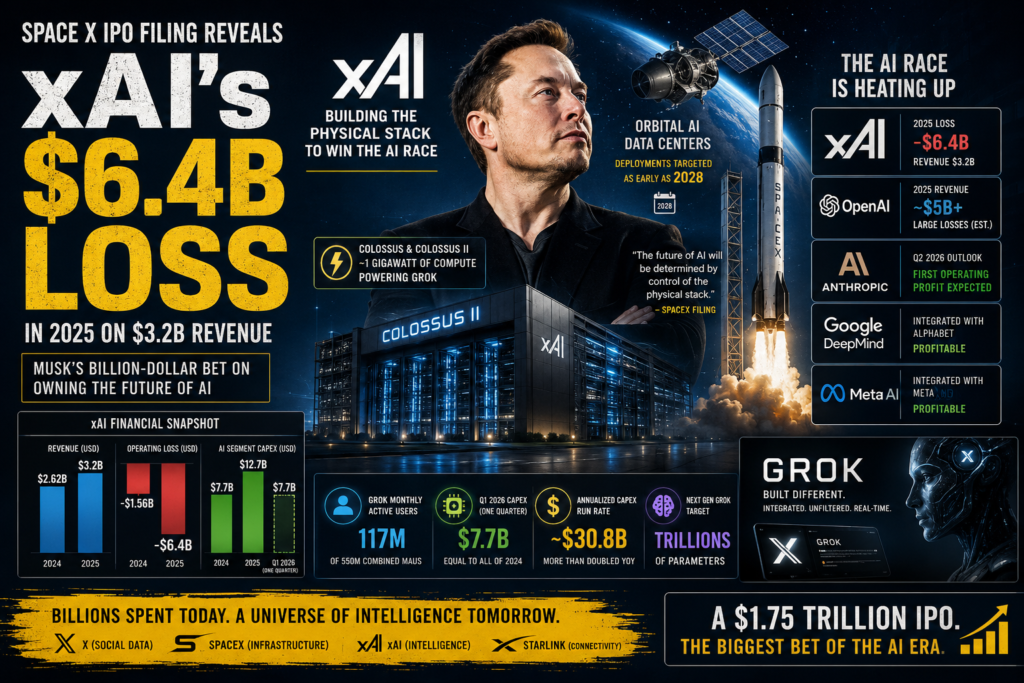
xAI burned $6.4 billion in 2025 while generating only $3.2 billion in revenue — and the SpaceX IPO filing that revealed these numbers makes one thing abundantly clear: the spending is nowhere near its peak. For anyone tracking the AI arms race, the xAI SpaceX IPO disclosure is the most important financial document of 2026 so far.
This is the first time xAI’s financials have ever been made public. And what they show is a company making an enormous, high-stakes bet that controlling the physical infrastructure of AI will eventually win the market — no matter what it costs today.
The Numbers at a Glance — xAI’s Financial Reality
Before diving into strategy and context, here are the hard numbers disclosed in the SpaceX S-1 filing submitted to the SEC in May 2026:
| Metric | 2024 | 2025 | Q1 2026 |
|---|---|---|---|
| xAI Revenue | $2.62B | $3.2B | Not disclosed |
| xAI Operating Loss | $1.56B | $6.4B | Not disclosed |
| AI Segment Capex | $7.7B | $12.7B | $7.7B (one quarter alone) |
| Grok Monthly Active Users | — | — | 117M (of 550M combined MAUs) |
| Annualized Capex Run Rate | — | ~$15B | ~$30.8B |
The annualized capital expenditure run rate for Q1 2026 alone — roughly $30.8 billion — has more than doubled year-over-year. Revenue grew from $2.62 billion to $3.2 billion, but the gap between earnings and spending widened dramatically. This is not a company tightening its belt; it is a company accelerating.
What Is xAI, and Why Does It Matter?
xAI is Elon Musk’s artificial intelligence company, founded in 2023 with the stated mission of understanding the true nature of the universe. In practice, it is the developer of Grok, an AI assistant integrated into X (formerly Twitter) and available as a standalone product.
What makes xAI unique among AI companies is its scope of integration. It does not merely build AI models — it owns social media data through X, satellite and launch infrastructure through SpaceX, and now, through the combined entity’s IPO, is attempting to become the first AI company to own its compute infrastructure at planetary scale.
The SpaceX-xAI-X Merger Explained
In February 2026, Musk merged xAI — which had previously acquired X — into SpaceX before announcing the combined entity would go public. The resulting conglomerate spans AI research, social media, satellite internet (Starlink), and rocket launches.
The xAI SpaceX IPO is expected to be one of the largest in history, with a potential valuation of $1.75 trillion. Competitors OpenAI and Anthropic are also eyeing public debuts in 2026, but SpaceX’s offering dwarfs them in scope and structural complexity.
Why does this merger matter? Because it means xAI’s losses are now SpaceX’s losses — and SpaceX’s credibility and cash flows are now backstopping xAI’s ambitions. Investors buying into the xAI SpaceX IPO are not buying a pure AI play. They are buying an integrated empire spanning Earth’s orbit to the X timeline.
Why xAI Is Burning Billions — and Accelerating
The core reason xAI is losing money at scale is compute. Training and running large language models at the frontier requires enormous clusters of specialized chips, massive cooling infrastructure, and vast amounts of electricity. xAI is not cutting corners on any of these.
The filing’s AI segment capital expenditure jumped from $7.7 billion across all of 2024 to $12.7 billion in 2025 — and then hit $7.7 billion in Q1 2026 alone. That single-quarter figure is equal to the entire annual capex of 2024. This is not a spending plateau; it is a spending cliff, going up.
Grok’s Trillion-Parameter Ambition
What is xAI planning to build with all this compute? The SpaceX filing describes plans to scale Grok to “multiple trillions of parameters” — a figure that would represent a significant leap beyond current frontier models. The filing describes this as a “step change in reasoning in depth and overall intelligence.”
To put that in perspective: most frontier AI models today operate in the hundreds of billions of parameters. Scaling to trillions requires proportionally more chips, more power, and more data. The compute expenditure trajectory disclosed in the xAI SpaceX IPO filing makes more sense when viewed through this lens — Musk is not spending to maintain current Grok; he is spending to build next-generation Grok.
The Colossus Data Centers and Vertical Integration
xAI operates two data centers called Colossus and Colossus II, both built at remarkable speed — in 122 days and 91 days, respectively. Together, they provide approximately 1 gigawatt of compute power used for Grok’s training and inference.
The filing’s strategic rationale for owning this infrastructure is direct: vertical integration across the AI stack allows xAI to “train and iterate frontier models at lower cost and higher velocity” than competitors who rent compute from cloud providers. This is the same philosophy that made SpaceX successful in the launch industry — own the full stack, drive down costs through iteration.
This vertical integration thesis is central to understanding the xAI SpaceX IPO narrative. Management is arguing that the billions being spent today will produce a structural cost advantage tomorrow that outside competitors cannot easily replicate.
xAI vs. Competitors: How the Losses Stack Up
How does xAI’s financial profile compare to its closest competitors? Here is an overview based on publicly available and reported figures as of mid-2026:
| Company | 2025 Revenue (est.) | 2025 Loss / Profit | Public? | Key AI Product |
|---|---|---|---|---|
| xAI | $3.2B | -$6.4B | IPO pending (SpaceX) | Grok |
| OpenAI | ~$5B+ | Large losses (est.) | IPO rumored 2026 | ChatGPT |
| Anthropic | ~$4B+ (est.) | Approaching profit (Q2 2026) | IPO rumored 2026 | Claude |
| Google DeepMind | Integrated with Alphabet | Profitable (parent) | Yes (GOOG) | Gemini |
| Meta AI | Integrated with Meta | Profitable (parent) | Yes (META) | Llama / Meta AI |
The most striking contrast visible here is between xAI and Anthropic. While the SpaceX filing discloses xAI’s $6.4 billion operating loss, Anthropic has been reported as expecting its first operating profit in Q2 2026, on the back of a projected 130% revenue jump to $10.9 billion for that quarter. The two companies represent very different capital philosophies: xAI is spending aggressively to own infrastructure, while Anthropic has focused on a model-first, API-first approach.
OpenAI sits somewhere in the middle, spending heavily but also generating substantial enterprise and consumer revenue from ChatGPT and its API.
For investors evaluating the xAI SpaceX IPO, the relevant question is not whether xAI is profitable today — it clearly is not — but whether the infrastructure-ownership thesis will produce a durable competitive moat.
What the SpaceX IPO Means for xAI’s Future
The xAI SpaceX IPO is not simply a fundraising event. It is a strategic statement. By going public as a combined entity, Musk is simultaneously:
- Accessing public capital markets to fund the next phase of Grok development
- Lending SpaceX’s credibility — a cash-flow positive aerospace leader — to backstop xAI’s losses
- Creating a public currency (stock) that can be used for acquisitions and employee compensation
- Establishing an audited record of xAI’s financials for the first time, increasing institutional trust
The “use of proceeds” section of the filing explicitly mentions expansion of AI compute infrastructure. In other words, the money raised in the IPO will directly fund more Colossus-scale data centers and more Grok training runs. The IPO is, in part, a mechanism to accelerate the very spending that is already alarming some analysts.
Orbital Data Centers: Musk’s Wildcard
Perhaps the most startling disclosure in the xAI SpaceX IPO filing is the timeline for orbital AI compute satellites. SpaceX intends to begin deploying these satellites — essentially data centers in space — as early as 2028.
What are orbital data centers? They are computing facilities placed in orbit around Earth, theoretically capable of running AI training and inference from space. Musk has previously argued that orbital data centers could be dramatically cheaper to operate than terrestrial ones, partly because of the free cooling available in space and access to constant solar power without atmospheric interference.
This is an ambitious vision that most analysts treat as speculative — but the filing sets a concrete 2028 target, making it the first official timeline for such a deployment. If it works, it could meaningfully change the economics of AI compute. If it does not, it represents an enormous capital allocation gamble.
The filing’s own philosophical statement captures the audacity of the bet: “The future of AI will be determined by control of the physical stack.”
Is xAI’s Spending Strategy Justified?
The short answer: it depends on whether the infrastructure thesis is right.
Here is the bull case for the xAI SpaceX IPO’s spending strategy:
- Owning compute infrastructure at scale has historically produced cost advantages that grow over time (see: Amazon AWS, Google data centers)
- The integration of X’s 550 million monthly active users provides a distribution channel that no other AI company possesses
- Grok is embedded directly into the social media feed of hundreds of millions of users, making it uniquely positioned for organic adoption growth
- The orbital data center thesis, if successful, could provide a generational cost advantage
- SpaceX’s cash flows from Starlink and launch services provide a financial cushion that pure AI companies like OpenAI and Anthropic lack
Here is the bear case:
- Revenue growth (from $2.62B to $3.2B) is not keeping pace with loss growth (from $1.56B to $6.4B)
- Only 117 million of 550 million combined MAUs actively use Grok AI features — just one in five
- The orbital data center timeline is speculative and any delays would require continued massive terrestrial investment
- Competitors like Anthropic are approaching profitability on a model-first approach without owning physical infrastructure
- The combined SpaceX-xAI-X entity has complex governance and conflict-of-interest considerations tied to Musk’s oversight of all three
Neither case is obviously correct. This is a genuine strategic bet, and the xAI SpaceX IPO will force public market investors to take a side.
Key Takeaways for Investors and AI Watchers
Whether you are a retail investor, an enterprise AI buyer, or simply someone following the AI industry, here are the most important facts to walk away with from the SpaceX IPO filing:
- xAI lost $6.4 billion in 2025 on $3.2 billion in revenue — its first publicly disclosed financials
- The Q1 2026 capex alone ($7.7B) matches all of 2024’s full-year capex, signaling acceleration
- Grok reaches only 117 million monthly active users out of 550 million combined MAUs, leaving significant untapped headroom
- The next generation of Grok is planned to scale to trillions of parameters, requiring substantially more compute investment
- Orbital AI compute satellites are targeted for 2028, a first concrete timeline from Musk for this vision
- The xAI SpaceX IPO is expected to carry a $1.75 trillion valuation, making it potentially one of the largest public offerings in history
- Anthropic, a direct competitor, is approaching its first operating profit in Q2 2026, illustrating an alternative path to AI sustainability
The fundamental tension at the heart of the xAI SpaceX IPO is this: Musk is making a physical-infrastructure bet in an industry that has so far rewarded model quality and distribution speed. Whether owning the “physical stack” produces durable returns — or simply produces the most spectacular burn rate in AI history — is the defining question that public market investors will now have to answer.
FAQ: Understanding the xAI SpaceX IPO and Elon Musk’s AI Spending Strategy
What is the xAI SpaceX IPO?
The xAI SpaceX IPO refers to the planned public offering of the combined SpaceX, xAI, and X entity created by Elon Musk in 2026. The IPO filing revealed xAI’s financials for the first time, including a massive $6.4 billion operating loss in 2025. The xAI SpaceX IPO is expected to become one of the largest public offerings in history, with estimates placing the valuation near $1.75 trillion.
What makes the xAI SpaceX IPO unique is that it combines artificial intelligence, social media, satellite internet, and aerospace infrastructure into one company. Instead of operating separately, xAI now benefits from SpaceX infrastructure and X’s user base, creating a vertically integrated AI ecosystem.
Why did xAI lose $6.4 billion in 2025?
The primary reason behind the enormous losses disclosed in the xAI SpaceX IPO filing is infrastructure spending. xAI is investing aggressively in AI compute, data centers, GPUs, cooling systems, and electricity needed to train advanced AI models like Grok.
According to the filing, AI segment capital expenditures increased from $7.7 billion in 2024 to $12.7 billion in 2025. Even more striking, xAI spent another $7.7 billion in Q1 2026 alone. This shows that the company is accelerating investment rather than reducing costs.
The xAI SpaceX IPO filing makes it clear that Musk believes controlling AI infrastructure will create long-term competitive advantages, even if it creates massive short-term losses.
What is Grok AI and why is it important?
Grok is the flagship AI assistant developed by xAI and integrated into X. Grok competes directly with tools like ChatGPT, Claude, and Gemini.
The xAI SpaceX IPO filing revealed that Grok currently reaches 117 million monthly active users out of X’s combined 550 million monthly active users. Musk’s long-term goal is to scale Grok into a multi-trillion-parameter AI model capable of deeper reasoning and more advanced intelligence.
This matters because Grok is deeply integrated into the X platform, giving xAI direct access to real-time social media data and a built-in distribution network that competitors lack.
How does the xAI SpaceX IPO compare with OpenAI and Anthropic?
The xAI SpaceX IPO highlights a very different AI strategy compared to competitors. While companies like Anthropic focus on model efficiency and enterprise APIs, xAI is focused on owning the entire AI infrastructure stack.
OpenAI reportedly generates more revenue today, but it also depends heavily on cloud infrastructure partnerships. Anthropic, meanwhile, is reportedly approaching profitability faster than xAI. However, Musk’s strategy is based on the idea that infrastructure ownership will matter more over the long term than near-term profitability.
The xAI SpaceX IPO filing suggests that Musk sees AI infrastructure as similar to rocket manufacturing at SpaceX — expensive initially, but potentially dominant once scale advantages appear.
What are orbital AI data centers?
One of the most surprising revelations in the xAI SpaceX IPO filing was the plan for orbital AI data centers targeted for deployment by 2028.
Orbital AI data centers are computing satellites placed in space to handle AI training and inference workloads. Musk argues these systems could dramatically reduce cooling costs and access uninterrupted solar energy outside Earth’s atmosphere.
If successful, orbital AI infrastructure could completely reshape the economics of artificial intelligence. However, many analysts still consider the idea speculative because the technology and operational logistics remain unproven at scale.
Still, the xAI SpaceX IPO filing marks the first official timeline for such a project, making it one of the most ambitious AI infrastructure concepts currently under development.
Why is xAI spending so heavily on compute infrastructure?
The answer is simple: modern AI requires enormous computing power. Training frontier AI systems demands tens of thousands of advanced GPUs, huge data centers, sophisticated networking systems, and massive electricity consumption.
The xAI SpaceX IPO filing revealed that xAI operates Colossus and Colossus II, two giant AI data centers built at record speed. Together, these facilities reportedly provide nearly 1 gigawatt of compute power for Grok training and inference.
Musk’s belief is that companies relying on rented cloud infrastructure may struggle to compete with firms that own their compute stack directly. This infrastructure-first strategy sits at the center of the xAI SpaceX IPO narrative.
Is the xAI SpaceX IPO a good investment opportunity?
The xAI SpaceX IPO presents both enormous opportunity and significant risk. Bulls argue that combining SpaceX, Starlink, X, and xAI creates one of the strongest technology ecosystems ever assembled. They believe AI infrastructure ownership could become incredibly valuable over the next decade.
Critics, however, point to the company’s massive losses, rising capital expenditures, and uncertain profitability timeline. Some investors also worry about governance complexity because Elon Musk oversees multiple interconnected businesses simultaneously.
Ultimately, the xAI SpaceX IPO is less about current profitability and more about belief in Musk’s long-term AI infrastructure vision.
What is the biggest takeaway from the xAI SpaceX IPO filing?
The biggest takeaway from the xAI SpaceX IPO filing is that the AI race is increasingly becoming a battle over physical infrastructure, not just software models.
Musk is betting billions that owning compute, energy systems, satellites, data centers, and distribution networks will matter more than simply building the best chatbot. Whether that strategy creates the next dominant AI empire — or one of the largest spending disasters in tech history — remains one of the defining questions of the AI industry in 2026.