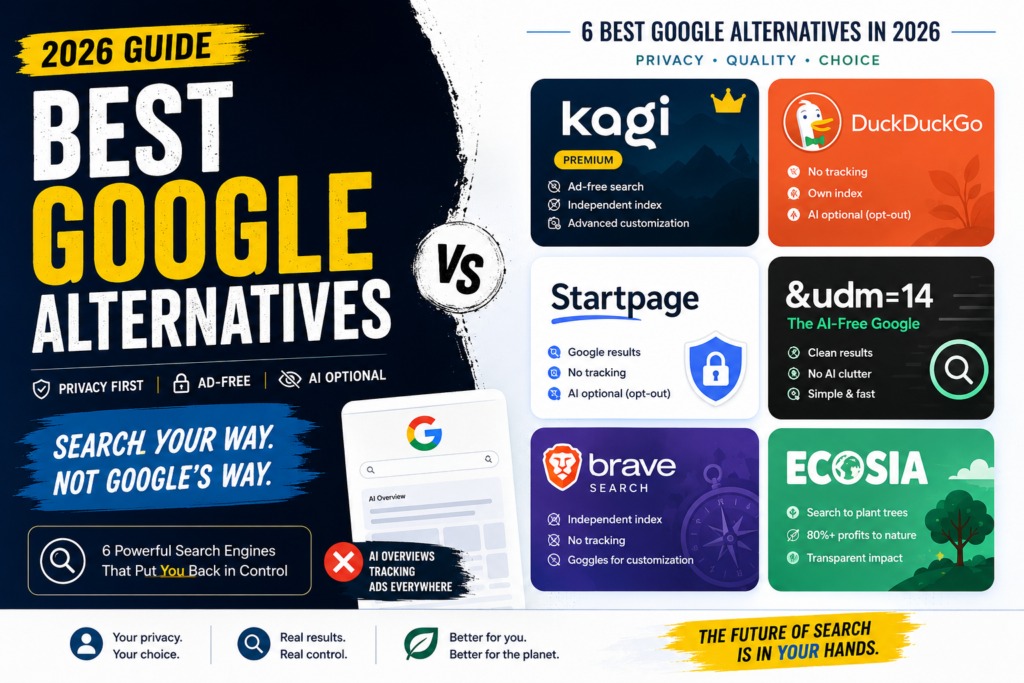
Google just rewrote the rules of search — and not everyone is happy about it. If you’re looking for Google alternatives that respect your privacy, ditch the AI clutter, and actually surface the web links you need, this guide covers the six best options available right now.
At Google I/O 2026, the company announced it is overhauling Search into a fully conversational, AI-driven experience. The leader of Google’s Search organization called it “the biggest upgrade to our iconic search box since its debut over 25 years ago.” For users who already dislike AI Overviews, the new Google is going to feel even more alienating — and the backlash has been immediate. One commenter on Google’s announcement video put it plainly: “this is the best advertisement for letting people know it’s time to get a different search engine.”
They’re right. And the good news is, you have excellent options.
Why Millions Are Abandoning Google in 2026
Google’s AI Overhaul Is Dividing Its Own Users
The friction started with AI Overviews — the auto-generated summaries that appear above organic search results. Early rollouts were rocky, producing embarrassing and sometimes dangerous outputs. Despite the backlash, Google doubled down at Google I/O 2026, announcing that AI mode will now be the default search experience, complete with a conversational chat interface that makes Google look more like ChatGPT than the search engine people have used for decades.
For many users, that’s a dealbreaker. They don’t want an AI to interpret their search — they want a list of links. They want to decide what’s relevant. And increasingly, they’re voting with their browsers.
The Monopoly Problem
The AI pivot isn’t the only reason people are leaving. A U.S. District Court ruled in 2024 that Google had acted illegally to maintain a monopoly in online search. That ruling crystallized something many users had suspected for years: the search results they see aren’t necessarily the best results, they’re the results that serve Google’s advertising ecosystem. Ads, sponsored results, AI overviews, knowledge panels — actual web links have been pushed further and further down the page.
Together, these forces have created the biggest moment of user migration in search since the early 2000s. Google alternatives are no longer a niche concern for privacy advocates. They’re going mainstream.
What to Look for in a Google Alternative
Not all Google alternatives are built the same. Before switching, it’s worth asking a few focused questions:
- Does it collect your personal data? Many search engines monetize through behavioral advertising, just like Google.
- Does it have its own search index, or does it rely on Google/Bing? Independent indexes (Kagi, DuckDuckGo, Brave) tend to produce different results; proxies (Startpage, &udm=14) return Google’s results with a privacy layer.
- Can you opt out of AI-generated answers? Some alternatives offer AI features but make them truly optional — unlike the new Google.
- How does it make money? Ad-supported, subscription, or mission-driven models each come with trade-offs.
Understanding your own priorities — privacy, result quality, cost, or AI preferences — will help you pick the right fit from the Google alternatives listed below.
The 6 Best Google Alternatives Right Now
Kagi — The Ad-Free Premium Option
What is Kagi? Kagi is a subscription-based, ad-free search engine with its own independent index. It costs $5/month for a limited plan or $10/month for unlimited searches.
Why it stands out: The absence of ads isn’t just a perk — it’s the entire business model. Because Kagi earns revenue from subscriptions rather than advertisers, it has no incentive to bias results toward paying sponsors or to keep you scrolling longer than necessary.
Beyond being ad-free, Kagi offers a level of customization that Google has never provided to regular users:
- Website blocking and boosting: Permanently demote domains you find spammy (think content farms) or boost sources you trust.
- Lenses: Filter results by category — academic journals, tech blogs, news sources, or recipe sites — before you even search.
- Quick Answer (optional AI): A brief AI-generated summary with cited sources, toggled only when you want it.
Kagi is the best choice for power users who are willing to pay for a cleaner, more controlled search experience. It’s what Google should have built.
DuckDuckGo — The Free Privacy Workhorse
What is DuckDuckGo? DuckDuckGo is a free, privacy-focused search engine that has its own index and does not track user behavior across sessions.
Why it stands out: Unlike Google, DuckDuckGo doesn’t build a profile of you based on your search history, location history, or browsing behavior. Instead of behavioral targeting, it serves contextual ads based only on the current search query — if you search for flights, you see flight ads. When the session ends, it forgets you.
DuckDuckGo has also made its AI feature genuinely optional. Users can completely opt out of AI-generated answers in the settings menu, which is a design choice that respects user autonomy in a way that the new Google conspicuously does not.
For anyone who wants a free, functional Google alternative that doesn’t surveil them, DuckDuckGo remains the default recommendation.
Startpage — Google Results Without Google Tracking
What is Startpage? Startpage is a privacy proxy that strips your personal data from search queries, sends them to Google anonymously, and returns the results to you — so you get Google’s index without Google knowing who asked.
Why it stands out: If you genuinely trust Google’s search quality but don’t trust Google’s data practices, Startpage is a logical middle ground. Your IP address and personal identifiers are removed before the query reaches Google’s servers.
The main limitation is philosophical: you’re still getting results shaped by Google’s algorithm and its advertising relationships. You just aren’t personally identifiable within that system.
Startpage lets you disable AI features, making it a reasonable choice for users who prioritize result familiarity over index independence.
&udm=14 — The Minimalist Hack
What is &udm=14? It’s a search engine named after the URL parameter &udm=14 that, when appended to a Google search, bypasses AI Overviews and returns a clean list of organic links.
Why it stands out: Sometimes the best interface is the simplest one. The developer behind &udm=14 built a site that automatically appends this parameter to every search, delivering the Google results interface that users knew before AI Overviews existed — no chat boxes, no AI summaries, no generated content. The source code is published on GitHub for anyone who wants to self-host.
The trade-off is privacy: unlike Startpage, &udm=14 doesn’t strip your identifying information, so Google still knows it’s you. But for users whose main complaint is AI clutter rather than surveillance, it’s an elegant, zero-cost fix.
Brave Search — Privacy Plus Customization
What is Brave Search? Brave Search is an independent search engine with its own index, built by the same company behind the Brave browser. Both are free to use.
Why it stands out: Brave Search operates one of the few genuinely independent search indexes outside of Google and Bing, meaning its results aren’t simply borrowed from a larger player. That independence matters if you’re trying to escape the Google orbit entirely.
The standout feature is “Goggles” — curated result filters that users can apply to shape what they see. Options include ideologically filtered news feeds (“News from the Right,” “News from the Left”), technical communities (“Hacker News/1k short,” which excludes the top 1,000 mainstream domains), and targeted blocklists like “No Pinterest.” It’s a transparency-first approach to search curation.
Because the Brave browser is built on Chromium (the same open-source base as Google Chrome), users who switch browsers can carry over their Chrome extensions without rebuilding their toolkit.
Ecosia — Search That Plants Trees
What is Ecosia? Ecosia is a free, ad-supported search engine and browser that donates approximately 80% of its ad revenue to tree-planting and reforestation projects worldwide.
Why it stands out: Ecosia carves out a clear mission-driven niche among Google alternatives: every search contributes, in a small but meaningful way, to environmental restoration. The company publishes monthly financial reports and blogs documenting the actual impact of funded projects, which sets it apart from surface-level greenwashing.
Like Brave, Ecosia’s browser is built on Chromium, meaning Chrome extensions work seamlessly. For users who want their online habits to have a positive ecological footprint without paying a subscription fee, Ecosia offers a genuinely differentiated value proposition.
Google Alternatives Compared
| Search Engine | Cost | Own Index | AI Features | Privacy Approach | Best For |
|---|---|---|---|---|---|
| Kagi | $5–$10/mo | Yes | Optional | No data collection | Power users, ad-haters |
| DuckDuckGo | Free | Yes | Optional (opt-out) | No behavioral tracking | Privacy + free |
| Startpage | Free | No (Google proxy) | Optional (opt-out) | Anonymizes queries | Familiar Google results |
| &udm=14 | Free | No (Google) | None | No extra privacy | AI-free Google results |
| Brave Search | Free | Yes | Optional | No tracking | Customization + independence |
| Ecosia | Free | No (Bing-powered) | Minimal | No profiling | Eco-conscious users |
Which Google Alternative Is Right for You?
Choosing among these Google alternatives comes down to three core trade-offs: cost, index independence, and AI preferences.
If privacy is your top priority: Start with DuckDuckGo (free) or Kagi (paid). Both have independent indexes and genuinely opt-in AI features.
If you want Google’s result quality without Google’s tracking: Startpage is your best bet. You get the same index, anonymized.
If you’re frustrated specifically by AI Overviews but don’t mind Google otherwise: Try &udm=14. It’s the simplest, fastest fix.
If you want full ecosystem independence (browser + search): Brave or Ecosia give you a Chromium-based browser alongside a search engine, so you can leave Google’s orbit entirely — Chrome included.
If you’re motivated by environmental impact: Ecosia is the only major Google alternative that ties revenue directly to reforestation.
The common thread across all six is this: unlike the new Google, every one of these options gives you meaningful control over your own search experience. That control — the ability to opt out of AI, to block annoying domains, to choose what you see — is what Google has been quietly stripping away for years.
Frequently Asked Questions
Is there a Google alternative with the same result quality?
Kagi and DuckDuckGo come closest for independent indexes. If you specifically need Google’s result quality, Startpage or &udm=14 deliver Google’s index with varying degrees of privacy protection.
Are Google alternatives safe to use?
Yes. Engines like DuckDuckGo, Kagi, Startpage, and Brave Search are widely used and well-audited. Because they collect less data than Google, they represent a smaller attack surface for data breaches tied to your personal information.
Which Google alternative is best for privacy?
Kagi and DuckDuckGo are the strongest privacy-focused search engines with independent indexes. Startpage is strong for privacy if you need Google’s results specifically. Avoid &udm=14 if privacy is your primary concern, as it doesn’t strip your identifying data.
Can I use a Google alternative as my default browser search engine?
Yes. All six options in this guide can be set as the default search engine in Chrome, Firefox, Safari, and most other browsers. Brave and Ecosia also offer their own browsers with built-in defaults.
Do any of these Google alternatives have AI features?
Most do — but critically, all of them make AI features optional in a way that the new Google does not. Kagi’s “Quick Answer,” DuckDuckGo’s AI chat, and Brave’s AI assistant can all be disabled completely.
The Bottom Line
The search engine landscape has changed dramatically in 2026, and for many users, that change has pushed them to actively explore better Google alternatives. What was once a straightforward tool for discovering websites has evolved into an AI-heavy ecosystem filled with conversational summaries, sponsored answers, predictive recommendations, and algorithmic filtering. While some users enjoy these additions, millions of others are looking for a simpler, cleaner, and more private way to search the web. That shift is exactly why interest in Google alternatives has exploded this year.
For more than two decades, Google dominated online search because it consistently delivered fast and accurate results. But the latest AI overhaul has created growing frustration among users who simply want direct access to web pages instead of AI-generated interpretations. The rise of AI Overviews, conversational search interfaces, and increasingly aggressive ad placement has made traditional search feel less transparent. As a result, Google alternatives are no longer niche tools for privacy enthusiasts — they are becoming mainstream solutions for everyday internet users.
One of the biggest reasons people are switching to Google alternatives is privacy. Google’s business model relies heavily on data collection and behavioral advertising. Every search, click, and interaction contributes to a user profile that powers targeted ads across the web. In contrast, modern Google alternatives like DuckDuckGo, Brave Search, and Kagi are built around minimizing or eliminating user tracking entirely. They focus on contextual results instead of surveillance-based personalization, giving users greater control over their digital footprint.
Another reason why Google alternatives are gaining popularity is the growing demand for AI-free search experiences. Many users do not want AI summaries replacing original sources or influencing how information is presented. They prefer to evaluate links themselves and decide which websites deserve their attention. Platforms like &udm=14 and Startpage appeal directly to those users by stripping away unnecessary clutter and restoring a more traditional search experience. In a world increasingly dominated by automated answers, these Google alternatives provide something refreshingly simple: access to the open web.
Cost and business models also play a major role in the rise of Google alternatives. Google’s free ecosystem is funded by advertising, which naturally incentivizes the company to keep users engaged for as long as possible. Subscription-based search engines like Kagi flip that model entirely. Because users pay directly for the service, the company’s priorities shift toward delivering cleaner results, fewer distractions, and a more efficient experience. This approach has helped premium Google alternatives gain credibility among professionals, researchers, developers, and power users who value quality over convenience.
At the same time, mission-driven platforms are reshaping what users expect from search engines. Ecosia, for example, turns everyday searches into environmental impact by funding global reforestation projects. This makes Google alternatives more than just replacements for search — they become value-driven tools aligned with specific user priorities. Whether someone cares most about privacy, sustainability, customization, or independence from big tech ecosystems, there is now a search engine built around those preferences.
The diversity among today’s Google alternatives is what makes the current market so interesting. Users are no longer limited to a single dominant platform. DuckDuckGo offers accessible privacy for mainstream users. Brave Search emphasizes index independence and customization. Startpage provides Google-quality results without direct tracking. Kagi delivers a premium, ad-free experience designed for focused searching. Even lightweight solutions like &udm=14 demonstrate how strong the demand has become for cleaner, AI-free results. Each of these Google alternatives solves a slightly different problem, giving users more flexibility than ever before.
What makes this moment especially significant is that search behavior itself is changing. For years, most people accepted Google as the default gateway to the internet. But as AI-generated content grows and search interfaces become more controlled, users are starting to question whether convenience should come at the expense of transparency and autonomy. The growing popularity of Google alternatives suggests that people still value independent thinking, direct access to information, and the ability to search without constant algorithmic intervention.
Ultimately, the best Google alternatives are succeeding because they return control to users. They allow people to decide how much AI they want, how much data they are willing to share, and what kind of search experience fits their needs. Some prioritize speed and simplicity, others focus on ethics and sustainability, while premium platforms emphasize customization and accuracy. Together, these options represent a broader movement away from one-size-fits-all search.
As Google continues moving deeper into AI-first experiences, the gap between traditional web search and conversational search will only grow wider. That creates enormous opportunities for Google alternatives to capture users who want a more human-centered experience. Whether you choose Kagi, DuckDuckGo, Brave Search, Startpage, Ecosia, or another emerging platform, one thing is clear: the future of search is no longer controlled by a single company. The rise of Google alternatives proves that users still want freedom, privacy, and genuine choice when navigating the web.