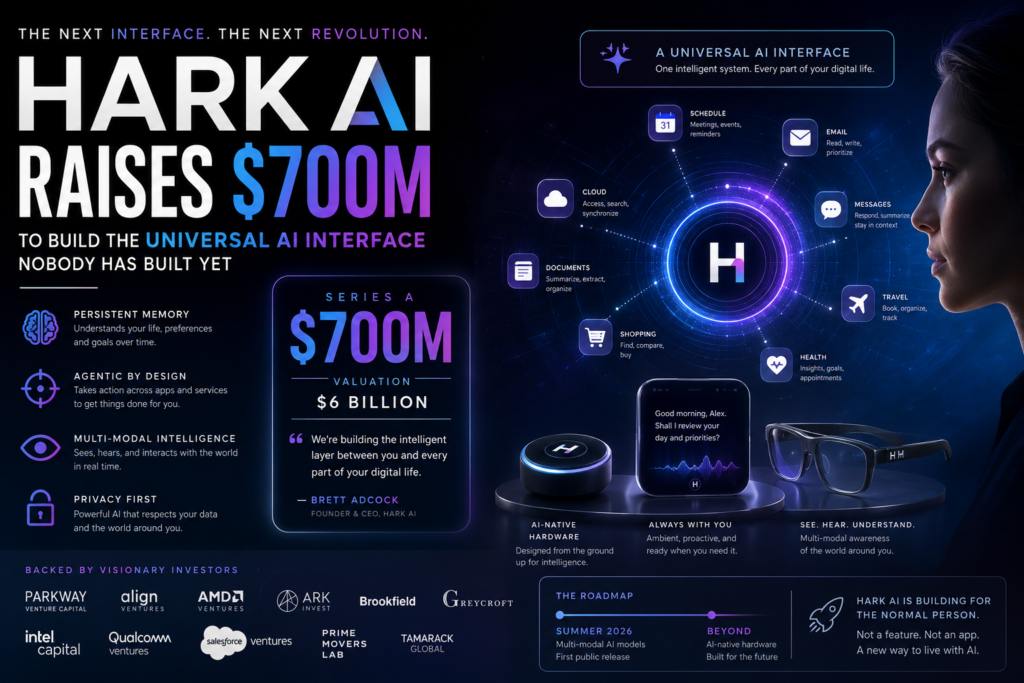
The race to create the first must-have AI consumer product has a new frontrunner. Hark, a secretive AI lab founded by serial entrepreneur Brett Adcock, just closed a $700 million Series A at a $6 billion valuation — making it one of the largest early-stage AI fundraises ever. The company’s goal is audacious and deceptively simple: build a universal AI interface that acts as the intelligent layer between you and every part of your digital life.
If that sounds like science fiction, you’re not alone in thinking so. But a roster of major institutional investors — including AMD Ventures, ARK Invest, Intel Capital, Qualcomm Ventures, and Salesforce Ventures — clearly believe it isn’t.
What Is Hark? The Universal AI Interface Explained
Definition: A universal AI interface is an agentic AI system designed to interact with, orchestrate, and automate across all of a user’s existing digital products and services — not as a feature bolted onto an app, but as the foundational intelligence layer of a person’s entire digital life.
Hark’s vision is to create exactly that: a platform with persistent memory of your life that can listen, see, and interact with the world in real time. Rather than asking you to switch between apps, fill out forms manually, or copy-paste information between services, a universal AI interface would handle those tasks on your behalf — invisibly and continuously.
This stands in sharp contrast to how most people experience AI today: as a chatbot you open, type into, and close. Hark’s ambition is to make AI something that runs alongside your life, not something you consciously invoke.
Why “Universal” Is the Key Word
Most AI products today are narrow by design. ChatGPT is a chat interface. Copilot is a coding assistant. Even the most capable AI assistants on smartphones remain siloed inside an app. The word “universal” in Hark’s mission statement is a direct challenge to this model.
A true universal AI interface would need to:
- Understand context across all your devices and apps without being repeatedly prompted
- Maintain a persistent, evolving memory of your preferences, habits, and goals
- Take actions — booking, scheduling, form-filling, communication — not just suggest them
- Work with hardware designed from the ground up for AI, not retrofitted to it
- Do all of this without being intrusive or privacy-invasive
That’s an enormously tall order. It’s also precisely what Hark says it’s building.
The $700M Series A: Who’s Betting on Hark and Why
The round was led by Parkway Venture Capital, with participation from a notably diverse group of strategic investors:
- Align Ventures
- AMD Ventures
- ARK Invest
- Brookfield
- Greycroft
- Intel Capital
- Prime Movers Lab
- Qualcomm Ventures
- Salesforce Ventures
- Tamarack Global
The presence of semiconductor giants AMD and Intel, alongside Qualcomm — whose chips power most of the world’s mobile devices — signals something important: this round is not purely a software bet. Investors with deep hardware expertise are backing Hark, suggesting the company’s hardware ambitions are credible and differentiated.
ARK Invest’s participation is equally telling. The firm specializes in disruptive technology with long-horizon payoffs, and has previously made early bets on Tesla, Roku, and Coinbase. Backing Hark at Series A suggests ARK sees the universal AI interface category as a platform-level opportunity comparable to the smartphone.
A $6 Billion Valuation on Almost No Public Product
Perhaps the most striking aspect of this fundraise is what Hark has not shown the world. The company has released no product. It has shared no demos publicly. Its website reveals almost nothing. And yet investors have assigned it a $6 billion post-money valuation.
The explanation lies in the private demos. Hark’s Director of Design Abidur Chowdhury confirmed to TechCrunch that investors were shown a series of internal demos from his design team, and those demos were compelling enough to unlock the capital. In an industry where early-stage AI valuations are increasingly driven by team pedigree and vision, Hark’s combination of hardware and model-building expertise appears to have closed the gap.
Brett Adcock: The Serial Founder Behind the Vision
Brett Adcock is not building his first company. He is the founder of Figure AI, one of the most well-funded humanoid robotics startups in the world, and Archer Aviation, a leading electric aircraft (eVTOL) company. Both companies represent long-horizon, capital-intensive bets on deep technology — exactly the profile of someone willing to seed a new AI lab with $100 million of his own money.
Adcock launched Hark in late 2025 with that personal seed investment, describing his thesis in a January internal memo: “My view is simple: today’s AI models aren’t nearly intelligent enough, they feel quite dumb, and the devices we use to access them are fundamentally pre-AI. We’re moving toward a world that looks more like sci-fi characters Jarvis or Her, with systems that anticipate, adapt, and genuinely care about the people using them.”
Notably, Hark’s AI models are already being trained on data from Figure’s humanoid robots — a unique feedback loop that gives Hark access to real-world physical interaction data that most purely software-focused AI labs lack entirely.(Hark AI startup AI personal assistant agentic AI system AI-native hardware
)
The Design Philosophy: Apple DNA Meets AI-Native Hardware
If Adcock is the vision, Abidur Chowdhury is the execution. A former Apple industrial designer, Chowdhury is widely credited with leading the design team behind the iPhone Air and other recent Apple products. He left Apple in late 2025 after meeting Adcock and buying into his thesis about what the next computing paradigm would look like.
Chowdhury’s framing of Hark’s mission is worth quoting at length: “Very few people are really going after what the future is. There’s so much that we could be doing if intelligence was at the base layer of everything we touched instead of becoming an app or a website at that upper layer.”
His point cuts to the heart of why a universal AI interface is so elusive. Every major tech company — Apple, Google, Microsoft, Amazon — has tried to embed AI assistants at the base layer. None of them has succeeded in making it feel natural or indispensable. Chowdhury believes this is a design failure as much as a model capability failure. At Hark, the models, the hardware, and the interface are being designed in tandem from day one — not bolted together after the fact.
What Makes Hark’s Approach Different from Existing AI Assistants
The traditional approach to AI assistants has been additive: take an existing device (a smartphone, a speaker, a watch), add an AI layer on top, and call it an assistant. Siri, Google Assistant, Alexa, and Cortana all follow this model. The results have been underwhelming for everyday, complex tasks.
Hark’s approach is generative: design the AI capability first, then design the hardware and interface that best expresses that capability. This is sometimes called an “AI-native” design philosophy, and it’s the same logic that Jony Ive is reportedly applying at OpenAI’s hardware initiative — a parallel Hark declines to address directly.
The company currently employs 70 people, including former Meta AI researchers and designers from Apple and Tesla. It runs a data center equipped with NVIDIA B200 GPUs — the current generation of AI training hardware — and the fresh $700 million will go toward recruiting more top talent in hardware, product design, and AI research, as well as securing additional compute and components.
Comparison: Hark vs. the Current AI Personal Assistant Landscape
How does Hark’s vision stack up against what’s already available? Here’s a clear-eyed comparison:
| Feature | Siri / Google Assistant / Alexa | ChatGPT / Claude / Gemini | Meta AI Glasses | Hark (Planned) |
|---|---|---|---|---|
| Interface Type | App-based, voice-triggered | Chat interface | Wearable, camera-based | Universal (TBD hardware form factor) |
| Persistent Memory | Limited or none | Optional / session-based | Limited | Core design principle |
| Multi-modal Input | Voice + some vision | Text, vision, voice | Vision + voice | Multi-modal end-to-end |
| Agentic Capability | Very limited | Growing (web browsing, tools) | None | Full agentic system |
| Hardware Integration | Retrofitted to existing devices | Software only | Dedicated wearable | Custom AI-native hardware |
| Target User | General consumer | Developer / power user | Early adopter | “The normal person” |
| Model + Hardware Co-design | No | No | Partial | Yes |
| Public Product Available | Yes | Yes | Yes | Summer 2026 (models only) |
The table makes Hark’s differentiation clear: it is the only company in this cohort attempting full co-design of models, hardware, and interface — and the only one that explicitly targets non-technical everyday users as its primary audience.
The Roadmap: What to Expect from Hark in 2026 and Beyond
Hark has outlined a two-phase public roadmap, though details remain intentionally sparse:
Phase 1 — Summer 2026: Multi-modal model release Hark expects to release its first multi-modal AI models this summer. These will be the foundational intelligence layer powering everything that follows. The models are described as “end-to-end,” meaning they are designed holistically for the company’s specific use case rather than adapted from general-purpose foundations.
Phase 2 — Post-model: AI-native hardware devices Following the model release, Hark plans to introduce hardware devices designed specifically for its AI systems. The form factor remains undisclosed. Chowdhury’s comments suggest it will not be a traditional wearable or camera-based pin — he has expressed skepticism about those categories specifically.
The $700 million in fresh capital positions Hark to execute on both phases aggressively. For context, this single Series A round is larger than the total venture funding received by many successful AI companies before their first product launch.
The Big Open Questions
Privacy, Context, and the Wearable Problem
The most difficult unsolved problem for any universal AI interface is also the most human one: how do you give an AI enough context about your life to be genuinely useful without making everyone around you uncomfortable?
Meta’s smart glasses have surfaced this dilemma vividly. A device that can see and hear the world around you is, by definition, also seeing and hearing the people around you — without their knowledge or consent. Hark is aware of this tension. When pressed on how Hark plans to solve it, Chowdhury offered only a smile and the observation: “Sounds like that would make a great product.”
That’s either an admission that the problem is unsolved, or a signal that the solution is one of Hark’s most tightly guarded competitive advantages. Given the caliber of the team and the amount of capital now behind them, the latter seems at least plausible.
Other open questions worth watching:
- What will the hardware form factor actually look like?
- How will Hark handle data privacy and on-device vs. cloud processing?
- Will Hark’s models be proprietary, or will they be open for developers to build on?
- How does Hark plan to distribute its products — direct-to-consumer, carrier partnerships, or enterprise?
- What is the relationship between Hark’s AI systems and Figure’s humanoid robotics platform?
Why This Moment Matters for the Future of AI Consumer Products
There is a growing consensus in the AI industry that the next major battleground is the consumer interface layer — and that nobody has won it yet. Anthropic is focused on coding and enterprise tools. OpenAI is preparing for an IPO while building toward AGI. Google is defending its search dominance. Microsoft is embedding Copilot across its enterprise suite. Apple is moving cautiously with Apple Intelligence.
That leaves a genuine opening for a company willing to focus entirely on the everyday consumer experience — not the developer, not the enterprise, not the power user, but the person who just wants their digital life to be less exhausting.
Chowdhury said it bluntly in his TechCrunch interview: “I haven’t seen anything that feels like something that will really help the normal person. People are really building things to help people make software, and it’s working, and it’s really impactful, but we haven’t really seen that for the normal person yet.”
This is the thesis at the heart of Hark’s existence. And it’s a thesis that a significant portion of the institutional investment world now appears to share, to the tune of $700 million.
The analogy Chowdhury keeps reaching for is the iPhone. Before 2007, nobody knew they needed a touchscreen pocket computer. After 2007, they couldn’t imagine life without one. Hark is betting that the universal AI interface will have a similar before/after effect on how humans relate to technology — and that the team that designs it from first principles, rather than kludging it onto existing platforms, will own that moment.
Bottom Line
The rise of the universal AI interface may become the single biggest shift in consumer technology since the smartphone era began. Hark AI is not simply building another chatbot, voice assistant, or productivity tool. Instead, the company is attempting to create an entirely new computing layer where a universal AI interface understands context, remembers preferences, and performs tasks across every part of a user’s digital life. That ambition is precisely why investors were willing to commit an extraordinary $700 million Series A round at a $6 billion valuation before a public product even exists.
What makes this moment important is that the current generation of AI tools still feels fragmented for everyday users. Most people today interact with AI through isolated apps or browser tabs. You open a chatbot, ask a question, and leave. A true universal AI interface changes that relationship completely by acting as an always-available intelligence layer operating quietly in the background. Instead of forcing users to jump between apps, calendars, emails, shopping platforms, and search engines, the AI could eventually coordinate all those experiences automatically.
Hark AI’s strategy also stands out because of its AI-native design philosophy. The company is not retrofitting AI onto existing devices the way traditional assistants like Siri, Alexa, or Google Assistant were built. Hark wants the universal AI interface itself to become the foundation of both the software and hardware experience. That approach explains why hardware-focused investors such as AMD Ventures, Intel Capital, and Qualcomm Ventures joined the funding round. They are not betting on another software app; they are betting on the possibility of a new consumer computing platform.
The leadership team further strengthens that vision. Brett Adcock already has experience building ambitious deep-tech companies through Figure AI and Archer Aviation. Meanwhile, former Apple designer Abidur Chowdhury brings premium consumer design expertise that could help make the universal AI interface accessible to ordinary people rather than only developers or power users. This combination of AI research, robotics data, and hardware-first thinking gives Hark AI a positioning that few startups can currently match.
Still, major challenges remain unresolved. Privacy concerns around persistent AI systems will be enormous. A universal AI interface requires deep awareness of a user’s habits, communications, and environment to function effectively. Balancing that level of intelligence with trust and transparency will likely determine whether mainstream consumers fully embrace this category. Hardware adoption is another critical hurdle. Consumers will need a compelling reason to adopt new AI-native devices if Hark plans to move beyond smartphones and laptops.
Even with those uncertainties, the broader significance of Hark AI is clear. The company represents a growing belief inside Silicon Valley that the next AI battle is not about who has the smartest chatbot, but who controls the interface between humans and digital systems. If Hark succeeds, the universal AI interface could become as transformative as the internet browser or touchscreen smartphone. If it fails, it will still push the industry closer toward AI systems that feel more integrated, proactive, and human-centered.
For now, Hark AI remains one of the most closely watched startups in the industry. Its upcoming multi-modal model launch in 2026 will offer the first real test of whether the company can turn the promise of a universal AI interface into a practical consumer experience. Until then, Hark stands as a bold signal that the future of AI may no longer revolve around apps at all, but around a single intelligent layer capable of understanding and assisting people across every aspect of daily life.