Google just unveiled its most ambitious AI push yet — and the technology is genuinely impressive. But the real question is whether the Google AI agent ecosystem announced at Google IO 2026 is built for the average person, or only for the most dedicated (and well-funded) tech enthusiasts.
What Is Google’s AI Agent Ecosystem?
Definition: A Google AI agent ecosystem is a network of interconnected, autonomous AI programs — called “agents” — that can execute multi-step tasks on your behalf, across apps and devices, often running in the background without constant human input.
Think of it less like a chatbot you talk to, and more like a silent digital assistant that monitors your calendar, drafts your emails, tracks your packages, and files reports — all while you sleep.
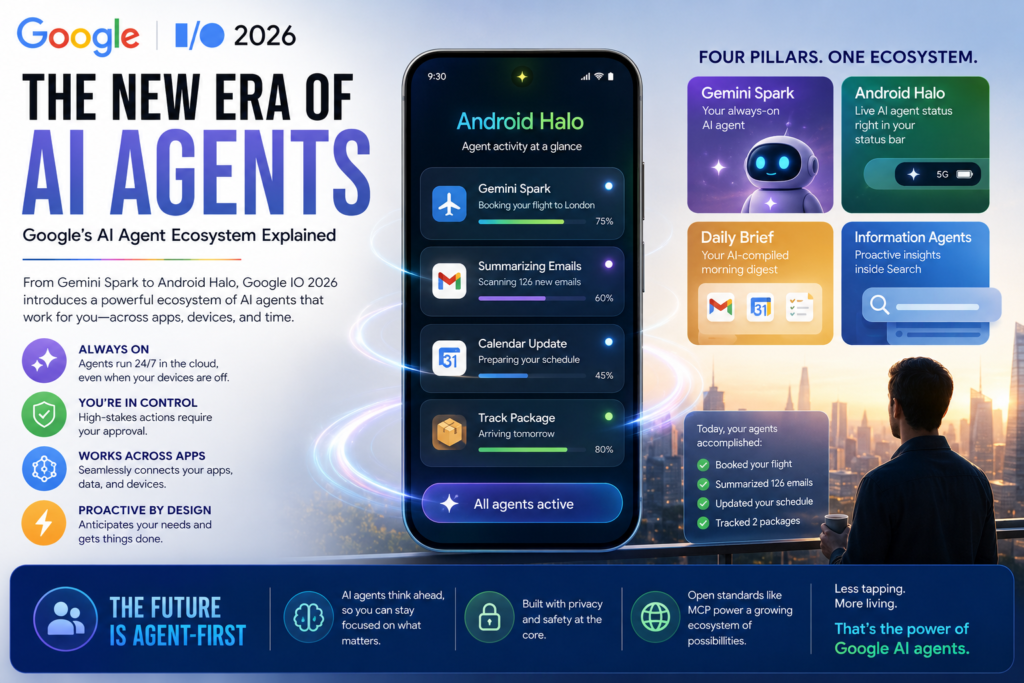
At Google IO 2026, Google formalized this vision by announcing four major agent-layer products: Gemini Spark, Android Halo, Daily Brief, and Information Agents embedded in Search. Together, they form what Google is calling its next era of computing — one where AI agents, not apps, are the primary way people interact with technology.
The ambition is real. The execution, however, raises some important questions.
The Four Pillars of Google’s AI Agent Vision
Google IO 2026 didn’t introduce a single product. It introduced an architecture — a layered set of AI agent tools that are meant to work together across the Google ecosystem. Here’s a breakdown of each.
Gemini Spark: The Always-On AI Agent
Gemini Spark is the centerpiece of the entire Google AI agent ecosystem. According to Google, Spark is a “24/7 personal AI agent” that runs on dedicated cloud virtual machines — meaning it operates even when your phone or laptop is turned off.
Spark can handle complex, multi-step tasks across applications: booking travel, processing emails, managing files, and coordinating between services. Unlike a traditional assistant that waits for a prompt, Spark is proactive. It identifies tasks that need doing and executes them, then surfaces results when you’re ready to review.
For high-stakes actions — sending money, deleting files, making purchases — Spark pauses and requests human approval before proceeding. This “human-in-the-loop” design is Google’s answer to concerns about fully autonomous agents acting without oversight.
Availability: Trusted testers this week, then Google AI Ultra subscribers ($100/month) in the U.S. “soon.”
Android Halo: The Agent Status Layer
If Spark is the engine, Android Halo is the dashboard. Android Halo is a new interface layer built directly into Android that shows users live updates and progress from Spark and other AI agents as they work.
Rather than requiring users to open an app to check on an agent’s status, Halo surfaces progress updates in the status bar — a persistent visual indicator that something is happening on your behalf. Google describes it as bringing “intelligence from your agent right to your status bar.”
The result is an Android experience increasingly optimized around agents rather than individual apps. If Google’s bet plays out, the app drawer — the grid of icons that has defined mobile computing for nearly two decades — may eventually become secondary to a continuously active AI layer.
Availability: Rolling out to Android users later in 2026.
Google IO 2026 AI announcements Gemini Spark AI agent Android Halo AI Google AI Ultra subscription
Daily Brief: Your AI-Compiled Morning Digest
Daily Brief is a Gemini app feature that reaches into your Gmail, Google Calendar, and tasks to compile a personalized morning summary. Instead of opening four apps and spending 20 minutes triaging your inbox, Daily Brief surfaces the highlights in one structured update.
It’s the most immediately relatable product in Google’s new lineup. The use case — saving time on email and calendar management — is universal and tangible. No technical literacy required.
Availability: Rolling out now in the U.S. for Google AI Ultra, Pro, and Plus subscribers.
Information Agents: AI Built Into Search
Google Search is also getting an agent upgrade. Information Agents are proactive AI programs embedded in Search that can monitor topics, track changes, and surface relevant results — without requiring the user to re-enter a query.
Rather than answering a one-time question, Information Agents can watch for developments (a price drop, a news event, a deadline) and alert users when something actionable happens. This is a significant evolution from the link-list paradigm that defined Google Search for 25 years.
Availability: Google Pro and Ultra subscribers in the U.S. starting summer 2026.
Google’s AI Agents at a Glance: A Comparison
| Product | Core Function | Always-On? | Availability | Cost Tier |
|---|---|---|---|---|
| Gemini Spark | Multi-step task execution across apps | Yes (cloud VMs) | Ultra subscribers, “soon” | $100/mo (Ultra) |
| Android Halo | Live agent status on Android | Yes (UI layer) | Android users, later 2026 | Bundled with Android |
| Daily Brief | AI digest from Gmail, Calendar, Tasks | No (scheduled) | Ultra, Pro, Plus now | $19.99+/mo |
| Information Agents | Proactive monitoring within Search | Yes | Ultra, Pro (US, Summer 2026) | $19.99+/mo |
The $100/Month Problem: Who Is This Really For?
Here’s where the Google AI agent ecosystem runs into its first major barrier: price.
Most of the headline features from Google IO 2026 are gated behind Google AI Ultra — a subscription tier that costs $100 per month. That’s $1,200 per year for access to Spark, full Information Agents, and priority access to most new features.
To put that in perspective: Netflix’s most expensive plan costs $22.99/month. A full Microsoft 365 Family subscription — which covers six users with Word, Excel, PowerPoint, and 1TB of OneDrive storage each — is $9.99/month per person.
Google’s Ultra pricing positions its AI agent ecosystem squarely in the “power user” or corporate-expense-account category, not the mainstream consumer market. That’s a strategic choice — but it also creates a significant adoption ceiling.
Daily Brief and some Information Agent features are available at the Pro ($19.99/month) and Plus tiers, offering a more accessible entry point. But Gemini Spark — the flagship feature that anchors the entire vision — remains locked to Ultra for now.(Google IO 2026 AI announcements Gemini Spark AI agent Android Halo AI Google AI Ultra subscription
)
Why Consumers May Not Buy Google’s AI Agent Vision
The Google AI agent ecosystem is technically impressive. But impressive technology and mass adoption are not the same thing. Several structural friction points stand between Google’s vision and the everyday user.
The Branding Problem
At Google IO 2026, Google introduced: Gemini, Spark, Halo, Information Agents, Daily Brief, Gemini Omni, and more. Each carries a distinct brand, despite all being part of the same ecosystem.
For a curious but non-technical user, this naming landscape is impenetrable. Is Spark part of Gemini? Is Halo an app? Do I need to download something? The confusion is real — and confusion kills adoption.
As TechCrunch noted in its IO 2026 analysis, regular users “don’t want to think about whether it’s called Gemini or Spark or Halo or information agents, or where you go to use it.” They have problems to solve, not product taxonomies to memorize.
This fragmentation likely reflects Google’s internal team structure, where separate product groups compete for visibility and naming rights — even at the cost of user coherence.
The Trust Problem
AI agents that act autonomously — reading your Gmail, monitoring your calendar, executing tasks in the background — require an enormous amount of user trust. That trust isn’t automatic, and for many people it won’t come easily.
Questions consumers are already asking include:
- What data is Spark storing about my tasks and preferences?
- Can I audit what actions an agent has taken on my behalf?
- What happens when an agent makes a mistake — like sending a draft email prematurely?
- Who is liable if an agent takes an action that causes financial harm?
Google has addressed some of these concerns by designing Spark with a human-approval gate for high-stakes actions. But the broader trust infrastructure — clear data policies, transparent audit logs, and well-publicized error-recovery mechanisms — needs to be front-and-center in consumer communications, not buried in terms of service.
The “So What?” Problem
Many features in the Google AI agent ecosystem suffer from what could be called the “so what?” problem: the demos look impressive, but the concrete, relatable use case doesn’t land.
“Your AI agent can compile a multi-step travel plan while you sleep” is a compelling headline. But for a working parent managing a household budget, the more pressing questions are: Can it help me dispute a medical bill? Can it find me a better insurance rate? Can it help my kid with college applications?
The gap between what AI agents can do in a demo and what they reliably do in real-world, high-stakes contexts is still significant. Closing that gap — not announcing new agent brand names — is what will drive mainstream adoption.
What Google Got Right
It would be unfair to catalog the friction without acknowledging the genuine strengths in Google’s IO 2026 strategy.
Scale is real. Google reports that AI Overviews now has over 2.5 billion monthly active users, the Gemini app has grown from 400 million to over 900 million monthly users in a single year, and Google processes more than 3.2 quadrillion tokens per month — up sevenfold year over year. The infrastructure and adoption are not theoretical.
The MCP integration is a smart developer bet. By adopting the Model Context Protocol (MCP), an open standard now managed under the Linux Foundation’s Agentic AI Foundation, Google has dramatically lowered the integration barrier for third-party developers. Any app that builds MCP compliance automatically becomes visible to Spark’s task-routing logic — turning developer adoption into a distribution strategy rather than a technical obligation.
Daily Brief is genuinely useful today. Among all the announcements, Daily Brief stands out as the most immediately accessible and useful feature. It solves a real, universal problem (inbox overwhelm) in a way that requires zero learning curve. That’s the template Google should follow for its broader agent rollout.
Android integration is the right long game. Embedding Halo directly into Android — rather than requiring a separate app download — is how you normalize a new behavior at scale. If agent status becomes as familiar as the battery indicator, the psychological barrier to using agents drops significantly.
What Needs to Change for Mainstream Adoption
For the Google AI agent ecosystem to reach true mainstream adoption, three things need to happen:
1. Pricing must become tiered and accessible. A $100/month ceiling locks out the majority of potential users. Google should create a meaningful free tier that lets users experience Spark in a limited but real way — enough to build trust and demonstrate value before asking for a subscription commitment.
2. Branding needs radical simplification. One name. One entry point. One place to manage all your agents. The current multi-brand architecture may work for developer documentation, but consumer products need a single door. Apple’s approach of wrapping all AI features under “Apple Intelligence” is an instructive contrast.
3. Transparency and control must be visible, not assumed. Every AI agent interaction should come with a simple, accessible log: “Here’s what Spark did today, and here’s why.” Users need to feel in control of the agents working on their behalf. Without that, trust will stagnate — and with it, adoption.
The Bigger Picture: Is the App Era Ending?
Google IO 2026 made one thing unmistakably clear: Google is betting that the app-centric era of computing is winding down, and that an AI-agent-first future is coming. From Gemini Spark to Android Halo, the entire product architecture is oriented around persistent, proactive AI agents operating continuously across devices and services.
If that vision succeeds, the grid of app icons you tap through every morning will gradually give way to a layer of agents that anticipate your needs before you articulate them.
That’s a genuinely exciting future. But futures don’t ship at Google IO — products do. And right now, the Google AI agent ecosystem is a vision with impressive infrastructure, real adoption momentum, and serious friction points standing between it and the everyday user.
The technology is ready. The question is whether Google can meet regular people where they are — with pricing they can afford, branding they can follow, and trust they can build over time.
That’s the bet Google is making. Whether consumers buy it remains to be seen.
Frequently Asked Questions
What is Google’s AI agent ecosystem? It is Google’s network of interconnected AI programs — including Gemini Spark, Android Halo, Daily Brief, and Information Agents — that can execute tasks autonomously across apps and devices on a user’s behalf.
What is Gemini Spark? Gemini Spark is Google’s always-on AI agent, announced at Google IO 2026. It runs on cloud virtual machines 24/7, handles multi-step tasks across applications, and pauses for user approval before taking high-stakes actions.
How much does Google AI Ultra cost? Google AI Ultra costs $100 per month. Most new AI agent features — including Gemini Spark and full Information Agents access — are initially available only to Ultra subscribers.
What is Android Halo? Android Halo is a new Android interface layer that surfaces live status updates from AI agents like Gemini Spark directly in the status bar, so users can track what their agents are doing without opening a separate app.
Will Google’s AI agents be available for free? As of May 2026, Google has not announced a free tier for most AI agent features. Daily Brief is available to Plus subscribers ($9.99/month and above), while Spark and Information Agents require Pro or Ultra subscriptions.
The Bottom Line
The Google AI agent ecosystem unveiled at Google I/O 2026 represents one of the biggest shifts in consumer technology since the smartphone era began. Instead of relying on dozens of separate apps, Google is betting on a future where intelligent AI agents work continuously in the background, handling tasks before users even ask. From Gemini Spark managing workflows 24/7 to Android Halo surfacing live agent updates and proactive Search agents tracking information automatically, the Google AI agent ecosystem is designed to redefine how people interact with technology in everyday life.
What makes the Google AI agent ecosystem so important is that Google is no longer treating AI as a chatbot feature. Instead, it is transforming AI into an operating layer that sits across Android, Search, Gmail, Calendar, and cloud services. This is a major evolution from reactive assistants toward proactive digital systems that anticipate needs, coordinate tasks, and reduce manual interaction with apps. If successful, the Google AI agent ecosystem could fundamentally change mobile computing over the next decade.
At the same time, the biggest challenge for the Google AI agent ecosystem is accessibility. Many of the most advanced features announced at Google IO 2026 are locked behind expensive subscription plans. The $100-per-month Google AI Ultra tier creates a serious barrier for mainstream users who may find the technology impressive but difficult to justify financially. While power users, developers, and enterprise customers may adopt the Google AI agent ecosystem quickly, average consumers will likely wait for lower pricing and more practical everyday use cases before fully embracing it.
Another major factor affecting adoption is trust. The Google AI agent ecosystem relies heavily on autonomous decision-making, which means users must feel comfortable allowing AI agents to access emails, calendars, files, tasks, and browsing activity. Google has attempted to address this with approval gates for high-risk actions, but long-term success depends on transparency. Consumers will want clear logs showing what an AI agent did, why it acted, and how to reverse mistakes if something goes wrong. Without visible safeguards, even the most advanced Google AI agent ecosystem could struggle to gain widespread trust.
Still, Google clearly understands the scale of opportunity ahead. The integration of AI agents directly into Android gives Google a distribution advantage no competitor can easily match. Unlike standalone AI startups, Google can embed the Google AI agent ecosystem into billions of existing devices and services almost instantly. Features like Daily Brief already demonstrate how practical AI agents can simplify routine digital overload by organizing emails, meetings, reminders, and updates into a single personalized experience.
The broader significance of the Google AI agent ecosystem is that it signals the beginning of an AI-agent-first internet. Instead of manually searching, clicking, comparing, and organizing information, users may increasingly rely on AI systems to do those tasks automatically. That transition could eventually make traditional app-centric computing feel outdated.
In the end, the Google AI agent ecosystem is both exciting and unfinished. The technology is powerful, the infrastructure is real, and Google’s long-term strategy is clear. However, mainstream adoption will depend on whether Google can simplify branding, lower pricing, improve transparency, and prove that AI agents genuinely solve everyday problems better than existing apps. If Google succeeds, the Google AI agent ecosystem may become the foundation of the next generation of computing. If not, it risks remaining a premium experiment admired mostly by tech enthusiasts rather than embraced by the average user.