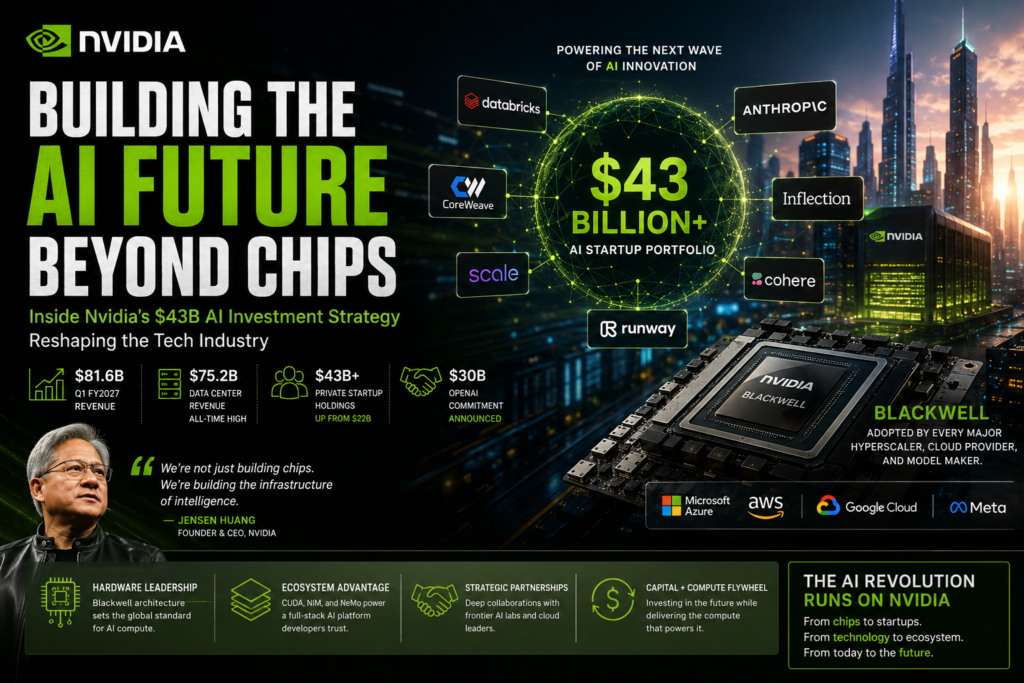
Nvidia just posted $81.6 billion in quarterly revenue — and that’s almost the less interesting headline. The company’s Nvidia AI investment strategy has quietly ballooned into a $43 billion bet on the private startup ecosystem, revealing a deliberate pivot from chip manufacturer to AI industry architect.
If you want to understand where AI infrastructure money is going — and who controls it — Nvidia’s Q1 FY2027 results are required reading.(Nvidia startup portfolio Nvidia Blackwell architecture AI infrastructure investments Nvidia Q1 FY2027 earnings
)
What the Numbers Actually Mean
Nvidia’s earnings report for the quarter ending April 26, 2026, delivered another round of records. But the raw figures only tell part of the story.
Data Center Revenue Breaks Records Again
Total revenue: $81.6 billion (up 20% quarter-over-quarter) Data center revenue: $75.2 billion — a new all-time record Share repurchase authorization: $80 billion
These figures establish Nvidia not as a company riding the AI wave but as the wave itself. Data center revenue now accounts for over 92% of total revenue, a concentration that speaks to the singular demand for Nvidia’s GPUs among hyperscalers, cloud providers, and AI model builders.
CFO Colette Kress framed it simply: the Blackwell architecture has been “adopted and deployed by every major hyperscaler, every cloud provider, and every major model maker.” That kind of universal adoption is rare in any industry, let alone one as competitive as enterprise semiconductors.
The Growth Slowdown Signal Worth Watching
Nvidia’s forward guidance projected $91 billion in revenue for Q2 FY2027 — a 12% sequential increase. For almost any other company, 12% quarterly growth would be cause for celebration. For Nvidia, it represents a deliberate cooling from the 20%-plus growth rates investors have grown accustomed to.
This is not a warning sign of weakness. It is a signal of maturation. When a company generating nearly $82 billion per quarter begins normalizing its growth curve, it is transitioning from hypergrowth into a durable, compounding business — which is arguably more valuable to long-term investors.
The $43 Billion Startup Bombshell
The figure that stopped analysts in their tracks was not the revenue record. It was the disclosure of Nvidia’s privately held equity stakes — listed in the SEC filing as “non-marketable equity securities.”
Why the Jump from $22B to $43B Matters
At the start of Q1, Nvidia held approximately $22 billion in privately held company stakes. By the end of the quarter, that figure had nearly doubled to $43 billion — driven by $18.5 billion in new purchases over just three months.
For context, the previous quarter had seen only $649 million in equivalent purchases. The scale of acceleration is staggering: Nvidia deployed roughly 28 times more capital into private companies in Q1 than it did in Q4.
This is the operational core of Nvidia’s AI investment strategy — a concentrated, rapid accumulation of stakes in the companies most likely to define the next decade of AI development.
What’s Included — and What Isn’t
Here is where the headline number gets even more remarkable: the $43 billion figure does not include:
- Nvidia’s investments in publicly traded companies like Corning and IREN
- Future commitments that have not yet formally closed, such as the $30 billion OpenAI investment announced in February 2026 (the precise structure of which remains undisclosed)
Add those pipeline commitments and public-market positions, and the total scope of Nvidia’s AI investment strategy extends well beyond what the earnings filing formally captures.
Nvidia’s Blackwell Architecture Is Everywhere
What is Blackwell? Nvidia’s Blackwell architecture is the company’s current-generation GPU platform, designed specifically for large-scale AI training and inference workloads. It succeeded the Hopper architecture and is the foundation of products like the H200 and B200 GPUs.
Why does it matter? According to Kress’s remarks, Blackwell has achieved something that no GPU architecture before it has: simultaneous adoption across every tier of AI infrastructure. Hyperscalers (Google, Microsoft, Amazon, Meta), cloud providers, and frontier AI labs are all running Blackwell-based hardware.
This near-total market capture has two effects. First, it entrenches Nvidia’s hardware as the de facto standard for AI computation. Second, it creates a natural distribution channel for Nvidia’s expanding software and investment ecosystem — making Nvidia AI investment strategy a logical extension of its hardware dominance, not a departure from it.(Nvidia startup portfolio Nvidia Blackwell architecture AI infrastructure investments Nvidia Q1 FY2027 earnings
)
China: A Revenue Void, Not a Crisis
One of the most closely watched dimensions of Nvidia’s quarter was its exposure to China. The answer came in stark terms from CFO Kress: “We have yet to generate any revenue, and we are uncertain whether any imports will be allowed.”
While the H200 GPU has received U.S. export approval, actual revenue recognition from China sales has not materialized. This creates a dual reality for Nvidia:
- China represents a significant potential market that remains inaccessible for now
- The absence of Chinese revenue has had no material impact on earnings, given the extraordinary demand from U.S. and international hyperscalers
The China situation is best understood as an upside optionality — not a drag on current performance. If export restrictions ease, Nvidia has a large, ready market. If they don’t, the company has demonstrated it can sustain record quarters without it.
Jensen Huang’s Vision — From Chip Maker to AI Ecosystem Kingmaker
CEO Jensen Huang’s remarks on the investor call went beyond quarterly metrics. His comments reveal the philosophical ambition behind Nvidia’s AI investment strategy: the company intends to be not just a supplier to AI but a co-builder of the AI economy.
The Anthropic Partnership
Among the most striking disclosures was Huang’s comment about Anthropic — the AI safety company and maker of the Claude AI assistant:
“The amount of capacity we’re going to bring online for Anthropic this year and next year is going to be quite significant. Our coverage for Anthropic had been largely zero until this.”
The phrasing — “coverage” — is deliberate and revealing. Nvidia is not describing itself as a vendor. It is using the language of a strategic partner that has identified a gap and is now moving to fill it at scale. For a frontier AI lab like Anthropic, reliable access to Nvidia GPU clusters is existential infrastructure.
This dynamic — Nvidia investing in AI companies while simultaneously supplying their compute — represents a flywheel that is unique to Nvidia’s position in the market.
Nvidia vs. Traditional Chip Companies: A Strategic Comparison
How does Nvidia’s current posture compare to historically dominant semiconductor companies?
| Dimension | Traditional Chip Companies | Nvidia (2026) |
|---|---|---|
| Primary revenue | Hardware sales | Hardware + ecosystem services |
| Customer relationship | Transactional (supply/buy) | Strategic (co-invest + supply) |
| Startup engagement | Minimal or none | $43B+ in private equity holdings |
| Market position | Category-dependent | Cross-category AI infrastructure standard |
| Software layer | Optional | Core (CUDA, NIM, NeMo) |
| Growth driver | Product cycles | AI infrastructure buildout (multi-year) |
The table illustrates why Nvidia’s AI investment strategy is more than a financial maneuver. It represents a fundamental repositioning of what a chip company is allowed to be.
What This Means for Investors, Startups, and the AI Industry
For Investors
Nvidia’s Nvidia AI investment strategy introduces a new layer of complexity — and potential value — for shareholders. The company is now functioning simultaneously as:
- A hardware manufacturer with near-monopoly margins in AI GPUs
- A venture investor with $43B+ in private AI company stakes
- A strategic infrastructure partner for frontier AI labs
- An ecosystem builder through CUDA, software platforms, and developer tools
The $80 billion share repurchase authorization signals that management believes the stock is undervalued even at its current price — an unusually confident posture for a company already trading at historic highs.
For Startups and AI Labs
The implications of Nvidia’s AI investment strategy for the startup ecosystem are profound. When Nvidia invests in a company, it is not a passive check-writer. It is a strategic move that likely comes with preferential compute access, closer engineering collaboration, and visibility at the highest levels of AI infrastructure planning.
For AI startups, a Nvidia equity relationship is effectively:
- A compute supply guarantee in a market where GPU access is competitively constrained
- A signal to other investors that the company has cleared a credibility threshold
- An alignment of incentives that could accelerate product development timelines
For the AI Industry
Nvidia is increasingly functioning as an invisible axis of the AI economy — the entity through which capital, compute, and company relationships all flow. Its AI investment strategy consolidates influence in ways that have no clear historical parallel in the semiconductor industry.
The question for competitors — AMD, Intel, and a wave of AI chip startups — is not simply whether they can build a better chip. It is whether they can replicate an ecosystem in which the hardware company is also the bank, the partner, and the infrastructure of record for every serious AI developer on earth.
Frequently Asked Questions (FAQ)
What is Nvidia’s AI investment strategy?
Nvidia’s AI investment strategy is the company’s long-term plan to dominate the artificial intelligence ecosystem beyond just selling GPUs. Instead of acting only as a semiconductor company, Nvidia is investing billions into AI startups, infrastructure providers, cloud platforms, and frontier AI labs. The strategy combines hardware leadership, software ecosystems like CUDA and NeMo, and direct equity investments into fast-growing AI companies.
The most important aspect of Nvidia AI investment strategy is that it creates a powerful flywheel. Nvidia funds AI companies, supplies them with GPUs, supports them with software infrastructure, and then benefits as those companies scale their AI workloads. This approach strengthens Nvidia’s position across the entire AI economy.
Why did Nvidia increase its startup investments to $43 billion?
Nvidia increased its private startup holdings from $22 billion to $43 billion because the company sees AI infrastructure as the defining technology market of the next decade. The surge in investments allows Nvidia to secure strategic relationships with the most promising AI startups before competitors can.
This expansion of Nvidia AI investment strategy also helps Nvidia lock in long-term GPU demand. Companies building large AI models require massive compute resources, and Nvidia ensures these firms stay within its ecosystem by becoming both a supplier and strategic investor.
The move signals that Nvidia wants influence not only over hardware markets but also over the future direction of AI innovation itself. (Nvidia startup portfolio Nvidia Blackwell architecture AI infrastructure investments Nvidia Q1 FY2027 earnings
)
How does Blackwell support Nvidia’s AI investment strategy?
Blackwell is Nvidia’s next-generation GPU architecture designed for AI training and inference at hyperscale. According to Nvidia executives, Blackwell has already achieved adoption across nearly every major hyperscaler, cloud provider, and AI model developer.
This widespread adoption strengthens Nvidia AI investment strategy because it establishes Blackwell as the default infrastructure layer for artificial intelligence. When startups or enterprise AI companies adopt Blackwell systems, they naturally become connected to Nvidia’s broader software and compute ecosystem.
That ecosystem advantage makes it easier for Nvidia to expand strategic investments, partnerships, and long-term infrastructure agreements. (Nvidia startup portfolio Nvidia Blackwell architecture AI infrastructure investments Nvidia Q1 FY2027 earnings
)
Why is Nvidia investing in companies like Anthropic and OpenAI?
Nvidia’s investments in frontier AI labs such as Anthropic and its reported OpenAI commitment are strategic rather than purely financial. These companies consume enormous amounts of compute power, making them ideal long-term infrastructure partners.
By supporting these firms, Nvidia AI investment strategy creates mutually beneficial relationships:
- AI labs gain reliable access to advanced GPU infrastructure
- Nvidia secures sustained demand for Blackwell hardware
- Both parties benefit from faster AI ecosystem expansion
This strategy also gives Nvidia early visibility into future AI computing requirements, allowing the company to optimize future GPU architectures around real-world frontier AI workloads.
Is Nvidia becoming more than a chip company?
Yes. Nvidia AI investment strategy clearly shows the company evolving beyond traditional semiconductor manufacturing. Nvidia now operates simultaneously as:
- An AI infrastructure provider
- A software ecosystem company
- A venture investor
- A strategic AI partner
- A cloud-scale compute supplier
Traditional chip companies mostly focused on selling hardware products. Nvidia is creating a vertically integrated AI ecosystem that combines capital, compute, software, and partnerships into a single platform.
That transformation is one reason many analysts view Nvidia as the most influential company in the AI industry today.
How does Nvidia’s AI investment strategy affect startups?
For startups, receiving Nvidia investment can be transformational. Nvidia AI investment strategy often gives startups access to resources that are difficult to secure elsewhere, especially during periods of GPU shortages.
Benefits may include:
- Priority access to Nvidia AI hardware
- Engineering collaboration opportunities
- Enhanced credibility with investors
- Faster infrastructure scaling
- Deeper ecosystem integration
Because AI development is highly compute-intensive, Nvidia’s support can dramatically reduce infrastructure bottlenecks for emerging companies.
What role does CUDA play in Nvidia’s ecosystem dominance?
CUDA is Nvidia’s software platform for GPU computing and one of the biggest competitive advantages supporting Nvidia AI investment strategy. Developers build AI applications directly around CUDA, making it difficult to migrate workloads to competing hardware platforms.
This creates ecosystem lock-in. Even if rival chipmakers release competitive hardware, many AI companies remain dependent on Nvidia software tools, libraries, and optimized AI frameworks.
CUDA effectively strengthens Nvidia’s market moat while reinforcing the value of Nvidia’s startup investment network.
Is Nvidia’s slowing growth a warning sign?
Not necessarily. Nvidia projected approximately 12% sequential growth for Q2 FY2027 after previously delivering growth above 20% per quarter. While some investors may interpret this as slowing momentum, it is more accurately viewed as business normalization at an enormous scale.
When a company generates over $80 billion in quarterly revenue, sustaining hypergrowth indefinitely becomes unrealistic. Nvidia AI investment strategy suggests management is focused on long-term ecosystem control rather than maximizing short-term quarterly acceleration.
This maturity phase could make Nvidia more stable and durable over the next decade.
How important is China to Nvidia’s future?
China remains an important potential growth market for Nvidia, but current export restrictions have limited revenue opportunities. Nvidia executives stated that approved hardware has not yet generated meaningful Chinese revenue.
Despite that limitation, Nvidia AI investment strategy continues expanding aggressively because global AI demand outside China remains exceptionally strong. Major cloud providers, enterprise AI firms, and frontier labs continue purchasing massive quantities of Nvidia hardware.
If restrictions eventually ease, China could become an additional upside growth catalyst rather than a requirement for Nvidia’s current success.
The Bottom Line
Nvidia AI investment strategy is no longer simply about building faster GPUs. The company is constructing the foundational infrastructure layer for the global artificial intelligence economy, and its Q1 FY2027 results reveal how rapidly that transformation is accelerating.
For years, Nvidia was primarily viewed as a semiconductor company benefiting from gaming demand and data center expansion. Today, that narrative is outdated. Nvidia has evolved into something far more powerful: a vertically integrated AI ecosystem builder that controls compute, software, strategic partnerships, and increasingly, capital flows within the AI industry itself.
The numbers alone demonstrate the scale of this shift. Nvidia generated $81.6 billion in quarterly revenue, with $75.2 billion coming from the data center segment. That concentration shows just how dominant AI infrastructure demand has become. But the more important revelation was the explosive expansion of Nvidia AI investment strategy through its private startup portfolio.
The jump from $22 billion to $43 billion in privately held equity stakes within a single quarter is extraordinary. Few companies in history have deployed capital at this pace while simultaneously maintaining dominant operating margins and massive revenue growth. Nvidia is effectively using its enormous cash generation to buy influence across the next generation of AI companies.
This matters because artificial intelligence is becoming increasingly infrastructure-dependent. AI labs, cloud providers, autonomous systems companies, robotics startups, healthcare AI firms, and enterprise software businesses all require massive compute resources. Nvidia sits directly at the center of that dependency chain.
Unlike traditional venture investors, Nvidia brings more than money to the table. Nvidia AI investment strategy offers startups access to the most critical resource in modern AI development: compute capacity. In a market where advanced GPUs remain supply constrained, Nvidia’s support can determine whether an AI company scales quickly or falls behind competitors.
That creates a unique power dynamic. Nvidia is simultaneously the hardware supplier, strategic investor, ecosystem provider, and infrastructure partner for many of the companies shaping the future of AI. No traditional semiconductor company has ever operated with this level of cross-industry influence.
Blackwell further strengthens that position. Universal adoption of Blackwell architecture across hyperscalers and frontier AI labs effectively standardizes Nvidia hardware as the operating layer of artificial intelligence. When nearly every major AI company builds around the same infrastructure stack, switching costs become extremely high.
This is where Nvidia AI investment strategy becomes especially important. Hardware leadership alone can be challenged over time. Competitors like AMD, Intel, and specialized AI chip startups are all working to capture portions of the AI accelerator market. But replicating Nvidia’s ecosystem advantage is significantly harder.
Competitors would need:
- Comparable AI hardware performance
- Equivalent software ecosystems
- Developer trust
- Startup investment networks
- Strategic AI partnerships
- Global cloud-scale relationships
Very few companies possess all of those capabilities simultaneously.
Another critical aspect of Nvidia AI investment strategy is the company’s role in shaping AI industry economics. By investing directly into AI startups, Nvidia gains early insight into future compute demands, emerging AI architectures, and infrastructure bottlenecks. This intelligence loop allows Nvidia to optimize future products around real-world customer needs faster than competitors.
The Anthropic partnership illustrates this perfectly. Nvidia is not simply selling GPUs to Anthropic. It is helping enable the company’s infrastructure expansion at scale. That relationship creates recurring demand, ecosystem alignment, and long-term strategic dependency.
The same logic likely applies to Nvidia’s broader AI investment portfolio. Each investment strengthens Nvidia’s position within the larger AI economy while increasing long-term reliance on Nvidia infrastructure.
Investors should also pay close attention to the company’s $80 billion share repurchase authorization. Nvidia AI investment strategy is expanding aggressively, yet management still believes the stock remains attractive enough to justify massive buybacks. That level of confidence from leadership is notable given Nvidia’s already historic valuation.
Importantly, Nvidia’s current trajectory suggests the company may become less cyclical than traditional semiconductor firms. Historically, chip companies experienced sharp boom-and-bust demand cycles tied to consumer electronics or enterprise upgrades. Nvidia’s AI ecosystem strategy creates recurring infrastructure demand that could persist for years.
Artificial intelligence training, inference, robotics, autonomous systems, digital twins, AI agents, and enterprise automation all require increasing compute intensity. Nvidia is positioning itself as the default infrastructure provider across every layer of that expansion.
Even China, currently viewed as a risk factor, represents future optionality rather than a present weakness. Nvidia has demonstrated it can produce record-breaking financial performance without significant Chinese revenue contribution. If restrictions eventually loosen, China could simply add another growth engine to an already dominant business.
Ultimately, Nvidia AI investment strategy reveals a company pursuing something much larger than semiconductor leadership. Nvidia is attempting to become the foundational operating system of artificial intelligence itself.
The company now controls:
- The leading AI hardware platform
- The dominant AI software ecosystem
- Strategic relationships with frontier AI labs
- Billions in startup equity stakes
- Critical AI compute infrastructure
That combination gives Nvidia an unprecedented level of influence over the future direction of artificial intelligence.
The real story is not just that Nvidia made $81.6 billion in quarterly revenue. The real story is that Nvidia is quietly building the economic infrastructure layer beneath the entire AI industry — and the $43 billion startup portfolio may only be the beginning of that transformation.