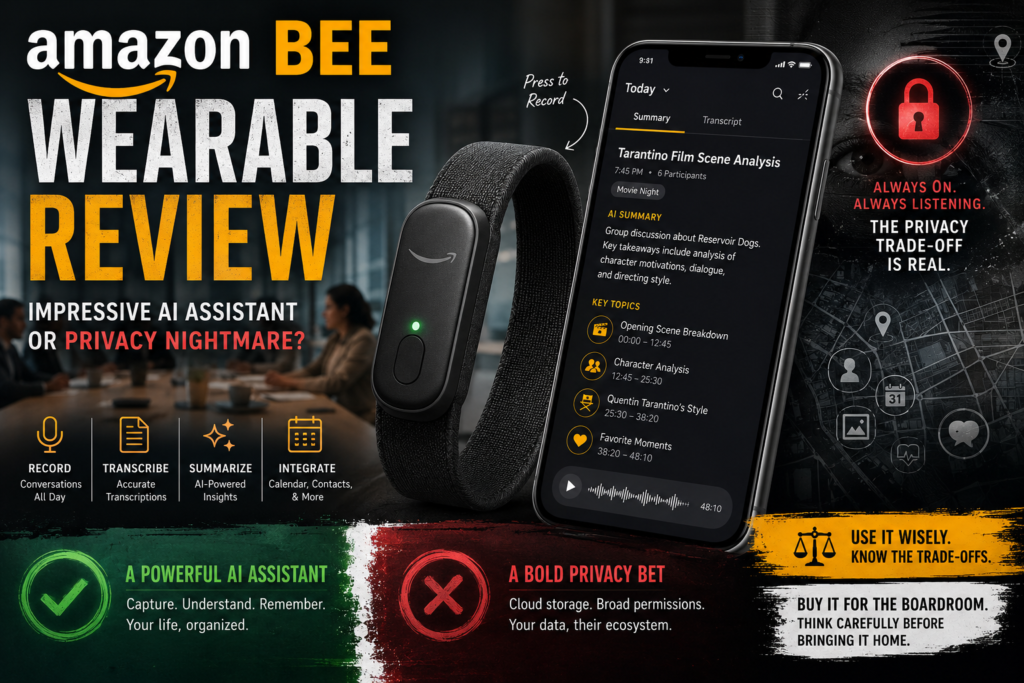
The Amazon Bee wearable is a voice-recording AI wristband that automatically transcribes and summarizes your conversations throughout the day — and it genuinely works. But whether it should be recording your life is a question worth sitting with before you strap one on. Amazon Bee wearable review
Acquired by Amazon in 2025 and updated with a wave of new features since, the Amazon Bee wearable sits at the intersection of two of tech’s hottest trends: ambient AI and always-on wearables. It promises to become your personal memory system. What it delivers is more nuanced: a legitimately useful tool for professionals, wrapped in a privacy trade-off that not everyone will be comfortable making.
What Is the Amazon Bee Wearable?
Definition: The Amazon Bee wearable is a compact wrist-worn device that continuously records ambient audio, then uses on-device and cloud-based AI to transcribe, summarize, and organize those conversations into a searchable personal log. It pairs with a smartphone app and integrates with calendars, contacts, photos, and notifications.
It is not a smartwatch, fitness tracker, or health monitor — though it can optionally ingest health data. Its singular purpose is memory augmentation: turning the blur of daily conversations into structured, reviewable records.
Amazon acquired the original Bee startup in July 2025 and has since overhauled the device with additional integrations and improved summarization capabilities. As of May 2026, it remains one of the most capable — and most privacy-invasive — AI wearables on the consumer market.
How Bee Works
The setup process is straightforward. You power the device, sync it with the Bee companion app on your phone, and enter some basic personal information. From there, operation is simple:
- Press the button to toggle recording on or off.
- A green LED indicator flashes when recording is active, giving a (minimal) visual cue to people nearby.
- The app processes audio and generates a structured summary, broken into conversation segments, alongside a full transcript.
- Calendar integration enables proactive reminders and agenda alerts throughout your day.
After each recorded session ends, the Bee app surfaces a readable summary — typically organized by topic or speaker turn — that you can review in seconds rather than scrubbing through a full audio file.
Key Features at a Glance
- Continuous or on-demand audio recording with LED status indicator
- AI-generated conversation summaries and full transcriptions
- Calendar sync with smart reminders
- Access to contacts, photos, location, and mobile notifications
- Optional health data integration (sleep, heart rate)
- Cloud storage of all recordings and summaries
- Encryption at rest and in transit
- Third-party security audits (per company claims)
What the Amazon Bee Wearable Does Well
Professional Use Cases
The Amazon Bee wearable genuinely earns its keep in professional settings. If your workday is dense with meetings, calls, and verbal decisions that need to be recalled later, Bee functions as a quiet, competent assistant.
During a business phone call, testing showed that Bee produced a clean, segmented summary of the conversation afterward — organized by topic, easy to skim, and accurate enough to be useful without re-listening to the recording. For someone who moves between back-to-back meetings, the appeal is real: keep Bee running all day, then spend ten minutes in the evening reviewing what was said, what was decided, and what’s pending.
This is the core promise of the device, and in a controlled professional context, it mostly delivers.
Conversation Summaries and Transcription Quality
The summary engine is where the Amazon Bee wearable shines brightest. Rather than dumping a wall of transcript text, Bee breaks conversations into labeled segments with clear takeaways. In one informal test — a movie night watching Reservoir Dogs — Bee correctly identified that the group was watching a film rather than witnessing an actual event, and labeled its summary “Tarantino Film Scene Analysis.” That’s a small but telling sign of contextual intelligence.
Summaries are concise, well-structured, and generally accurate in capturing the substance of a conversation even when the verbatim transcript has gaps.
Where the Amazon Bee Wearable Falls Short
Transcript Accuracy Issues
The full transcripts produced by the Amazon Bee wearable are notably messier than the summaries. Three recurring problems stand out:
- Speaker identification requires manual input. Bee does not automatically distinguish between voices, meaning you often have to retroactively label who said what.
- Sections get dropped. Testing revealed omitted portions of conversations — not large gaps, but meaningful ones for anyone relying on a complete record.
- No multi-speaker intelligence. In group settings or multi-party calls, the transcript can devolve into undifferentiated blocks of text.
These are not dealbreakers for occasional professional use, but they significantly limit Bee’s reliability as a comprehensive documentation tool compared to dedicated transcription services.
Privacy Permissions and Data Collection
This is where the Amazon Bee wearable becomes genuinely uncomfortable for privacy-conscious users. To function at its advertised capability level, Bee requests access to:
- Your location
- Your photo library
- Your phone contacts
- Your calendar
- Your mobile notifications
- Optionally, your health data (sleep patterns, heart rate, etc.)
All recorded audio and derived data is stored in the cloud. Bee uses encryption in transit and at rest, claims to undergo rigorous third-party security audits, and employs continuous security monitoring — but these are baseline practices for any responsible data handler, not a unique standard of care.
What’s notable is that Amazon — a company that operates a substantial portion of the global cloud infrastructure — has a history of data security incidents. Entrusting an always-on audio recorder to an ecosystem with that footprint is a decision worth making deliberately, not casually.
A local-processing mode was reportedly demoed for a tech YouTuber, which would keep all data on-device and address the most serious privacy objection. As of this writing, Amazon has not announced a timeline for making local processing commercially available.
Amazon Bee vs. Other AI Wearables: How Does It Compare?
The Amazon Bee wearable does not exist in a vacuum. The AI wearable category is filling up fast, with competitors ranging from standalone transcription apps to dedicated hardware.
| Feature | Amazon Bee Wearable | Otter.ai (App) | Granola (App) | Meta Ray-Ban Glasses |
|---|---|---|---|---|
| Form Factor | Wrist wearable | Smartphone app | Desktop/mobile app | Eyewear |
| Always-on recording | Yes | Manual activation | Manual activation | Yes (with tap) |
| Auto-summaries | Yes | Yes | Yes | No (audio only) |
| Speaker ID | Manual labeling | Automatic (premium) | Limited | N/A |
| Calendar integration | Yes | Yes | Yes | No |
| Health data access | Optional | No | No | No |
| Local processing option | Demo only | No | No | No |
| Cloud storage | Required | Required | Required | Required |
| Primary use case | All-day life logging | Meeting transcription | Meeting notes | Social/navigation |
| Privacy posture | High data appetite | Moderate | Moderate | High data appetite |
Key takeaway: The Amazon Bee wearable is uniquely positioned for continuous, ambient life logging. Its closest competitors are transcription apps like Otter.ai and Granola, which require deliberate activation but offer better speaker identification. Hardware alternatives like Meta’s Ray-Ban smart glasses match Bee’s always-on posture but serve a different primary function.
Privacy Concerns: The Elephant in the Room
Ambience is Bee’s superpower and its liability. The Amazon Bee wearable is not designed to be turned on for specific meetings — it is designed to run continuously, capturing the texture of your entire day. That framing immediately surfaces a question: who is consenting to being recorded?
When you activate Bee in a business meeting and announce that you’re recording, the social contract is clear. When you wear it at a dinner party, a doctor’s appointment, or a school pickup, it is not. The green LED is small, easy to miss, and not self-explanatory to anyone who hasn’t heard of the device.
Bee has notably been marketed as a personal-use product — precisely the context where continuous recording is most fraught. Personal conversations carry intimacy, vulnerability, and an implicit expectation of privacy that professional settings do not. Using an always-on recorder in these contexts without explicit disclosure to everyone present occupies legally and ethically ambiguous territory in many jurisdictions.
This is not a hypothetical concern. The data Bee collects — audio, transcripts, summaries, location, calendar events, contacts — represents an extraordinarily comprehensive portrait of a person’s life. Cloud storage of that data means it is theoretically accessible to Amazon, subject to law enforcement requests, and vulnerable to the security incidents that affect every cloud platform at scale.
Who Should (and Shouldn’t) Buy the Amazon Bee Wearable?
Bee is a strong fit for:
- Professionals with meeting-heavy schedules who need reliable conversation recall without manual note-taking
- Executives and consultants who want structured summaries of client calls and internal discussions
- People with memory challenges who benefit from an external record of daily interactions
- Early adopters comfortable trading privacy for convenience and willing to set clear social norms around use
Bee is a poor fit for:
- Privacy-conscious users who are uncomfortable with cloud storage of audio and personal metadata
- People in jurisdictions with strict two-party consent recording laws (check your local regulations before purchasing)
- Anyone expecting medical-grade transcription accuracy — Bee is useful but not reliable enough for legal or clinical documentation
- Users seeking a personal-life companion device — the intimacy of personal use and the invasiveness of always-on recording are a difficult combination
Final Verdict: A Promising Tool That’s Asking Too Much, Too Soon
The Amazon Bee wearable is one of the most technically interesting AI wearables available in 2026. Its conversation summarization is genuinely good, its professional utility is real, and the ambient recording concept — in the right controlled context — solves a legitimate problem that sticky notes and calendar apps cannot.
But the Amazon Bee wearable as currently configured asks users to make a significant privacy concession without offering a compelling reason why that concession needs to be so large. The absence of local processing, the breadth of permissions required, the cloud dependency, and the awkward social dynamics of wearing a recording device in personal settings are not minor footnotes — they are central features of what this product is.
If Amazon releases a version of the Bee wearable with on-device processing and granular consent controls, the calculus changes substantially. Until then, the device is best understood as a genuinely useful professional tool that happens to have been packaged as a personal one.
Bottom line: Buy it for the boardroom. Think carefully before bringing it home.
Frequently Asked Questions
What is the Amazon Bee wearable? The Amazon Bee wearable is an AI-powered wrist device that records, transcribes, and summarizes conversations throughout the day. Originally a startup product, it was acquired by Amazon in 2025 and updated with new AI features and integrations.
Does the Amazon Bee wearable work without an internet connection? Currently, the Amazon Bee wearable requires cloud connectivity for its core functions. A local-processing mode was demoed but has not been released commercially as of May 2026.
Is it legal to use the Amazon Bee wearable in public? Legality depends on your jurisdiction. In one-party consent states and countries, recording your own conversations is generally legal. In two-party or all-party consent jurisdictions, recording others without their knowledge may violate the law. Always check local regulations before using an always-on recording device.
How does Amazon Bee compare to Otter.ai? Both tools offer AI-powered transcription and summaries. Otter.ai requires deliberate activation per meeting and offers better automatic speaker identification. The Amazon Bee wearable is designed for continuous, ambient recording throughout the day and integrates more deeply with personal data sources.
What data does the Amazon Bee wearable collect? The Amazon Bee wearable collects audio recordings, transcripts, location data, calendar information, contacts, and mobile notifications. Health data integration is optional. All data is stored in the cloud with encryption.