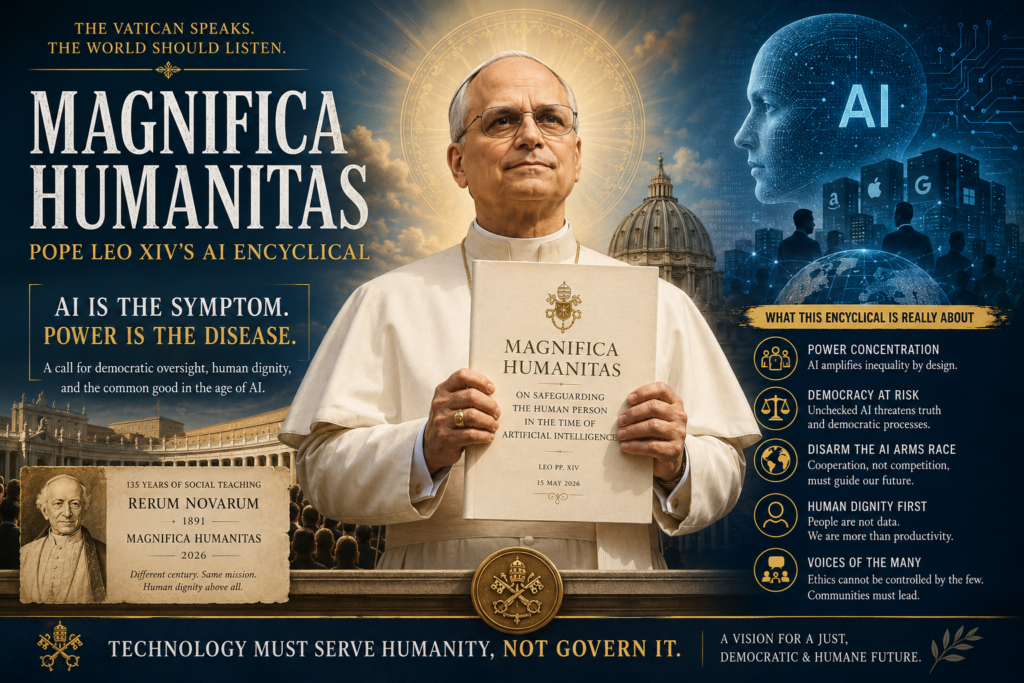
Pope Leo XIV’s first encyclical, Magnifica Humanitas, dropped on May 25, 2026 — and despite its billing as a document about artificial intelligence, it is fundamentally a manifesto about power. If you want to understand why the Vatican just published a 200-page treatise on AI, the short answer is this: AI is the symptom; concentrated power, eroding democracy, and unchecked technological elites are the disease.
This post breaks down everything you need to know about Magnifica Humanitas — what it says, why it matters far beyond Catholic circles, and what it means for the global debate on AI governance.
What Is Magnifica Humanitas? A Definition
Magnifica Humanitas (Latin for “Magnificent Humanity”) is the first encyclical letter of Pope Leo XIV, signed on May 15, 2026 — the 135th anniversary of Rerum Novarum, the foundational Catholic social teaching document — and formally released on May 25, 2026.
An encyclical is one of the highest forms of papal teaching: a formal letter addressed to the entire Catholic Church, and by tradition, to all people of good will. Magnifica Humanitas carries the full subtitle “On Safeguarding the Human Person in the Time of Artificial Intelligence.”
The document runs to approximately 42,300 words and 245 paragraphs across five chapters. Its architecture moves from theological foundation to concrete policy demands:
- Chapters 1–2: The history and principles of Catholic Social Doctrine, from Leo XIII to the present
- Chapter 3: The “technocratic paradigm” of AI and the imbalance of digital power
- Chapter 4: Protecting truth, democracy, work, and education in the AI age
- Chapter 5: A theological vision of authentic human development and peace
The encyclical was presented to the world alongside Chris Olah, co-founder of the AI safety company Anthropic — an unusual and pointed choice that signalled the Vatican’s intent to engage the industry directly, not merely critique it from the outside.
Why “AI Encyclical” Is a Misleading Label
The Real Thesis: An Old Crisis in New Clothes
Headlines have called Magnifica Humanitas the Pope’s “AI encyclical.” That framing, while accurate on the surface, undersells the document’s ambition. Pope Leo XIV uses artificial intelligence as a contemporary lens to diagnose a far older and more stubborn set of problems: inequality, the erosion of democratic norms, and the concentration of wealth and influence in the hands of people who face no accountability for how that power shapes the world.
This is not a document about large language models or transformer architectures. It is a document about who governs, who benefits, and who gets left behind when transformative technology arrives without adequate moral or political guardrails.
Leo argues that AI-driven outcomes are inseparable from the social conditions in which AI is built. The technology reflects the priorities, incentives, and blind spots of the people who design, finance, and regulate it. Change those people — or hold them accountable — and you change the technology’s trajectory.
The Industrial Revolution Echo
The historical reference point for Magnifica Humanitas is not a sci-fi dystopia but the 19th-century factory floor. Pope Leo XIII’s 1891 Rerum Novarum confronted the Industrial Revolution’s brutal concentration of capital and the dispossession of workers. Leo XIV has explicitly positioned his encyclical as Rerum Novarum for the digital age, signing the document on its 135th anniversary as a deliberate act of continuity.
The parallel is instructive. Just as industrialization amplified the power of capital owners over labor, AI amplifies the power of data owners over everyone else. The mechanism is different; the structural dynamic is identical.
Tech Elites and the Erosion of Democracy
Leo XIV does not name names in the encyclical, but the targets are legible. He warns that a small elite — those who control economic resources, expertise, and access to data — is using that position to “shape information and consumption patterns, influence democratic processes and steer economic dynamics to their own advantage.”
The timing of the document’s release reinforces the subtext. It appeared just days after President Trump reportedly delayed signing an executive order that would have mandated government oversight of powerful AI models — a delay attributed to lobbying by Silicon Valley investors. Whether or not the Vatican coordinated that timing, the juxtaposition was impossible to ignore.
What Magnifica Humanitas Actually Argues
AI Amplifies Existing Inequality — By Design
One of the encyclical’s central empirical claims is both simple and devastating: AI does not distribute power more evenly. It concentrates it. Those who already hold advantages — computational infrastructure, proprietary datasets, top engineering talent, political access — get more powerful as AI improves. Those without those advantages fall further behind.
Magnifica Humanitas argues this is not an accident or an unfortunate side effect that better algorithms could solve. It is a structural feature of how AI development is currently organized. When systems are designed, funded, and governed by a narrow class of actors, those systems will — by definition — serve that class’s interests first.
For this reason, the encyclical insists that a more ethical AI is not sufficient if that ethics is determined by the few. Moral frameworks developed inside a Silicon Valley boardroom, however earnest, cannot substitute for democratic participation from the communities most affected by AI’s consequences.
The “Disarm AI” Call — What It Actually Means
One of the most striking phrases in Magnifica Humanitas is the pope’s call to “disarm” AI. This requires careful unpacking, because it is not a call for a moratorium on research or a Luddite rejection of technology.
What Leo XIV means by disarmament is the dismantling of a specific assumption: that technical superiority automatically confers the right to govern. He is targeting the AI arms race — the race between companies and between nations for ever-more-powerful models and ever-larger datasets, driven by the belief that dominance in AI will deliver geopolitical and commercial supremacy.
His argument is that this race, left unchecked, produces a world where the winners define the rules for everyone else. Disarming AI means subjecting that race to democratic oversight, international cooperation, and community participation — not stopping the development of AI itself.
Technology Is Never Neutral
Perhaps the most philosophically rich idea in Magnifica Humanitas is its treatment of technological neutrality. The encyclical explicitly rejects the common defense offered by technologists: that a tool is just a tool, and what matters is how people use it.
“Technology is never neutral,” Leo XIV writes, “because it takes on the characteristics of those who devise, finance, regulate, and use it.”
This is a significant claim. It means that the ethical evaluation of AI cannot be deferred to the moment of deployment. Bias, power imbalances, and exclusions are built into systems at the design stage — in the choice of training data, the definition of benchmarks, the incentive structures of the companies building the models. Magnifica Humanitas is therefore asking for ethics at the foundation, not as an afterthought.
Rerum Novarum vs. Magnifica Humanitas: A Side-by-Side Comparison
Both documents are watershed moments in Catholic Social Teaching, each responding to the defining technological disruption of its era. Understanding their similarities and differences clarifies what Magnifica Humanitas is actually asking for.
| Dimension | Rerum Novarum (Leo XIII, 1891) | Magnifica Humanitas (Leo XIV, 2026) |
|---|---|---|
| Historical context | Industrial Revolution; factory labor; rise of capital | AI revolution; data economy; rise of algorithmic power |
| Central threat | Concentration of capital over labor | Concentration of data and AI capability over citizens |
| Key actor held accountable | Industrial capitalists | Tech elites and AI corporations |
| Core human value | Dignity of labor | Dignity of the human person (not reducible to productivity) |
| Policy demand | Fair wages, right to association, workers’ rights | Democratic AI oversight, end to AI arms race, community participation |
| Philosophical claim | Capital must serve human labor | Algorithms must always serve the human person |
| Scope of audience | Catholics; workers; governments | All people of good will; technologists; policymakers |
| Historical parallel invoked | N/A (originating document) | Rerum Novarum itself |
The throughline across 135 years is remarkably consistent: no economic system, and no technological revolution, should ever be allowed to treat human beings as means rather than ends.
The Chris Olah Moment: When Silicon Valley Met the Vatican
One of the most symbolically loaded aspects of Magnifica Humanitas‘ launch was the choice to feature Chris Olah — Anthropic’s co-founder and one of the world’s foremost researchers in AI interpretability — as a featured speaker at the Vatican presentation.
Olah’s remarks were notable for what he conceded: that computer scientists alone cannot and should not determine the ethical boundaries of AI. Engineers operate inside systems shaped by “incentives” — competition, ambition, financial pressure — that skew their judgment. External voices, including moral and theological ones, are not an intrusion into the technical domain but a necessary corrective to it.
The presence of an AI safety researcher at the Vatican was not a photo opportunity. It was the pope’s argument made visible: the technology industry needs democratic and moral accountability precisely because its own internal checks are insufficient. The fact that Anthropic — one of the leading “safety-focused” AI labs — sent a co-founder to stand beside the pope suggests that at least some parts of the industry recognize this.
Five Core Takeaways from Magnifica Humanitas for Policymakers, Technologists, and Citizens
Magnifica Humanitas is a dense, 42,000-word document. For those who need to act on its ideas rather than study them, here are the five claims that matter most:
- AI is not morally neutral. It matters not just how AI is used, but how it is designed, who finances it, and who sets the rules for its deployment. Ethical evaluation must happen at every stage of development, not only at the point of release.
- Concentration of AI power is the central danger. When a small number of corporations and nations control the most capable AI systems, those systems will serve narrow interests. The encyclical insists on democratic participation and community oversight as structural requirements, not optional features.
- The AI arms race must end. Competing for geopolitical and commercial dominance through AI capability is, in Leo XIV’s framework, a form of violence against the common good. He calls for international cooperation to replace competition.
- Human dignity cannot be reduced to productivity or data. One of the encyclical’s sharpest critiques is of a worldview that values people for what they produce or what information they generate. Magnifica Humanitas insists that human beings have intrinsic worth that no algorithm can quantify.
- A more ethical AI is not enough if ethics is controlled by the few. Corporate AI ethics teams, however well-intentioned, cannot substitute for genuine democratic governance. The encyclical calls for oversight rooted in affected communities — not frameworks designed by the same companies being overseen.
Why Magnifica Humanitas Matters Beyond Catholicism
It would be a mistake to read Magnifica Humanitas as a document only for Catholics, or only for people who take theological arguments seriously. Its power lies in its translation of moral concerns into political and structural claims that secular policymakers, civil society organizations, and even technologists can engage with directly.
The encyclical arrives at a moment of genuine regulatory vacuum. The European Union’s AI Act — the world’s most comprehensive AI regulation — is in early implementation. The United States has retreated from federal oversight. China’s regulatory approach prioritizes state control over democratic accountability. No existing governance framework has squarely confronted the power concentration problem that Magnifica Humanitas places at the center.
By naming that problem explicitly, and by doing so with the moral authority of the papacy and the institutional reach of the Catholic Church’s global network, Leo XIV has inserted a clear and demanding standard into the debate: AI governance must be participatory, democratic, and oriented toward the common good — or it is not governance at all.
The Notre Dame Law professor Paolo Carozza, a member of the Pontifical Academy of Social Sciences, put the stakes plainly when he described how AI-driven misinformation and deepfakes have “corroded our capacity to recognize what’s true and what’s not true” — with direct consequences for democratic politics. That is not a theological claim. It is a diagnosis that any serious citizen or policymaker should be able to evaluate on its merits.
The Precedent of Rerum Novarum
History offers some reason for optimism about the encyclical’s long-term impact. Rerum Novarum is widely credited with laying the intellectual and moral groundwork for labor rights movements, minimum wage legislation, and the concept of the welfare state across the 20th century. It did not produce immediate policy change; it shifted the terms of the debate by giving moral weight and systematic argument to the position that workers had rights that could not be traded away in the name of economic efficiency.
Magnifica Humanitas is attempting something analogous. Its 245 paragraphs are making a bet: that naming the power concentration problem clearly, grounding it in a long tradition of social teaching, and demanding democratic accountability will, over time, reshape what AI governance is expected to look like.
Whether that bet pays off depends on whether policymakers, technologists, and citizens treat the encyclical as what it is — not a religious curiosity, but a serious intervention in one of the most consequential governance debates of the 21st century.
Conclusion: Read the Subtext
Magnifica Humanitas is, on its surface, a document about artificial intelligence. Beneath that surface, it is a document about an ancient problem: who decides, who benefits, and who is left to bear the costs when power concentrates without accountability.
Pope Leo XIV chose AI as his lens because AI is the sharpest contemporary expression of that problem. The technology amplifies power faster, more invisibly, and at greater scale than anything the Industrial Revolution produced. The stakes, as he writes, are correspondingly higher.
The encyclical’s most important contribution is not any specific policy proposal. It is the insistence that the question of AI governance is, at its root, a question about the kind of society we want to live in — and that answering it requires the participation of far more voices than are currently in the room.
Magnifica Humanitas is asking those voices to show up. What happens next depends on whether they do.