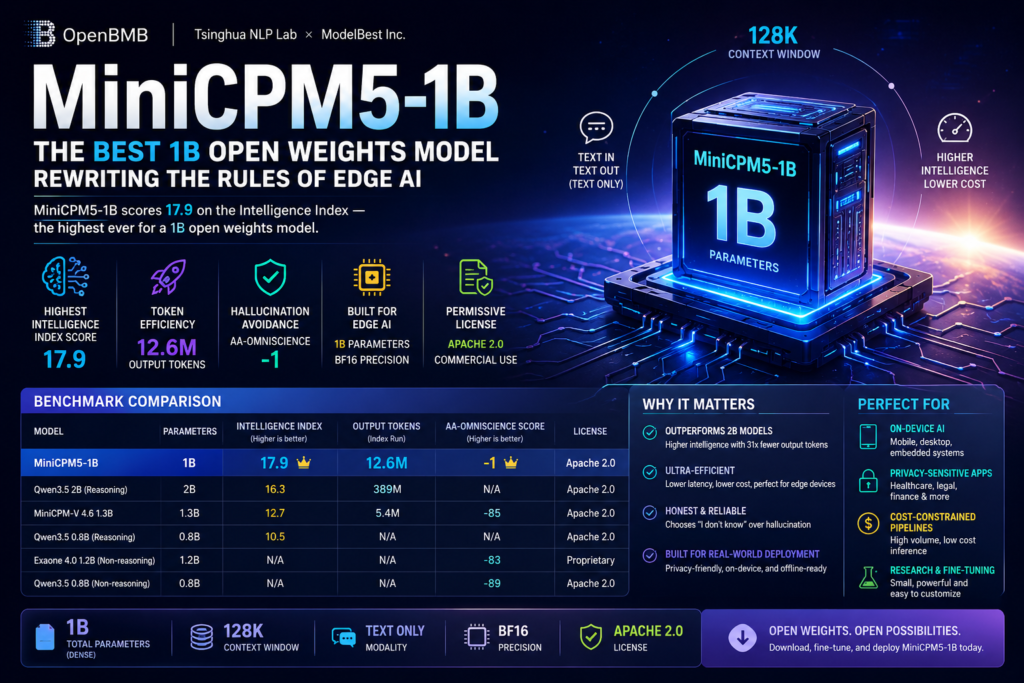
MiniCPM5-1B is the most intelligent 1-billion-parameter open weights model ever benchmarked — and it just made every larger small model look over-engineered. If you’re building on-device AI applications, running inference on constrained hardware, or simply trying to squeeze maximum intelligence out of minimum parameters, this release from OpenBMB deserves your full attention.
What Is MiniCPM5-1B?
MiniCPM5-1B is a 1-billion-parameter, dense large language model developed by OpenBMB — a China-based AI lab jointly founded in 2022 by Tsinghua University’s NLP Lab and ModelBest Inc. Released in May 2026, it is a text-in, text-out model that does not support multimodal input (unlike its sibling, MiniCPM-V 4.6 1.3B Instruct).
Key Technical Specifications at a Glance
| Attribute | Value |
|---|---|
| Total Parameters | 1 billion (dense) |
| Context Window | 128,000 tokens |
| Modality | Text input & output only |
| Precision | BF16 |
| License | Apache 2.0 (permissive) |
| Reasoning Mode | Non-reasoning |
| Developer | OpenBMB (Tsinghua University / ModelBest Inc.) |
The Apache 2.0 license is particularly significant: it means MiniCPM5-1B can be used freely in commercial applications without royalty obligations, making it immediately viable for startups and enterprise developers alike.
Benchmark Results: How Does MiniCPM5-1B Perform?
The short answer: better than any other 1B open weights model — by a wide margin.
Intelligence Index Score
Independent AI evaluation platform Artificial Analysis rates models on its Artificial Analysis Intelligence Index, a composite benchmark covering reasoning, knowledge, coding, mathematics, and instruction-following. MiniCPM5-1B scored 17.9 on the Intelligence Index, the highest ever recorded for any open weights model at or below 1 billion parameters.
To understand why that number is remarkable, consider that:
- The previous best sub-2B open weights model was Qwen3.5 0.8B (Reasoning) at 10.5 — a gap of 7.4 points.
- No other open weights model under 2 billion parameters had previously exceeded a score of 15 on the Intelligence Index.
- OpenBMB’s own predecessor, MiniCPM-V 4.6 1.3B, scored 12.7 — meaning MiniCPM5-1B delivers a 5.3-point intelligence gain with roughly 23% fewer parameters.
That last point is the crux of the story. MiniCPM5-1B doesn’t just lead its size class; it redraws what that size class is capable of.
Token Efficiency: Smarter Output, Lower Cost
One of the most overlooked aspects of small language model performance is token efficiency — how many output tokens a model consumes to produce its answers. Verbose models cost more per query in both API fees and inference compute.
MiniCPM5-1B used 12.6 million output tokens to complete the full Intelligence Index evaluation. Compare that to:
- Qwen3.5 2B (Reasoning): ~389 million tokens — roughly 31 times more
- Qwen3.5 2B (Non-reasoning): ~100 million tokens — roughly 8 times more
- MiniCPM-V 4.6 1.3B (predecessor): ~5.4 million tokens — MiniCPM5-1B uses about 2.3x more
The model uses more tokens than its non-reasoning predecessor, which is an expected trade-off for higher intelligence. But compared to the larger reasoning models it outperforms on quality, MiniCPM5-1B achieves superior intelligence at a fraction of the computational cost — a crucial advantage for latency-sensitive deployments.
Hallucination Avoidance: Choosing Silence Over Fabrication
Artificial Analysis also measures models on its AA-Omniscience benchmark, which tests whether models accurately represent the limits of their knowledge. This is where MiniCPM5-1B’s design philosophy becomes clearest.
Most sub-2B models attempt to answer questions they don’t actually know, hallucinating confidently and incurring heavy score penalties:
- Qwen3.5 0.8B (Non-reasoning): -89
- MiniCPM-V 4.6 1.3B: -85
- Exaone 4.0 1.2B (Non-reasoning): -83
MiniCPM5-1B scored -1 — the highest in its class — by simply declining to answer the vast majority of questions it was uncertain about. Rather than confabulating, it abstains. This “honest posture” is not just a philosophical preference; for production AI applications where user trust is paramount, a model that says “I don’t know” is categorically more reliable than one that invents a plausible-sounding wrong answer.
MiniCPM5-1B vs. Competitors: How Does It Stack Up?
Here is a direct comparison of MiniCPM5-1B against the leading small language models currently available, based on Artificial Analysis Intelligence Index data:
| Model | Parameters | Intelligence Index | Output Tokens (Index Run) | AA-Omniscience Score | License |
|---|---|---|---|---|---|
| MiniCPM5-1B | 1B | 17.9 | 12.6M | -1 | Apache 2.0 |
| Qwen3.5 2B (Reasoning) | 2B | 16.3 | 389M | N/A | Apache 2.0 |
| MiniCPM-V 4.6 1.3B | 1.3B | 12.7 | 5.4M | -85 | Apache 2.0 |
| Qwen3.5 0.8B (Reasoning) | 0.8B | 10.5 | N/A | N/A | Apache 2.0 |
| Exaone 4.0 1.2B (Non-reasoning) | 1.2B | N/A | N/A | -83 | Proprietary |
| Qwen3.5 0.8B (Non-reasoning) | 0.8B | N/A | N/A | -89 | Apache 2.0 |
Key takeaways from the table:
- MiniCPM5-1B outperforms a 2B model (Qwen3.5 2B Reasoning) on the Intelligence Index while using fewer than half the parameters and 31x fewer output tokens.
- It achieves the highest AA-Omniscience score in its class by an enormous margin — nearly 84 points ahead of its closest sub-2B competitor.
- Its Apache 2.0 license places it on equal commercial footing with Qwen3.5, the other leading permissively licensed small language model family.
Why Parameter Count Matters: The Case for Efficient Small Language Models
Why does a 1B model beating a 2B model matter so much? Because parameters are a proxy for cost, latency, and hardware requirements — and those constraints are real.
Every billion parameters in a model translates to roughly 2 GB of memory in BF16 precision. A 1B model like MiniCPM5-1B can run comfortably on:
- Mobile devices with 4–6 GB of RAM
- Raspberry Pi and similar single-board computers
- Edge inference hardware such as NVIDIA Jetson Nano
- Browser-based environments via WebAssembly runtimes
- Serverless functions with limited memory allocations
A 2B or 7B model cannot. This means MiniCPM5-1B doesn’t just compete with Qwen3.5 2B — it opens deployment scenarios that Qwen3.5 2B is physically incapable of reaching.
The Pareto frontier concept used by Artificial Analysis captures this well. A model sits on the Pareto frontier when no other model offers both higher intelligence and fewer parameters simultaneously. MiniCPM5-1B now defines that frontier at the sub-2B scale: it is the most intelligent option at every parameter count up to ~2B, making it the rational default for developers constrained to that range.
The Efficiency Equation for Edge AI Inference
For edge AI inference specifically, the relevant variables are:
- Model size (determines what hardware can run it)
- Intelligence (determines task quality)
- Token output rate (determines latency and per-query cost)
- Reliability (hallucination rate determines trustworthiness in production)
MiniCPM5-1B optimizes all four simultaneously in a way no prior 1B open weights model has achieved. For practitioners building voice assistants, document summarizers, local coding helpers, or embedded reasoning systems, this is a meaningful inflection point. on-device AI model
Key Limitations to Know Before You Deploy
MiniCPM5-1B is exceptional for its size, but it has real constraints that users should understand before building on it.
1. Text-only modality. Unlike MiniCPM-V 4.6 1.3B Instruct (which supports images), MiniCPM5-1B accepts and outputs text only. If your application requires vision, document parsing from images, or multimodal reasoning, this model is not the right choice.
2. No confirmed inference providers at launch. At time of release, Artificial Analysis reported no confirmed commercial API providers for MiniCPM5-1B. Developers who want managed inference will need to self-host initially, which adds operational overhead.
3. Non-reasoning architecture. MiniCPM5-1B is explicitly a non-reasoning model. It does not use extended chain-of-thought processes. On complex multi-step reasoning tasks — advanced mathematics, competitive coding, or long logical chains — reasoning-mode models from Qwen or DeepSeek will likely outperform it.
4. Higher token usage than its predecessor for non-reasoning tasks. Compared to MiniCPM-V 4.6 1.3B, MiniCPM5-1B uses roughly 2.3x more output tokens on the same evaluations. For very high-volume, low-cost use cases where the predecessor was sufficient, this is a meaningful cost increase.
5. Dense architecture. Unlike Mixture-of-Experts (MoE) models that activate only a fraction of parameters per token, MiniCPM5-1B is a dense model — all 1B parameters are active during every inference step. This is efficient at this scale but is worth noting if you’re comparing architectures.
Who Should Use MiniCPM5-1B?
MiniCPM5-1B is the right model for developers and organizations in the following situations:
- On-device AI applications — mobile apps, embedded systems, or desktop tools where you cannot rely on a network connection or cloud API
- Privacy-sensitive deployments — local inference ensures data never leaves the device, which is critical for healthcare, legal, and financial applications
- Cost-constrained inference pipelines — at 12.6M tokens for a full benchmark suite, it is dramatically cheaper to run than competing 2B models
- High-volume text classification and extraction — structured output tasks where hallucination tolerance is low and speed matters
- Research and fine-tuning experiments — its Apache 2.0 license and small size make it ideal for researchers who want to fine-tune a capable base model without expensive GPU requirements
- Applications where “I don’t know” is an acceptable answer — trust-sensitive use cases where hallucination is worse than abstention (e.g., medical information triage, legal Q&A, financial fact lookup)
- Developers running benchmarks or proof-of-concept prototypes who want the most intelligent available model that fits within a 2 GB memory budget
Frequently Asked Questions
What does “open weights” mean for MiniCPM5-1B?
“Open weights” means the trained model parameters are publicly released and downloadable. Combined with the Apache 2.0 license, this means anyone can run, modify, fine-tune, and deploy MiniCPM5-1B commercially without permission or payment. This is distinct from “open source,” which would additionally require the training data and code to be public.
How does MiniCPM5-1B compare to GPT-4o Mini or Gemini Flash?
MiniCPM5-1B is not directly comparable to closed-API models like GPT-4o Mini or Gemini 3.5 Flash in terms of overall capability — those are significantly larger models. The relevant comparison is the open weights sub-2B segment. Within that segment, MiniCPM5-1B is the unambiguous leader as of May 2026.
Can MiniCPM5-1B run on a CPU?
Yes, with appropriate quantization (e.g., GGUF format via llama.cpp), MiniCPM5-1B can run on consumer CPUs. Performance will be slower than GPU inference, but it is feasible for low-throughput applications on modern laptops.
Is MiniCPM5-1B suitable for production use today?
The main barrier to immediate production use is the absence of managed inference providers at launch. Teams comfortable with self-hosted deployment (via Ollama, vLLM, or llama.cpp) can deploy it today. Those requiring an API endpoint may need to wait for third-party hosting support.
What is the Artificial Analysis Intelligence Index?
The Artificial Analysis Intelligence Index is a composite benchmark created by the independent AI evaluation organization Artificial Analysis. It aggregates scores across multiple evaluation domains — including reasoning, mathematics, coding, and factual knowledge — to produce a single comparable intelligence score across models of all sizes. It is one of the most comprehensive independent benchmarks for comparing language models.
How does MiniCPM5-1B handle long documents?
With a 128,000-token context window, MiniCPM5-1B can process documents of approximately 96,000 words in a single pass — roughly equivalent to a full-length novel. This is unusually large for a 1B model and makes it practical for summarization, Q&A, and extraction tasks on lengthy documents without chunking.
The Bottom Line: A Genuine Leap for Sub-2B AI
The release of MiniCPM5-1B marks one of the most important moments in the evolution of compact language models. For years, the AI industry has largely operated under a simple assumption: better intelligence requires larger models, more parameters, more compute, and dramatically higher operating costs. The dominant narrative has been that meaningful improvements in capability can only come from scaling upward. Bigger clusters, larger datasets, longer training cycles, and increasingly expensive infrastructure have defined the competitive landscape of modern artificial intelligence.
MiniCPM5-1B challenges that assumption directly.
What makes this model remarkable is not merely that it performs well for its size. Small models have existed for years, and many of them have been useful in narrow applications. The real significance lies in the fact that MiniCPM5-1B competes with — and in some cases surpasses — models that are substantially larger while operating within a dramatically smaller hardware footprint. That changes the economics, accessibility, and deployment strategy of AI systems in a very practical way.
The broader AI market has been dominated by the pursuit of gigantic frontier models. Those systems are undeniably powerful, but they also introduce serious trade-offs. Large-scale models require expensive GPUs, continuous cloud connectivity, high power consumption, and complex serving infrastructure. For enterprises with massive budgets, those costs may be manageable. For startups, independent developers, researchers, educational institutions, and edge-device manufacturers, they often are not.
This is where MiniCPM5-1B becomes strategically important.
A compact model with strong intelligence characteristics creates opportunities that larger systems simply cannot address efficiently. A lightweight architecture can run directly on local hardware, reducing dependency on cloud inference and enabling applications in environments with limited connectivity. Devices such as smartphones, industrial systems, embedded computers, field equipment, kiosks, robotics platforms, and offline enterprise systems suddenly become viable AI deployment targets without requiring a remote data center to process every interaction.
That shift matters because the next phase of AI adoption will not be limited to cloud-hosted chatbots. The future of intelligent software includes local assistants, offline productivity tools, privacy-preserving healthcare systems, embedded industrial automation, intelligent consumer electronics, and edge-native decision systems. In all of those scenarios, efficiency matters just as much as raw intelligence.
MiniCPM5-1B demonstrates that strong performance no longer requires massive computational overhead at the lower end of the parameter spectrum. The model’s benchmark results indicate a level of optimization that feels less like incremental tuning and more like a structural leap in efficiency engineering. Achieving higher benchmark intelligence while maintaining a compact architecture is difficult enough. Doing so while dramatically reducing hallucination tendencies and maintaining practical inference efficiency is even more notable.
One of the most interesting aspects of the model is its apparent design philosophy around reliability. Many smaller models attempt to answer everything, even when they lack confidence or knowledge. That behavior creates an illusion of intelligence while quietly undermining trust. MiniCPM5-1B takes a different approach by favoring restraint over fabrication. In real-world deployments, that distinction is incredibly important.
For applications in finance, healthcare, legal workflows, or enterprise automation, an incorrect answer delivered confidently can be more damaging than a refusal to answer. Systems that understand uncertainty are generally more useful than systems optimized purely for conversational fluency. This is one reason why the model’s hallucination resistance has attracted so much attention among developers focused on production-grade AI rather than demo-quality outputs.
Another major implication of this release is what it signals about the trajectory of efficient model development. Historically, smaller models have often been viewed as compressed or weakened versions of larger systems. MiniCPM5-1B suggests that small models may evolve into their own specialized category with unique advantages rather than simply being “reduced” alternatives to flagship architectures.
That distinction is important because the AI industry is increasingly splitting into two directions simultaneously. On one side are extremely large general-purpose reasoning systems intended to solve highly complex tasks across domains. On the other side is a growing demand for highly efficient, targeted, deployable intelligence that works reliably within constrained environments. Compact open-weight systems are becoming the foundation of that second category.
The open-weight nature of MiniCPM5-1B further amplifies its impact. Open access enables experimentation, fine-tuning, benchmarking, local deployment, and community-driven optimization. Developers are not locked into a proprietary API pricing model or dependent on a single vendor’s infrastructure roadmap. That freedom is especially valuable for research groups, startups, and regional technology ecosystems trying to innovate without massive capital resources.
Equally important is the psychological shift this release creates within the AI community. For a long time, there has been a perception that small models inevitably represent compromise. Lower quality, weaker reasoning, poor contextual understanding, and limited usability were commonly accepted trade-offs. MiniCPM5-1B weakens that assumption significantly. It shows that intelligent optimization, efficient architecture design, and disciplined training strategies can produce outcomes that rival systems with far larger footprints.
The implications extend beyond benchmarks and comparison charts. Efficient AI changes who can build products, who can afford deployment, and where intelligent systems can operate. It lowers barriers for emerging markets, educational institutions, independent creators, and hardware manufacturers that cannot sustain large-scale inference costs. In practical terms, this expands the reach of AI technology far beyond premium cloud ecosystems.
MiniCPM5-1B may ultimately be remembered not only as a successful compact model, but as evidence that the future of artificial intelligence is not exclusively about scaling upward. Sometimes progress comes from making systems smaller, faster, more reliable, and more deployable. In that sense, this release represents more than a benchmark victory. It represents a change in direction for efficient AI engineering and a meaningful step forward for the entire sub-2B ecosystem.