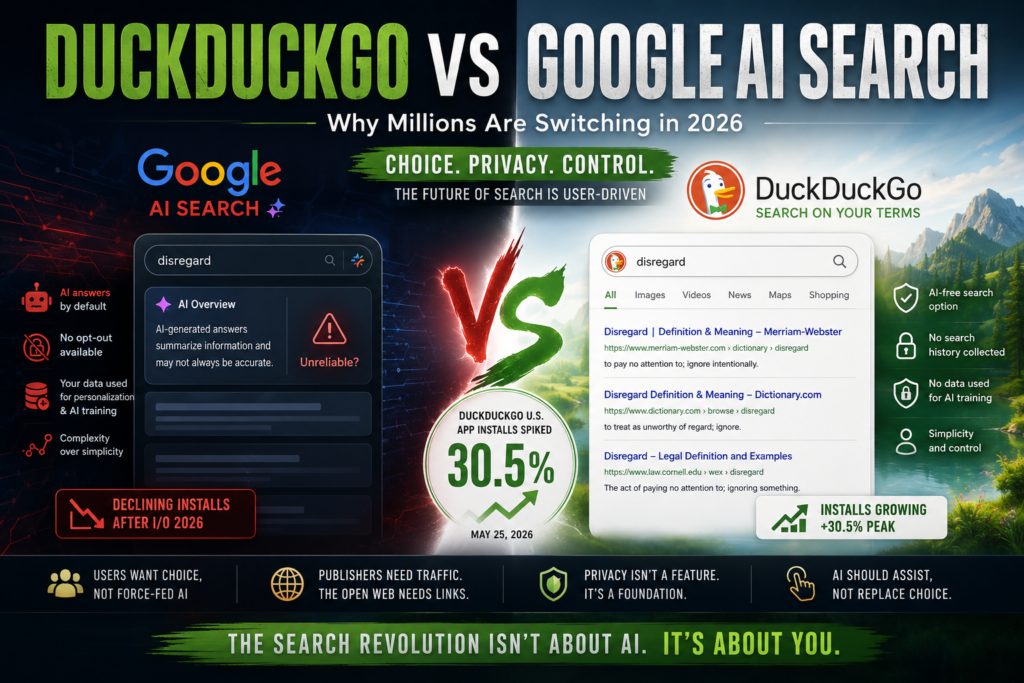
Users are fleeing Google Search at a measurable pace — and DuckDuckGo is capturing them. After Google replaced its traditional blue-link results with AI agents at I/O 2026, DuckDuckGo recorded a 30.5% spike in U.S. app installs in a single day, the clearest signal yet that forced AI adoption is a product risk, not just a PR one.
This post breaks down exactly what changed, why users are reacting the way they are, and what the DuckDuckGo vs Google AI Search moment means for anyone thinking about where they get their information online.
What Happened: Google’s AI Search Overhaul at I/O 2026
At its annual developer conference in May 2026, Google announced a fundamental restructuring of Search. The familiar list of blue links — the interface that has defined web discovery for over two decades — is being replaced by an AI agent system. This agent doesn’t just surface results; it answers queries, executes tasks on the user’s behalf, and runs background monitoring agents.
What changed specifically:
- Traditional organic search results are now secondary to AI-generated answers
- AI agents can proactively execute tasks (booking, research, summarization) without the user visiting a source website
- AI overviews appear by default with no native opt-out mechanism
- Simple searches have become more complex — Google’s own handling of the search term “disregard” became a widely shared example of the new system producing confusing, unreliable results
The update drew an immediate and sharp backlash from users, publishers, and digital rights advocates alike.
(Google AI Search 2026 DuckDuckGo AI-free search AI search engine comparison Privacy-focused search engines)
Why Users Are Rejecting Google’s AI Search
The Problem of Forced Adoption
DuckDuckGo CEO Gabriel Weinberg captured the user sentiment precisely: “Google is force-feeding AI with no way to opt out.”
That phrase — force-feeding — is doing a lot of work. The objection isn’t that Google added AI. It’s that Google removed the choice not to use it. For many users, the absence of a control mechanism is itself the product failure. When a search engine takes away the ability to get a direct link to a primary source, it changes the fundamental relationship between user and tool.
This is the central tension in the DuckDuckGo vs Google AI Search debate: it isn’t really about AI versus no AI. It’s about who decides how much AI appears in a search session.
Accuracy Concerns and Trust Erosion
AI overviews have a documented accuracy problem. Users and researchers have flagged instances where AI-generated answers surface incorrect information with the same visual confidence as correct information. When a system is designed to synthesize and summarize rather than retrieve and point, errors become harder for users to catch and correct.
The trust calculus for a search engine is simple: if you’re wrong often enough, users leave. Google built two decades of user loyalty on the understanding that it would show you where to go, not tell you what to think. That implicit contract has now shifted, and not everyone agreed to the new terms.
Complexity Replacing Simplicity
Search’s original value proposition was speed and directness. Type a query, get links, visit the one that looks right. The new Google experience introduces an additional cognitive layer: evaluating whether the AI answer is trustworthy, deciding whether to dig into sources, and navigating a results page increasingly built around AI engagement rather than user navigation.
For millions of users doing routine, low-stakes queries, that added complexity is simply friction they didn’t ask for.
DuckDuckGo vs Google AI Search: A Direct Comparison
The following table captures the key functional differences between the two search experiences as they stand in mid-2026.
| Feature | Google AI Search | DuckDuckGo |
|---|---|---|
| Default results format | AI-generated answers with agent capabilities | Traditional web links |
| AI opt-out | No native opt-out available | Dedicated AI-free page (noai.duckduckgo.com) |
| AI features available | AI overviews, task agents, background monitoring | Duck.ai (optional), Search Assist (optional), AI Image Filter |
| Data collection | Search history retained; used for personalization | No search history collected |
| AI training use | User data used for model improvement | Chats not used for training |
| Privacy architecture | IP address and profile linked to queries | IP stripped before reaching model providers |
| Market share (U.S.) | ~90%+ | ~2% |
| App install trend (May 2026) | Declining installs in the period | +30.5% daily peak, +33% iOS average WoW |
| Monetization model | Advertising tied to search behavior | Contextual advertising, not behavioral |
The comparison reveals something important: DuckDuckGo is not winning on features. It is winning on restraint — the deliberate choice not to force a particular experience on every user.
How DuckDuckGo’s “AI on Your Terms” Model Works
DuckDuckGo has never tried to out-Google Google. Its product strategy in 2026 is built on a different premise entirely: that user control is a feature worth building around.
The AI-Free Search Page
DuckDuckGo’s noai.duckduckgo.com page disables every AI feature by default — no AI-assisted answers, no AI-generated images, no summarization layer. During the week of May 20–25, 2026, visits to this page grew an average of 22.7% week-over-week, peaking at 27.7% on May 24. Users aren’t just switching to DuckDuckGo; they’re specifically seeking out its least-AI version.
Duck.ai: Optional AI, Not Mandatory AI
DuckDuckGo does offer its own AI product — Duck.ai — and this is where the DuckDuckGo vs Google AI Search contrast becomes philosophically clear. Duck.ai is free, requires no account, and provides access to a range of models including Claude, Llama, Mistral, and GPT. Users who want AI can have it. Users who don’t, don’t have to see it.
The privacy architecture reinforces this: DuckDuckGo strips IP addresses before queries reach model providers, deletes conversations within 30 days, and contractually prevents chats from being used for AI training. Control extends beyond just the interface — it goes into the data layer.
(Google AI Search 2026 DuckDuckGo AI-free search AI search engine comparison Privacy-focused search engines)
Search Assist and the AI Image Filter
Two of DuckDuckGo’s most popular features in 2026 are Search Assist (an optional AI overview layer similar to what Google now forces on all users) and an AI Image Filter that removes AI-generated images from search results. That these two features — one adding AI, one filtering it out — are equally popular tells you something important: users don’t want less AI or more AI. They want the ability to choose.
As DuckDuckGo’s chief communications and policy officer Kamyl Bazbaz put it plainly: “People just want a choice.”
The Data Behind the Shift: What the Numbers Actually Mean
It’s worth being precise about what the install numbers represent, because the narrative can outrun the evidence.
DuckDuckGo’s U.S. app installs grew 18.1% week-over-week on average across May 20–25, peaking at 30.5% on May 25. On iOS specifically, the average weekly growth hit 33%, with a single-day peak of 69.9%. The company also reported that growth held over the Memorial Day weekend — a period when it typically sees a traffic dip.
These are meaningful numbers, but DuckDuckGo still holds only around 2% of the U.S. search market. The spike represents a shift in sentiment and intent more than an immediate structural rebalancing of the search market. Google isn’t in existential danger from this week’s data.
What it does represent is a leading indicator. When users who have never before considered switching suddenly act on that consideration — within days of a product change — it signals that the switching cost has dropped below a threshold. The question for Google isn’t whether DuckDuckGo can take 2% of its market. It’s whether this moment establishes a new pattern of user behavior when major AI changes are forced on them. (Google AI Search 2026 DuckDuckGo AI-free search AI search engine comparison Privacy-focused search engines)
What the DuckDuckGo vs Google AI Search Moment Means for the Web
The backlash to Google’s AI Search overhaul isn’t just a consumer story. It has structural implications for how the web functions.
Publishers and the Open Web
Critics of Google’s update have argued that AI agents that execute tasks and answer queries without sending users to source websites could systematically reduce traffic to publishers, journalists, and small businesses that depend on search referrals. If the answer is always served inside Google, the incentive to produce the original content that feeds those answers deteriorates over time.
DuckDuckGo’s model, which preserves the link to the original source as the primary output of a search query, is more compatible with the existing publisher ecosystem.
The Antitrust Backdrop
This is not Google’s first encounter with the competitive dynamics of search defaults. In the 2023 antitrust trial over its search distribution agreements, DuckDuckGo’s own CEO testified that Google’s exclusive default contracts had limited DuckDuckGo’s ability to pitch itself as a default option on other browsers. The current wave of voluntary switching is notable precisely because it’s happening without any structural change to those defaults — users are overriding the default on their own.
AI Search as a Trust Variable
For the broader AI industry, the Google backlash in May 2026 establishes a useful data point: users will tolerate AI features and even embrace them, but forced adoption without meaningful opt-out mechanisms creates measurable user defection. The lesson for any product integrating AI isn’t that AI is unwanted. It’s that the removal of choice is what triggers the reaction.
Should You Switch? Key Questions to Ask
If you’re evaluating the DuckDuckGo vs Google AI Search decision for yourself, these questions will help clarify your priorities:
- Do you want AI-generated answers by default? If not, DuckDuckGo’s traditional results or its AI-free page will suit you better.
- How important is source transparency to you? DuckDuckGo prioritizes linking to original sources; Google’s AI mode increasingly synthesizes answers that may obscure the underlying sources.
- Are you concerned about your search history being used for personalization or AI training? DuckDuckGo collects no search history and uses no chat data for training; Google’s model is built on behavioral data.
- Do you occasionally want AI assistance in your search experience? Both platforms offer it — but only DuckDuckGo lets you turn it on or off by choice.
- Do you rely on highly specialized or professional searches? Google’s breadth and depth of index remains unmatched; DuckDuckGo sources from Bing and its own crawler, which may produce less comprehensive results for highly specialized queries.
- Are you on iOS? The iOS install spike was the steepest — 69.9% single-day growth — suggesting the mobile switching behavior is especially strong on Apple devices.
- Do you use a browser other than Chrome? DuckDuckGo is easier to set as default on Firefox, Safari, and Brave than on Chrome, where Google’s integration is tightest.
The Bigger Signal: User Agency Is Becoming a Search Feature
The DuckDuckGo vs Google AI Search story is ultimately about what users consider a feature and what they consider a flaw. For years, personalization was framed as unambiguously good — more relevant results, better answers, a more efficient experience. The May 2026 backlash suggests that a significant portion of the search-using public has updated that calculus.
Relevance is still valued. But relevance delivered through an AI system that removes user control is starting to feel less like a benefit and more like a liability. The ability to opt out — to say “show me links, not answers” — is emerging as a genuine product differentiator, one that DuckDuckGo has built its entire 2026 positioning around.
Whether Google responds with a credible opt-out mechanism, or doubles down on AI-first results, will determine whether this week’s install spike is a temporary blip or the beginning of a structural shift in how users think about which search engine they owe their default.
What’s already clear is that the search market’s most boring, overlooked assumption — that users will accept whatever Google gives them — no longer holds the way it once did. And that changes everything about how the next phase of search competition will be fought.
Frequently Asked Questions About DuckDuckGo vs Google AI Search
1. Why are users switching from Google AI Search to DuckDuckGo in 2026?
The biggest reason users are moving from Google AI Search to DuckDuckGo is the lack of control over AI-generated results. After Google introduced its AI-first search experience at I/O 2026, many users felt that traditional search had become harder to use. Instead of getting direct blue links, users were shown AI-generated summaries and agent-based answers by default.
In the DuckDuckGo vs Google AI Search debate, privacy and simplicity are becoming major decision factors. Users who simply want quick access to websites without AI summaries often feel frustrated by Google’s new interface. DuckDuckGo, on the other hand, still prioritizes traditional search results while offering optional AI tools rather than forcing them on everyone.
Another major issue is trust. Many users believe Google AI Search sometimes provides overconfident but inaccurate responses. DuckDuckGo has benefited from this growing distrust because it emphasizes direct source links and user choice. The DuckDuckGo vs Google AI Search trend shows that people still value transparency more than automated answers.
2. Is DuckDuckGo completely free from AI features?
No, DuckDuckGo is not completely AI-free. However, the key difference in the DuckDuckGo vs Google AI Search conversation is that DuckDuckGo gives users control over whether they want AI features enabled.
DuckDuckGo offers optional services such as Duck.ai and Search Assist. These tools can help users summarize information or interact with AI chat systems when needed. However, users can disable these features or use the dedicated AI-free experience through noai.duckduckgo.com.
This flexibility is why many people prefer DuckDuckGo vs Google AI Search in 2026. Google places AI-generated content at the center of the search experience, while DuckDuckGo treats AI as an optional enhancement rather than a mandatory layer.
The ability to decide how much AI appears during browsing has become one of the strongest competitive advantages for DuckDuckGo.
3. Does DuckDuckGo protect privacy better than Google AI Search?
Yes, privacy is one of the strongest reasons users prefer DuckDuckGo vs Google AI Search. DuckDuckGo does not store personal search history, build advertising profiles, or track users across the web in the same way Google does.
Google AI Search relies heavily on personalization and behavioral data. Search activity can influence advertisements, recommendations, and AI-generated responses. Many users are uncomfortable with this level of tracking, especially when AI systems use data to improve future models.
DuckDuckGo takes a different approach. The company claims it strips IP addresses before AI requests reach model providers and does not use chat conversations for AI training. In the DuckDuckGo vs Google AI Search comparison, this privacy-first architecture appeals strongly to users who want less surveillance online.
As AI systems become more integrated into search engines, data privacy concerns will likely become even more important in future search engine competition.
4. Is Google AI Search actually better for productivity?
For some users, yes. Google AI Search can save time by summarizing information quickly, answering questions directly, and even performing tasks automatically. Users who enjoy AI-assisted workflows may find Google AI Search highly convenient.
However, the DuckDuckGo vs Google AI Search debate is not really about whether AI is useful. It is about whether AI should dominate the search experience by default.
Some users prefer researching information manually because they trust original sources more than AI-generated summaries. Others dislike how AI answers sometimes remove the need to visit websites, making it harder to verify information independently.
DuckDuckGo appeals to users who want a balance between traditional browsing and optional AI support. The DuckDuckGo vs Google AI Search trend suggests that many users still prefer having direct access to websites instead of relying entirely on synthesized AI responses.
5. Can Google AI Search replace traditional search completely?
Google is clearly moving toward an AI-first future, but traditional search is unlikely to disappear completely anytime soon. The strong reaction to the DuckDuckGo vs Google AI Search changes proves there is still massive demand for standard web browsing.
Millions of users are comfortable with the classic “search and click” model. They prefer evaluating multiple sources themselves rather than relying on AI-generated conclusions. Publishers, journalists, and website owners also worry that AI summaries could reduce traffic to original content creators.
The DuckDuckGo vs Google AI Search conversation highlights a broader issue: people do not necessarily want AI to replace the web. Many users want AI to assist with search, not become the entire search experience.
Because of this, search engines that preserve user choice may gain long-term loyalty even if AI becomes more advanced.
6. Is DuckDuckGo growing because of the Google AI backlash?
Yes, DuckDuckGo experienced a significant increase in app installs after Google’s AI Search overhaul in 2026. Reports showed a major spike in downloads immediately after Google announced its AI-focused search changes.
The DuckDuckGo vs Google AI Search trend demonstrates how quickly users react when search experiences change dramatically. Even though DuckDuckGo still controls a relatively small portion of the overall market, the sudden growth indicates rising frustration with forced AI adoption.
What matters most is not just the install numbers themselves, but what they represent psychologically. Users who had never previously considered switching search engines suddenly became willing to explore alternatives.
That behavioral shift is important because search engine habits are traditionally very difficult to change. The DuckDuckGo vs Google AI Search battle may ultimately become one of the most important tech industry stories of 2026.
7. Which search engine should you choose in 2026?
The answer depends entirely on your priorities. If you prefer AI-powered summaries, automation, and integrated productivity tools, Google AI Search may feel more efficient.
However, if you value privacy, transparency, and control over your browsing experience, DuckDuckGo may be the better option. The DuckDuckGo vs Google AI Search comparison is ultimately about user choice rather than technology itself.
Many users now see search engines as more than simple tools. Search platforms shape how information is discovered, filtered, and trusted online. That is why the DuckDuckGo vs Google AI Search debate has become so important in 2026.
For users who want cleaner results, fewer tracking concerns, and optional AI tools instead of mandatory ones, DuckDuckGo offers a compelling alternative. For users deeply invested in AI-assisted workflows, Google AI Search may remain the preferred ecosystem.
The future of search will likely belong to companies that can balance AI innovation with genuine user control.