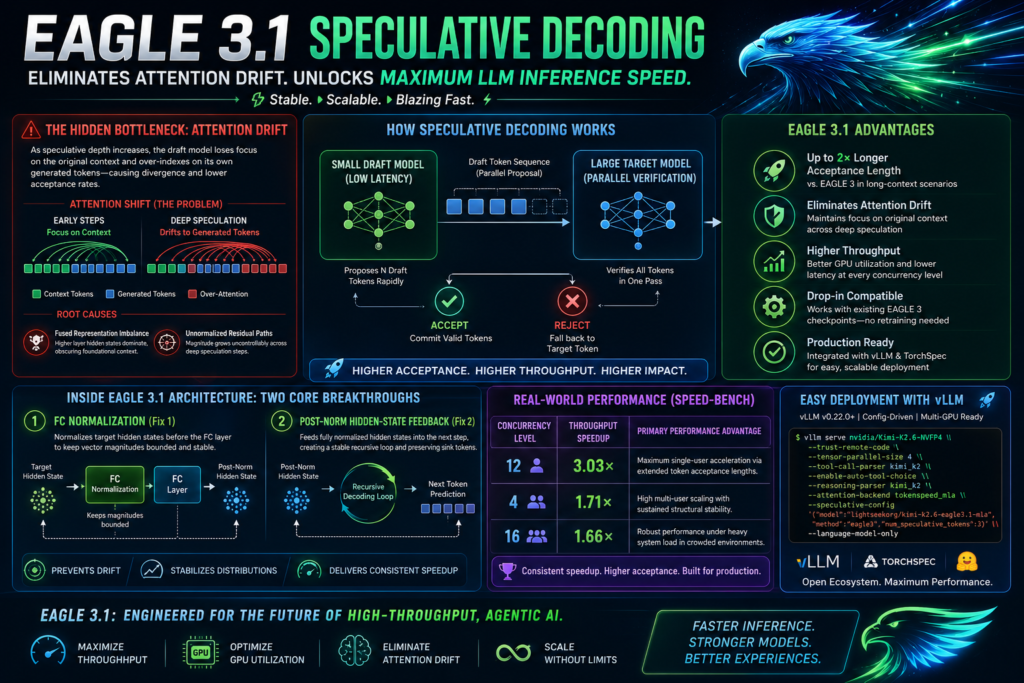
To maximize large language model throughput, engineering teams rely on a speculative decoding algorithm to accelerate generation speeds by validating multiple tokens in parallel. However, scaling these systems in production has historically caused model degradation due to a drop-off in draft model precision known as attention drift.
The newly released EAGLE 3.1 framework directly addresses this performance barrier. By introducing structural modifications to the speculative decoding algorithm pipeline, it eliminates mathematical divergence across deep token paths. This structural refinement ensures high token acceptance rates even during complex, long-context operational workloads.
Understanding Speculative Decoding in Modern LLM Inference
Accelerating large language model performance requires bypassing the foundational constraint of autoregressive generation: memory bandwidth limitations. Every single token generated requires loading billions of model parameters from high-bandwidth memory (HBM) into the processor SRAM. When serving models at scale, this reality creates severe computing bottlenecks.
The Core Mechanics of Speculative Systems
To achieve a meaningful LLM inference speed up, speculative architectures restructure the traditional token generation cycle. Instead of using the primary, high-parameter target model for every sequential token prediction, the environment deploys a multi-model execution pipeline.
+---------------------+     Proposes N Draft Tokens     +------------------------+
|  Small Draft Model  | ------------------------------> | Large Target Model     |
|  (Low Latency)      |                                 | (Parallel Verification)|
+---------------------+                                 +------------------------+
                                                                     |
                                                                     v
                                                        Accept / Reject Decisions
This structural execution involves a clear two-step workflow:
- The Speculative Drafter Stage: A significantly smaller, highly optimized draft model rapidly generates a series of candidate tokens (a speculative draft sequence). Because this model possesses far fewer parameters, it executes at a fraction of the compute cost and time.
- The Target Verification Stage: The primary large language model ingests the entire draft sequence simultaneously. It evaluates the tokens in a single parallel computing pass rather than sequentially processing them.
If the primary model confirms the validity of the drafted tokens, they are committed to the final output text. If a candidate token fails verification, the engine discards the inaccurate sequence segments and falls back gracefully to a verified target token. This complete collaborative cycle defines the typical operational loop of a modern speculative decoding algorithm.
Why Production LLM Serving Demands Higher Throughput
Operating enterprise conversational systems, automated software agents, and analytical platforms requires managing highly dynamic user requests. In a production LLM serving framework, maintaining low time-to-first-token (TTFT) and high inter-token latency properties is absolutely essential for real-world usability.
When user demand spikes across an enterprise network, traditional generation methods experience linear slowdowns. By leveraging an advanced speculative decoding algorithm, infrastructure engineers can maximize hardware utilization across advanced GPU clusters, shifting workloads from being severely memory-bound to more compute-bound. This transition scales overall system efficiency, allowing data centers to process significantly higher concurrent user volume without requiring massive expansions in hardware infrastructure.
The Hidden Bottleneck: What is Attention Drift?
While first-generation speculative decoding models exhibited high performance in restricted laboratory benchmarks, real-world deployment exposed operational vulnerabilities. As the speculative depth—the number of tokens guessed ahead by the drafter—increased, the overall token acceptance rate began to decline sharply.
The Mechanics of Trapped Focus
The underlying cause of this performance drop is a phenomenon known as attention drift. This issue describes an architectural failure mode where a small draft model gradually loses track of the foundational prompt context during deep speculative sequences.
In an ideal setup, the draft model evaluates the entire historical input context alongside its own newly proposed tokens to predict subsequent words accurately. However, during deep speculative generation phases, the drafter begins to systematically over-index on its own newly created, unverified tokens. It starts ignoring vital early context elements, such as initialization instructions and structural system prompts, causing its predictions to diverge from the intent of the primary model.
Root Causes of Drafter Instability
Deep technical analysis of early speculative decoding algorithm engines revealed that attention drift stems from two specific mathematical design issues:
- Fused Representation Imbalance: As speculation steps extend deeper, the hidden states originating from higher layers begin to dominate the input vector of the draft system. This dynamic causes a significant imbalance, obscuring the primary foundational context.
- Unnormalized Residual Paths: The continuous additions occurring along the unnormalized residual processing pathways cause hidden-state magnitudes to expand uncontrollably across deep speculation cycles.
[Image showing attention drift where draft model attention shifts away from context tokens toward generated tokens]
When these two issues interact, the draft model becomes increasingly erratic. This structural instability lowers the overall token acceptance rate, directly undermining the primary objective of achieving an explicit LLM inference speed up.
Inside EAGLE 3.1 Architecture: Two Core Breakthroughs
To permanently resolve these compounding stability issues, the development team introduced the revised EAGLE 3.1 architecture. This framework integrates two explicit structural adaptations directly into the speculative decoding algorithm execution path, ensuring uniform mathematical distributions regardless of speculative generation depth.
Target Hidden State ---> [ FC Normalization ] ---> [ FC Layer ] ---> Post-Norm Feedback Loop
                                 |                                           |
                                 +-------------------------------------------+
Fix 1: Feature Convolution (FC) Normalization
The first structural update within the EAGLE 3.1 architecture centers on the integration of an explicit Feature Convolution (FC) normalization layer. This processing mechanism applies normalization calculations directly after the target hidden state is extracted, right before it encounters the primary FC transformation layer.
Raw Target Hidden State
          │
          ▼
┌─────────────────────────────────┐
│     FC Normalization Layer      │  <-- Keeps vector magnitudes bounded
└─────────────────────────────────┘
          │
          ▼
┌─────────────────────────────────┐
│        FC Layer Module          │
└─────────────────────────────────┘
By enforcing strict mathematical boundaries on these hidden-state distributions, FC normalization prevents vector magnitudes from growing uncontrollably across deep speculation steps. This constraint ensures that the input tokens entering the drafter remain stable and mathematically uniform, regardless of how many speculative cycles have executed.
Fix 2: Post-Norm Hidden-State Feedback
The second architectural modification involves updating the feedback loop mechanism to leverage post-norm hidden states. Instead of feeding unadjusted hidden states directly into subsequent prediction steps, EAGLE 3.1 routes the fully normalized hidden states into the next decoding iteration.
This design choice shifts the functional behavior of the model. Rather than acting like an appended series of extra processing layers stacked onto the target model, the system operates as a clean, recursive invocation loop. This recursion preserves foundational anchor tokens—often referred to as sink tokens—ensuring the draft model maintains an accurate contextual focus across long sequences.
EAGLE 3.1 Performance vs. Previous Speculative Models
The integration of these structural changes yields measurable performance advantages when comparing EAGLE 3.1 against previous versions and alternative speculative decoding approaches.
Throughput Scaling and Acceptance Length Gains
In long-context evaluation workloads, the structural enhancements found in the EAGLE 3.1 architecture produce major efficiency gains. By preventing attention drift, the system achieves up to a 2× longer token acceptance length compared to standard EAGLE 3 baselines when processing extended operational contexts.
To demonstrate these real-world improvements, extensive benchmark testing was conducted using the complex SPEED-Bench coding dataset. The evaluation paired a vLLM serving infrastructure with an advanced Kimi K2.6 model configuration running on NVIDIA hardware. The resulting data highlights clear performance advantages across various operational concurrency levels:
| System Configuration | Concurrency Level | Throughput Speedup Multiplier | Primary Performance Advantage |
| EAGLE 3.1 Framework | Concurrency 1 | 2.03× Throughput | Maximum single-user acceleration via extended token acceptance lengths. |
| EAGLE 3.1 Framework | Concurrency 4 | 1.71× Throughput | High multi-user scaling with sustained structural stability. |
| EAGLE 3.1 Framework | Concurrency 16 | 1.66× Throughput | Robust performance under heavy system load inside crowded production environments. |
This benchmark data proves that the updated speculative decoding algorithm maintains a reliable speed up even during heavy system concurrency. While traditional speculative setups frequently collapse under high multi-user loads due to memory bottlenecks and context mixing, EAGLE 3.1 preserves its speed advantages, making it an excellent option for production LLM serving deployments.
Step-by-Step Production Deployment with vLLM
Implementing EAGLE 3.1 within an existing enterprise infrastructure is a highly streamlined process. Thanks to deep integration with the open-source vLLM and TorchSpec ecosystems, engineers can easily launch optimized model instances using config-driven orchestration tools.
Integration Configuration and Code Implementation
EAGLE 3.1 is natively supported in vLLM starting with version v0.22.0. This integration fully eliminates hardcoded structural dependencies regarding target hidden states, replacing them with dynamic, config-driven execution paths.
Engineers can initialize a production-ready instance of the model via the standard command-line interface using the following configuration script:
Bash
vllm serve nvidia/Kimi-K2.6-NVFP4 \
  --trust-remote-code \
  --tensor-parallel-size 4 \
  --tool-call-parser kimi_k2 \
  --enable-auto-tool-choice \
  --reasoning-parser kimi_k2 \
  --attention-backend tokenspeed_mla \
  --speculative-config '{"model":"lightseekorg/kimi-k2.6-eagle3.1-mla","method":"eagle3","num_speculative_tokens":3}' \
  --language-model-only
This launch command configures a multi-GPU tensor-parallel setup while explicitly activating the eagle3 methodology parameters. It points directly to a specialized EAGLE 3.1 draft model trained via TorchSpec and hosted openly on HuggingFace.
Backward Compatibility with Existing Hardware Ecosystems
A key operational benefit of the EAGLE 3.1 implementation is its full backward compatibility with previous model iterations. Engineering teams do not need to retrain or discard their existing portfolio of foundational EAGLE 3 model checkpoints.
The updated speculative decoding algorithm engine natively ingests previous-generation checkpoints, applying its architectural fixes dynamically through the vLLM runtime layer. This ensures that enterprise infrastructures can transition to the more stable framework instantly, avoiding complex data conversion processes or costly secondary training cycles.
The Future of High-Throughput Agentic Workflows
As the artificial intelligence landscape transitions from simple conversational interfaces toward autonomous agentic workflows, the requirement for high-efficiency, long-context text generation will continue to grow exponentially. Multi-agent systems routinely execute recursive loop actions, code verification cycles, and real-time contextual updates that generate massive token volumes.
By eliminating systemic issues like attention drift, frameworks like EAGLE 3.1 prove that high computational efficiency does not require sacrificing model accuracy. Refining the foundational mathematical paths of a speculative decoding algorithm allows engineering teams to unlock substantial speed improvements, maximizing the value of modern GPU infrastructure and paving the way for highly responsive, real-time AI applications.