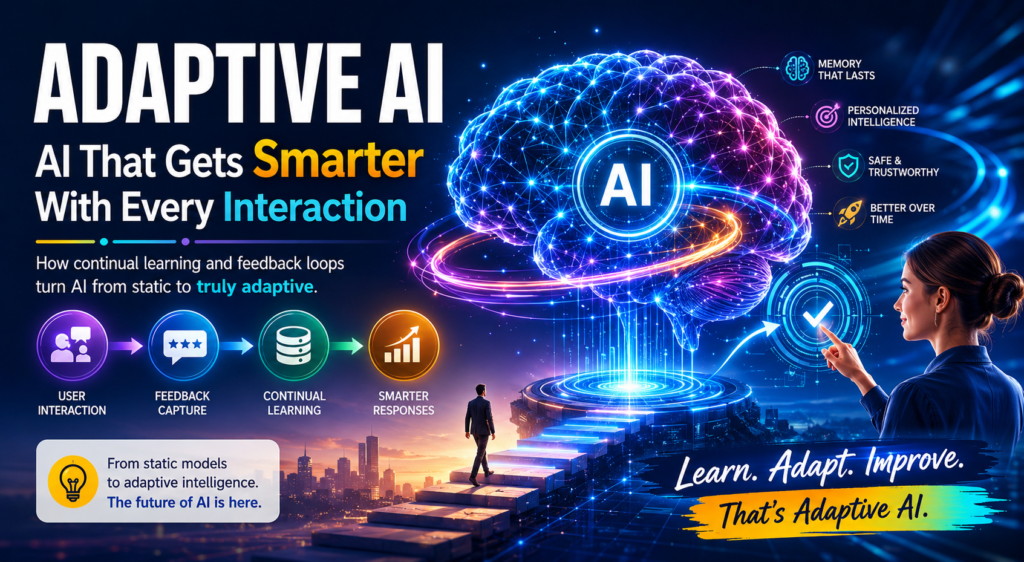
Adaptive AI — artificial intelligence that genuinely improves through ongoing use — is no longer a research fantasy. It is the central problem that the next generation of AI companies is racing to solve, and the breakthrough that could permanently close the gap between today’s sophisticated but forgetful models and the kind of intelligence humans naturally possess.
If you’ve ever wondered why ChatGPT doesn’t remember your preferences from last week, or why enterprise AI tools seem equally clumsy on day one and day one thousand, this post is your answer.
What Is Adaptive AI?
Adaptive AI is a class of artificial intelligence designed to update its knowledge, behavior, or responses based on new information, user interactions, and real-world feedback — without requiring a full retraining cycle.
Unlike a standard large language model (LLM) that is trained once on a fixed dataset and then deployed in a frozen state, adaptive AI systems are architected to keep learning after deployment. The adaptation can happen at different levels: at the model weights level (the parameters that define what the model “knows”), at the memory layer (what it retrieves from context), or at the feedback infrastructure layer (how user corrections and evaluations are fed back into the system).
The simplest analogy is a new employee versus a seasoned one. Both may have the same degree, but the seasoned employee has absorbed years of corrections, edge cases, company norms, and user preferences. Adaptive AI is the engineering attempt to replicate that compounding growth in a machine.
The Core Problem: Why Today’s AI Resets With Every Session
The Frozen Model Problem
Every major AI assistant you use today — ChatGPT, Gemini, Claude — was trained on a corpus of data that has a hard cutoff date. Once training ends, the model’s underlying weights are locked. It doesn’t learn from the thousands of conversations it has each day. It doesn’t remember that you prefer bullet points over prose, or that your company uses a specific naming convention, or that it gave you wrong advice last Tuesday and you corrected it.
This is sometimes called the static model problem, and it has serious consequences for enterprise deployments. A company can integrate an AI tool into its workflow, spend months fine-tuning prompts and context-setting, and the model will still approach every new session with the same blank slate.
Why This Is a Structural Bottleneck
AI models may hold more raw knowledge than 100,000 humans combined, but there is still a significant advantage humans have over artificial intelligence: continual learning. Back in mid-2025, prominent voices across the industry — from researchers at Anthropic to the founders of Safe Superintelligence — publicly flagged this as one of the deepest unsolved problems in the field.
Anthropic CEO Dario Amodei stated publicly, “We have some evidence to suggest that continual learning is another of those problems that is not as difficult as it seems,” while Anthropic researcher Sholto Douglas went further by explicitly predicting that continual learning would be solved in a satisfying way by 2026.
The stakes are not academic. As companies move from AI pilots to live production deployments, the inability of models to adapt to real usage creates a compounding reliability gap that benchmark scores simply cannot capture.
How Continual Learning Is Solving AI’s Forgetting Problem
What Is Continual Learning in AI?
Continual learning (also called lifelong learning) is the field of machine learning research focused on enabling models to acquire new knowledge over time without catastrophically forgetting what they already know. The phrase “catastrophic forgetting” describes the well-documented phenomenon where training a neural network on new data causes it to overwrite previously learned information.
Human brains solve this elegantly. When you learn a new language, you don’t forget how to speak your first one. Neural networks, historically, do not share this property.
The Nested Learning Breakthrough
Google’s HOPE model, introduced at NeurIPS 2025, attempts to address this directly through a framework called nested learning — a self-modifying architecture that the researchers describe as capable of overcoming AI’s inability to continually learn without forgetting past information.
The nested learning approach uses faster-updating memory banks for immediate information and slower ones that consolidate more abstract knowledge over longer periods, allowing the model to optimize its own memory in a self-referential loop — creating an architecture with theoretically infinite learning levels.
The research team wrote: “We believe the nested learning paradigm offers a robust foundation for closing the gap between the limited, forgetting nature of current LLMs and the remarkable continual learning abilities of the human brain.”
This represents a fundamental architectural rethink — not just a training tweak.
The Missing Feedback Layer: Why Adaptive AI Needs More Than Better Models
What Is AI Feedback Infrastructure?
Even the most sophisticated continual learning architecture is useless in production without a reliable mechanism for capturing, evaluating, and routing user feedback back into the system. This is what researchers are calling the feedback infrastructure layer — and it is emerging as its own critical discipline.
According to WIRED, a company called Trajectory — founded by former researchers from Google and Apple — is focused precisely on what it describes as the missing layer in modern AI development: reliable feedback infrastructure for evaluation and reinforcement learning.
That is a practical problem, not a theoretical one, and it is becoming more valuable as companies move from pilots to live deployments. The founders’ backgrounds at Google and Apple give the company an immediate credibility advantage, especially with buyers who care about technical depth and execution. Former researchers from major AI labs often bring not just research credentials, but a lived understanding of how large systems fail in practice — which is exactly the perspective this category needs.
Why Feedback Infrastructure Is the New Bottleneck
Think of it this way: even if you could theoretically update a model continuously, you would need to answer several hard engineering questions first:
- Which user interactions signal that the model was wrong?
- How do you distinguish a user correction from a user preference?
- How do you prevent malicious or low-quality feedback from degrading the model?
- How do you trace a behavioral change back to a specific feedback event for auditability?
Without infrastructure that answers these questions reliably, adaptive AI remains a theoretical capability rather than a deployable one. Enterprise buyers want to know whether a model behaves well in production — under messy inputs, changing workflows, and repeated user correction — and that requires tooling that can measure, trace, and improve performance over time.
This is precisely why the feedback infrastructure market is attracting serious talent and serious investment in 2026.
Adaptive AI vs. Traditional AI: A Direct Comparison
Understanding where adaptive AI differs from conventional AI is essential for anyone evaluating tools, building products, or making deployment decisions.
| Dimension | Traditional (Static) AI | Adaptive AI |
|---|---|---|
| Learning after deployment | None — model weights are frozen | Continuous — model updates from interaction |
| Memory of past sessions | None (unless manually injected via context) | Persistent, accumulated over time |
| Response to user correction | Ignored after session ends | Feeds into model improvement pipeline |
| Personalization depth | Shallow (prompt-level only) | Deep (behavioral, preference, domain-specific) |
| Performance over time | Flat — same capability on day 1 and day 1,000 | Compounding — improves with usage volume |
| Catastrophic forgetting risk | Not applicable (model never updates) | Active engineering challenge requiring mitigation |
| Infrastructure required | Standard inference stack | Inference + feedback loop + evaluation layer |
| Current maturity | Production-ready and widespread | Emerging — early commercial deployments in 2025–2026 |
The table makes clear that adaptive AI is not simply “better AI.” It is a different operational paradigm, one that requires rethinking infrastructure, evaluation, and trust at every layer.
Where Adaptive AI Is Being Applied Right Now
The use cases for adaptive AI are widest where the cost of static behavior is highest. Here are the domains leading early adoption:
- Enterprise knowledge management: AI assistants that learn a company’s specific terminology, product names, internal processes, and preferred communication style — rather than requiring prompt engineers to rebuild that context in every session.
- Healthcare decision support: Clinical AI tools that adapt to a specific institution’s patient population, treatment protocols, and documentation standards over time, reducing the gap between general training data and local practice.
- Customer service automation: Support bots that learn from every resolved ticket, improving resolution rates without requiring a quarterly retraining cycle managed by an ML team.
- Coding assistants: Developer tools that internalize a team’s codebase conventions, preferred libraries, and architectural decisions, giving more contextually accurate suggestions the longer they are used.
- Personalized education: Tutoring systems that track individual student misconceptions and adjust explanations accordingly — a form of adaptive AI that mirrors how the best human teachers operate.
- Robotics and physical AI: Prominent Anthropic researcher Sholto Douglas predicted that “robotics is going to start working much, much faster than people expect” partly as a consequence of continual learning being solved — since robots operating in physical environments must adapt to spatial and contextual variation in real time.
The Technical Challenges Still Standing in the Way
Adaptive AI is not yet a solved problem. Several significant obstacles sit between the research breakthroughs of 2025 and reliable production deployments at scale.
Catastrophic Forgetting Remains Partially Unsolved
Even the most promising architectures — including Google’s nested learning approach — address catastrophic forgetting partially and within specific task distributions. A model that adapts well to new language patterns may still forget fine-grained factual knowledge acquired during pretraining. Solving this robustly across all domains is an open research problem.
Hardware and Software Ecosystem Lag
Current AI hardware and software stacks are heavily optimized for classic deep learning architectures and Transformer models in particular. Adopting continual learning paradigms at scale may require fundamental changes to infrastructure. This is not a trivial obstacle — the entire ecosystem of GPUs, serving frameworks, and deployment pipelines was engineered around static models.
Trust, Safety, and Auditability
An AI system that changes based on user input is an AI system that can be manipulated by user input. Building adaptive AI that is also safe requires solving hard problems around feedback quality filtering, adversarial correction detection, and behavioral auditability. Regulators in healthcare, finance, and legal sectors will require clear explanations of why a model’s behavior changed — documentation that most current adaptive architectures cannot yet provide.
The Cold Start Problem
Adaptive AI requires usage volume to improve. In early deployments, before sufficient feedback data has accumulated, the system may perform no better (and potentially worse) than a well-tuned static model. Managing user expectations during this maturation period is as much a product design challenge as a technical one.
What Comes Next: The Road to Truly Personalized AI
Adaptive AI in 2026 and Beyond
Dario Amodei has stated that 2026 will be an important moment for the practical application of continual learning technology. The convergence of architectural research (nested learning, memory-augmented transformers), infrastructure tooling (feedback pipelines, evaluation frameworks), and enterprise demand is creating conditions for the first genuinely robust deployments of adaptive AI in production environments.
The most likely near-term form factor is not a single model that learns everything, but rather a layered architecture: a large frozen foundation model providing general capability, combined with a lightweight adaptive layer that captures user-specific and domain-specific knowledge. This approach sidesteps the most dangerous failure modes while still delivering meaningful personalization.
What “AI That Gets Smarter as You Use It” Will Actually Feel Like
The experiential shift for end users will be gradual but transformative. In the near term, a personalized AI assistant built on adaptive AI infrastructure will:
- Require fewer instructions to do familiar tasks correctly
- Make fewer errors that users have already corrected once
- Proactively apply domain-specific conventions without prompting
- Improve noticeably over weeks rather than remaining static
In the longer term, adaptive AI represents the foundation for something closer to genuine institutional memory in AI systems — tools that carry the accumulated operational knowledge of the organizations that use them.
As the AI market matures, more ex-Big Tech researchers are leaving the labs to build the infrastructure around AI rather than the models themselves — and the most aggressively funded corners of the market are moving toward infrastructure, agent tooling, and systems that make AI more reliable rather than simply more impressive.
Adaptive AI is exactly that kind of infrastructure play. It is less about making headlines with benchmark scores and more about making AI genuinely useful across months and years of real deployment.
The Bottom Line
Adaptive AI is the field’s answer to one of its most glaring limitations: the inability of even the most powerful models to grow with the organizations and individuals who rely on them. The convergence of continual learning research, dedicated feedback infrastructure, and engineering talent migrating from the hyperscalers is bringing this capability within reach for the first time.
The companies that understand this shift early — and invest in both the technical infrastructure and the product design discipline required to make adaptive AI trustworthy in production — will hold a durable advantage as AI moves from a novel capability into an operational necessity.
The next generation of AI doesn’t just know more. It learns more. Every day it’s in use.