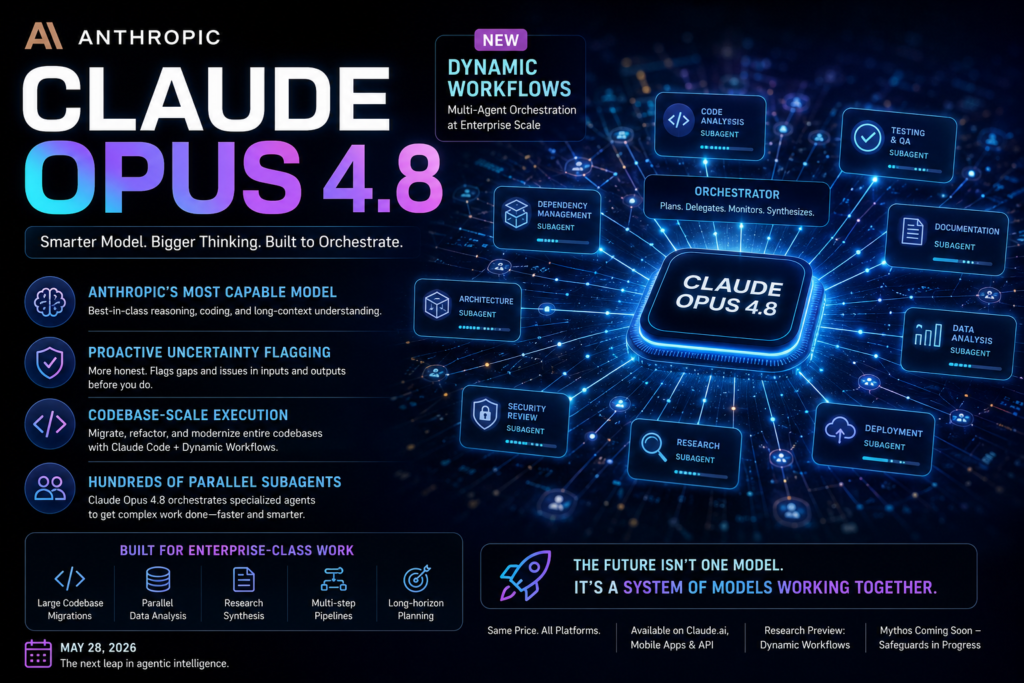
Anthropic’s Claude Opus 4.8 is the most capable publicly available Claude model as of May 2026, and it ships with a groundbreaking new feature called Dynamic Workflows — a system that lets AI orchestrate hundreds of parallel subagents to complete enterprise-scale tasks autonomously. If you’re a developer, researcher, or business leader wondering whether this upgrade matters for you, the short answer is: yes, especially if you work with large codebases, complex data pipelines, or autonomous AI systems.
Released on May 28, 2026, just 41 days after Opus 4.7, this model signals a new competitive urgency at Anthropic. It comes packed with improvements in uncertainty flagging, proactive error detection, and — most significantly — a research-preview tool that changes how AI coordinates multi-agent work. Here’s everything you need to know.
What Is Claude Opus 4.8?
Claude Opus 4.8 is Anthropic’s latest flagship AI model, succeeding Opus 4.7 and sitting at the top of Anthropic’s publicly available model family, which also includes Sonnet and Haiku variants.
The model is available across all of Anthropic’s platforms — including the Claude.ai web interface, the mobile apps, and via the Anthropic API — at the same pricing tier as Opus 4.7. It delivers best-in-class benchmark performance on reasoning, code generation, and long-context understanding.
What makes Claude Opus 4.8 particularly notable compared to its predecessor isn’t just raw capability. Anthropic has specifically tuned it to handle uncertainty better: early testers found it more likely to flag gaps or ambiguities in its own analysis, rather than confidently producing outputs that may be subtly wrong. That shift in epistemic posture — toward acknowledging rather than hiding uncertainty — has significant real-world value in professional and enterprise settings.
What Are Claude Dynamic Workflows?
Dynamic Workflows is Anthropic’s new multi-agent orchestration system, currently available in research preview alongside Claude Opus 4.8. It is designed to allow a lead AI model to coordinate and manage large numbers of parallel subagents, each handling a discrete part of a complex task.
Think of it as the difference between a single contractor and a general contractor managing an entire construction crew. A single model handles one thread of reasoning at a time. Dynamic Workflows lets Claude Opus 4.8 act as an orchestrator — decomposing large tasks, dispatching sub-tasks to specialized agents, monitoring their outputs, and synthesizing the results — all within a single coherent workflow.
How Dynamic Workflows Orchestrate AI Subagents
The architecture follows a hierarchical pattern: the primary Claude Opus 4.8 instance acts as a planning and coordination layer, while downstream subagents — potentially hundreds of them running in parallel — execute specific sub-tasks. The system is built to handle coordination at scale, which means it can maintain coherence across threads of work that would overwhelm a single model’s context window.
Anthropic’s launch post described how Claude Code, when paired with Claude Opus 4.8 and Dynamic Workflows, can now carry out “codebase-scale migrations across hundreds of thousands of lines of code from kickoff to merge, with the existing test suite as its bar.” That’s not a research demo — it’s a production-capable workflow for one of software engineering’s most error-prone tasks.
What Can Dynamic Workflows Actually Do?
Here are the primary use cases Dynamic Workflows is designed to support:
- Large codebase migrations: Refactoring or upgrading entire repositories, not just individual files, with test suites as guardrails.
- Parallel data analysis: Running multiple analysis threads simultaneously across large, heterogeneous datasets.
- Document-scale research synthesis: Coordinating agents that each review separate source documents and produce a unified synthesis.
- Multi-step deployment pipelines: Breaking CI/CD-adjacent workflows into discrete agent tasks with error-checking at each stage.
- Long-horizon planning tasks: Delegating sub-plans to agents while the orchestrator maintains the strategic objective.
The “research preview” label means the feature is live and usable but still evolving — Anthropic is actively gathering feedback on reliability, failure modes, and coordination patterns before a full production release.
What’s New in Claude Opus 4.8 vs Opus 4.7?
The upgrade cycle from 4.7 to 4.8 was unusually rapid — just 41 days. That speed was partly a response to a lukewarm reception to Opus 4.7, which some users found disappointing relative to expectations. Here is a direct comparison of the two models:
| Feature | Claude Opus 4.7 | Claude Opus 4.8 |
|---|---|---|
| Release date | April 2026 | May 28, 2026 |
| Multi-agent orchestration | Not available | Dynamic Workflows (research preview) |
| Uncertainty flagging | Standard | Proactive — flags gaps in inputs/outputs |
| Unsupported claims | Occasional | Significantly reduced |
| Codebase-scale task support | Limited | Yes, via Claude Code + Dynamic Workflows |
| Pricing | Standard Opus tier | Same as Opus 4.7 |
| Availability | All platforms | All platforms |
| Reception | Mixed user feedback | Substantially improved per early testers |
Bridgewater Associates, cited in Anthropic’s launch post, noted that the most meaningful improvement was Opus 4.8’s tendency to proactively flag issues with the inputs and outputs of an analysis — “something other models routinely missed and left to the users to catch.” That’s a subtle but critically important upgrade for any workflow that depends on model outputs feeding into downstream decisions.
Why Did Anthropic Release Claude Opus 4.8 So Quickly?
The 41-day release cycle is not typical for Anthropic — the most recent Sonnet model was three months old at the time of the Opus 4.8 launch, and Haiku was seven months old. So why the acceleration?
Two factors converged. First, the reception to Opus 4.7 was cooler than expected. Users who had anticipated a major leap found the improvements incremental, and that feedback was visible on social media and developer forums in the weeks after launch.
Second, the competitive landscape shifted sharply in that same 41-day window. OpenAI shipped significant updates to Codex, and Google released Gemini 3.5 Flash with a strong agent-first positioning. For a company whose flagship model is its most visible product, falling perceptibly behind competitors — even temporarily — creates real customer risk.
The result: Anthropic compressed its release cycle, delivering an upgrade that addresses the specific criticisms of 4.7 (uncertainty handling, over-confident outputs) while adding a genuinely novel capability in Dynamic Workflows.
Claude Opus 4.8 vs GPT and Gemini: How Does It Compare?
Assessing frontier AI models is inherently imprecise — benchmarks tell part of the story, but real-world performance varies significantly by task type. Here’s a high-level comparison based on available public information as of late May 2026:
| Dimension | Claude Opus 4.8 | OpenAI GPT (Codex / latest) | Google Gemini 3.5 Flash |
|---|---|---|---|
| Multi-agent orchestration | Dynamic Workflows (research preview) | Codex Agents | Agent-first architecture |
| Uncertainty disclosure | Proactive flagging | Variable by prompt | Variable by prompt |
| Codebase-scale tasks | Yes, via Claude Code integration | Yes, via Codex | Developing |
| Pricing model | API + Claude.ai plans | API + ChatGPT plans | API + Gemini plans |
| Safety positioning | Constitutional AI, safety-first | RLHF with safety tuning | Gemini safety framework |
| Long context | Best-in-class Opus tier | Strong | Strong |
| Developer tooling | Claude Code (CLI), API | Codex CLI, API | Gemini API, AI Studio |
Claude Opus 4.8 differentiates most clearly on proactive uncertainty handling and the tight integration between Claude Code and Dynamic Workflows. For engineering-heavy workflows — especially those involving large, heterogeneous codebases — that integration is a meaningful practical advantage.
Who Should Use Claude Opus 4.8?
Claude Opus 4.8 is designed for users and teams tackling tasks that exceed what a single AI prompt can accomplish. The right audience for this model — especially the Dynamic Workflows feature — includes:
- Software engineering teams working on large-scale code migrations, dependency upgrades, or cross-service refactors who need more than file-by-file AI assistance.
- Data analysts and researchers who run multi-step analytical workflows involving large volumes of structured and unstructured data.
- Enterprise AI teams building agentic pipelines where reliability, error transparency, and orchestration at scale are non-negotiable.
- Financial and professional services firms (as exemplified by Bridgewater’s testimonial) where AI-generated analysis feeds into consequential decisions and uncertainty flagging is essential.
- Developers exploring Claude Code who want the most capable model as the backbone of their coding agent workflows.
Casual or individual users who primarily use Claude for writing, summarization, or Q&A will find Claude Opus 4.8 capable but may not fully utilize Dynamic Workflows. In those cases, Claude Sonnet remains a more cost-efficient option for everyday tasks.
What About Anthropic’s Mythos Model?
Anthropic’s most advanced model — internally called Mythos — remains unavailable to the public following a research preview in April 2026 that raised cybersecurity concerns. However, the Claude Opus 4.8 launch post included a notable signal: Anthropic stated it is “making swift progress on developing these safeguards” and expects to bring Mythos-class models to customers “in the coming weeks.”
That framing suggests the Mythos launch is no longer indefinitely deferred — it is actively in progress. When Mythos does release, it will represent a step change above Claude Opus 4.8 in capability, likely introducing further expansion of what Dynamic Workflows and multi-agent systems can accomplish.
For now, Claude Opus 4.8 occupies the frontier of what Anthropic makes publicly available, and Dynamic Workflows gives it a structural advantage in multi-agent orchestration that neither Opus 4.6 nor Opus 4.7 could offer.
Key Takeaways: Claude Opus 4.8 and Dynamic Workflows
Here is what the release of Claude Opus 4.8 means, distilled:
- Claude Opus 4.8 is Anthropic’s best publicly available model as of May 2026, with same-price access across all platforms.
- Dynamic Workflows enables multi-agent orchestration at scale, letting Opus 4.8 coordinate hundreds of parallel subagents for enterprise-scale tasks.
- The model is significantly more epistemically honest than its predecessor — it proactively flags uncertainty and is less likely to produce over-confident or unsupported outputs.
- The 41-day release cycle reflects competitive pressure from OpenAI and Google, as well as direct feedback from users who found Opus 4.7 underwhelming.
- Mythos is coming — Anthropic has signaled that its most advanced model could be publicly released within weeks, once safety safeguards are finalized.
- Enterprise users — particularly in software, finance, and research — stand to benefit most from the combination of Opus 4.8’s reasoning improvements and Dynamic Workflows’ orchestration capabilities.
Claude Opus 4.8 and Dynamic Workflows represent Anthropic’s clearest signal yet that the future of frontier AI isn’t a smarter single model — it’s a smarter system of models working together. For developers and enterprises building on top of AI infrastructure, that distinction is increasingly what matters.